
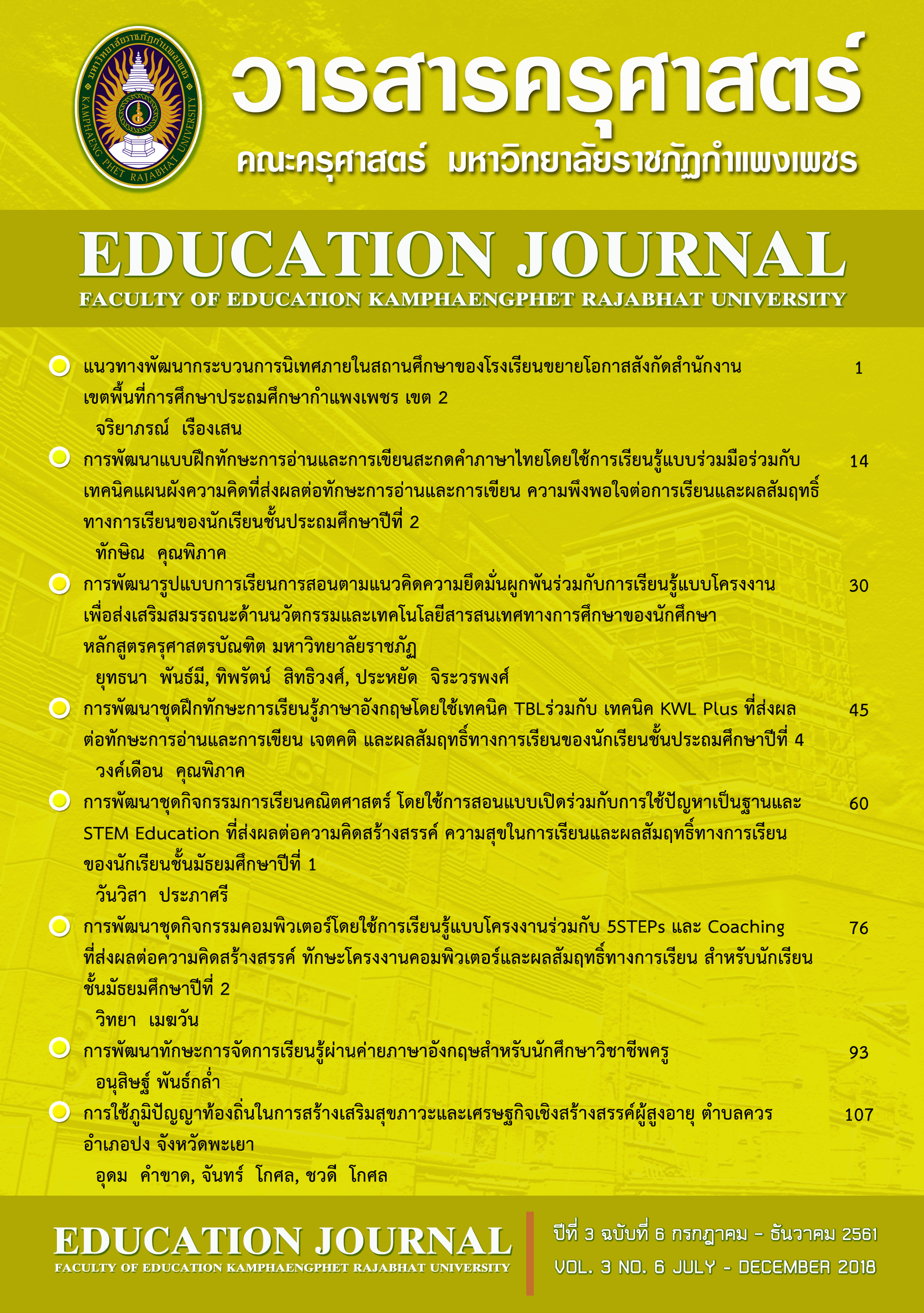
THE DEVELOPMENT MODEL OF LEARNING ENGAGEMENT WITH PROJECT-BASED LEARNING TO ENHANEE INNOVATION, TECHNOLOGY AND INFORMATION COMPETENCIES FOR THE UNDER GRADUATE STUDENTS OF EDUCATION FACUITY, RAJABHAT UNIVERSITY
Article Sidebar
Main Article Content
Abstract
The purposes of this study were 1) to develop the model of learning engagement with project-based learning to enhances innovation competencies technology and information for under graduate 2) to compare students learning achievement after using the model learning engagement with project-based learning 3) study the engagement t of students to teaching and learning styles 4) to investigate students satisfaction towards model of learning engagement with project-based learning. Sample group 30 students derived by purposive selection. The research instruments were 1) the model of learning engagement with project-based learning 2) an achievement test 3) the learning engagement test, 4) students’ competencies evaluation 5) a quality appraisal form focused on the model of learning engagement with project – based learning to enhance competencies for experts .an analyze data were percentage, mean, standard deviations and dependent single t-test for testing the research hypothesis. The research finding were as follows : 1) engagement with project-based learning consist of 4 main components: (1.1) principles concept 1.2) objectives 1.3) instruction 8 step Motivate to attract attention, motivate to Recalling previous knowledge, inform learning objectives, offering new stimuli or content, motivate to Expressing knowledge and ability, learning guidelines, evaluate learning and Promote Durability of knowledge and (1.4) environment and resources support and the efficiency of model at 82.31 /83.79 that it reveal criteria 80/80, 2) the students’ achievement score after using learning engagement with Project Based learning were higher than before using it at 0.5 level of statistical significance and self-evaluated their competencies by mean at highest level 3) students engagement of the model learning engagement with project-based learning was at highest level and 4) students satisfaction of the model learning engagement with project-based learning was at highest level
Article Details

This work is licensed under a Creative Commons Attribution-NonCommercial 4.0 International License.
CC Attribution-NonCommercial-NoDerivatives 4.0
References
กำพล วิลยาลัย. (2560). การสอนแบบโครงงานคอมพิวเตอร์. โรงเรียนบรมราชินีนาถราชวิทยาลัย : ราชบุรี.
ชัยยงค์ พรหมวงศ์. (2523). เอกสารการสอนชุดวิชาเทคโนโลยีและสื่อสารการศึกษา. กรุงเทพฯ : ชุมนุมสหกรณ์การเกษตรแห่งประเทศไทย.
ทิศนา แขมมณีและคณะ. (2533). วิทยาการด้านการคิด. กรุงเทพฯ : เดอะมาสเตอร์กรุ๊ปแมเนจเม้นท์.
บุญชม ศรีสะอาด. (2545). การวิจัยเบื้องต้น. พิมพ์ครั้งที่ 7. กรุงเทพฯ : ชมรมเด็ก.
ปรียา บุญญสิริ, พิมพันธ์ เดชะคุปต์, พเยาว์ ยินดีสุข, และ ราเชน มีศรี. (2553). การสอนคิดด้วยโครงงาน : การเรียนการสอนแบบบูรณาการ. กรุงเทพฯ: โรงพิมพ์แห่งจุฬาลงกรณ์มหาวิทยาลัย.
พรรณี ชูทัยเจนจิต. (2538). จิตวิทยาการเรียนการสอน. กรุงเทพฯ : ต้นอ้อ.
รัตนะ บัวสนธ์. (2551). การวิจัยและพัฒนานวัตกรรมการศึกษา. มหาวิทยาลัยนเรศวร. พิษณุโลก.
ล้วน สายยศ และอังคณา สายยศ. (2538). การวิจัยและพัฒนาการเรียนรู้. พิมพ์ครั้งที่ 3 กรุงเทพฯ : สำนักพิมพ์แห่งจุฬาลงกรณ์มหาวิทยาลัย.
ศศิธร รณะบุตร. (2558). การศึกษาและพัฒนาความมุ่งมั่นในการเรียนของนักเรียนระดับปริญญาตรีสาขาการศึกษาปฐมวัย. วิทยานิพนธ์ปริญญาดุษฎีบัณฑิต สาขาทดสอบและวัดผลการศึกษา. มหาวิทยาลัยศรีนครินทรวิโรฒ ประสานมิตร.
Bender, W. N. (2012). Project-Based Learning : Differentiating Instruction for the 21st. Century. California : CORWIN A SAGE Company.
Clark, J.C. and Walsh, J. (2007). Rationing scarce life-sustaining resources on the basis of age. Journal of Advanced Nursing, 35(5), 799-804.
Handscomb, G., and MacBeath, J. (2003). The Research-Engaged School. Colchester: Essex County Council, Forum for Learning and Research Enquiry (FLARE).
Maslow, Abraham. (1970). Motivation and Personnality. New York : Harper and Row Publishers.
Sharp et al. (2003). The New Public Service: Serving not Steering. New York : Sharpe.
