
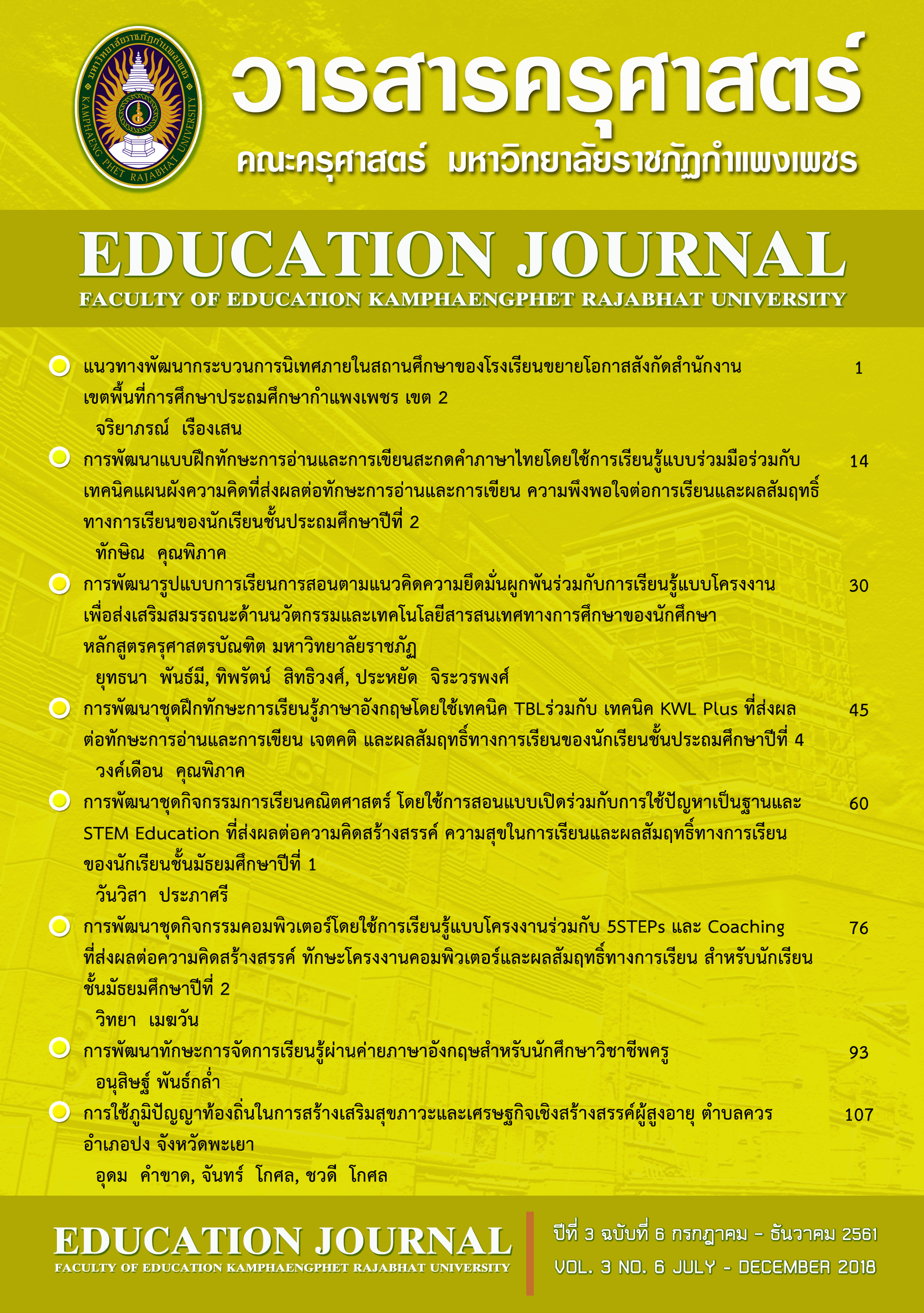
DEVELOPMENT OF MATHEMATICS ACTIVITY PACKAGES BASED ON OPEN APPROACH, PROBLEM BASED LEARNING (PBL) AND STEM EDUCATION AFFECTING MATHAYOM SUKSA 1 STUDENTS’ CREATIVENESS, LEARNING HAPPINESS AND LEARNING ACHIEVEMENT
Article Sidebar
Main Article Content
Abstract
The purposes of this study were to develop Mathayom Suksa 1 Students’ Mathematics Activity Packages based Open Approach, Problem Based Learning and STEM Education to gain the standard effective index, to compare Mathayom Suksa 1 Students’ creativeness, learning happiness and learning achievement possessed before and after learning through the developed Mathematics Activity Packages based Open Approach, Problem Based Learning and STEM Education, to compare creativeness, learning happiness and learning achievement of the students whose attitudes towards learning differed after they had learnt through the developed Mathayom Suksa 1 Students’ Mathematics Activity Packages based Open Approach, Problem Based Learning and STEM Education. The subjects were 38 Mathayom Suksa 1 Students who were studying in the second semester of 2017 academic year at Mukdahan School under the jurisdiction of the Office of Secondary Educational Service Area 22. They were gained by cluster random sampling technique using the classrooms as their sampling units. The instruments employed consisted of Mathayom Suksa 1 Students’ Mathematics Activity Packages based Open Approach, Problem Based Learning and STEM Education, to test to examine the students’ creativeness, the test to measure the students’ learning happiness, learning achievement test, and 5) a questionnaire to survey the students’ attitude. The statistics adopted for data analysis included mean, standard deviation, effectiveness index, t-test (Dependent Samples), One-way ANOVA, One-way MANCOVA, and One-way ANCOVA. The study unveiled these results: The developed Mathayom Suksa 1 students’ Mathematics Activity Packages based on Open Approach, Problem Based Learning and STEM Education gained their standard effectiveness index of 0.66 which was higher than the set criteria of 0.50 or higher. After the students had learnt through the Mathematics Activity Packages based on Open Approach, Problem Based Learning and STEM Education, their creativeness, learning happiness and learning achievement were significantly higher than those of before at .05 statistical level and After the students whose attitudes towards learning differed (high, moderate, low) had learnt through the Mathematics Activity Packages based on Open Approach, Problem Based Learning and STEM Education, their creativeness, learning happiness and learning achievement were not significantly different at .05 statistical level.
Article Details

This work is licensed under a Creative Commons Attribution-NonCommercial 4.0 International License.
CC Attribution-NonCommercial-NoDerivatives 4.0
References
กนกกร พวงสมบัติ. (2560). “การพัฒนาแบบฝึกทักษะคณิตศาสตร์เรื่อง ระบบจำนวนเต็มสำหรับนักเรียนชั้นมัธยมศึกษาปีที่ 1” ใน วารสารมหาวิทยาลัยราชภัฏร้อยเอ็ด. ปีที่ 11 (2),หน้า 1–7.
จันทรา เทพอวยพร. (2560). รายงานการประชุมใหญ่สามัญประจำปี 2559 และประชุมวิชาการเรื่อง “ห้องสมุดดิจิทัลกับการก้าวสู่ยุค Thailand 4.0”. กรุงเทพฯ: มหาวิทยาลัยมหิดล.
ชนิดาภรณ์ บุญประจักษ์. (2557). การพัฒนาความคิดสร้างสรรค์ของนักเรียนชั้นมัธยมศึกษาปีที่ 2ที่เรียนรู้ด้วยวิธีการแบบเปิด (Open Approach). ปริญญานิพนธ์ศึกษาศาสตรมหาบัณฑิต, มหาวิทยาลัยขอนแก่น.
บุญเกื้อ ควรหาเวช. (2545). นวัตกรรมการศึกษา. พิมพ์ครั้งที่ 6. กรุงเทพฯ: เอสอาพริ้นติ้ง.
ปฏิมา สิงห์ศร. (2554). ผลของการใช้ชุดกิจกรรมคณิตศาสตร์เส้นด้ายที่มีต่อความคิดสร้างสรรค์ทางคณิตศาสตร์ของนักเรียนชั้นมัธยมศึกษาปีที่ 1. ปริญญานิพนธ์การศึกษามหาบัณฑิต, มหาวิทยาลัยศรีนครินทรวิโรฒ.
ไมตรี อินทร์ประสิทธิ์ และคณะ. (2546). ปฏิรูปการเรียนรู้วิชาคณิตศาสตร์ในโรงเรียนโดย เน้นกระบวนการทางคณิตศาสตร์. ขอนแก่น: ขอนแก่นการพิมพ์.
วิริรดาภรณ์ ลาบรรเทา. (2557). การพัฒนาชุดกิจกรรมการเรียนรู้คณิตศาสตร์ตามทฤษฎี การสร้างความรู้ด้วยตนเองร่วมกับการจัดการเรียนรู้แบบร่วมมือ เรื่อง ระบบจำนวนเต็ม สำหรับชั้นมัธยมศึกษาปีที่ 1. ปริญญานิพนธ์ ค.ม. อุตรดิตถ์: มหาวิทยาลัยราชภัฏอุตรดิตถ์.
วิโรจน์ สารรัตนะ. (2556). กระบวนทัศน์ใหม่ทางการศึกษา กรณีทัศนะต่อการศึกษา ศตวรรษที่ 21. กรุงเทพฯ: ทิพยวิสุทธุ์.
สายชล วนาธรัตน์. (2550). การเปรียบเทียบผลสัมฤทธิ์ทางการเรียน และความสุขในการ เรียนวิชาคณิตศาสตร์ของนักเรียนชั้นมัธยมศึกษาปีที่ 2 ระหว่างการสอนโดย ใช้วัฏจักรการเรียนรู้ 4MAT และการสอนแบบปกติ. ปริญญานิพนธ์ ครุศาสตรมหาบัณฑิต, มหาวิทยาลัยราชภัฏพิบูลสงคราม.
สายชล สิมสิน. (2556). การพัฒนาชุดกิจกรรมเกมคณิตศาสตร์ โดยวิธีการสอนแบบ แก้ปัญหาร่วมกับการคิดแบบ โยนิโสมนสิการ ที่ส่งผลต่อความสุขในการเรียน ความคิดสร้างสรรค์ และผลสัมฤทธิ์ทางการเรียน ของนักเรียนชั้นมัธยมศึกษา ปีที่ 2. ปริญญานิพนธ์ครุศาสตรมหาบัณฑิต, มหาวิทยาลัยราชภัฏสกลนคร.
สุวิทย์ มูลคำ และคณะ. (2554). การจัดกิจกรรมการเรียนรู้ที่เน้นการคิด. กรุงเทพฯ: อี เคบุ๊คส์.
สำนักงานคณะกรรมการการศึกษาแห่งชาติ. (2552). หลักสูตรแกนกลางการศึกษาขั้น พื้นฐาน พุทธศักราช 2551. กรุงเทพฯ: โรงพิมพ์ชุมนุมสหกรณ์การเกษตรแห่ง ประเทศไทย จำกัด.
สถาบันส่งเสริมการสอนวิทยาศาสตร์และเทคโนโลยี. (2557). รู้จักสะเต็ม. เข้าถึงได้จาก http://www.stemedthailand.org/?page_id=23.
อนุชา โสมาบุตร. (2556). การจัดการเรียนรู้แบบใช้ปัญหาเป็นฐาน. เข้าถึงได้จาก https://teacherweekly.wordpress.com/2013/09/25/problem-based-learning/.
