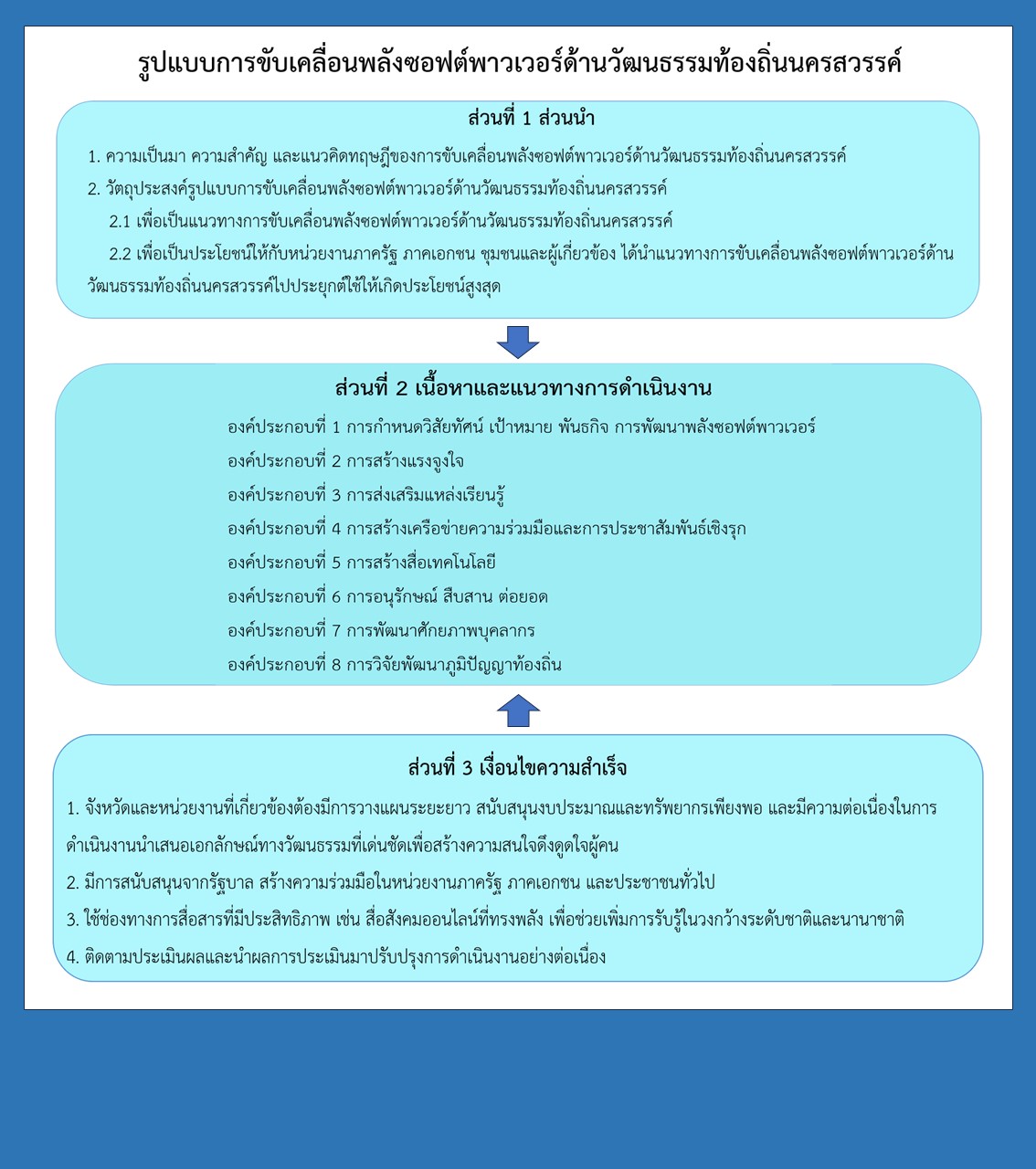
รูปแบบการขับเคลื่อนพลังซอฟต์พาวเวอร์ด้านวัฒนธรรมท้องถิ่นนครสวรรค์
คำสำคัญ:
รูปแบบ, การขับเคลื่อนพลังซอฟต์พาวเวอร์, วัฒนธรรมท้องถิ่นนครสวรรค์บทคัดย่อ
บทความวิจัยครั้งนี้มีวัตถุประสงค์เพื่อ 1. วิเคราะห์องค์ประกอบการขับเคลื่อนพลังซอฟต์พาวเวอร์ด้านวัฒนธรรมท้องถิ่นนครสวรรค์ 2. สร้างรูปแบบการขับเคลื่อนพลังซอฟต์พาวเวอร์ด้านวัฒนธรรมท้องถิ่นนครสวรรค์ และ 3. ประเมินคุณภาพรูปแบบการขับเคลื่อนพลังซอฟต์พาวเวอร์ด้านวัฒนธรรมท้องถิ่นนครสวรรค์ เป็นการวิจัยแบบผสานวิธี ผู้ให้ข้อมูลสำคัญและกลุ่มตัวอย่างสำหรับการวิเคราะห์องค์ประกอบ ประกอบด้วย ผู้ให้ข้อมูลสำคัญที่เลือกมาแบบเจาะจง จำนวน 16 คน และกลุ่มตัวอย่างเลือกมาแบบไม่ใช้ความน่าจะเป็น จำนวน 826 คน โดยกำหนดขนาดกลุ่มตัวอย่างของการวิเคราะห์องค์ประกอบเชิงสำรวจที่ระดับดีมาก ผู้ให้ข้อมูลสำคัญสำหรับการสร้างรูปแบบที่เลือกมาแบบเจาะจง จำนวน 9 คน ส่วนผู้ให้ข้อมูลสำคัญสำหรับการประเมินคุณภาพรูปแบบที่เลือกมาแบบเจาะจง จำนวน 30 คน เครื่องมือวิจัย ประกอบด้วย แบบสัมภาษณ์ แบบสอบถาม แนวคำถามการสัมมนาอิงผู้เชี่ยวชาญ และแบบประเมิน การวิเคราะห์ข้อมูลเชิงคุณภาพใช้การวิเคราะห์เนื้อหา การวิเคราะห์ข้อมูลเชิงปริมาณใช้สถิติบรรยาย ได้แก่ ความถี่ ร้อยละ ค่าเฉลี่ย และส่วนเบี่ยงเบนมาตรฐาน และสถิติอนุมานใช้การวิเคราะห์องค์ประกอบเชิงสำรวจ
ผลการวิจัยพบว่า 1. องค์ประกอบการขับเคลื่อนพลังซอฟต์พาวเวอร์ด้านวัฒนธรรมท้องถิ่นนครสวรรค์ ประกอบด้วย 8 องค์ประกอบ ได้แก่ 1.1 การกำหนดวิสัยทัศน์ เป้าหมาย พันธกิจการพัฒนาพลังซอฟต์พาวเวอร์ 1.2 การสร้างแรงจูงใจ 1.3 การส่งเสริมแหล่งเรียนรู้ 1.4 การสร้างเครือข่ายความร่วมมือและการประชาสัมพันธ์เชิงรุก 1.5 การสร้างสื่อเทคโนโลยี 1.6 การอนุรักษ์ สืบสาน ต่อยอด 1.7 การพัฒนาศักยภาพบุคลากร และ 1.8 การวิจัยพัฒนาภูมิปัญญาท้องถิ่น 2. รูปแบบการขับเคลื่อนพลังซอฟต์พาวเวอร์ด้านวัฒนธรรมท้องถิ่นนครสวรรค์ ประกอบด้วย 3 ส่วน ได้แก่ ส่วนที่ 1 ส่วนนำ เป็นส่วนที่เป็นทิศทางของรูปแบบ ส่วนที่ 2 เนื้อหาและแนวทางการดำเนินงาน เป็นส่วนที่เป็นระบบและกลไกในการขับเคลื่อน และส่วนที่ 3 เงื่อนไขความสำเร็จ เป็นส่วนสนับสนุนการขับเคลื่อน และ 3. คุณภาพของรูปแบบมีความถูกต้อง ความเหมาะสม ความเป็นไปได้ และความเป็นประโยชน์อยู่ในระดับมากที่สุด
เอกสารอ้างอิง
จังหวัดนครสวรรค์. (2567). ข่าวประชาสัมพันธ์. สืบค้น 5 มิถุนายน 2567, จาก https://www.nakhonsawan.go.th/joomla/
ดวงฤทธิ์ เบ็ญจาธิกุล ชัยรุ่งเรือง. (2566). การขับเคลื่อน Soft Power: อัตลักษณ์ท้องถิ่นภาคใต้เพื่อส่งเสริมการท่องเที่ยวจังหวัดชุมพร. วารสารสันติศึกษาปริทรรศน์ มจร, 11(5), 1679-1694.
วุฒิสภา. (ม.ป.ป.). แผนกลยุทธ์ การส่งเสริมซอฟต์พาวเวอร์แห่งชาติเพื่อประโยชน์ด้านเศรษฐกิจ สังคม และความมั่นคงแห่งชาติ. กรุงเทพฯ: สำนักการพิมพ์ สำนักงานเลขาธิการวุฒิสภา.
Aruni, A., et al. (2022). Cool Japan’s Role as A Japanese Public Diplomacy Strategy Through the Asia Kakehashi Project in Indonesia. Eduvest-Journal of Universal Studies, 2(8), 1587-1596.
Baker, C., et al. (2024). Soft power, cultural relations and conflict through Eurovision and other mega-events: a literature review. British Council. Retrieved June 5, 2024, from https://www.britishcouncil.org/sites/default/files/eurovision_culture_place_and_partnership_report.pdf
Bakhtyorovna, K.S. (2023). The Soft Power in the Foreign Policy of the republic of South Korea in Asian Countries. Journal of Language and Linguistics, 6(5), 165-170.
Christopher, E.S. (2021). A Study on Institutional Mechanisms of Soft Power Effectiveness: Korea's Global, International and Cultural Centers. Retrieved June 5, 2024, from https://repository.pknu.ac.kr:8443/handle/2021.oak/1069
Comrey, A.L., et al. (1992). A first course in factor analysis, Hillsdale. New Jersey: Erlbau.
Cronbach, L.J. (1982). Designing evaluations of educational and social programs. San Francisco: Jossey-Bass.
Dunn, W.N. (2018). Public policy analysis (6th ed.). London: Routledge.
Hair, J.F., et al. (2010). Multivariate data analysis (7th ed.). New Jersey: Pearson Prentice Hall.
Hsieh, Y.Y. et al. (2022). The future development trends of Taiwan cultural and creative products from the perspective of industrial design. Creative Industries Journal, 17(1), 60–74.
Jin, D.Y. (2024). The rise of digital platforms as a soft power apparatus in the New Korean Wave era. Sage Journals. 9(2), 161–177. https://doi.org/10.1177/2057047324123420
Kaiser, H.F. (1958). The Varimax Criterion for Analytic Rotation in Factor Analysis. Psychometrika, 23, 187-240.
Kalfas, D., et al. (2024). Contribution of the Cultural and Creative Industries to Regional Development and Revitalization: A European Perspective. Urban Sci. 8(2), 39; https://doi.org/10.3390/urbansci8020039
Kirkpatrick, D. L. (1994). Evaluating Training Program: The Four Levels. San Francisco, CA: Berret-Koehler Publishers, Inc.
Meter, V. & Horn, V. (1975). The policy implementation process: A conceptual framework. Administration & Society, 6(4), 445-488.
Nye, J.S. (2004). Soft power: The means to success in world politics. New York: PublicAffairs.
O'Toole, L.J. (2000). Public management: The state of the field. Journal of Public Administration Research and Theory, 10(1), 1-17.
Repnikova, M. (2022). The Balance of Soft Power: The American and Chinese Quests to Win Hearts and Minds. Retrieved June 5, 2024, from https://www.viet-studies.net/kinhte/BalanceSoftPower_FA.pdf
Scriven, M. (1991). Evaluation thesaurus (4th ed.). New York: Sage Publications, Inc.
ดาวน์โหลด
เผยแพร่แล้ว
รูปแบบการอ้างอิง
ฉบับ
ประเภทบทความ
หมวดหมู่
สัญญาอนุญาต
ลิขสิทธิ์ (c) 2025 วารสารวิชาการรัฐศาสตร์และรัฐประศาสนศาสตร์

อนุญาตภายใต้เงื่อนไข Creative Commons Attribution-NonCommercial-NoDerivatives 4.0 International License.