SOCIO-POLITICAL AND CULTURAL FACTORS AFFECTING THE STRUCTURAL EQUILIBRIUM OF AUTHORITY AMONG THE EXECUTIVE, LEGISLATIVE, AND JUDICIAL BRANCHES IN THAILAND'S PARLIAMENTARY SYSTEM
คำสำคัญ:
Socio-Political, Cultural, Structural Equilibrium, Executive, Legislative, Judicialบทคัดย่อ
This research aims to 1. analyze the socio-political and cultural factors affecting the structural equilibrium of authority among the executive, legislative, and judicial branches within Thailand's parliamentary system, and 2. examine the compound effects of these factors on the functioning of checks and balances. The study employs a qualitative research design using qualitative institutional analysis. Data were collected through documentary research and in-depth interviews, twenty key informants were purposively selected, comprising political scientists, legal scholars specializing in public and constitutional law, and politicians. Data were analyzed through qualitative content analysis and interpretative analysis. Triangulation was applied to enhance the credibility of the findings.
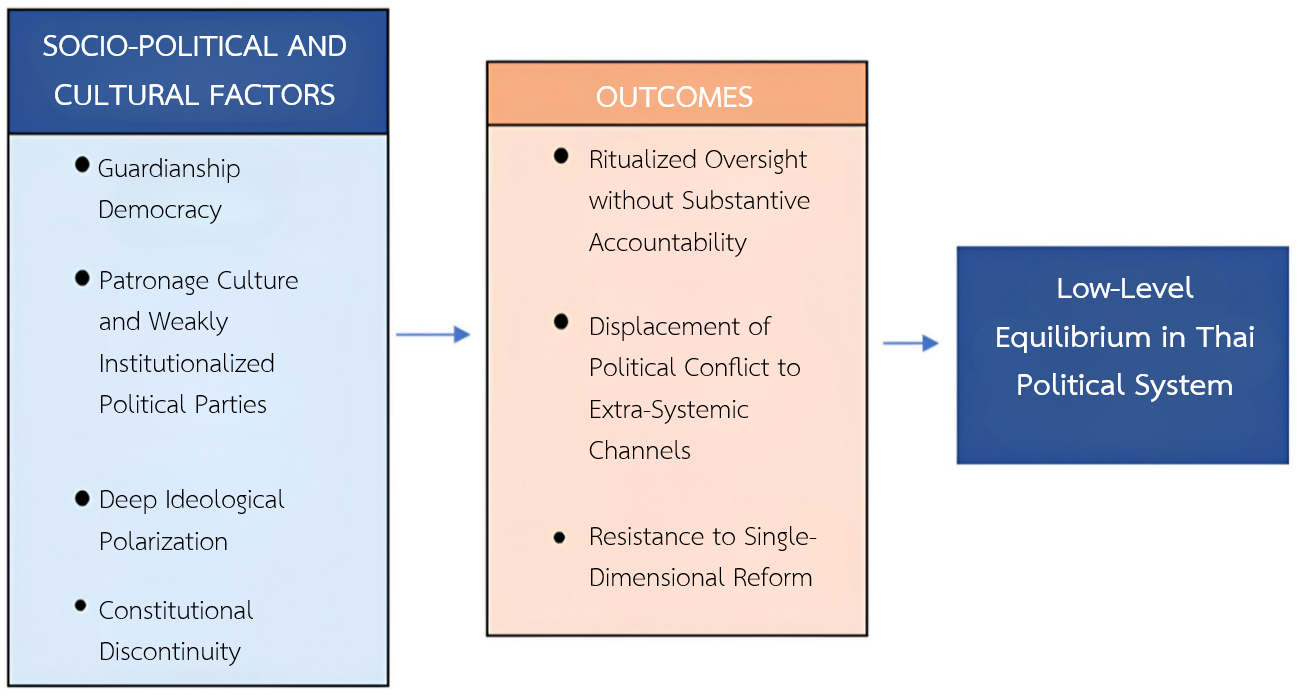
The findings reveal that the imbalance of power among the three branches is deeply rooted in socio-political and cultural factors operating as a mutually reinforcing cycle. Four principal factors were identified: 1. guardianship democracy, in which extra-constitutional actors — particularly the military — have repeatedly reshaped political structures, undermining horizontal accountability among democratic institutions, 2. patronage culture and weak party institutionalization, which hollow out the legislature as an autonomous oversight body by rendering MPs structurally dependent on party leaders holding executive power, 3. deep ideological polarization, which transforms institutional checks from neutral accountability mechanisms into instruments of political warfare, and 4. constitutional discontinuity, whereby frequent constitutional replacement prevents the institutionalization of accountability norms and interrupts institutional learning. These factors interact to produce a “low-level equilibrium” in which checks and balances remain nominally intact but operate selectively and substantively constrained.
เอกสารอ้างอิง
Constitution of the Kingdom of Thailand, B.E. 2560 (2017). Royal Thai Government Gazette. Retrieved February 12, 2026, from https://shorturl.asia/PySYV.
Hirschl, R. (2008). The Judicialization of Mega-Politics and The Rise of Political Courts. Annual Review of Political Science, 11, 93–118.
Kongmuang, P. (2002). Will The Merger of Political Parties Into an Absolute Majority in Parliament Lead to Parliamentary Dictatorship?. Suddiparithat, 16(50), 99–105.
Lertpaithoon, S. (2020). The New Constitution Must Be Better Than The Old: Proposals for Political Reform Through The Drafting of A New Constitution. King Prajadhipok's Institute Journal, 4(3), 1–21.
Lortanapaisan, T. (2025). The Oversight of The System of Checks And Balances Between The Legislative, Executive, and Judicial Branches Under The Constitution of The Kingdom of Thailand 2017. Journal of Asia Social Science Studies, 2(2), 37–49.
Mérieau, E. (2022). Constitutional Bricolage: Thailand's Sacred Monarchy vs. The Rule of Law. Oxford, UK: Hart Publishing.
Montesquieu, C. de. (1748). The Spirit of Laws (T. Nugent, Trans.). Batoche Books. Retrieved February 13, 2026, from https://shorturl.asia/NHEzk.
North, D. C. (1990). Institutions, Institutional Change and Economic Performance. Cambridge, UK: Cambridge University Press.
Rathamarit, N. & Rathamarit, U. (2019). Independent Bodies and Their Function as Checks and Balances Mechanism. King Prajadhipok's Institute Journal, 17(2), 20–36.
Russell, M. et al. (2016). Does The Executive Dominate The Westminster Legislative Process?: Six Reasons for Doubt. Parliamentary Affairs, 69(2), 286–308.
Supap, R. (2019). Legal Consideration on The Senator’s Authrorities in Constitution of The Kingdom of Thailand (B.E.2560 (2017)). Nitipat NIDA Law Journal, 8(2), 65–81.
Vile, M. J. C. (1967). Constitutionalism and The Separation of Powers. Oxford: Clarendon Press.
Wisetchai, S. (2024). Thai Politics and Government: Evolution and Changes. Pathumthani : Thammasat University Press.
ดาวน์โหลด
เผยแพร่แล้ว
รูปแบบการอ้างอิง
ฉบับ
ประเภทบทความ
หมวดหมู่
สัญญาอนุญาต
ลิขสิทธิ์ (c) 2026 วารสารวิชาการรัฐศาสตร์และรัฐประศาสนศาสตร์

อนุญาตภายใต้เงื่อนไข Creative Commons Attribution-NonCommercial-NoDerivatives 4.0 International License.