FACTORS INFLUENCING FLOOD PREPAREDNESS BEHAVIOR OF GOVERNMENT AGENCIES IN THE PING RIVER BASIN, CHIANG MAI
คำสำคัญ:
Flood Preparedness Behavior, Government Agencies, Ping River Basin, Area-based Management, Chiang Maiบทคัดย่อ
This study had the objective to study the factors related to knowledge, attitudes, perceived risk, and experience that influence the flood preparedness of government agencies in the Ping River basin, Chiang Mai Province and to develop policy recommendations for disaster management. A mixed methods approach was employed. Quantitative data were collected from 209 government agencies selected through stratified random sampling, using a questionnaire with a reliability coefficient of 0.98. Qualitative data were gathered through open-ended questions and in-depth interviews with 5 key informants. Data were analyzed using descriptive statistics (mean and standard deviation) and content analysis to ensure consistency with the research objectives.
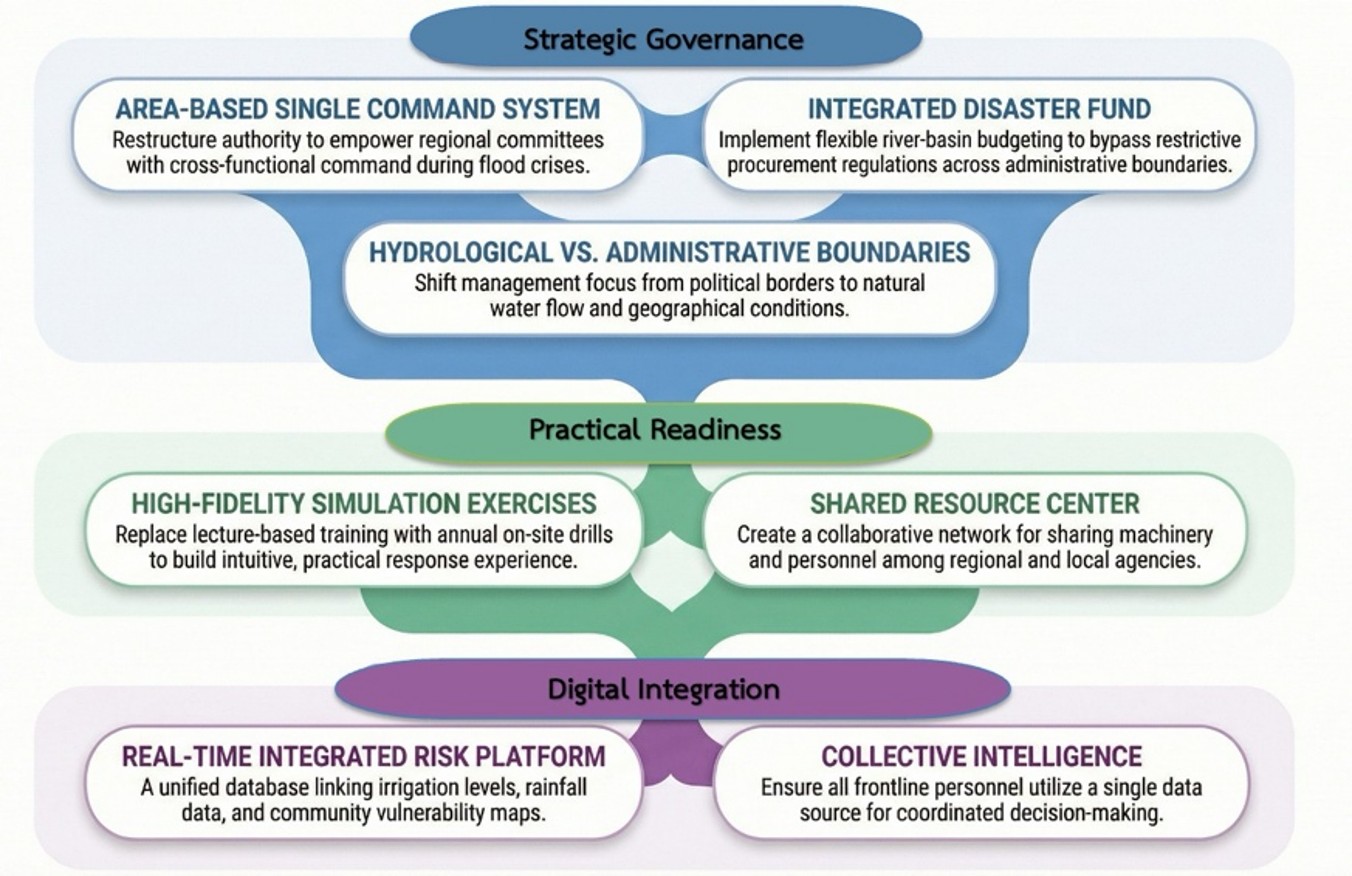
The findings showed a behavioral paradox, reflecting that government agencies demonstrated the highest level of knowledge on flood preparedness (mean = 4.27) and a positive attitude towards flood preparedness (mean = 4.00). However, practical flood preparedness behavior was significantly lower (mean = 3.42), particularly in the resource management (mean= 3.29). This is in line with factors related to a moderate level of experience and perceived risk. Qualitative data also showed that the main problems were not personnel but structural failures, namely separate work processes and inflexible budgetary regulations across administrative areas. A new knowledge found is the “institutional knowledge trap,” showing that knowledge and paper plans did not accurately reflect practical disaster response capabilities. Therefore, the researchers proposed a reform of disaster management towards an area-based management, changing from administrative assumptions to hydrological management and simulation drills to enhance proactive simulation experiences for personnel in the area.
เอกสารอ้างอิง
Campbell, K. A. et al. (2019). First insights from the flood resilience measurement tool: A large-scale community flood resilience analysis. International Journal of Disaster Risk Reduction, 40, Article 101257.
Coppola, D. P. (2006). Introduction to International Disaster Management. Amsterdam: Elsevier.
Hair, J. F. et al. (2022). A Primer on Partial Least Squares Structural Equation Modeling (PLS-SEM) (3rd ed.). Thousand Oaks, CA: SAGE Publications.
Kosonkittiumporn, S. et al. (2020). Disaster Management Guidelines: from Government to Community. Journal of MCU Peace Studies, 8(1), 348–360.
Lindell, M. K. & Perry, R. W. (2012). The Protective Action Decision Model: Theoretical Modifications and Additional Evidence. Risk Analysis, 32(4), 616–632.
Perry, R. W. & Lindell, M. K. (2003). Preparedness for Emergency Response: Guidelines for The Emergency Planning Process. Disasters, 27(4), 336–350.
Provincial Office of Natural Resources and Environment Chiang Mai. (2024). Flood Situation Report in Chiang Mai Province, Phase 1: September 22–30, 2024, and Phase 2: October 2–14, 2024. Retrieved October 8, 2024, from https://chiangmai.mnre.go.th.
Quarantelli, E. L. (1998). What is A Disaster? Perspectives on The Question. London: Routledge.
Sutton, J. & Tierney, K. (2006). Disaster Preparedness: Concepts, Guidance, and Research. Retrieved October 8, 2024, from http://www.colorado.edu/hazards.
Thai PBS. (2024). Chiang Mai Floods Recede, Big Cleaning Begins; Economic Loss Estimated at 2 Billion Baht. Retrieved October 8, 2024, from https://www.thaipbs.or.th/news/content/345063.
United Nations Office for Disaster Risk Reduction. (2015). Sendai Framework for Disaster Risk Reduction 2015–2030. Retrieved October 8, 2024, from https://shorturl.asia/VznJU.
_____. (2020). Disaster Risk Reduction in Thailand: Status Report 2020. Retrieved October 8, 2024, from https://www.undrr.org/media/48642/download.
Wichaipa, K. (2020). A Study of Disaster Management Competency and Indicators in Thailand's Local Administration. Asian Review, 33(2), 1–29.
ดาวน์โหลด
เผยแพร่แล้ว
รูปแบบการอ้างอิง
ฉบับ
ประเภทบทความ
หมวดหมู่
สัญญาอนุญาต
ลิขสิทธิ์ (c) 2026 วารสารวิชาการรัฐศาสตร์และรัฐประศาสนศาสตร์

อนุญาตภายใต้เงื่อนไข Creative Commons Attribution-NonCommercial-NoDerivatives 4.0 International License.