COLLABORATIVE GOVERNANCE AND THE PRESERVATION OF ISAN SERMON CHANTING AT THE BUN PHAWET FESTIVAL IN THAILAND
คำสำคัญ:
Collaborative Governance, Intangible Cultural Heritage, Isan Sermon Chanting, Cultural Sustainability, Bun Phawet Festivalบทคัดย่อ
This qualitative study examines how collaborative governance preserves Isan sermon chanting during the Bun Phawet Festival in Roi Et Province, Thailand. It seeks to 1. examine collaborative governance mechanisms between public agencies, local communities, and community-based networks to sustain this practice, 2. analyse the processes that sustain it, and 3. identify stakeholder networks that preserve it. Content analysis and triangulation were used to strengthen the findings from in-depth interviews and focus group discussions with 30 purposively selected key informants, including government officials, religious leaders, community scholars, residents, and educational representatives.
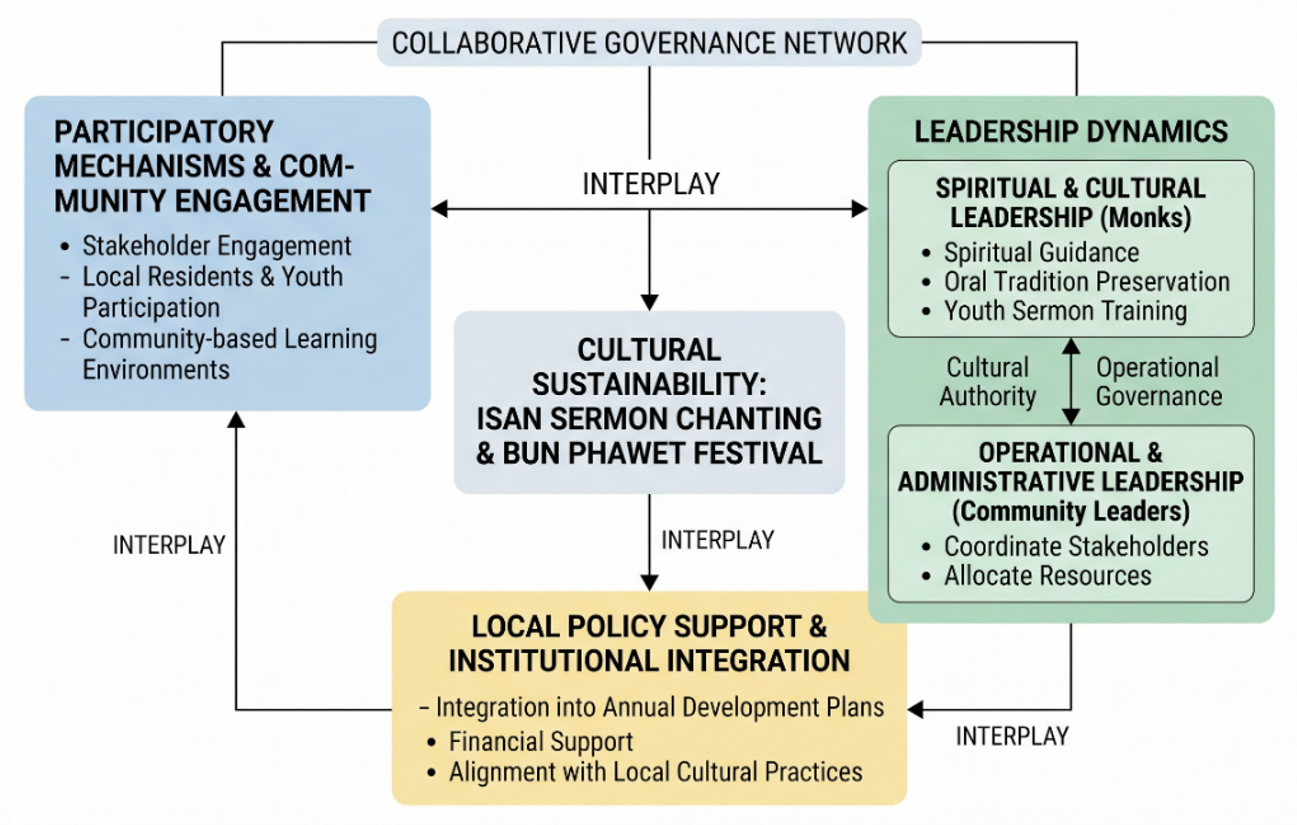
The findings show that collaborative governance involves participatory planning, resource support, and collective implementation. These practices go beyond administrative coordination and reflect relational governance based on shared responsibility, trust, and stakeholder engagement. Cultural awareness, intergenerational knowledge transfer, and cross-sector collaboration among local communities, educational institutions, religious organisations, and youth groups support Isan sermon chanting. According to collaborative governance theory, preserving intangible cultural heritage requires institutional arrangements, culturally embedded participation, and locally grounded leadership. We also identified stakeholder participation, multi-level community leadership, and supportive local government policies for long-term cultural continuity.
Public agencies, temples and religious leaders, community leaders and local scholars, villagers and youth, educational institutions, collaborative partner networks, and tourists are all involved in protecting Isan sermon chanting, according to the study. These actors create a community-centered governance ecosystem that strengthens cultural resilience and local identity amid social change. This study shows that collaborative cultural governance can adapt to protect intangible cultural heritage and emphasizes the importance of participatory governance in promoting intergenerational transmission, civic engagement, and local cultural traditions' long-term sustainability.
เอกสารอ้างอิง
Ansell, C. & Gash, A. (2008). Collaborative governance in theory and practice. Journal of Public Administration Research and Theory, 18(4), 543–571.
Bochon, S. (2019). The creation of sermon texts and the Bun Phawet tradition in Roi Et Province (Master’s thesis). Mahasarakham: Mahasarakham University.
Emerson, K. et al. (2012). An integrative framework for collaborative governance. Journal of Public Administration Research and Theory, 22(1), 1–29.
Khantisaro, P. M. (2018). The influence of the Bun Phawet (Mahachat sermon) tradition on Buddhists in Lam Plai Mat District, Buriram Province (Master’s thesis). Ayutthaya: Mahachulalongkornrajavidyalaya University.
Maneewat, T. (2023). The development of collaborative networks among communities to enhance participatory management efficiency in educational institutions. Jintasit Academic Journal, 1(4), 230–243.
Pannam, K. (2000). Impacts of artistic environmental management on communities within the old city walls of Chiang Saen (Unpublished doctoral dissertation). Chiang Mai: Chiang Mai University.
Pimmasak, A. (2014). Sermon Traditions: Identity and Transmission of Isan Melodic Preaching. Bangkok: Ministry of Culture.
Rhodes, R. A. W. (1997). Understanding Governance: Policy Networks, Governance, Reflexivity and Accountability. Buckingham: Open University Press.
Samakkarn, S. & Chaiamphon, S. (1995). Thai Society: Current Conditions and Future Trends (1992–2007). Bangkok: Office of the National Education Commission.
Sokhuma, A. et al. (2023). The development of integrated collaborative networks among central, regional, and local sectors. Journal of Modern Learning Development, 8(7), 410–420.
Suthamdee, C. S. (2025, March 10). (Interview).
ดาวน์โหลด
เผยแพร่แล้ว
รูปแบบการอ้างอิง
ฉบับ
ประเภทบทความ
หมวดหมู่
สัญญาอนุญาต
ลิขสิทธิ์ (c) 2026 วารสารวิชาการรัฐศาสตร์และรัฐประศาสนศาสตร์

อนุญาตภายใต้เงื่อนไข Creative Commons Attribution-NonCommercial-NoDerivatives 4.0 International License.