
“School”, A Space for Expression in the Anti-Corruption: Reflection Through the Production of Short Films by Students
Article Sidebar
Main Article Content
Abstract
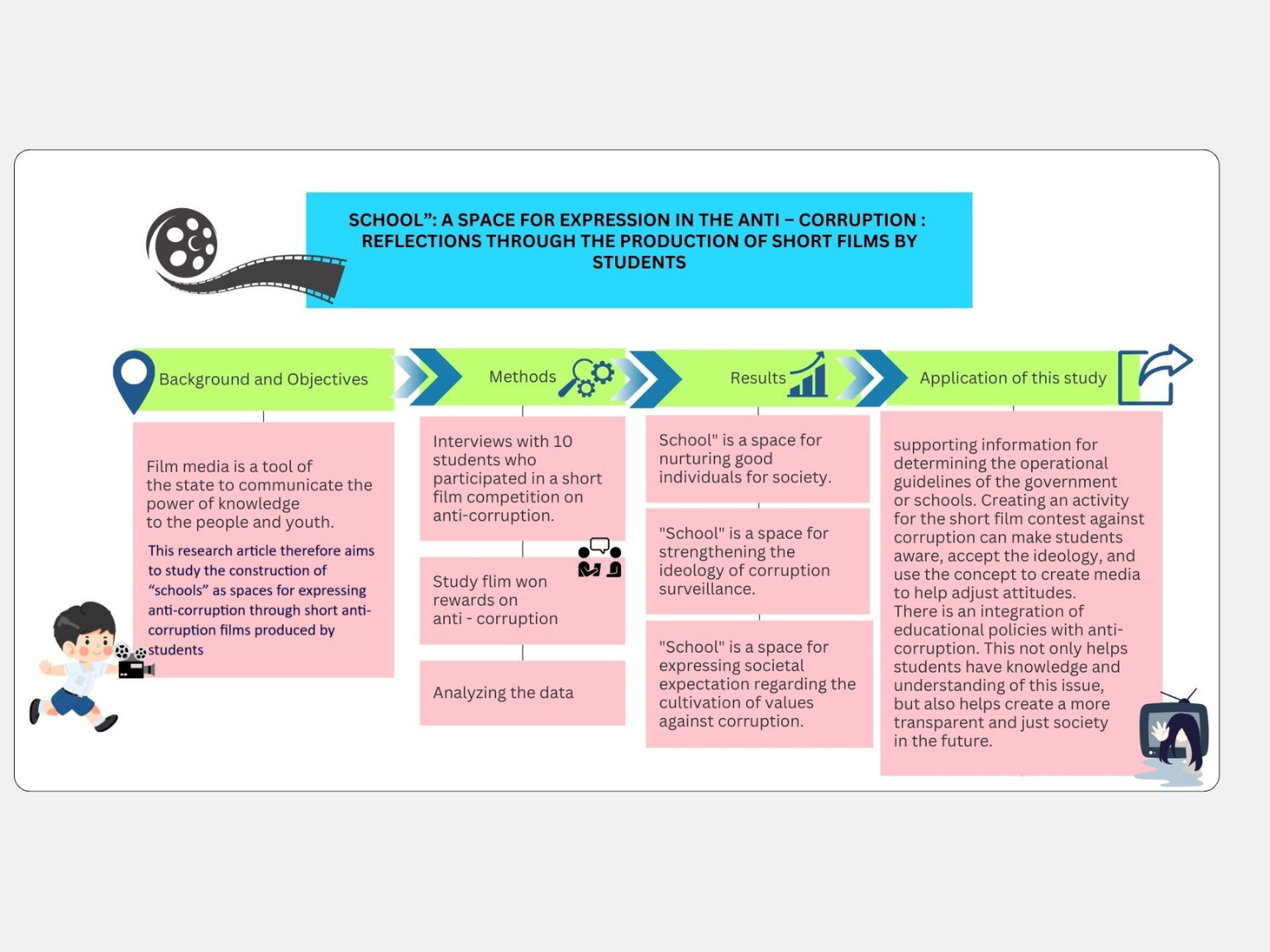
Background and Objectives: A film is an important communication tool. The Thai government has integrated it into its anti-corruption project through short film media, encouraging public participation, including students by producing and submitting short films for an anti-corruption film competition. It was found that student-produced films tend to reflect school-related narratives and contexts. This research article therefore aims to study the construction of “schools” as spaces for expressing anti-corruption through anti-corruption short films produced by students.
Methods: This is qualitative research, collecting data through interviews. The key informants are ten students who have previously participated in a short film competition on anti-corruption organized by a government agency. The participants were selected through purposive sampling. The study incorporates observations of anti-corruption short films and a review of relevant documents. The researcher utilizes thematic analysis as a framework for data analysis.
Results: The research results indicated that the construction of “schools” as spaces for expressing anti-corruption through the short films produced by students and by telling stories in the short film media of students show the “good person discourse”, linking the knowledge of anti-corruption discourse in schools, which can be divided into 3 types: 1. “School”, a space for nurturing good individuals for society. 2. “School”, a space for strengthening the ideology of corruption surveillance, and 3. “School”, is a space for expressing societal expectations regarding the cultivation of values against corruption. This set of knowledge often dominates the students who produce short films with the power of knowledge in anti-corruption, which is full of the state ideology that is continuous and reproduced as a result of the anti-corruption discourse.
Application of this study: The research findings can be utilized as supporting data for developing guidelines for government agencies or schools. Organizing short film competitions on anti-corruption can make students aware, foster their acceptance of anti-corruption ideologies, and encourage them to create media that contribute to attitude adjustment. This approach integrates educational policies with anti-corruption efforts, not only increasing students’ knowledge and understanding of the issue but also promoting a more transparent and just society in the future.
Conclusions: Short films produced by students serve as a medium for disseminating anti-corruption knowledge within school spaces, highlighting the relationship between schools and anti-corruption efforts. The analysis of this relationship indicates that schools can function as spaces for constructing ideologies and knowledge of anti-corruption through the short films produced by students. Students express their perspectives within the school setting, reflecting the idea that schools are arenas for anti-corruption advocacy. Their short films reflect three main narratives: 1) nurturing good individuals, 2) promoting a vigilant anti-corruption ideology, and 3) societal expectation. These themes illustrate students’ desire to express anti-corruption messages through their films within the school context. Therefore, some schools have become spaces for constructing and expressing anti-corruption ideas in the short films produced by students. The findings of this study can be further utilized as supporting information for developing anti-corruption strategies in government or school operations for children and youth, aiming to foster honest and corruption-free Thai society.
Downloads
Article Details

This work is licensed under a Creative Commons Attribution-NonCommercial-NoDerivatives 4.0 International License.
References
Anukansai, K. (2003). Anti-Corruption and Transparency Radio Broadcasts. Bangkok: Transparency International.
Althusser, L. (2014). Ideology and Ideological State Apparatuses. Kaewthep, K. (Trans.). Bangkok: Siamparitut.
Bardhan, P. (1997). Corruption and development: A Review of Issues. Journal of Economic Literature, 35(3), 1320-1346.
Belch, G., & Belch, M. (2009). Advertising and Promotion: An Integrated Marketing Communications Perspective. 6th ed. Boston: McGraw-Hill Irwin.
Bell, A. (1991). The Language of News Media. Oxford: Blackwell.
Bereghazyova, G. (2017). Discourses of corruption in Slovakia: society, media and small and medium-sized enterprises. Doctoral Dissertation, Ph.D. in Arts and Social Sciences, University of Surrey, United Kingdom.
Bold, C. (2012). Using Narrative in Research. London: Sage Publications.
Bracking, S., & Ivanov, K. (2007). Conclusion. In S. Bracking (Ed.) Corruption and Development: The Anti-Corruption Campaigns. (pp. 295-303). New York: Palgrave Macmillan.
Bukovansky, M. (2006). The Hollowness of Anti-corruption Discourse. Review of International Political Economy, 13(2), 181-209.
Bunn, M. (2009). Corruption and Nuclear Proliferation. In R. I. Rotberg (Ed.) Corruption, Global Security, and World Order. (pp.124-166). Baltimore: Brookings Institution Press.
Camaj, L. (2013). The Media’s Role in Fighting Corruption. The International Journal of Press/Politics, 18(1), 21-42.
Chantavanich, S. (2016). Qualitative Research Data Analysis. 12th ed. Bangkok: Chulalongkorn University Press. (In Thai)
Charoensin-o-larn, C. (2017). Development Discourse: Power Knowledge Truth Identity and Otherness. 6th ed. Bangkok: Wibhasa. (In Thai)
Chofa, S., Prakongpan, P., & Noklang, S. (2025). Figure 1 Research Results.
Croteau, D., & Hoynes, W. (2000). Media/society: Industries, Images and Audiences. 2nd ed. Thousand Oaks: Pine Forge Press.
Disch, A., Vigeland, E., & Sundet, G. (2009). Anti-Corruption Approaches: A Literature Review. Norway: Norwegian agency for development cooperation (Norad).
Di Puppo, L. (2010). Anti-Corruption Interventions in Georgia. Global Crime, 11(2), 220-236. https://doi.org/10.1080/17440571003669233
Donald, J., & Renov, M. (2008). Film Studies. UK: Sage Publications.
Downey, J., & Fenton, N. (2003). New Media, Counter Publicity and The Public Sphere. New Media and Society, 5(2), 185-202.
Everett, J. (2006). The Global Fight Against Corruption: A Foucaltian, Virtues-Ethics Framing. Journal of Business Ethics, 65(1), 1-12.
Fairclough, N. (1995). Critical Discourse Analysis the Critical Study of Language. UK: Longman.
Foucault, M. (1981). The Order of Discourse. In R. Young (Ed.) Untying the text: A Post-Structuralist reader, (pp. 48-78). Boston: Routledge.
Fusch, P. I., & Ness, L. R. (2015). Are We There Yet? Data Saturation in Qualitative Research. The Qualitative Report, 20(9), 1408-1416. https://doi.org/10.46743/2160-3715/2015.2281.
Inkaew, C. (2020). Music: The Construction of Social Reality. Journal of Humanities, Social Science, and Arts, 1(1), 58-71. (In Thai)
Kaewthep, K. (2010). New Perspectives in Communication Studies. Bangkok: Pabpim. (In Thai)
Kuorphung, S. (2009). A Discourse of Questions and Answers on Childcare Issues in Rakluk Magazine. Master Thesis, M.A. in Arts (Thai), Chulalongkorn University, Thailand. (In Thai)
Limsuthiwanpoom, T. (2020). Model and Guidelines for Preventing Corruption in Thai Government Agencies. Rajapark Journal, 14(35), 1-11. (In Thai)
Malithong, K. (2005). Technological and Communication for Education. Bangkok: Aroonkarnpim. (In Thai)
Mergel, I. (2012). Social Media in the Public Sector: A Guide to Participation, Collaboration, and Transparency in the Networked World. New York: Jossey-Bass.
Murthy, D. (2012). Towards a Sociological Understanding of Social Media: Theorizing Twitter. Sociology, 46(6), 1059-1073.
NACC Thailand Official. (2015a, April 17). Kha Pae Chia. [Bribe]. Retrieved 18 October 2024, from https://www.youtube.com/watch?v=J64_jdEOy3Q. (In Thai)
NACC Thailand Official. (2015b, October 2). The Imitation. Retrieved 18 October 2024, from https://www.youtube.com/watch?v=pVpGIabB-3A. (In Thai)
NACC Thailand Official. (2015c, October 2). Majority Rule. Retrieved 18 October 2024, from https://www.youtube.com/watch?v=xmM41ldoI_Q&t=45s. (In Thai)
NACC Thailand Official. (2015d, October 2). Paper. Retrieved 18 October 2024, from https://www.youtube.com/watch?v=VLgez-bjAjs. (In Thai)
NACC Thailand Official. (2016, September 16). Baiset. [Receipt]. Retrieved 18 October 2024, from https://www.youtube.com/watch?v=ZBTE-_jcKKE. (In Thai)
Office of the National Anti-Corruption Commission. (2019). Annual Report of Fiscal Year 2018. Nonthaburi: Division of Policy and Strategy Office of the National Anti-Corruption Commission. (In Thai)
O’Keeffe, A. (2006). Investigating Media Discourse. New York: Routledge.
Panpothong, N. (2013). Critical Analytical Discourse According to Linguistics: Concepts and Implementation of Discourse Thai Language. 2nd ed. Bangkok: Academic dissemination project Faculty of Arts Chulalongkorn University. (In Thai)
Paltridge, B. (2006). Discourse Analysis: An Introduction. UK: Continuum.
Prateeppornnarong, D. (2021). Prevention of Corruption in Public Procurement: The Role of Independent Bservers Regarding the Integrity Pact Approach (Research Report). Bangkok: Graduate School of Public Administration National Institute of Development Administration. (In Thai)
Promata, S., Noklang, S., & Saleemad, K. (2024). Rural Teachers: Meaning from Mainstream Development Discourse on Teachers’ Self-Stigma in Rural Areas. Journal of Arts and Thai Studies, 46(3), E3679 (1-13). https://doi.org/10.69598/artssu.2024.3679. (In Thai)
Rabinow, P. (Ed.). (1997). Ethics Subjectivity and Truth / By Michel Foucault. New York: The New Press.
Sedgwick, J. (2009). Measuring Film Popularity: Principles and Applications. In M. Ross, M. Grauer, & B. Freisleben (Eds.), Digital Tools in Media Studies: Analysis and Research. An Overview (pp. 43-54). Netherlands: Transcript Verlag. https://doi.org/10.14361/9783839410233-003
Sukata, S., & Bunnag, N. (2015). Discourse Analysis of Thai Nationalism in Social Studies and Historical Textbooks. Journal of Interdisciplinary Research: Graduate Studies, 4(1), 126-137. (In Thai)
Tangkitvanich, S., & Thamwanich, T. (2012). Transparency in Government Procurement: A Case Study of Thailand. National Anti-Corruption Commission Journal, 5(1), 48-66. (In Thai)
van Dijk, T. A. (2006). Discourse and Manipulation. Discourse & Society, 17(3), 359-383. https://doi.org/10.1177/0957926506060250
van Dijk, T. A. (2008). Discourse and Power. New York: Palgrave Macmillan.
Wannasorn, J. (2019). Form of Content Marketing on Social Media Generation Z. In Proceedings of the 14th National and International Sripatum University Conference (SPUCON2019), (pp. 133-141), Sripatum University, December 19, 2019. Bangkok, Thailand, 34(2), 133-141. (In Thai)
Widdowson, H. G. (1998). The Theory and Practice of Critical Discourse Analysis. Applied Linguistics, 19(1), 136-151.
