
Questioning Strategies in the Interview Segments of “Puean Khang Nai” Program
Article Sidebar
Main Article Content
Abstract
Background and Objectives: An interview is a situation of using questions to obtain the desired information. From a linguistic perspective, an interview is a discourse genre in conversations that is frequently found. It is distinct from other types of everyday conversation. An interview is a type of spoken discourse in which the participants hold unequal status, assume clearly different roles, and follow a predetermined set of topics or issues. In contrast, everyday conversational discourse typically lacks fixed topics and is characterized by equal status between participants. Therefore, the study of interview discourse involves analyzing language as it occurs in
real-life contexts or situations, where one participant controls the flow of conversation by posing questions to elicit information or narratives from the other. This research article aims to examine the questioning strategies employed in interview discourse and to investigate the functions of these strategies in the interview segments of the
“Puean Khang Nai” program.
Methods: This research is a qualitative study conducted in two phases: 1) the review of concepts related to discourse, interview discourse, speech acts, and question acts, as well as 2) a review of documents and related research on questioning strategies in interview discourse. The aim is to apply these frameworks to study questioning strategies in the interview discourse of the program Puean Khang Nai (“Friends Inside”). The data were collected from interviews on the “Puean Khang Nai” program available on the KoBoyKrush YouTube channel, which has 1.38 million subscribers. The data span from 2019 to 2023, totaling 226 episodes. A purposive sampling method was used to select 10 episodes—specifically the most popular episodes based on the top two highest “Like” counts from each year.
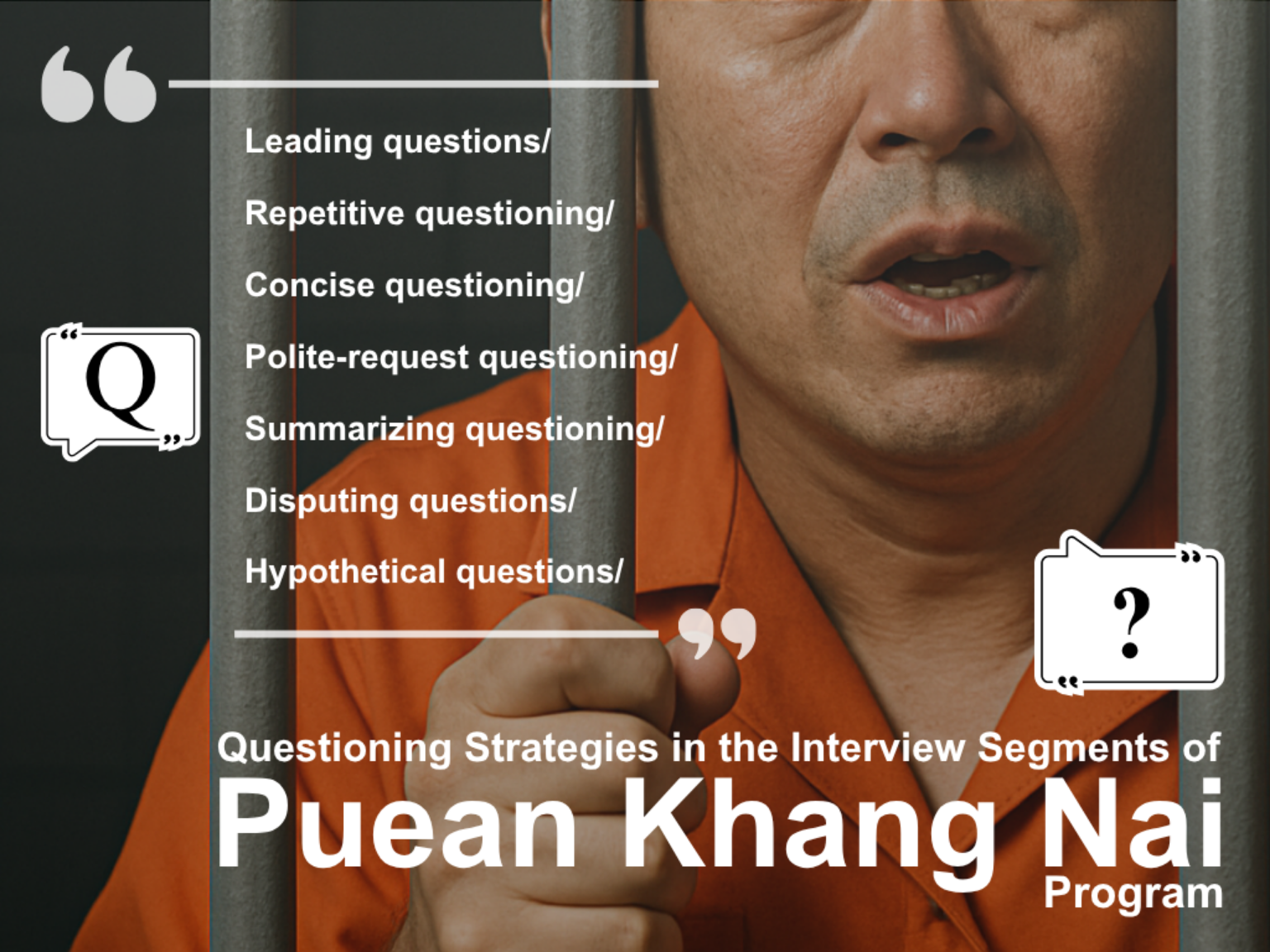
Results: The findings revealed seven questioning strategies: 1) leading questions, 2) repetitive questioning,
3) concise questioning, 4) polite-request questioning, 5) summarizing questioning, 6) disputing questions, and
7) hypothetical questions. In addition, the research showed that questioning served not only to elicit information from the interviewees, but also fulfilled six key functions: 1) obtaining information from the interviewee, 2) reviewing and ensuring mutual understanding, 3) raising awareness or offering insights to the audience, 4) expressing the interviewer’s perspectives, 5) verifying facts or confirming responses, and 6) maintaining a continuous sequence of events.
Application of this study: The “Puean Khang Nai” program is a public broadcast, aiming at presenting life lessons from inmates who have taken wrongful paths and are serving legal penalties. The program aims to raise awareness among viewers about living morally correct lives and instill respect for the law, which serves as a mechanism for regulating individuals in society and maintaining peaceful coexistence.
Conclusions: For the “Puean Khang Nai” program, there are seven questioning strategies: 1) leading questions, 2) repetitive questioning, 3) concise questioning, 4) polite-request questioning, 5) summarizing questioning,
6) disputing questions, and 7) hypothetical questions and there are six key functions: 1) obtaining information from the interviewee, 2) reviewing and ensuring mutual understanding, 3) raising awareness or offering insights to the audience, 4) expressing the interviewer’s perspectives, 5) verifying facts or confirming responses, and
6) maintaining a continuous sequence of events. The program aims to raise awareness among viewers about living morally correct lives and instill respect for the law.
Downloads
Article Details

This work is licensed under a Creative Commons Attribution-NonCommercial-NoDerivatives 4.0 International License.
References
Austin, J. L. (1962). How to Do Things with Words. UK: Oxford University Press.
Brown, G., & Yule, G. (1983). Discourse Analysis. UK: Cambridge University Press.
Harris, Z. S. (1951). Structural linguistics. Chicago: University of Chicago Press.
Kamonwan, P. (2006). Questioning Strategies in The Interview Discourse Of "Thueng Luk Thueng Khon". Master Thesis, M.A. in Thai, Faculty of Arts, Chulalongkorn University, Thailand. (In Thai)
KoBoyKrush. (2019, September 22). 100-corpse gunman at Ratchaburi Prison. Retrieved 25 September 2024, from https://www.youtube.com/watch?v=K0dggQUBy6Y&t=449s. (In Thai)
KoBoyKrush. (2019, November 18). 31 wounds were inflicted on the godfather#Saraburi. Retrieved 25 September 2024, from https://www.youtube.com/watch?v=f8dkrJGH99M&t=1720s. (In Thai)
KoBoyKrush. (2020, March 18). Souvenirs from prison#Chicken pond. Retrieved 25 September 2024, from https://www.youtube.com/watch?v=V3JbzoPtHF8&t=1060s. (In Thai)
KoBoyKrush. (2020, July 26). The Gunman's Promise#Bang Kwang Central Prison. Retrieved 25 September 2024, from https://www.youtube.com/watch?v=pjyUX3fr_F8. (In Thai)
KoBoyKrush. (2021, July 21). Stuck in 3 prisons in Lao PDR. Retrieved 25 September 2024, from https://www.youtube.com/watch?v=NZ-HU7ffIpE&t=1509s. (In Thai)
KoBoyKrush. (2021, December 28). Camouflage, special tape, super luxurious condo. Retrieved 25 September 2024, from https://www.youtube.com/watch?v=0oUNvI4YKFQ&t=1143s. (In Thai)
KoBoyKrush. (2022, August 1). Abduction of a minor, a 14 year old child. Retrieved 25 September 2024, from https://www.youtube.com/watch?v=w48qp6xegz4&t=486s. (In Thai)
KoBoyKrush. (2022, August 11). Robbery of a 14 year old child. Retrieved 25 September 2024, from https://www.youtube.com/watch?v=ysgWd2lcx08&t=902s. (In Thai)
KoBoyKrush. (2023, May 5). The one who closed the legend of "Taipamoke". Retrieved 25 September 2024, from https://www.youtube.com/watch?v=wLPf8c-NkCc&t=873s. (In Thai)
KoBoyKrush. (2023, February 2). Husband and wife who stole from their employer were each sentenced to 200 years in prison. Retrieved 25 September 2024, from https://www.youtube.com/watch?v=N55fGd8x3Jw&t=446s. (In Thai)
Mabaquiao, N., Jr. (2018). Speech Act Theory: From Austin to Searle. A Journal for Humanities, Social Sciences, Business, and Education, 19(1), 35-45.
Post today. (2024). Prison Is Not for Keeping Dogs: Goboy Crush ‘Youtube Prison People’ Broadcasts Stories Behind the Wall to Give Life Freedom. Retrieved 13 December 2024, from https://www.posttoday.com/lifestyle/609005. (In Thai)
Prapaipan P. (1999). Questioning strategies in two types of television interview. Master Thesis, M.A. in Thai, Faculty of Arts, Chulalongkorn University, Thailand. (In Thai)
Prapasiri, P. & Kanokkarn, W. (2022). A Study Questioning Strategies in the Interview Discourse of Kanchai Kamnerdploy in the Talk Show “Hone-Krasae”. Journal of Humanities and Social Sciences Loei Rajabhat University, 4(2), 68-83. (In Thai)
Searle, J. R. (1965). What Is a Speech Act?. In M. Black (Ed.), Philosophy in America. (pp. 221–239). London: Allen & Unwin.
Searle, J. R. (1969). Speech Acts: An Essay in the Philosophy of Language. UK: Cambridge University Press.
Searle, J. K. (1976). The Classification of Illnocutionaryacts. Language in Society, 5, 1-24.
Steger, H., & Others. (1974). Redekonstellation, Redekonstellationstyp, Textexemplar, Textsorte im Rahmen eines Sprachverhaltensmodells. Begründung einer Forschungshypothese. [Speech constellation, type of speech constellation, text specimen, text type within a model of speech behavior. Justification of a research hypothesis]. In H. Moser (Ed.), Jahrbuch gesprochene Sprache. [Yearbook of Spoken Language]. (pp. 39–97). Dusseldorf : Schwann. (In Germany)
Stubbs, M. (1983). Discourse Analysis: The Sociolinguistic Analysis of Natural Language. Chicago: The University of Chicago Press.
