
The Concepts and Elements of the Dance Creation “YAB-YUM”
Article Sidebar
Main Article Content
Abstract
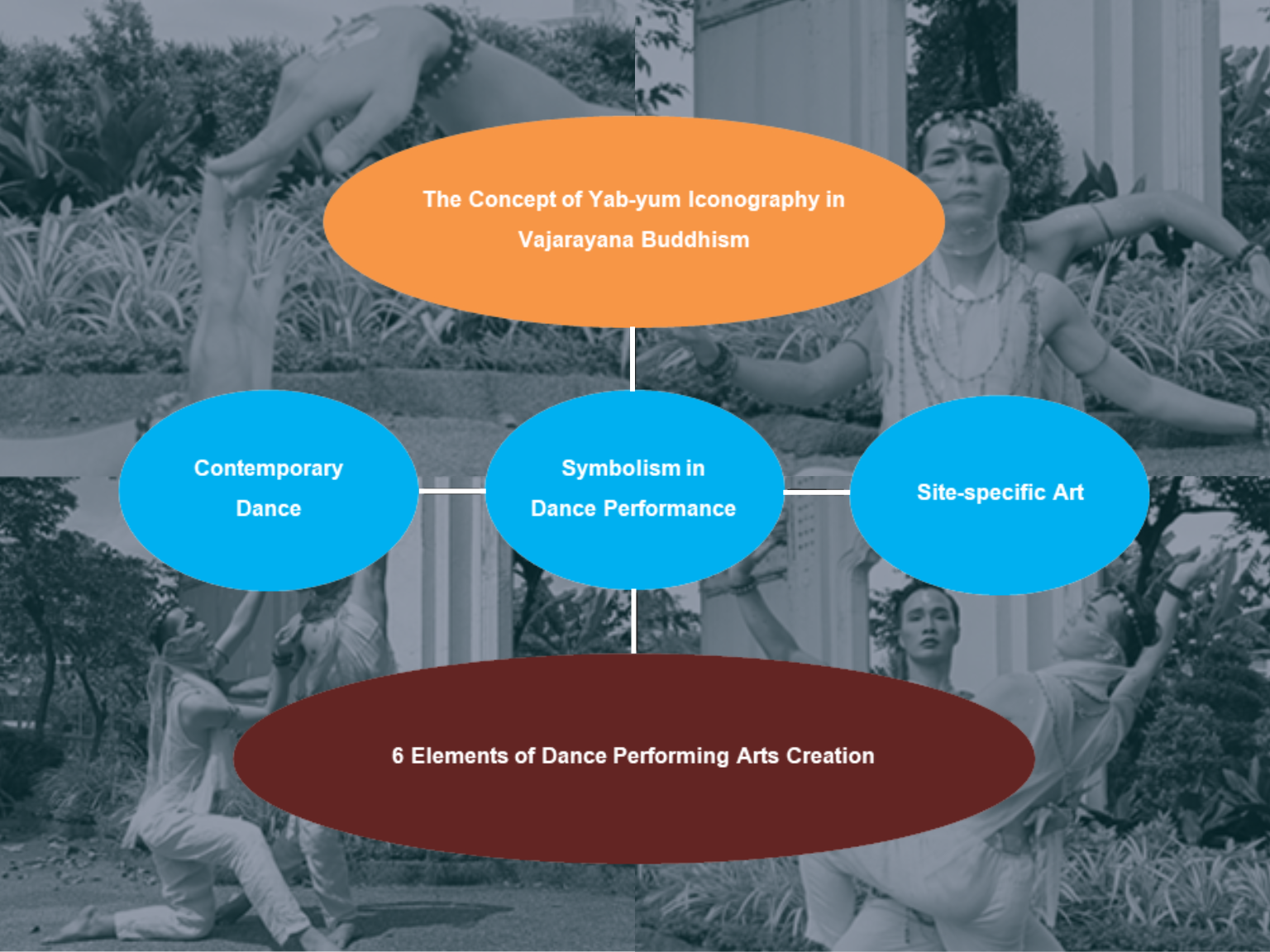
Background and Objectives: “YAB-YUM” represents the fusion of wisdom (Prajna) and compassion (Karuna). The Vajrayana sect believes that when wisdom and compassion unite in the human mind, it leads to liberation or the path to enlightenment. Therefore, this physical depiction is a Sambhogakaya form, visible in the Buddha’s person, and serves as a means of Dharma in the form of a man and a woman. This is because accessing wisdom requires compassion to ultimately achieve liberation or the attainment of Dharma. This research named The Concepts and Elements of the Dance Performance “YAB-YUM” aims to 1) present the concept of Yab-Yum iconography in Vajrayana Buddhism via the creation of works in the field of Dance Performance, and to 2) integrate the concept of Yab-Yum iconography in Vajrayana Buddhism with contemporary dance concepts, symbolism in dance performance, and site-specific art. This integration will be applied to the elements of dance performance creation: theme, dancers, choreography, sound and music, costume, and performance space.
Methods: The dance performance work is based on a qualitative research approach combined with creative research. It integrates knowledge from various conceptual frameworks, including the concept of Yab-Yum iconography in Vajrayana Buddhism, contemporary dance, symbolism in dance performance, and site-specific art. The creative process consists of the following steps: 1) studying relevant documents, 2) personal communication with related individuals, 3) fieldwork exploration, 4) analysis and creation of dance performance work, 5) review and refinement of dance performance work, and 6) presentation and independent critique of dance performance.
Results: The creative process for this dance performance piece integrates the concept of Yab-Yum iconography in Vajrayana Buddhism, contemporary dance, symbolism in the performing arts, and site-specific art. These ideas are combined with six elements of dance performance creation: 1) Theme; the dance performance is newly created under the concept of Yab-Yum iconography in Vajrayana Buddhism, inspired by the philosophical principles of Vajrayana Buddhism. 2) Dancers; knowledgeable and have skills in contemporary dance.
3) Choreography; present through contemporary dance, combined with improvisation and partnering techniques including body support, lifting to float up as well as expressing emotions and feelings. 4) Sound and music; newly compose a song from the Tibetan Singing Bowls to create concentration and calm. 5) Costume; conceptualized to reflect Yab-Yum symbolism, utilizing earth-tone colors to represent nature and simplicity. 6) Performance space, select performance space using the criteria of environment, size, and the utilization of performance spaces based on the concept of site-specific art.
Application of this study: The dance performance “YAB-YUM” represents the development of a creative work in dance that integrates philosophical concepts and symbolism in Vajrayana Buddhism into the creative process. By incorporating various disciplines and theoretical frameworks, this work introduces an innovative approach that diverges from traditional forms. This creative endeavor serves as a means to advance the field of dance by expanding knowledge and performance styles in alignment with contemporary contexts.
Conclusions: The concepts and elements of the dance performance “YAB-YUM” represent an integration of knowledge from philosophy, symbolism, and dance. This demonstrates that dance creation is not confined to the aesthetics of movement alone, but also serves as a space for philosophical communication, symbolic interpretation, and the integration of multiple disciplines—an essential approach in dance creation. Furthermore, the presentation of the concepts and elements in this performance serves as an example of how interdisciplinary dance creation can be further developed and expanded.
Downloads
Article Details

This work is licensed under a Creative Commons Attribution-NonCommercial-NoDerivatives 4.0 International License.
References
Chamnanmor, D. (2002). Sinlapa Haeng Kan Okbaep Lae Kamkap Lila. [The Art of Choreography and Movement Design]. In P. Suphasetsiri et al. (Eds.). Rabum Ram Ten. [Dance, Thai Dance and Western Dance]. Bangkok: Idea Square. (In Thai)
Chanthanasaro, D. (2012). The Dance from Concept of Trilaksana in Buddhism. Doctoral Dissertation, DFA. In Fine and Applied Arts, Chulalongkorn University, Thailand. (In Thai)
Chanthanasaro, D. (2020). The Dance from Viewpoint of Death in Tibetan Vajrayana Buddhism. Institute of Culture and Arts Journal, 22(1), 112-125. (In Thai)
Charoenrat, P. (2016). The Creation of a Contemporary Dance on The Reflection of The Hidden Dark Side of The Rose. Doctoral Dissertation, DFA. Fine and Applied Arts, Chulalongkorn University, Thailand. (In Thai)
Chantarawongpaisarn, J. (2016). Tibetan Art. Bangkok: Chulalongkorn Press. (In Thai)
Clubhawii. (2025). SUN SURF MANDALA: Silapa Bon Phuen Phah Thi Chueam Yong Chit Winyan Lae Style. [SUN SURF MANDALA: The Art on Fabric that Weaves Spirit and Style]. Retrieved 2 January 2025, from https://clubhawaii.net/mandala. (In Thai)
Hongjaru, J. (2015). “Sound in Theater.” In N. Waewhong (Ed.). Perspectives on Theater Arts, (pp. 123). Bangkok: Faculty of Arts, Chulalongkorn University, Thailand. (In Thai)
Hunter, V. (2015). Moving sites: Investigating Site-Specific Dance Performance. Routledge: London and New York.
Kachachiva, G. (2016). Vajrayana Tantra nai India lae Asia Tawan-Ok-Chiang-Tai chak Lakthan Thang Borankadee. [Tantric Vajrayana in India and Southeast Asia from Archaeological]. Bangkok: Faculty of Archaeology, Silpakorn University. (In Thai)
Kaewploy, P. (2020). Pas De Deux: The Art of Ballet Choreography. Fine Arts Journal, 24(1), 125-140. (In Thai)
Kalyano, C. (2017). Mahayana Buddhism: Tantrayan. Journal of Buddhist Philosophy Evolved, 1(3), 31-37. (In Thai)
Katekaew, A. (2019). The Creation of a Dance from the AUM Symbol in Brahmanism-Hinduism. Doctoral Dissertation, DFA. In Fine and Applied Arts, Chulalongkorn University, Thailand. (In Thai)
Kornmaneeroj, V. (2022a). Figure 1 The Conceptual Framework for Research and Creative Work.
Kornmaneeroj, V. (2022b). Figure 2 YAB-YUM of Tantra Ideology.
Kornmaneeroj, V. (2022c). Figure 3 The Concept of Contemporary Dance.
Kornmaneeroj, V. (2022d). Figure 4 The Concept of Symbolism in Dance Performance.
Kornmaneeroj, V. (2022d). Figure 5 The Concept of Site-Specific Art.
Kornmaneeroj, V. (2022e). Figure 6 The Script in The Dance Performance “YAB-YUM”.
Kornmaneeroj, V. (2022f). Figure 7 The Dancers in The Dance Performance “YAB-YUM”.
Kornmaneeroj, V. (2022g). Figure 8 The Choreography in The Dance Performance “YAB-YUM”.
Kornmaneeroj, V. (2022h). Figure 9 The Costume in The Dance Performance “YAB-YUM”.
Panomrak, J. (2018). The Transmission of Naraphong Charassri’s Creative Concepts of Site-Specific Dance Performance. Institute of Culture and Arts Journal, 20(1), 97-108. (In Thai)
Saengkaew, T. (2018). Philosophical Approach to Mental Development of Vajrayana School of Buddhism. Journal of MCU Palisueksabuddhaghosa Review, 4(2), 31–46. (In Thai)
Sukhasvasti, M. L. S. (2017). Lanna Buddha Statues and the Principles of Mahayana in the Vajrayana, Tantra. 2nd. Chiang Mai: Chiang Mai University Press. (In Thai)
Thapvajrabundit, Pra. (2025). Analysis of Vajrayana ep. 4. Retrieved 25 March 2025, from https://www.mcu.ac.th/directory_uploads/administrator/file_upload/20210504112412_34535AD4-4A03-4F93-B5C2-50CC073FFF29.pdf. (In Thai)
