
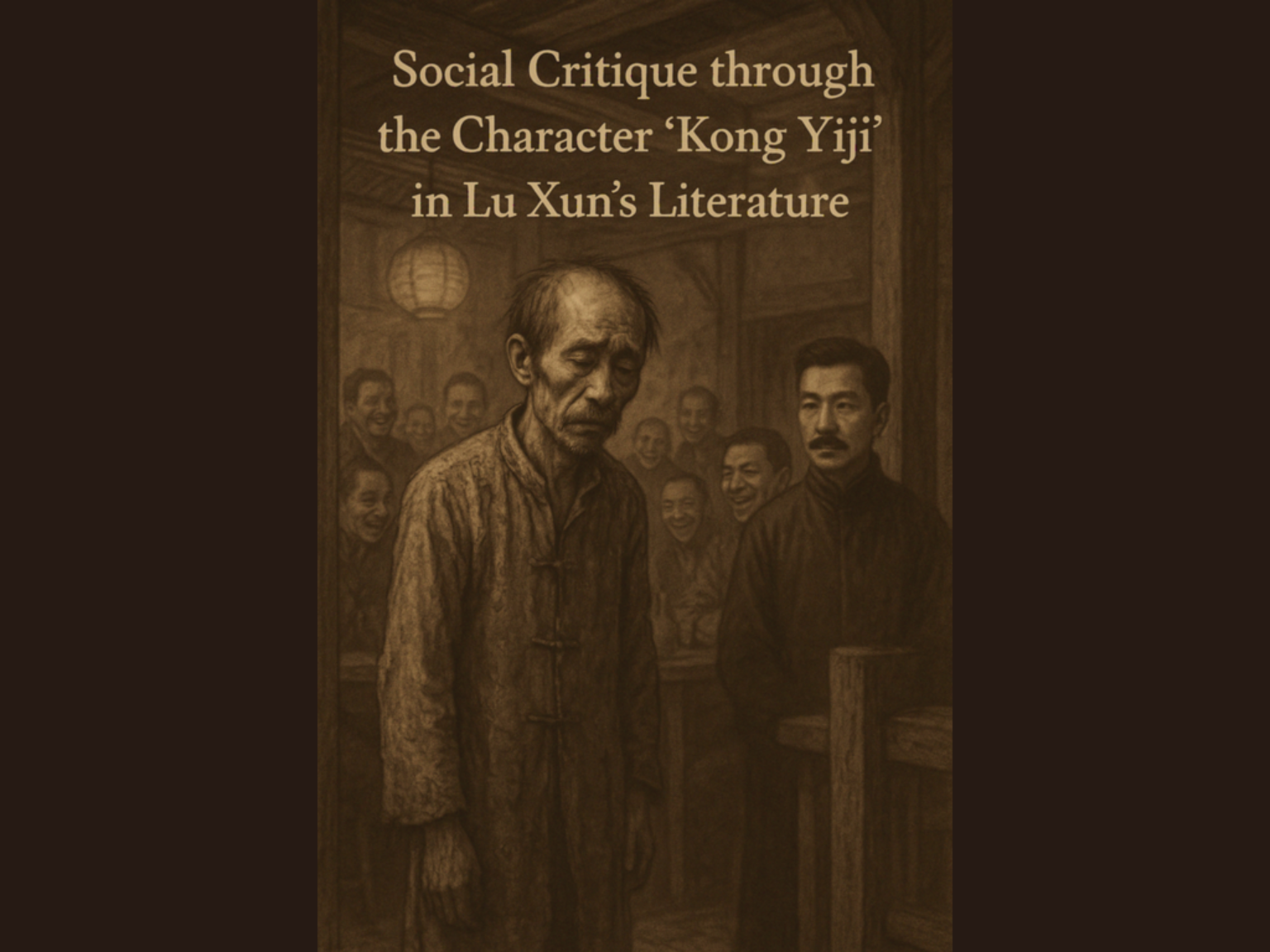
Social Critique of Chinese Society Through the Character “Kong Yiji” in Lu Xun’s Literature
Article Sidebar
Main Article Content
Abstract
Background and Objectives: Lu Xun’s literature has long been recognized as a powerful tool for critiquing Chinese society during the late feudal era. Kong Yiji is one of his works that reflects this effort. The character Kong Yiji is not merely a representation of a failed candidate in the imperial examination system, but symbolizes the defeated class that is driven to ruin by structural oppression and social myths. This research aims to analyze Kong Yiji’s role as a reflection of the relationship between Lu Xun’s life experience and his critique of social structures, as well as to reveal the author’s personal critical voice embedded in the text, highlighting the societal mechanisms that collectively contribute to the destruction of those who fail.
Methods: This qualitative research employed documentary analysis as the primary method. It examined the original Chinese text and its Thai translation of Kong Yiji. The content was analyzed through the lens of social critique literary theory and narrative theory, alongside the concepts concerning the relationship between the author and the text. The scope of this research focuses on three dimensions: critique of the feudal structure and the imperial examination system, analysis of narrative structure, and the author’s personal critical voice as conveyed through the text.
Results: The study finds that Kong Yiji reflects the feudal structure that oppressed the lower classes and the myths that ultimately destroyed those who clung to them. Kong Yiji illustrates a victim of both the imperial examination system and the mockery of society. The narrative structure, told through the eyes of a child at a tavern, makes the atmosphere of scorn and social judgment evident without overt criticism. Meanwhile, Lu Xun’s personal critical voice permeates the ambiance and details of the text, expressing his bitterness and life experience of accusation and failure imposed by societal structures.
Application of this study: This study can be applied in literary criticism and literary studies to deepen understanding of social mechanisms hidden in texts. It also serves as a case study for analyzing literature as a tool for critiquing power structures and societal myths, especially in the societies that continue to struggle with oppressive systems and rumors that function as tools of social execution.
Conclusions: Kong Yiji is not simply a short story about a failed examinee, but a mirror of the feudal social structure that collaborates to destroy the defeated, including the imperial examination system, public mockery, and rumors that act as social weapons. Lu Xun uses this story to expose the cruelty hidden in everyday life and to express a critical voice coming from real-life experience. The work retains its contemporary relevance in reflecting and criticizing society.
Downloads
Article Details

This work is licensed under a Creative Commons Attribution-NonCommercial-NoDerivatives 4.0 International License.
References
Chen, J. F. (2006). Yi “xiao” wei xian yi “xi” chen “bei”: “Kong Yiji” zhong “xiao sheng” miaoxie de zuoyong chutan. [Using “Laughter” as a Clue to Depict “Tragedy”: A Preliminary Study on Comic Sound in Kong Yiji]. Wenjiao Ziliao [Educational and Cultural Materials], (11), 56-57. (In Chinese)
Elman, B. A. (1991). Political, Social, and Cultural Reproduction via Civil Service Examinations in Late Imperial China. The Journal of Asian Studies, 50(1), 7-28.
Gao, H. W. (2023). Cong wudu shuoqi: Kong Yiji xushi yishu jiexi. [From Misreading to Reflection: An Analysis of Narrative Art in Kong Yiji]. Wenxue Jiaoyu. [Literature Education], (4), 154-169. (In Chinese)
Ho, P. (2000). The Ladder of Success in Imperial China: Aspects of Social Mobility, 1368–1911. New York: Columbia University Press.
Ji, Y. Y. (2006). Ming Qing keju zhi de shehui zhenghe gongneng — yi shehui liudong wei shijiao. [The Social Integrative Function of the Imperial Examination System in the Ming and Qing Dynasties: A Perspective of Social Mobility]. Shehui. [Society], 26(6), 197-215. (In Chinese)
Jiang, C. Y. (2022). Lun Kong Yiji de duoceng xushu jiegou. [On the multi-layered narrative structure in Kong Yiji]. Wenxue Jiaoyu. [Literature Education], (1), 27-29. (In Chinese)
Li, J. (2022). Buke wangque de chuangshang jiyi: Shilun “liuyan” zhi xia Lu Xun xiansheng de jingshen shijie ji qi chuangzuo. [Unforgettable traumatic memory: On the spiritual world and literary creation of Mr. Lu Xun under the shadow of “rumors”]. Jin Gu Wen Chuang. [Modern and Ancient Literary Creativity]. (39), 44-46. (In Chinese)
Li, Q., & Zheng, H. M. (2024). Cong wenxue piping jiaodu fenxi Kong Yiji yingyiben. [A Literary Criticism-Based Analysis of the English Translation of Kong Yiji]. Yingyu Guangchang. (English Plaza), (266), 19-22. (In Chinese)
Liu, P. X., Sun, C. X., & Han, C. J. (1958). Pipan “Lu Xun yanjiu” zhong de zichanjieji xueshu sixiang — “Lu Xun yanjiu” chubu ziwo pipan. [A Critique of Bourgeois Academic Thought in “Lu Xun Studies”: An Initial Self-Criticism of “Lu Xun Studies”]. Wenshi Zhe. [Literature, History and Philosophy], (12), 1-5. (In Chinese)
Liu, M. Z., & Wang, S. (2025). Qingnian meijiehua fennu de chan sheng yu biaoda — jiyu “Kong Yiji wenxue” shijian de zhagen yanjiu. [The Emergence and Expression of Media-Driven Youth Anger: A Grassroots Study Based on the “Kong Yiji Literature” Phenomenon]. Journalism & Communication Review, 78(1), 66-79. (In Chinese)
Wang, H. X., Li, J. X., & Tan, H. (2024). Kong Yiji wenxue weishenme hui yinfazhengyi? — Yingyong pipanxing siwei eryuan wenti fenxi fa pouxi shehui redian. [Why Has “Kong Yiji Literature” Become Controversial? An Analysis of Social Issues Using Dialectical Critical Thinking]. Critical and Creative Thinking Education Newsletter, (73), 16-20. (In Chinese)
Lu, X. (2000). Kong Yiji. In Lu Xun xiaoshuo [Lu Xun’s short stories] (pp. 20–24). Hangzhou: Zhejiang Wenyi Chubanshe.
Lu, X. (1981). Za lun Leifeng ta de daodiao. [On the fall of the Leifeng Tower again]. In Lu Xun xuanji, Vol. 1, 192–193. Sichuan: Sichuan Renmin Chubanshe.
Lu, Xun. (2005). Huagai ji: Zagan [Miscellaneous thoughts from Huagai Collection]. In Lu Xun quanji, Vol. 3, 52. Beijing: Renmin Wenxue Chubanshe.
Lu, Xun. (2005). Bingfei xianhua: Huagai ji [Not merely idle talk: From Huagai Collection]. In Lu Xun quanji, Vol. 3, 81–82. Beijing: Renmin Wenxue Chubanshe.
Lu, Xun. (2005). Suoji [Random notes]. In Lu Xun quanji, Vol. 2, 302. Beijing: Renmin Wenxue Chubanshe.
Wang, H. X., Li, J. X., & Tan, H. (2024). Kong Yiji wenxue weishenme hui yinfazhengyi? — Yingyong pipanxing siwei eryuan wenti fenxi fa pouxi shehui redian. [Why Has “Kong Yiji Literature” Become Controversial? An Analysis of Social Issues Using Dialectical Critical Thinking]. Critical and Creative Thinking Education Newsletter, (73), 16-20. (In Chinese)
Xin, M. Y. (2024). Cong mengxue dao jingxue: Lun Kong Yiji de shizi zhi yu. [From Elementary Learning to Classics: On Kong Yiji’s Scholarly Predicament]. Wenxue Pinglun, (6), 62-71. (In Chinese)
Yuan, L. R. (2024). “Kong Yiji wenxue” xianxiang xia daxuesheng jiuye guan wenti chengxian ji qiyu yindao. [The Emergence of the Employment Concept of College Students Under the Phenomenon of “Kong Yiji Literature” and Its Educational Guidance]. Hans Journal of Social Sciences, 13(9), 709-715. (In Chinese)
Zhang, C. C. (2018). Tingjue xushi shiyu xia Lu Xun xiaoshuo zhong de shengyin shuxie. [The Writing of Sound in Lu Xun’s Fiction From the Perspective of Auditory Narrative]. Xibu Xuekan, (2), 82-96. (In Chinese)
Zhang, Z. L. (1991). Zhongguo shenshi: Chuantong de shiren jieceng. [The Scholar-Officials of China: The Traditional Poetic Class]. Shanghai: Shanghai Shehui Kexueyuan Chubanshe. (In Chinese)
Zhao, Y. M. (2016). Zuowei yishu xingshi de Luzhen shikong. [Luzhen as an Artistic Space-Time Form]. Mingzuo Xinshang, (4). (In Chinese)
Zhou, L. G. (2022). “Kan”, kanke de “kan”. [“Kan”: The Gaze of the Onlooker]. Retrieved 18 May 2025, form https://www.thepaper.cn/ (In Chinese)
Zhu, X. Y. (2019). Lu Xun xiaoshuo zhong de shengyin yixiang yanjiu. [A Study of Sound Imagery in Lu Xun’s Fiction]. Nanchang Daxue Xuebao. [Journal of Nanchang University – Humanities and Social Sciences Edition], (2), 45-77. (In Chinese)
