
The Thailand Contract Project and the Teacher Production in Thailand Under U.S. Assistance (1954–1959)
Article Sidebar
Main Article Content
Abstract
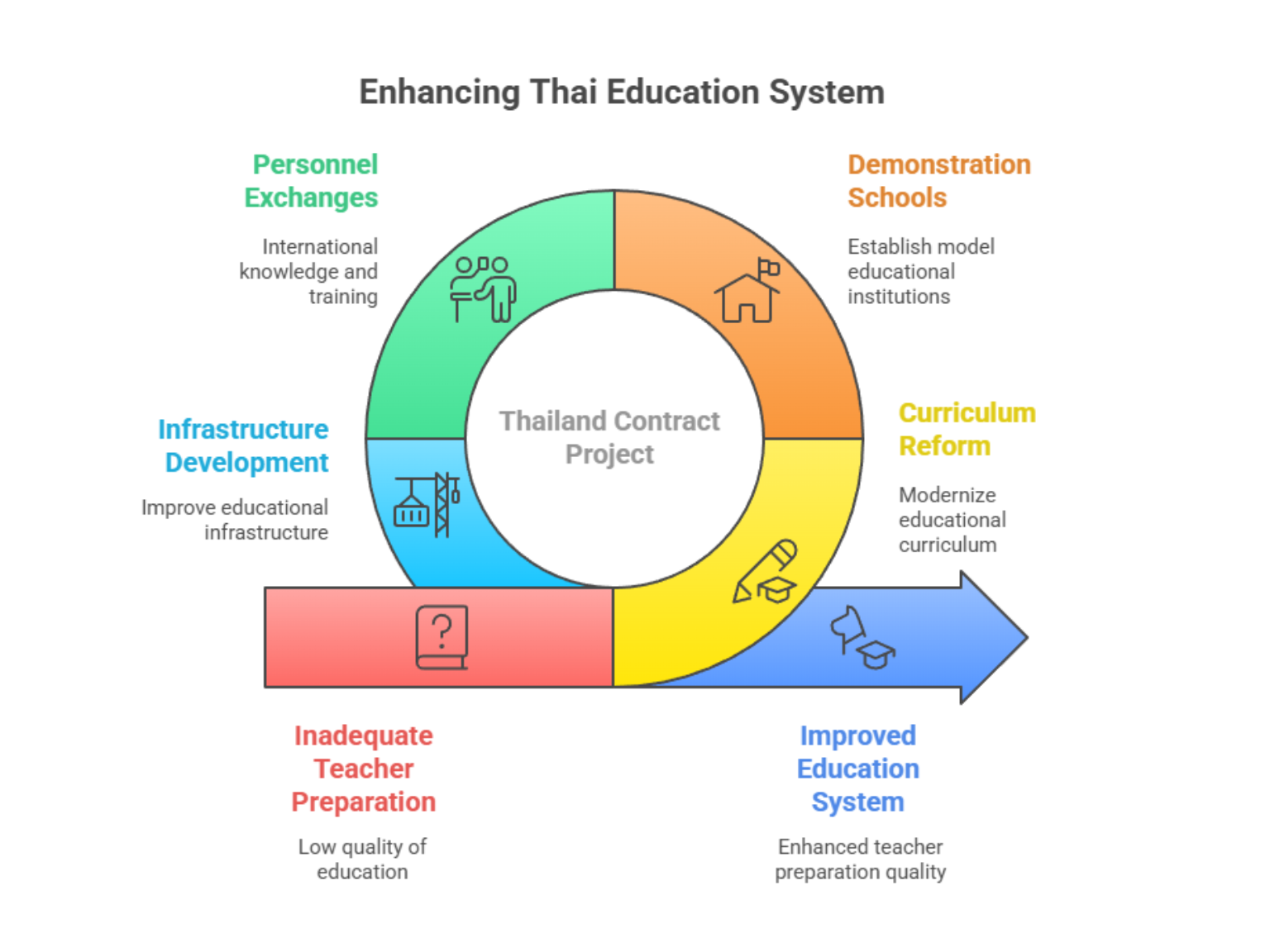
Background and Objectives: The Thailand Contract Project, implemented during the Cold War from 1954 to 1959, was a collaborative initiative between the Thai government and Indiana University, supported by the United States government. The primary objective of this project was to enhance Thailand’s teacher preparation system and improve the quality of education. Education was employed as a pivotal tool to promote democratic ideologies and counter communist influences. The collaboration involved curriculum reform, the establishment of demonstration schools, personnel exchanges, and the development of educational infrastructure. This study aims to analyze the role of U.S. assistance and its impact on the Thai education system during this critical period.
Methods: This research employs a historical methodology, focusing on the analysis of primary sources such as letters, reports, and memoranda authored by key individuals, such as Willis P. Porter, the Chief of the Thailand Contract Project. These documents were retrieved through the online archive of Indiana University. Additional sources include the official records of the Ministry of Education and the educational institutions of that period. The analysis emphasizes the study of the project’s context, objectives, implementation strategies, and outcomes, with the aim of understanding its impact on the development of education in Thailand during that era.
Results: The Thailand Contract Project played a significant role in establishing the foundation of Thailand’s education system, including the establishment of the Faculty of Education at Chulalongkorn University, the creation of teacher training colleges, and the introduction of teaching methods that balanced theory and practice. The project also strengthened the capacity of educators through international knowledge exchanges and training programs. However, urban-rural disparities and cultural differences between Thai and American educational philosophies were the important challenges that the project had to encounter.
Application of this study: The findings from this study can be used in the development of future education policies and international educational collaborations, particularly, with the consideration of adapting international concepts and strategies to align with the local context. Moreover, this project serves as an example of how education can act as a critical mechanism for fostering political cooperation and improving quality of life in the context of international relations.
Conclusions: The Thailand Contract Project is the case study showing education’s dual role as a tool for societal development and a strategic instrument in the Cold War era. While the project achieved success in laying the groundwork for Thailand’s education system, challenges such as reducing disparities and integrating foreign concepts into the local framework remained key issues. The outcomes of this project continue to influence Thailand’s education system today, serving as a foundational model for future development.
Downloads
Article Details

This work is licensed under a Creative Commons Attribution-NonCommercial-NoDerivatives 4.0 International License.
References
Faculty of Education, Chulalongkorn University. (1960). Special Issue of The Faculty of Education Journal on The Occasion of The Inauguration of The New Building (P. 5). Retrieved 1 January 2025, from https://cuir.car.chula.ac.th/dspace/bitstream/123456789/13529/3/EDU_Open.pdf
Phromyothi, M. (1956, April 1). Address of General Mangkorn Bhromyothi on the Occasion of the Anniversary of the Establishment of the Ministry of Education – April 1, 1956 – To Be Broadcast Over Education Radio Station. [Speech Transcript]. Bangkok: Ministry of Education.
Porter, W. P. (1954, November 19). Letter to General Mangkhorn Phromyothi regarding teacher training facilities in Chiengmai. Lampang Teacher Training Conference Report. Bangkok: Ministry of Education.
Porter, W. P. (1955, February 10). Memorandum to Mom Luang PIN Malakul Regarding the Implementation of Contract Between College of Education and Indiana University. [Unpublished Memorandum]. Ministry of Education, Thailand.
Porter, W. P. (1955, February 24). Letter to Luang Svastsisarn Regarding Morale in the Secondary Teacher Training School and Recommendations for Consolidation. [Unpublished letter]. Ministry of Education, Thailand.
Porter, W. P. (1955, July 15). Letter to the Minister of Education Regarding Progress and Future Collaboration Under the Indiana University Contract. Indiana University Contract Project, College of Education, Bangkok.
Porter, W. P. (1956, July 11 & 24). Reports on Mae Joe Agricultural School: Facilities and Teacher Training Program. Indiana University Contract Project, College of Education, Bangkok.
Porter, W. P. (1956, July 30). Letter to the Minister of Education Regarding the Third Semi-annual Report for the College of Education. Indiana University Contract Project, Bangkok.
Porter, W. P. (1959, February 16). Memorandum to Advisers on Supporting Thai Participants in the Education Contract Program. Indiana University Contract Project, Bloomington.
Srinakharinwirot University. (1974). Wittayalai Vichakarnsuksa. [The Present Faculty of Education is Srinakharinwirot University]. Retrieved 1 January 2025, from https://ejournals.swu.ac.th/index.php/ENEDU/article/download/6424/6055/20068 (In Thai)
Srinakharinwirot University. (2020). Bantuek Mo So Wo. [Milestone of Srinakharinwirot University]. Retrieved 3 January 2025, from https://www.swu.ac.th/milestone.php (In Thai)
Srinakharinwirot University. (2000). Sattrachan Dr. Saroj Buasri. [Educational Background of Professor Dr. Saroj Buasri]. Retrieved 4 January 2025, from http://thesis.swu.ac.th/swuebook/h328504.pdf (In Thai)
Srinakharinwirot University. (1993). Sattrachan Dr. Kaw Sawatdipanit. [Educational Background of Professor Dr. Kaw Sawatdipanit]. Retrieved 4 January 2025, from https://ejournals.swu.ac.th/index.php/ENEDU/article/download/6180/5813/19597 (In Thai)
Wongsurawat, K. (2000). The Cold War (1945-1991). In Kong Thammasat lae Kan Mueang (Ed.), Encyclopedia of World History: United States, Volume 2, Letters C-D. (pp. 119-122). Bangkok: Royal Institute. (In Thai)
