
The Diversity of Social Capital from the Khmer Literature Reamker
Article Sidebar
Main Article Content
Abstract
Background and Objectives: Reamker is a literary work that has long been closely intertwined with the way of life of the Khmer people. It serves as cultural information that reflects the values, beliefs, traditions, and rituals of local communities. Moreover, it is linked to toponyms, which are the names of many significant locations in Cambodia. For these reasons, the researcher is interested in exploring the social and cultural dimensions of Khmer society as reflected through the content of Reamker.
Methods: This research used qualitative research methodology by studying the data from the Khmer literary text Reamker, volumes 1–10, based on the edited and published version by the Buddhist Institute, the Kingdom of Cambodia. Hanifan’s concept of social capital was the main framework for this analysis, and the research findings were presented using analytical description.
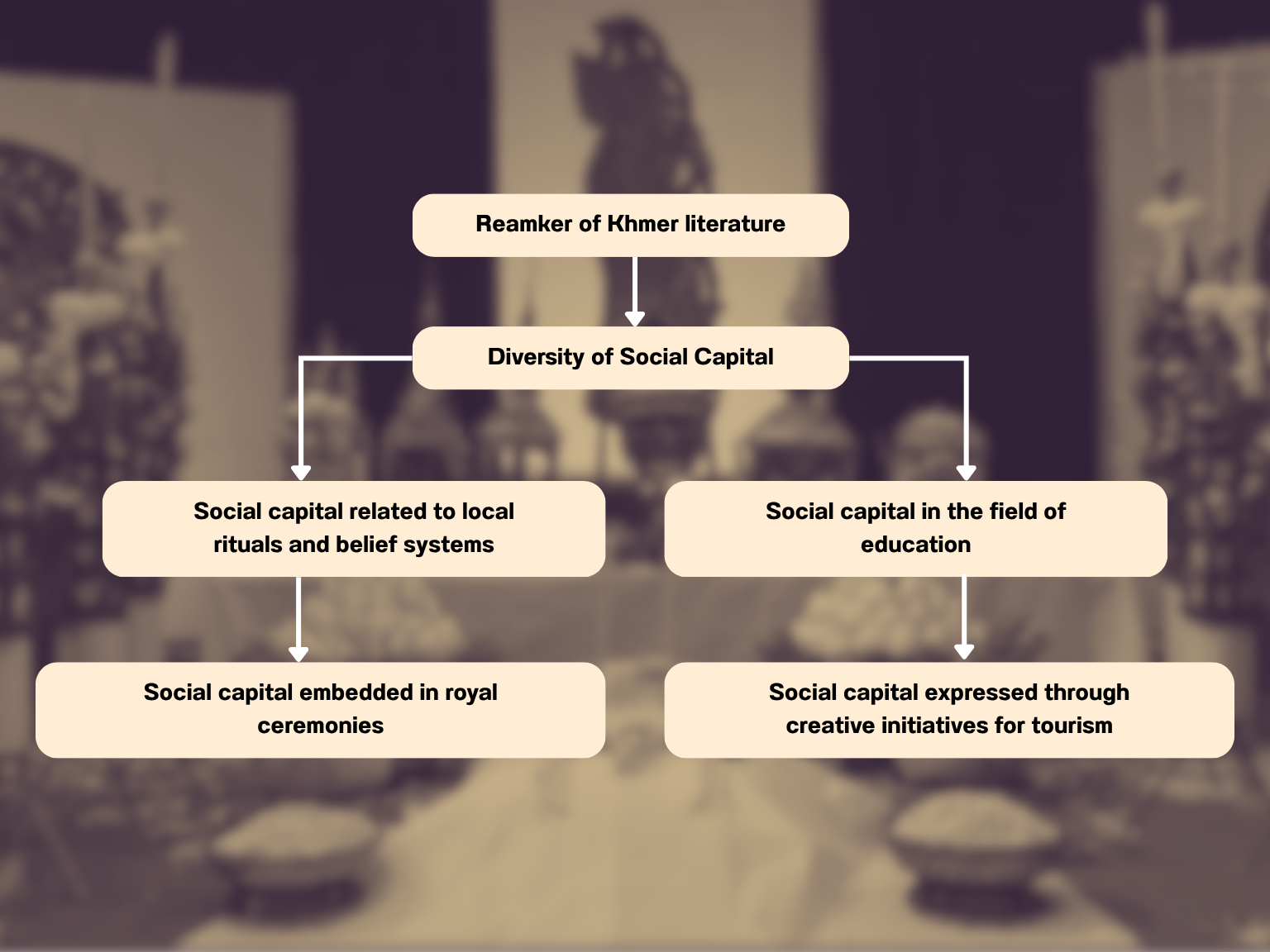
Results: Although Reamker originates from Indian literary traditions, its content is deeply localized, incorporating Khmer beliefs and socio-cultural values in a harmonious manner. This integration has made Reamker widely embraced by the Khmer people and recognized as one of the nation’s most important literary works. The findings of this study reveal that Reamker reflects four key aspects of the relationship with the social and cultural dimensions of the Khmer people: 1) social capital related to local rituals and belief systems, 2) social capital embedded in royal ceremonies, 3) social capital in the field of education, and 4) social capital expressed through creative initiatives for tourism.
Application of this study: This study of Reamker reveals its relationships to various dimensions, including local rituals and belief systems, royal ceremonies, education, and tourism. These can be applied as instructional media in teaching Khmer literature within academic institutions. Furthermore, they can be used to promote cross-cultural learning by comparing the similarities and differences between the Thai literary work Ramakien and the Khmer literary work Reamker from another perspective.
Conclusions: This study of the diversity of social capital from the Khmer literary work Reamker, through the conceptual framework of social capital, reveals the cultural meanings conveying the belief systems of the Khmer people well. This has contributed to the preservation and transmission of the Reamker literary work, which is evident in the traces of social and cultural lifestyles of the people from the past to the present.
Downloads
Article Details

This work is licensed under a Creative Commons Attribution-NonCommercial-NoDerivatives 4.0 International License.
References
Aum, C., & Others. (2015). Khmer Cultural Information Network, Issue 13. Cambodia: Yosothor. Retrieved 3 May 2025, from https://www.yosothor.org/udaya/No-13-2015.html.
Busaba, R. (2005). The Literary Art and the Reflection of Khmer Culture in Ramakerti, L’Institut Bouddhique Version, vol.1-10. Doctoral Dissertation, Ph.D. Department of Oriental, Silpakorn University, Thailand. (In Thai)
Channary, C., Wannakit, N., & Salee, B. (2025a). Figure 1 Conceptual Framework of Research.
Channary, C., Wannakit, N., & Salee, B. (2025b). Figure 9 Hanuman Beer.
Chuenka, R., Udomsilp, P., & Sujachaya, S. (2022). Beliefs and Rituals in Thai Society: Worship of “Chao Por Hanuman”. Mekong-Salaween Civilazation Studies Journal, 9(2), 121-141.
Department of Performing Arts. (2022). Asana worships the teacher in the ceremony before the performance. Retrieved 15 April 2024 from https://www.facebook.com/dpa.mcfacambodia?locale=zh_CN.
Department of Performing Arts. (2023). The ceremony to pay respect to the teachers of shadow puppetry and Khon. Retrieved 27 June 2024 from https://www.facebook.com/photo.phpfbid=781358164183397&set=pb.100069276606598.-2207520000&type=3&locale=zh_CN
Department of Performing Arts. (2022). The Khon Teacher Worship Ceremony. Retrieved 17 January 2024 from https://www.facebook.com/photo/fbid=502331331940533&set=pcb.502331688607164&locale=zh_CN
Ecotumbler Cambodia. (2022). Bamboo Water Bottle. Retrieved 29 December 2024, from https://www.facebook.com/EcotumblerCambodiaIII/photos/a.10316061189750/340344421512500/?type=3&_rdr
Hongsuwan, P. (2018). Look at Folklore from a Social Perspective. Bangkok: PaloThai Printing. (In Thai)
Jiamwichak, R. (2018). Thai Language Textbooks: Development from the Past to the Present. Pathum Thani: Thammasat University. (In Thai)
Khmer, T. (2004). Hanuman Tattoo on the Back. Retrieved 29 December 2024, from https://www.facebook.com/photo/fbid=917628063834080&set=a.508193111444246
Khongphianthum, C. (2015). An Analytical Study of Animal Symbols in Khmer Culture: The Existense and Change. Ubon Ratchathani: Ubon Ratchathani University. (In Thai)
Khongphianthum, C. (2013). Belief in Neak Ta in Khmer Society. Inthaninthaksin Journal, 7(2), 47-62. (In Thai)
Ministry of Education Youth and Sport. (2024). Khmer Literature Textbook, Mathayom 6 Level. Phnom Penh: Punish and Distribution House. (In Cambodia)
Naat, C. (1996). Dictionnaire Cambodgien. 5th ed. Phnom Penh: Buddhadhamma Graduate Institute. (In Thai)
Nathalang, S. (2015). Folklore Theory: Methodology for the Analysis of Legends and Folktales. 3rd ed. Bangkok: ChulaPress. (In Thai)
Pakdeekham, S. (2007). Royal Ceremony (Twatthatsamas) or Twelve-Month Ceremony of Cambodia, in the version celebrating the 55th anniversary of the establishment of diplomatic relations between Thailand and Cambodia (Part 2). Ministry of Foreign Affairs: Bangkok. (In Thai)
Petthongna, K. (2008). Thai Yantras Naming. Master Thesis, M.A. in Thai, Silpakorn University, Thailand. (In Thai)
Phdungchit, C. (2007). Culture, Communication and Identity. Chulalongkorn University Press: Bangkok. (In Thai)
Pich, T. (2001). Lakhon khon Performance. Phnom Penh: Buddhadhamma Graduate Institute. (In Cambodia)
Preap, C. (2013). The Royal Ceremony of Offering the Fire, the Body, the Sacred Reliquary, and the Sacred Place, Issue 18. Phnom Penh: Yosothor. (In Cambodia)
Preap, C. (2015). Khmer Cultural Information Network, Issue 14. Phnom Penh: Yosothor. (In Cambodia)
Preap, C. (2019). Wat Saway On Daed Khon Performance Group Sarika Kaew Subdistrict, Laveam District, Kandal Province. Retrieved 17 January 2024 from https://www.facebook.com/media/set/?set=a.2537580639798883&type=3
Reamker. (1996). Riem Kerliterature. 3rd ed. Phnom Penh: Buddhadhamma Graduate Institute. (In Cambodia)
Satchapant, R. (2011). Ramakien Encyclopedia. Bangkok: Saengdao. (In Thai)
Thitathan, S. (1979). Study of Ramayana: Diffusion in Folktales. Master Thesis, M.A. in Thai Language, Chulalongkorn University, Thailand. (In Thai)
Tubtim, S. (2017). A Comparative Study of TA MI CHAK Version of Khmer Reamakien and King Rama I Version of Ramakien. Master Thesis, M.A. in Thai, Silpakorn University, Thailand. (In Thai)
Tranet, M. (2005). Khmer Surin Culture: Magic Rules Series (Part 2), Phnom Penh: Kampuchea Surya. (In Cambodia)
