
Investigating Thai Local Secondary School English Teachers’ Perceptions of Climate Change and Its Classroom Teaching
Article Sidebar
Main Article Content
Abstract
Background and Objectives: Despite Thailand’s vulnerability to climate change, the topic is underrepresented in the national curriculum. This research investigated Thai local secondary school English teachers’ perceptions of climate change and the attitudes towards teaching this topic in the classroom. It explores whether the researcher’s training program, “Climate Awareness through English Classroom Activities,” which provides practical classroom strategies, enhances the linkage between climate change and human life, and indicates the possibility of instructional implementation, will be able to increase their willingness and confidence to teach this topic.
Methods: A two-day teacher training program, “Climate Awareness through English Classroom Activities,” was organized to collect data from 25 participants through a test, two questionnaires with open-ended items, an evaluation form, and personal interviews. This research employs a mixed-method approach. The quantitative data were analyzed using a 1–10 rating Likert scale, and percentages to interpret the responses. Descriptive statistics were used to summarize the quantitative findings. The qualitative data were analyzed through content-based interpretation.
Results: The results indicated that the teachers’ climate change knowledge was moderate, with an average score of 6.5 out of 10. While 96% believed they would be affected by climate change, only 27% could briefly identify its impacts. Nonetheless, all participants agreed on the importance of teaching climate change to secondary school students, demonstrating a positive attitude toward integrating the topic into English classrooms. They recognized climate change as a global issue requiring awareness. The training was reported to have positively influenced the teachers’ environmental perspectives and achieved a satisfaction rating of 4.7 out of 5. Additionally, 90% of the teachers reported a shift in their attitudes, attributing it to realizing that teaching climate change in English classrooms was less complex than they had initially thought.
Application of this study: The findings suggest that this kind of training projects can enhance English teachers’ perceptions and attitudes, as well as foster their confidence and willingness to teach climate change in the classroom. The data from these research results are beneficial to policymakers and educational strategists working to promote climate change awareness among students.
Conclusions: The findings suggest that tailored teacher training programs can significantly enhance English teachers’ perceptions of climate change and their confidence in teaching the topic. The positive shift in attitudes and increased willingness to integrate climate change into English classrooms highlight the potential for such training to effectively support climate change education. This study contributes to the development of climate change education in EFL contexts, offering practical guidelines in connecting environmental issues with English language instruction.
Downloads
Article Details

This work is licensed under a Creative Commons Attribution-NonCommercial-NoDerivatives 4.0 International License.
References
Beach, R., Share, J., & Webb, A. (2017). Teaching Climate Change to Adolescents: Reading, Writing, and Making a Difference. New York: Routledge. DOI: https://doi.org/10.4324/9781315276304
Beckett, G. H., & Slater, T. (2005). The Project Framework: A Tool for Language, Content, and Skills Integration. ELT Journal, 59(2), 108-116. DOI: https://doi.org/10.1093/eltj/cci024
Dal, B., & Others. (2015). An Analysis of the Teachers’ Climate Change Awareness. Athens Journal of Education, 2(2), 111-122. DOI: https://doi.org/10.30958/aje.2-2-2
Dawson, V. (2012). Science Teachers’ Perspectives About Climate Change. Teaching Science, 58(3), 8–13.
Chowdhury, M. T. A., & Others. (2021). How Do Teachers’ Perceptions of Climate Change Vary in Terms of Importance, Causes, Impacts and Mitigation? A Comparative Study in Bangladesh. Springer Nature Switzerland, 174(2021) https://doi.org/10.1007/s43545-021-00194-7 DOI: https://doi.org/10.1007/s43545-021-00194-7
Eckstein, D., Känzel, V., & Schäfer, L. (2021). Global Climate Risk Index 2021: Who Suffers Most from Extreme Weather Events? Weather-Related Loss Events in 2019 and 2000–2019. Germany: Germanwatch.
Ehui, S., & Rigaud, K. K. (2022). Climate Migration — Deepening Our Solutions. Washington, DC: World Bank.
Ghebreyesus, T. A., Jaber, S. A. A., & Kerry, V. (2023). We Must Fight One of the World’s Biggest Health Threats: Climate Change. Switzerland: World Health Organization.
International Energy Agency. (2021). Net Zero by 2050: A Roadmap for the Global Energy Sector. France: International Energy Agency. DOI: https://doi.org/10.1787/c8328405-en
IPCC. (2023). Climate Change 2023: Synthesis Report — Summary for Policymakers. Contribution of Working Groups I, II and III to the Sixth Assessment Report of the Intergovernmental Panel on Climate Change. Switzerland: Intergovernmental Panel on Climate Change. https://doi.org/10.59327/IPCC/AR6-9789291691647.001 DOI: https://doi.org/10.59327/IPCC/AR6-9789291691647.001
Herman, B. C., Feldman, A., & Vernaza-Hernandez, V. (2017). Florida and Puerto Rico Secondary Science Teachers’ Knowledge and Teaching of Climate Change Science. International Journal of Science and Mathematics Education, 15(3), 451-471. https://doi.org/10.1007/s10763-015-9706-6 DOI: https://doi.org/10.1007/s10763-015-9706-6
Manosorn, C., & Samiphak, S. (2022). Effect of inquiry instruction and games on students’ climate literacy. Journal of Education Naresuan University, 24(2), 75-84.
Micalay-Hurtado, M. A., & Poole, R. (2022). Eco-Critical Language Awareness for English Language Teaching (Elt): Promoting Justice, Wellbeing, and Sustainability in the Classroom. Journal of World Languages, 8(2), 371-390. https://doi.org/10.1515/jwl-2022-0023 DOI: https://doi.org/10.1515/jwl-2022-0023
Nunan, D. (2004). Task-Based Language Teaching. Cambridge: Cambridge University Press. DOI: https://doi.org/10.1017/CBO9780511667336
Nur, S., Anas, I., & Pilu, R. (2022). The Call for Environmentally-Based Language Teaching and Green Pedagogy: Climate Actions in Language Education. Elsya: Journal of English Language Studies, 4(1), 77-85. https://doi.org/10.31849/elsya.v4i1.9526 DOI: https://doi.org/10.31849/elsya.v4i1.9526
ONEP. (2015). Climate Change Master Plan 2015–2050. Bangkok: Office of Natural Resources and Environmental Policy and Planning.
Richards, J. C. (2006). Communicative Language Teaching Today. Cambridge: Cambridge University Press.
Sawaddee & Chiravate, (2025a). Figure 1 Responses to Identifying Climate Change Impacts.
Sawaddee & Chiravate, (2025b). Figure 2 Respondents’ Answers to Whether They Thought They Would Be Affected by Climate Change.
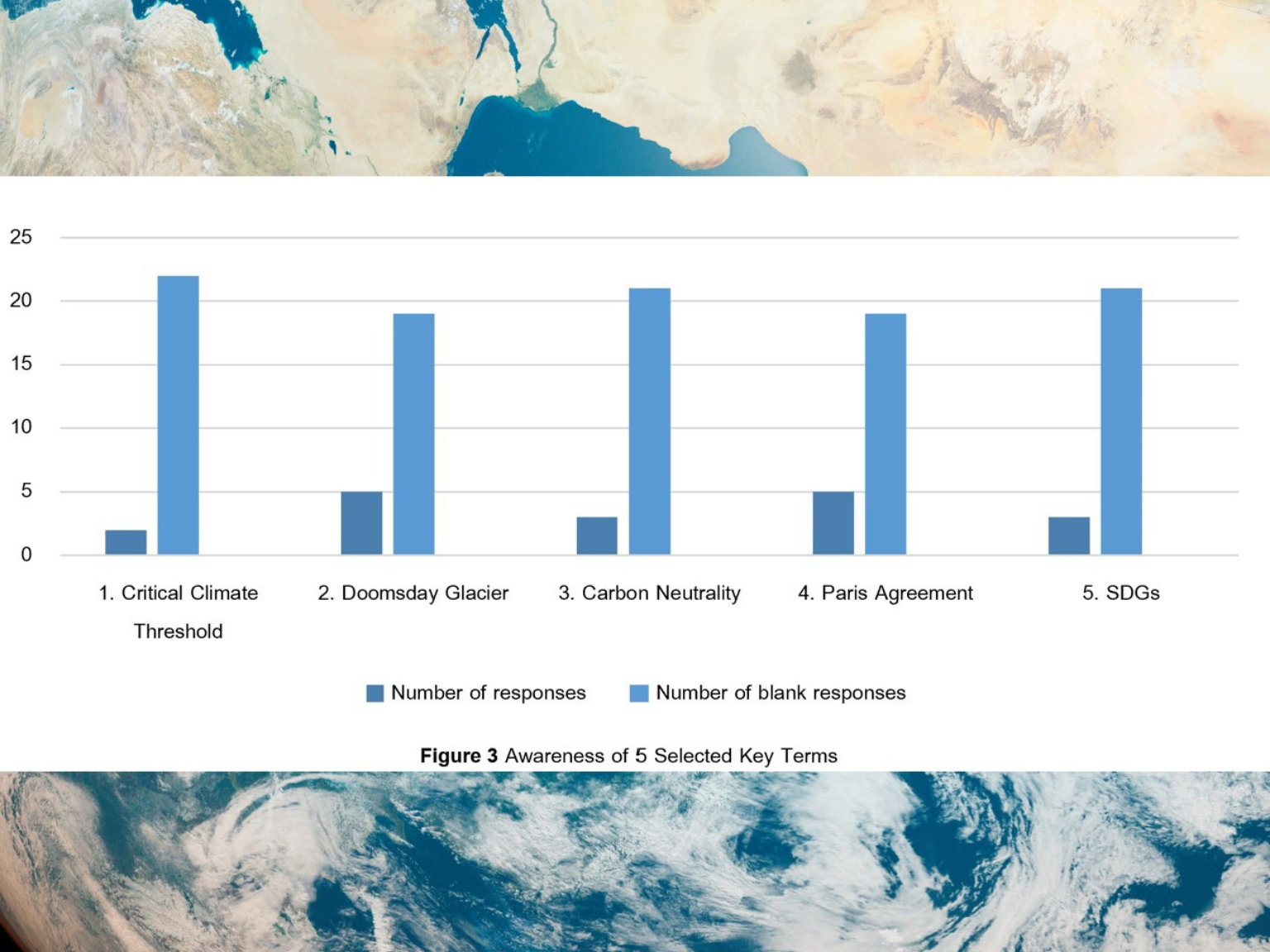
Sawaddee & Chiravate, (2025c). Figure 3 Awareness of 5 Selected Key Terms.
Sawaddee & Chiravate, (2025d). Figure 4 Percentage of Respondents With Classroom Materials Covering Climate Change.
Sawaddee & Chiravate, (2025e). Figure 5 Respondents’ Perceptions on the Possibility of Raising Environmental Awareness in the Classroom.
Sawaddee & Chiravate, (2025f). Figure 6 Respondents' Perceptions of What Could be Applied to Their Classroom From the Training.
Sawaddee & Chiravate, (2025g). Figure 7 Respondents With a Change of Attitude Towards Climate Change.
Sawaddee & Chiravate, (2025h). Figure 8 Percentage of Respondents With a Change of Attitude Towards Teaching Climate Change.
Sawaddee & Chiravate, (2025i). Figure 9 Respondents’ Interest in an English for Climate Change Book.
Seroussi, D.-E., & Others. (2019). Teachers’ knowledge, beliefs, and attitudes about climate change. International Education Studies, 12(8), 33-45. https://doi.org/10.5539/ies.v12n8p33 DOI: https://doi.org/10.5539/ies.v12n8p33
Silvhiany, S., Kurniawan, D., & Safrina, S. (2023). Climate Change Awareness in Elt: Ethnography in Connected Learning and Ecojustice Pedagogy. Journal of English Language Teaching Innovations and Materials, 5(2), 91-109. DOI: https://doi.org/10.26418/jeltim.v5i2.63548
Stoller, F. L. (2002). Content-Based Instruction: A Shell for Language Teaching or a Framework for Strategic Language and Content Learning?. TESOL Journal, 11(1), 36-42.
Supa, P., & Dasa, J. (2024). Development of Climate Change Awareness Measuring Instruments of Upper Secondary School Students. Journal of Educational Measurement, Mahasarakham University, 30(1), 124-142.
Titipongvanich, S., Viseshsiri, P., & Siribanpitak, P. (2020). Proposed school management strategies to strengthen the consciousness and practices of students to reduce global warming. Journal of Education Studies Chulalongkorn University, 48(3), 32-348. DOI: https://doi.org/10.58837/CHULA.EDUCU.48.3.20
UNESCO. (2016). Getting Climate-Ready: A Guide for Schools on Climate Action. Paris: United Nations Educational, Scientific and Cultural Organization.
UNESCO. (2021a). Berlin Declaration on Education for Sustainable Development. Paris: United Nations Educational, Scientific and Cultural Organization.
UNESCO. (2021b). UNESCO Declares Environmental Education Must Be a Core Curriculum Component by 2025. Retrieved 15 August 2024, from https://www.unesco.org/en/articles/unesco-declares-environmental-education-must-be-core-curriculum-component-2025
UNESCO. (2021c). Climate Science Literacy in Asia and the Pacific: Poster Series. Retrieved 15 August 2024, from https://knowledge.unasiapacific.org/our-work/knowledge-resources/climate-science-literacy-asia-and-pacific
UNESCO. (2023). Thailand: Climate Change Communication and Education. Retrieved 9 August 2024, from https://education-profiles.org/eastern-and-south-eastern-asia/thailand/~climate-change-communication-and-education
UNICEF. (2021). The Climate Crisis Is a Child Rights Crisis: The Impacts of Climate Change Through the Children’s Climate Risk Index. Retrieved 9 August 2024, from https://www.unicef.org/thailand/reports/climate-crisis-child-rights-crisis
UNDP. (2021). The Peoples’ Climate Vote. Retrieved 9 August 2024, from https://www.undp.org/publications/peoples-climate-vote#modal-publication-download
UNFCCC. (2022). Thailand’s long-term low greenhouse gas emission development strategy (Revised version). Retrieved 20 August 2024, from https://unfccc.int/sites/default/files/resource/Thailand%20LT-LEDS%20%28Revised%20Version%29_08Nov2022.pdf
UN Treaty Collection. (2016). Chapter XXVII: Environment-7-d: Paris Agreement. Retrieved 4 July 2024, from https://treaties.un.org/Pages/ViewDetails.aspx?src=TREATY&mtdsg_no=XXVII-7-d&chapter=27&clang=_en
U.S. Energy Information Administration (EIA). (2023). International Energy Outlook 2023. Retrieved 12 July 2024, from https://www.eia.gov/outlooks/ieo/narrative/index.php
Winter, V., Kranz, J., & Möller, A. (2022). Climate Change Education Challenges From Two Different Perspectives of Change Agents: Perceptions of School Students and Pre-service Teachers. Sustainability, 14(10), 6081. DOI: https://doi.org/10.3390/su14106081
Wise, S. B. (2010). Climate Change in the Classroom: Patterns, Motivations, and Barriers to Instruction Among Colorado Science Teachers. Journal of Geoscience Education, 58(5), 297-309. DOI: https://doi.org/10.5408/1.3559695
