
An Analysis of the Translation of Chinese Adverbial Modifiers with “地” into Thai Adverbial Modifiers using “อย่าง”: Based on the Hanyu Jiaocheng Textbook
Article Sidebar
Main Article Content
Abstract
Background and Objectives: The Thai equivalent of the Chinese adverb modifier “地” is “อย่าง”. However, previous studies have not addressed the issue of the possibility of translating Chinese adverbial modifiers with “地” into Thai adverbial modifiers using “อย่าง”, particularly based on authentic language use contexts, especially the examples from Chinese language textbooks for foreign learners. Therefore, this study aims to explore and analyze the translation of adverbial modifiers with “地” into Thai equivalents using “อย่าง”, based on the Hanyu Jiaocheng Chinese textbook as the primary source of data.
Methods: This research adopts a mixed-method approach, combining both quantitative and qualitative methods. A total of 195 phrases or sentences containing adverbial modifiers followed by “地” were collected from the Chinese language textbook Hanyu Jiaocheng. These examples were then analyzed to explore the situations in which such modifiers are translated into Thai adverbial modifiers using “อย่าง”.
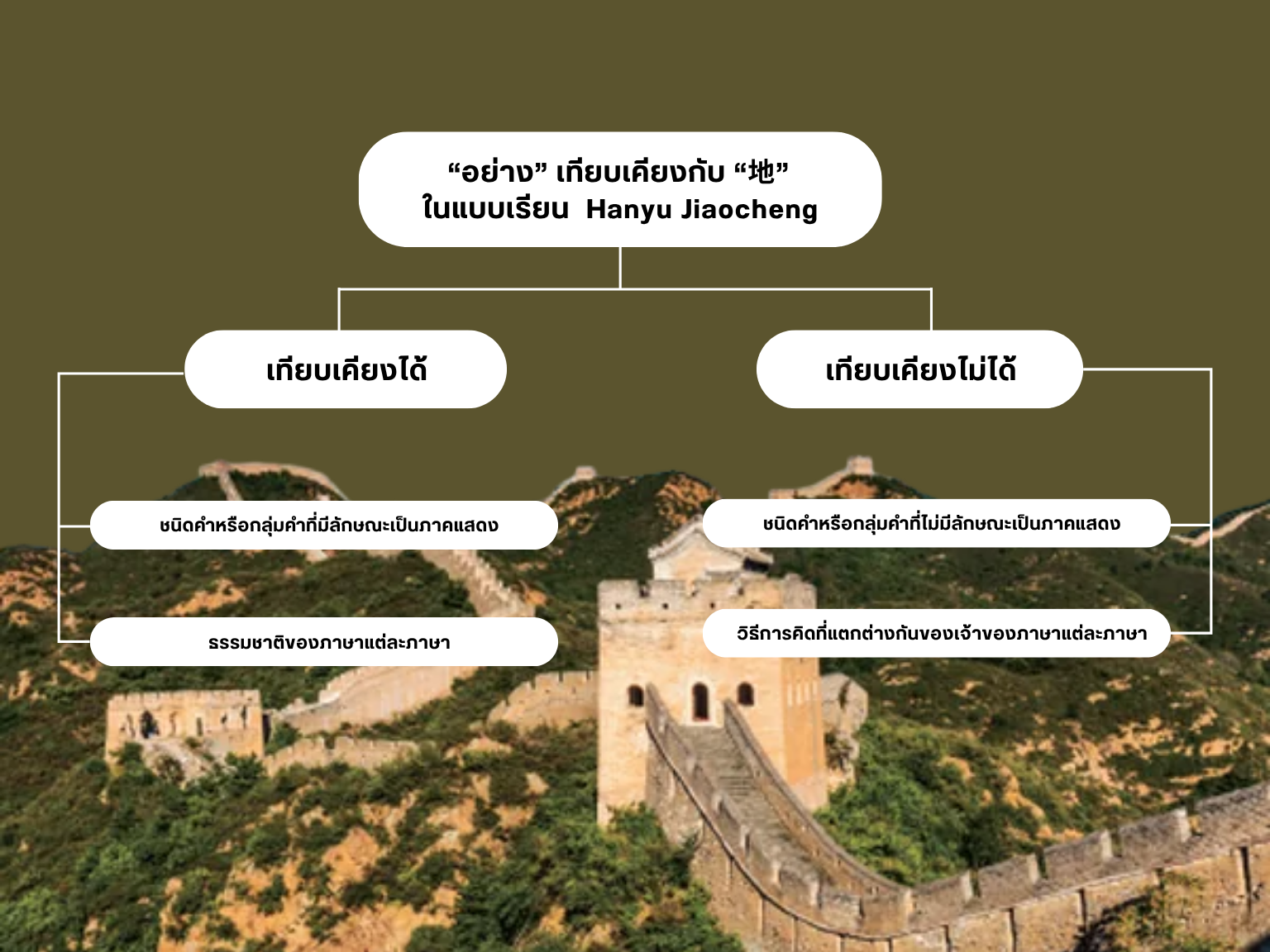
Results: The findings indicate that the examples can be categorized into two groups. Group 1 includes adverbial modifiers followed by “地” that can be translated into Thai using “อย่าง”, accounting for 79.49%. Group 2 includes those that cannot be translated with “อย่าง”, representing 20.51%. In the situations where translation is possible, the adverbial modifiers typically display predicate-like characteristics. In the cases where translation is not feasible, this is due not only to the absence of such characteristics, but also to differences in the cognitive logic of native speakers, leading to differences in language use. These include the meaning of words or phrases that function as adverbial modifiers, the semantic development of vocabulary, collocational patterns, and the strictness of the alignment between linguistic form and meaning.
Application of this study: The above results suggest that most examples from this textbook can be effectively translated using “อย่าง”. This supports positive language transfer in learning Chinese as a foreign language for Thai learners. Therefore, such translation can be applied in teaching and learning.
Conclusions: By utilizing the results of the comparative analysis—specifically identifying the Thai word “อย่าง” as a functional equivalent of the Chinese particle “地”—as a foundation, this study further explores the translation of adverbial modifiers containing “地” into Thai expressions introduced by “อย่าง”. The findings reveal that most examples from the Hanyu Jiaocheng textbook can be translated using this method. For the cases where direct equivalence is not applicable, two key factors are identified: 1) the types of adverbial modifiers used, and 2) the cognitive logic of native speakers. The above findings can help build more confidence among Chinese language instructors in using these translation strategies when teaching the structural particle for adverbial modifiers “地” and the adverbial modifiers followed by “地”. Moreover, they can provide more reasonable explanation of what factors affect the translation and suggestions for translating into other linguistic forms.
Downloads
Article Details

This work is licensed under a Creative Commons Attribution-NonCommercial-NoDerivatives 4.0 International License.
References
Amkid, S. (2024). A Study of Thai Sentences Compared to the Chinese “Adverbial Modifier + 地de + Verb” Construction Using Inventory Typology. Journal of Language and Linguistics, 42(2), 56-87. (In Chinese)
Amkid, S., & Kingkaew, Ch. (2025). A Comparative Study of the Semantic Role of the Chinese Adverbial Marker “地” and the Thai Adverbial Marker “อย่าง”. Journal of Humanities Naresuan University (in press). (In Thai)
Amkid, S., & Bavornpattanapak, M. (2025). Figure 1 Process of Transferring Language from First Language to Target Language.
Chen, J. M. (2005). A Comparative Study of Adverbials in Chinese and Thai. Master Thesis, M.A. in Linguistics and Applied Linguistics, Yunnan Normal University, China. (In Chinese)
Chinese Academy of Social Sciences, Institute of Linguistics. (2016). Xiandai Hanyu Cidian. [Modern Chinese Dictionary]. 7th ed. The Commercial Press. (In Chinese)
Deng, Sh. W. (2011). A Comparative Study of Adjectives and Adverbials in Chinese and Thai Languages. Master Thesis, M.A. in Chinese Linguistics, Huaqiao University, China. (In Chinese)
Department of Linguistics, Faculty of Arts, Chulalongkorn University. (2012). TNC: Thai National Corpus. 3rd ed. Retrieved 21 January 2025, from https://www.arts.chula.ac.th/ling/tnc3/
Ellis, R. (1999). The Study of Second Language Acquisition 第二语言习得研究. Shanghai: Shanghai Foreign Language Education Press.
Fan, L. L. (2019). Comparison of Chinese and English Adverbials and Research on Teaching Chinese Adverbials as a Foreign Language. Master Thesis, M.A. in Linguistics and Applied Linguistics, Shaanxi Normal University, China. (In Chinese)
He, F. X. (2019). Study On the Mark of Adverbials Between Chinese and Thai. Master Thesis, M.A. in Teaching Chinese to Speakers of Other Languages, Huaqiao University, China. (In Chinese)
Jiang, Zh. Q. (2008). Error Analysis and Research on Thai Students' Chinese Modifier Learning Based on Freshmen of Chinese Major in Mae Fah Luang University, Thailand. Master Thesis, M.A. in Linguistics and Applied Linguistics, Xiamen University, China. (In Chinese)
Liu, Y. H. (1983). Classification of Adverbials and Order of Multiple Adverbials. In J. M. Zhao, (Ed.). A New Perspective on Chinese Grammar Research, (pp. 261-285), Beijing: Beijing Language and Culture University Press. (In Chinese)
Lu, B. F. (2004). The Overall Characteristics and Functional Explanation of Chinese Word Order: From Topic Highlighting to Focus Highlighting. In the Linguistics Institute of Chinese Academy of Social Sciences, (Ed.). Collection of Academic Papers Celebrating the 50th Anniversary of the Founding of Chinese Language (pp. 28-38). Beijing: The Commercial Press. (In Chinese)
Luo, F. L. (2010). Study and Comparison of The Syntax of Chinese and Laos. Master Thesis, M.A. in in Asian and African Linguistics and Literature, Guangxi Normal University, China. (In Chinese)
Pinno, K. (2008). Functions of “DE” in Chinese-Language Newspapers Issued in Thailand. Master Thesis, M.A. in Linguistics, Chulalongkorn University, Thailand. (In Thai)
Ritthaporn, B. (1969). Adverbs in the Thai Language. Master Thesis, M.A. in Thai Language, Chulalongkorn University, Thailand. (In Thai)
Wasinanon, N. (2016). The Study of Thailand’s Systematic Chinese Teaching Management if Higher Education. Chinese Studies Journal, 9(2), 263-287. (In Thai)
Wang, J. Y. (2009). Declarative and Descriptive: Two Types of Adjectives as Adverbial. Chinese Teaching in the World, (4), 26-32+146-147. (In Chinese)
Wang, S. H. (2008). A Comparative Study of the Word Order of Attributes and Adverbials in Chinese and Thai Languages. Master Thesis, M.A. in Linguistics and Applied Linguistics, Xiamen University, China. (In Chinese)
Wang, W. Q. & Li, L. W. (2023). Analysis of Bias of Structural Particle “De” in Thai Students. Hans Publishers, 11(10), 4702-4712. (In Chinese)
Wei, Y. J. (2023). An Analysis of Equivalence of Thai Adverbial Markers and the Chinese Word “de 地” from Three Linguistic Aspects: A Case of 21 Modern Chinese Novels and Their Corresponding Thai Translations. In N. Meechaiyo, (Ed.). Chinese Study Book Chapter40, (pp. 1-22). Chiangrai: Sirindhorn Chinese Language and Culture Center Mae Fah Luang University. (In Chinese)
Yan, R. Y. (2020). Research on the Origin of Modern Chinese Frequency Adverbs. Master Thesis, M.A. in Chinese Linguistics, Jiangxi Normal University, China. (In Chinese)
Yan, X. Y. (2009). The adverbial modifier comparison between Chinese and Thai. Master Thesis, M.A. in Education, Beijing Language and Culture University, China. (In Chinese)
Yang, J. Zh. (2016). Hanyu Jiaocheng. [Chinese Course]. Vol. 1-3. 3rd ed. Beijing: Beijing Language and Culture University Press. (In Chinese)
Zhang, W. X. (2016). Research on the Cognitive Structure of Chinese Syntax (Revised Edition). Shanghai: Academia Press. (In Chinese)
