
Evolution of Riverside Commercial Districts in the Central Region of Thailand
Article Sidebar
Main Article Content
Abstract
Background and Objectives: Several riverside commercial districts in Thailand were once prosperous and the centers of development in those areas. Now, they are quiet, in a state of urban shrinkage, and seeing shops close. Most of the people in these areas are elderly due to the emergence of new commercial districts along the roads. This article aims to study the evolution of riverside commercial districts in the central region of Thailand to identify the factors that cause changes in the districts.
Methods: The researcher studied and analyzed the physical aspects of the towns, the use of rivers, the forms, and the commercial roles of the districts.
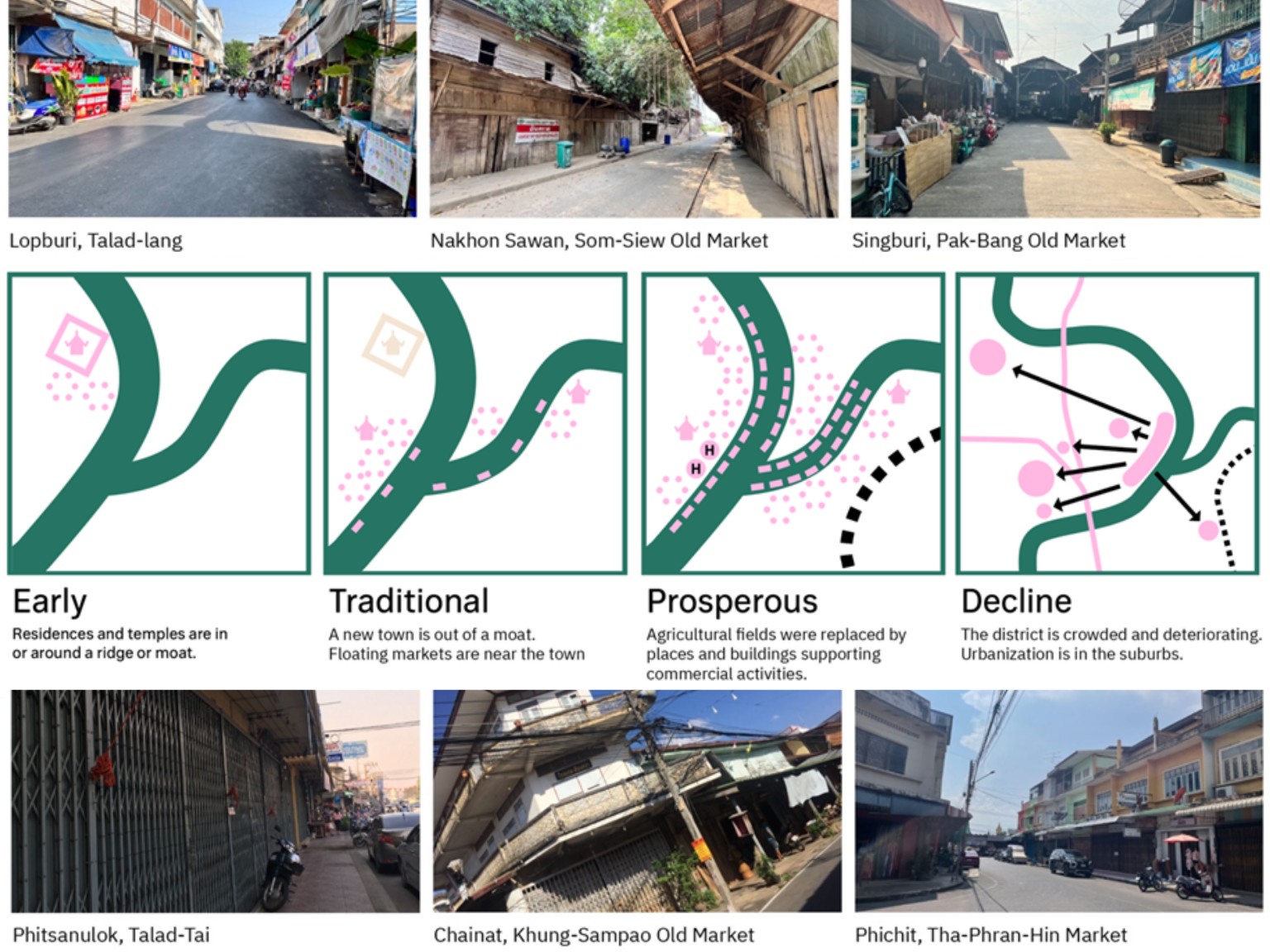
Results: The evolution of the riverside commercial districts in the central region can be divided into five periods: 1) the early period from the Dvaravati to Sukhothai, 2) the traditional or feudal period from the Ayutthaya to the early Rattanakosin, 3) the prosperous or free trade period, the raft-boat trading quarters and the riverside commercial districts from the reign of King Rama IV until 1957, 4) the decline or industrial period after the Chao Phraya Dam was in operation, and 5) the revival period or the riverside commercial districts under the concept of the creative economy. The factors affecting the change in the role of the riverside commercial districts in the central region district are politics, transportation, environment, natural disasters, the economy, and society.
Application of this study: This article is useful for those interested in cultural capital, local history and wisdom, architecture, urban planning, and creative design. It can be used to further develop creative work, tourism activities, cultural communication, and the creative economy, for example, applying the information to writing novels and designing scenes for films and animations.
Conclusions: The influx of outsiders and the evolving needs of local residents have driven the transformation of the riverside commercial districts. If a district lacked effective planning, management, and governance to solve environmental, natural disasters, economic pressures, and societal problems, its residents may begin to seek opportunities from new commercial locations, possibly leading to the deterioration of the old districts, leaving them shrunken or abandoned. These phenomena have always occurred through history, but nowadays, new commercial areas are usually not located along the rivers.
Downloads
Article Details

This work is licensed under a Creative Commons Attribution-NonCommercial-NoDerivatives 4.0 International License.
References
th Anniversary Celebration Organizing Committee. (1982a). Chotmaihet Kan Anurak Krung Rattanakosin. [Chronicle of the Conservation of Rattanakosin]. Bangkok: Sahaprachaphanit. (In Thai)
th Anniversary Celebration Organizing Committee. (1982b). Sinlapa Watthanatham Thai Lem Thi Sam: Khanop Thamniam Prapheni Lae Watthanatham Krung Rattanakosin. [Thai Arts and Culture Volume 3: Traditions and Culture of Rattanakosin]. Bangkok: Fine Arts Department. (In Thai)
Angkurawatcharaphan, A. Srithong, S., & Tanthet, A. (2016). Cultural Landscape Management to Communicate Local Wisdom for Cultural Tourism in the Central Chao Phraya River Basin (Sub-Project 2): Complete Research Report. Pathum Thani: National Science and Technology Development Agency. (In Thai)
Carta, M. (2012). Waterfronts Between Sicily and Malta: An Integrated and Creative Planning Approach. PortusPlus, 3, 1-9.
Damrong Rajanubhab. (1972). Chum-num Phra Niphon Bang Rueang. [Collection of Some Royal Writings]. Bangkok: Thammasat University Press. (In Thai)
Fine Arts Department. (1934). Pra-chum Charuek Sayam Phak Thi Nueng Charuek Krung Sukhothai. [Siamese Inscriptions Conference, Part: Sukhothai Inscriptions]. Phra Nakhon: Phrachan Printing House. (In Thai)
Google Maps. (2025a). Figure 3 Ancient Towns in the Dvaravati and Sukhothai Period. Retrieved 20 May 2025, from https://www.google.com/maps
Howkins, J. (2001). The Creative Economy. U.K.: Penguin.
Jiwakul, K., & Others. (1982). Markets in Bangkok: Expansion and Development. Bangkok: Chulalongkorn University.
(In Thai)
Kanchanakpan, S. (1968). Prawat Kan Kha Thai. [History of Thai Trading]. Phra Nakhon: Thai Chamber of Commerce. (In Thai)
Kanokphongchai, A. (2007). Withi Chin–Thai Nai Sangkhom Siam. [The Chinese-Thai Way of Life in Siamese Society]. Bangkok: Matichon. (In Thai)
Kaosol, N. (2019). “The Transformation of the Thai Economic Systems of Trading from Sukhothai period until Early Rattanakosin Period.” Chophayom Journal, 30(1), 83-94. (In Thai)
Khun Wichitmatra. (1966). Song Fang Lam Nam Chao Phraya. [Both sides of the Chao Phraya River]. Phra Nakhon: Phrachan Printing House. (In Thai)
Khunsong, S. (2015). Maritime Trade with China and Middle East Region in Dvaravati period. Veridian E-Journal, Silpakorn University, 8(2), 2526-2545. (In Thai)
Khunsong, S. (2014). The International Trade in Dvaravati Period: Aspect of the Archaeology of Nakhon Pathom. Silpakorn University Journal, 34(1), 9-29. (In Thai)
Khuttranon, S. (1985). Ekkasan Kiao Kap Prawattisat Mueang Nakhon Sawan Thi Kep Raksa Yu Nai Ho Samut Haeng Chat. [Documents about the history of Nakhon Sawan City kept in the National Library]. In S. Ocharoen (Ed.), Nakhon Sawan: A central state, proceedings of the seminar on the history and local culture of Nakhon Sawan Province (pp. 151-166). Nakhon Sawan: Witthaylai Khru Nakhon Sawan. (In Thai)
Mektrirat, N. (1985). Rup Baep Thang Kan Mueang, Kan Pokkhrong Lae Kan Thahan Chak Adit Chon Thueng Patchuban. [Political, Administrative and Military from the Past to the Present]. In S. Ocharoen (Ed.), Nakhon Sawan: A Central State, Proceedings of the Seminar on the History and Local Culture of Nakhon Sawan Province, (pp. 427-446). Nakhon Sawan: Witthaylai Khru Nakhon Sawan. (In Thai)
Chiamsripong, S. (1985). Chumchon Chin Lae Kan Toepto Thang Kan Kha Nai Changwat Nakhon Sawan. [The Chinese community and commercial growth in Nakhon Sawan Province]. In S. Ocharoen (Ed.), Nakhon Sawan: A Central State, Proceedings of the Seminar on the History and Local Culture of Nakhon Sawan Province, (pp. 213-224). Nakhon Sawan: Witthaylai Khru Nakhon Sawan. (In Thai)
Nartsupha, C. (2020). Setthakit Mu Baan Thai Nai Adit. [The Thai Villages Economy in the Past]. Bangkok: On Demand Printing. (In Thai)
Pallagoix, J. B. (2009). Stories of Siam. San T. Komonbutr (Trans.). Bangkok: Sripanya. (In Thai)
Phumthani, T. (2003). Tourist Industry. Bangkok: Ramkhamhaeng University. (In Thai)
Pinwanich, P., & Mallikamalai, S. (2012). Wangkrot Historic District: Reinterpreting History towards Design Intervention. NAJUA: History of Architecture and Thai Architecture, 9(2012), 187-214. (In Thai)
Pongajarn, C., Van der Duim, R., & Peters, K. (2016). Floating Markets in Thailand: Same, Same, but Different. Journal of Tourism and Cultural Change, 16(2), 109-122. https: //doi.org/10.1080/14766825.2016.1253704
Princess Maha Chakri Sirindhorn Anthropology Centre. (n.d.). Chansen-Chansen Museum. Retrieved 20 October 2024, from https://communityarchive.sac.or.th/community/Chansen (In Thai)
Princess Maha Chakri Sirindhorn Anthropology Centre. (2012a). King Ramkhamhaeng's Inscription, Side 1. Retrieved 20 October 2024, from https://db.sac.or.th/inscriptions/inscribe/image_detail/48 (In Thai)
Princess Maha Chakri Sirindhorn Anthropology Centre. (2012b). King Ramkhamhaeng's Inscription, Side 2. Retrieved 20 October 2024, from https://db.sac.or.th/inscriptions/inscribe/image_detail/49 (In Thai)
Rattanarungsikul, P. (2012). The Research Study of Dvaravati Lead and Lead Alloy Artifacts. Doctoral Dissertation, Ph.D. in Historical Archaeology, Silpakorn University, Thailand. (In Thai)
Rattanawaraha, A. (2020). Shrunk Cities. Retrieved 1 October 2024, from https: //www.the101.world/shrunk-cities/
(In Thai)
Rianthong, S., & Pangkesorn, A. (2025a). Figure 1 The Central Provinces of Thailand.
Rianthong, S., & Pangkesorn, A. (2025b). Figure 8 Shrines Near the Riverside Commercial Districts.
Rianthong, S., & Pangkesorn, A. (2025c). Figure 9 Commercial Districts Along the Riverside and Railway.
Rianthong, S., & Pangkesorn, A. (2025d). Figure 10 Riverside Commercial Districts in Central Region of Thailand.
Rianthong, S., & Pangkesorn, A. (2025e). Figure 11 Creative Activities in Riverside Communities and Commercial Districts.
Rianthong, S., & Pangkesorn, A. (2025f). Figure 12 Evolution of Community Maps of Nakhon-Sawan City.
Rianthong, S., & Pangkesorn, A. (2025g). Figure 12 Evolution of Riverside Commercial Districts in Central Region of Thailand.
Royal Irrigation Department. (1957). Thi Raluk Nai Kan Pert Khuean Chao Phraya Jed Kumpha Phan Song Pan Ha Roy. [Souvenir of the Opening of the Chao Phraya Dam, 7 February 1957]. Bangkok: Royal Irrigation Department. (In Thai)
Saranukromthai. (n.d.). Kitjakarn Pa Mai Sak Nai Adit. [Teak Forestry Business in the Past]. Retrieved 20 October 2024, from https://saranukromthai.or.th/oldchild/1282?utm_source=chatgpt.com (In Thai)
Sawangchot, W. (2018). Utsahakam Thang Watthanatham Kap Setthakit Sangsan. [Industry and Creative Cultural Economy]. Bangkok: Phap-Phip Press. (In Thai)
Skinner, G. W. (2021). Chinese Society in Thailand: An Analytical History. Bangkok: Matichon. (In Thai)
Songsiri, W. (2021). Laksana Doi Thammachat Khong Saphap Phumichat Sam Liem Pak Maenam Chao Phraya. [The natural characteristics of the Chao Phraya Delta geography]. Lum Nam Chao Phraya Rak Ngao Haeng Sayam Prathet. [Chao Phraya River Basin, the Roots of Siam], (pp. 63–72). Bangkok: Lek-Prapai Viriyaphan Foundation. (In Thai)
Songsiri, W. (2021). Khao, Suan Phonlamai Lae Suan Phak : Kan Phaw Pluk Phuet Setthakit Mueang Bangkok. [Rice, Fruit and Vegetable Gardens: Cultivation of Economic Crops in Bangkok]. Lum Nam Chao Phraya Rak Ngao Haeng Sayam Prathet. [Chao Phraya River Basin, the Roots of Siam], (pp. 153–206). Bangkok: Lek-Prapai Viriyaphan Foundation. (In Thai)
Songwanpong, S., & Kosolkanchan, K. (2016). Decoding the Charoen Krung Creative District, the First Proto-Type Creative Area of Thailand. Bankok: Creative Thailand, August. (In Thai)
Sriwichien, K., Keeratiboorana, Y., & Soungsaweng, W. (2015). The Decline of Local Riverside Markets in Suphanburi Province, Thailand. Asian Culture and History, 7(1), 49-52. (In Thai)
Suphachaturas, R., & Panin, O. (2014). Pattern of Fresh Market in Siam and in Suphanburi Province. Veridian E-Journal, Silpakorn University, 7(2), 1595-1610. (In Thai)
Thaiarry, P. (2005). Sukhothai Kings and the Care of Economic Activities: The Context of Thai State Enter-Prises in the Past. Journal of Social Sciences, 36(1), 58-84. (In Thai)
The Fine Arts Department. (n.d.). Mueang Boran Samai Thawarawadi. [An Ancient Town from the Dvaravati Period]. Retrieved 20 October 2024, from https://www.finearts.go.th/main/view/31461-เมืองโบราณสมัยทวารวดี (In Thai)
The National Archives of Thailand. (1906a). Paknam-Pho market along Ping River in Nakhon-Sawan. Retrieved 20 May 2025, from https://archives.nat.go.th/
The National Archives of Thailand. (1906b). Paknam-Pho market along Nan River in Nakhon-Sawan. Retrieved 20 May 2025, from https://archives.nat.go.th/
Throsby, D. (2001). Economics and Culture. UK: Cambridge University Press.
Hutangkura, T. (2014). A New Interpretation of the Boundary of Dvaravati Shoreline on the Lower Central Plain. Damrong Journal, 13(1), 11-44. (In Thai)
Vallipodom, S. (2021). Sangkhom Lum Maenam Chao Phraya : Phatthana Kan Lae Kan Plianplaeng. [Society in Chao Phraya River Basin: Development and Change]. Lum Nam Chao Phraya Rak Ngao Haeng Sayam Prathet. [Chao Phraya River Basin, the Roots of Siam] (pp. 101–152). Bangkok: Lek-Prapai Viriyaphan Foundation. (In Thai)
Vallipodom, S. (2021). Kan Khat Sati Thang Watthanatham (Culture shock) Nai Sangkhom Thai Lang Nam Tuam Yai. [Culture shock in Thai society after the great flood]. Lum Nam Chao Phraya Rak Ngao Haeng Sayam Prathet. [Chao Phraya River Basin, the Roots of Siam], (pp. 19–32). Bangkok: Lek-Prapai Viriyaphan Foundation. (In Thai)
Vallipodom, S. (2011). Phatthana Kan Thang Sangkhom-Watthanatham Thai. [Thai social and cultural development]. Bangkok: Muang Boran. (In Thai)
Wongrujirawanich, S. (2019). Sonthana Kap Doktor Piriya Boonchaiphreuk Rueang Yan Kao Lao Mai Lae Kan Plaeng Mueang Doi Khri-e-thip Chon. [Talk With Dr. Peeriya Boonchaipruk About the Old Neighborhoods, New Stories and Urban Transformation by Creative People]. Retrieved 9 September 2019, from https: //kooper.co/th-conversation-on-city-gentrification (In Thai)
Public Relations Group Office of Fine arts Department. (n.d.). Samanora pond, Lopburi province. Retrieved 1 October 2024, from https://www.finearts.go.th/promotion/view/15322- (In Thai)
Finearts Kamphaeng Phet Historical Park. (n.d.). The City Walls and Wooden Bridge of Kamphaeng Phet. Retrieved 1 October 2024, from https: //www.finearts.go.th/kamphaengphethistoricalpark/view/39677-กำแพงเมืองและสะพานไม้ของเมืองกำแพงเพชร (In Thai)
Vajirayana. (n.d.). Chotmai Rayathaang Pai Phitsanulok. [Letter of Distance to Phitsanulok]. Retrieved 1 October 2024, from https://vajirayana.org/จดหมายระยะทางไปพิษณุโลก/จดหมายระยะทางไปพิษณุโลก (In Thai)
La Loubère. (1693). A New Historical Relation of the Kingdom of Siam. London: F.L. for Tho. Horne.
Mouhot, H. (1864). Travels in the central parts of Indo-China (Siam), Cambodia, and Laos (Vol. 1). UK: John Murray.
UWM Libraries Digital Collections. (1937a). Nakhon Sawan Changwat (Thailand), local market in Bang Pak Krit. Retrieved 20 May 2025, from https://collections.lib.uwm.edu/digital/collection/agsphoto/id/18157/rec/51)
UWM Libraries Digital Collections. (1937b). Nakhon Sawan Changwat (Thailand), city street. Retrieved 20 May 2025, from https://collections.lib.uwm.edu/digital/collection/agsphoto/id/18055/rec/24)
UWM Libraries Digital Collections. (1937c). Nakhon Sawan Changwat (Thailand), logs on Ping River at the Royal Forest Department. Retrieved 20 October 2024, from https://collections.lib.uwm.edu/digital/collection/agsphoto/id/18053/rec/1)
UWM Libraries Digital Collections. (1937d). Nakhon Sawan Changwat (Thailand), rice boats on the Chao Phraya River. Retrieved 20 October 2024, from: https://collections.lib.uwm.edu/digital/collection/agsphoto/id/18046/)
UWM Libraries Digital Collections. (1937e). Uthai Thani Changwat (Thailand), street vendors at Uthai Thani market. Retrieved 20 October 2024, from https://collections.lib.uwm.edu/digital/collection/agsphoto/id/18033/rec/2)
UWM Libraries Digital Collections. (1938). Taphan Hin (Thailand), bank of the Nan River Archive. Retrieved 20 October 2024, from https://collections.lib.uwm.edu/digital/collection/agsphoto/id/1200/rec/1)
Wrenn, M. (1983). Urban Waterfront Development. Washington, D.C.: Urban Land Institute.
