
The Khao Wong Phrachan Temple Fair: Creation and Roles in Contemporary Thai Society
Article Sidebar
Main Article Content
Abstract
Background and Objectives: Khao Wong Phrachan is a significant tourist attraction in Lopburi. Every year, during the third lunar month (Makha Bucha Day), the Khao Wong Phrachan Temple Fair is held for locals and tourists to pay homage to the Buddha’s footprint, and this festival has continued from the past to the present. This research aims to study the concepts behind the creation of the Khao Wong Phrachan Temple Fair within the context of contemporary Thai society, the factors affecting the changes of this festival, and the roles of the festival in contemporary Thai society.
Methods: This qualitative research collected data through semi-structured interviews, observations, and document analysis with a total of 11 key informants from the community in Huai Pong subdistrict, Khok Samrong district, Lopburi province. They were selected using purposive sampling, and the snowball or chain sampling method was also used to reach further informants. The data analysis was based on the concept of creative folklore and the role of folklore.
Results: The findings showed three issues. 1) There were five concepts in the organizing of the Khao Wong Phrachan Temple Fair in contemporary Thai society. They included: 1.1 the integration of traditional cultural capital with new creativity, 1.2 the accommodation of multiculturalism and the blending of beliefs, 1.3 the transformation of sacred spaces into sites of creative tourism, 1.4 the reconstruction of rituals within the framework of traditional beliefs, and 1.5 the collaborative integration of stakeholders across various sectors. 2) There were five factors involved in changes in the festival’s organization, which were: 2.1 the organizers, 2.2 the objectives of the event, 2.3 the activity formats, 2.4 the sacred objects or amulets, and 2.5 the public relations. 3) There were four roles of the Khao Wong Phrachan Temple Fair, which were: 3.1 reinforcing cultural beliefs and societal values, 3.2 studying and disseminating knowledge, 3.3 regulating society, and 3.4 providing entertainment.
Application of this study: This research expands the scope of creative folklore studies within the context of temple fairs in contemporary Thai society and contributes to enriching research on local traditions and belief systems in Lopburi. The findings offer in-depth insights into the factors shaping the structure and roles of the Khao Wong Phrachan Temple Fair. The data can be utilized to support cultural tourism management and community development initiatives.
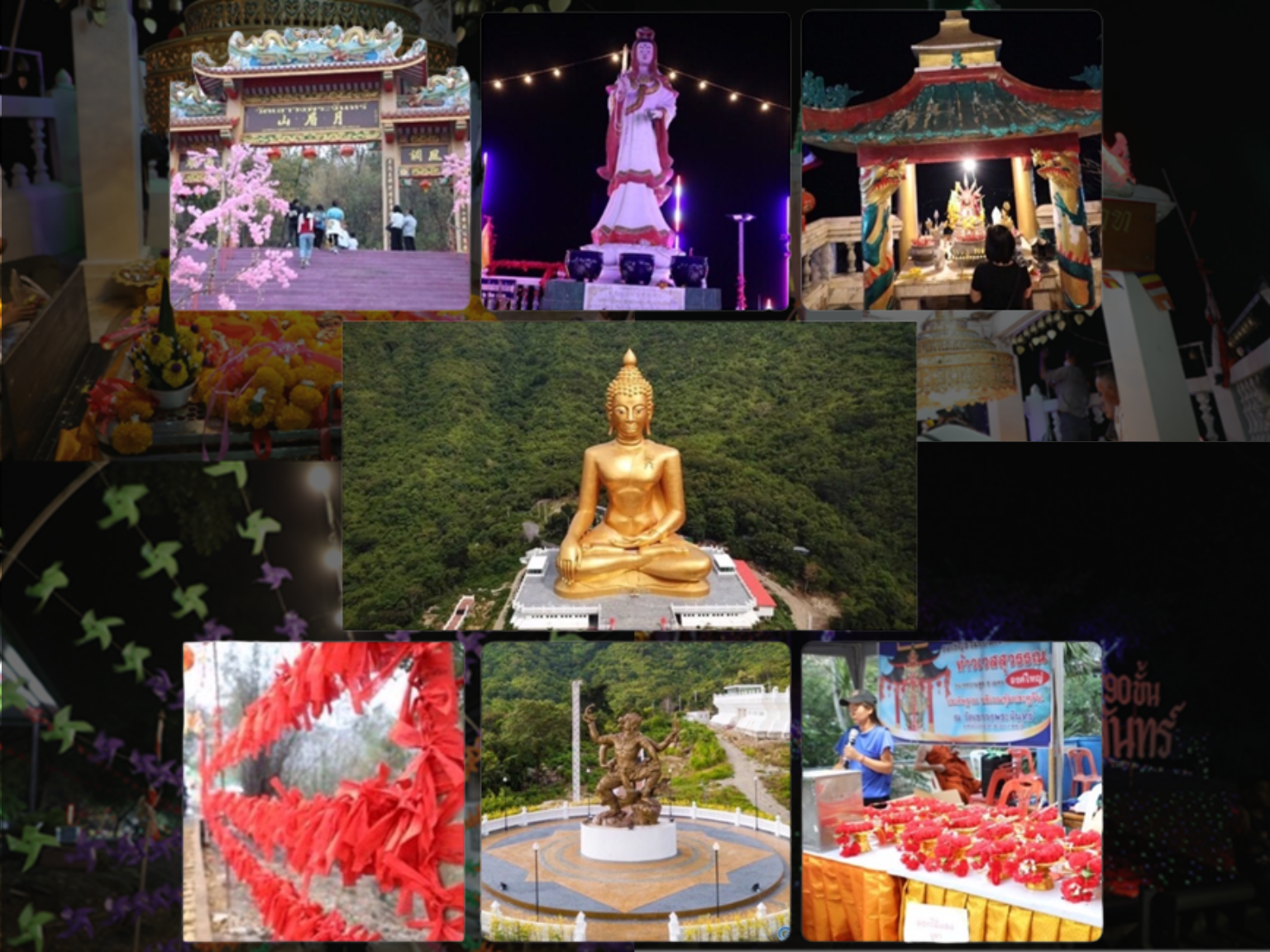
Conclusions: The central concept behind the organization of the Khao Wong Phrachan Temple Fair originates from the belief in “the veneration of the Buddha’s footprint”. Over time, this belief has been blended with Thai-Chinese beliefs, particularly those related to the Buddha’s footprints and the worship of deities on high mountains. The sacred site has gradually been developed into a tourism destination for the younger generation by creating new meanings within a changing social, economic, and technological context to align with the modern era and tourism. This reflects the Khao Wong Phrachan Temple Fair’s important role in preserving religious rituals and maintaining the social and local cultural structures of Lopburi in order to retain its own identity and traditional culture. At the same time, this can further enhance the progress of local communities.
Downloads
Article Details

This work is licensed under a Creative Commons Attribution-NonCommercial-NoDerivatives 4.0 International License.
References
Adari, R. A. S. F., & Elfira, M. (2021). The Changing Meaning of Taylagan Festival for Contemporary Russia Buryat Society: An Adaptation of Tradition. Simulacra, 4(2), 131-144. https://doi.org/10.21107/sml.v4i2.10527
Ananlayo, T. (2023, January 25). Interview. Monks. Wat Khaow Wong Phrachan Temple. (In Thai)
Chaiyen, N. (2023). The Khaow Wong Phrachan Mountain Temple Fairl: Creation and Roles in Contemporary Thai culture. Lopburi: Thepsatri Rajabhat University. (In Thai)
Creswell, J. W. (2018). Research Design: Qualitative, Quantitative, and Mixed Methods Approaches. 5th ed. Los Angeles: Sage.
Creswell, J. W., & Plano Clark, V. L. (2011). Designing and Conducting Mixed Methods Research. 2nd ed. Los Angeles: Sage.
Dörnyei, Z. (2007). Research Methods in Applied Linguistics. Oxford: Oxford University Press.
Hobsbawm, E., & Ranger, T. (Eds.). (1983). The Invention of Tradition. Cambridge: University Press.
Jaruworn, P. (2016). Folklore and Tourism: The Cultural Village of Nong Khao, Kanchanaburi Province. Bangkok: Academic work dissemination project Faculty of Arts Chulalongkorn University. (In Thai)
Chaiyen, N. (2023a). Figure 1 Mondop housing the Buddha’s footprint.
Chaiyen, N. (2023b). Figure 2 Buddha’s footprint on the summit of Khao Wong Phrachan.
Chaiyen, N. (2023c). Figure 3 The blending of Thai and Chinese beliefs.
Chaiyen, N. (2023d). Figure 5 Colorful windmill archway before ascending Khao Wong Phrachan.
Chaiyen, N. (2023e). Figure 6 Illuminated atmosphere on the summit of Khao Wong Phrachan.
Chaiyen, N. (2023f). Figure 8 Consecrated sand and amulets of Luang Pho Phak Phattachari.
Chaiyen, N. (2023g). Figure 9 Monks from other temples performing forehead anointing rituals for tourists.
Chanthasak, N. (2023, December 7). Interview. Policy and Planning Analyst, Tourism Authority of Thailand, Lopburi Province. (In Thai)
Kanchanapawong, M. (2011). Biography of Phra Mongkolpawanawikrom (Phak Phattachari) and the History of the Buddha’s Footprint on the Summit of Khao Wong Phrachan, Lopburi Province. n.p. (In Thai)
Klinchan, C. (2022). Cultural and Traditional Tourism Information System in Lopburi Province: A Virtual Reality Display for Senior Tourists. Research Journal Rajamangala University of Technology Srivijaya, 14(2), 497-512. (In Thai)
Likitsaran, N. (2016). Motivations and Behavior of Thai Tourists: Khok Samrong District, Lopburi Province. In N, Watchanathepin (Ed.). The 1st National Academic Conference, Rajamangala University of Technology Suvarnabhumi, (pp. 725-732), June 22, 2016, Ayutthaya, Thailand. (In Thai)
Na Thalang, S. (2016). Creative Folklore: A Synthesis and Theoretical Perspective. Bangkok: Anthropology Center Sirindhorn (Public Organization). (In Thai)
Na Thalang, S., & Jaruwan, P (2017). Drawing from the Past, Responding to the Present: Creative Folklore in Contemporary Society. Bangkok: Academic Dissemination Project Faculty of Arts, Chulalongkorn university. (In Thai)
Noikhlai, W., & Thambut, P. (2020). Tourism Potential and Sustainable Integrated Tourism Development in Lopburi Province, Thailand. Journal of Management Science Review, 22 (2), 109-120. (In Thai)
Nonta, J. (2019). South Korea’s Tourism Business and the Korean Wave Phenomenon (1997-2019). Retrieved 11 January 2024, from http://isas.arts.su.ac.th/wp-content/uploads/2562/history/05590737.pdf (In Thai)
Piamchit, S. (2023, July 3). Interview. Director of the Social Welfare Division, Huai Pong Subdistrict Administrative Organization Huai Pong, Koksamrong District, Lopburi Province. (In Thai)
Pinthuphan, H. (1972). Lopburi: A Province Worth Knowing. 2nd ed. Bangkok: Odeon Store. (In Thai)
Prakejitourthai. (2023). Figure 7 Consecrated sand and amulets of Luang Pho Phak Phattachari.
Prakejitourthai. (n.d.). Picture of Luang Pu Fak. Retrieved 11 January 2023, from http://prakejitourthai.com/ (In Thai)
Prueksakit, P., & Others. (1979). Lopburi. Bangkok: Bopit Printing. (In Thai)
Ruttanalum, W. (2013). Beliefs about the Buddha’s Footprint in Saraburi and the “Pai Phra Bat” Tradition in the Creation of Thai Literature. Master Thesis, M.A. in Thai Language, Chulalongkorn University, Thailand. (In Thai)
Selvi, A. F. (2019). Qualitative Content Analysis. In J. McKinley & H. Rose (Eds.), The Routledge Handbook of Research Methods in Applied Linguistics, (pp. 440-452). London: Routledge.
The Fine Arts Department. (1988). Collected Writings on Culture. Bangkok: Kurusapa Printing Ladphrao. (In Thai)
The Fine Arts Department. (2004). Rattanamongkolkhamchan. [Auspicious Meanings in The Buddha's Footprints]. Bangkok: The Fine Arts Department. (In Thai)
The Tourism Authority of Thailand. (2023). Figure 4 The advertisement of the Tourism Authority of Thailand.
Tourism Authority of Thailand. (2023). Khaow Wong Phrachan. [Temple/Mountain (Doi)]. Retrieved 11 January 2023, from https://thai.tourismthailand.org/Attraction/Khao Wong Phrachan (In Thai)
Tourism Authority of Thailand. Lopburi Province. (2017). Retrieved 11 January 2023, from https://www.facebook.com/TATLopburiOffice/?locale=hu_HU (In Thai)
Wat Luang Pho Ophasi. (2014). History of Khao Wong Phrachan. Retrieved 11 January 2023, from https://www.facebook.com/Watophasi (In Thai)
