
The Relationship between Linguistic Strategies and the Ideology of “Being a New Mother” on the Facebook Page “Khun Mae Luk On”
Article Sidebar
Main Article Content
Abstract
Background and Objectives: Modern women take on numerous roles comparable to those of men, including pursuing education and establishing careers in their chosen fields. However, one distinct role that sets them apart is motherhood, which encompasses conceiving, giving birth, and raising children. This responsibility remains a significant source of women’s value within both the family and society. This research aimed to examine the relationship between linguistic strategies and the ideology of “being a new mother” as shown on the Facebook page “Khun Mae Luk On”.
Methods: This research is a linguistic study employing a qualitative research method. Data were collected from the Facebook page “Khun Mae Luk On” between January 1 and December 31, 2023, totaling 124 posts. The data were analyzed using the critical discourse analysis (CDA) framework.
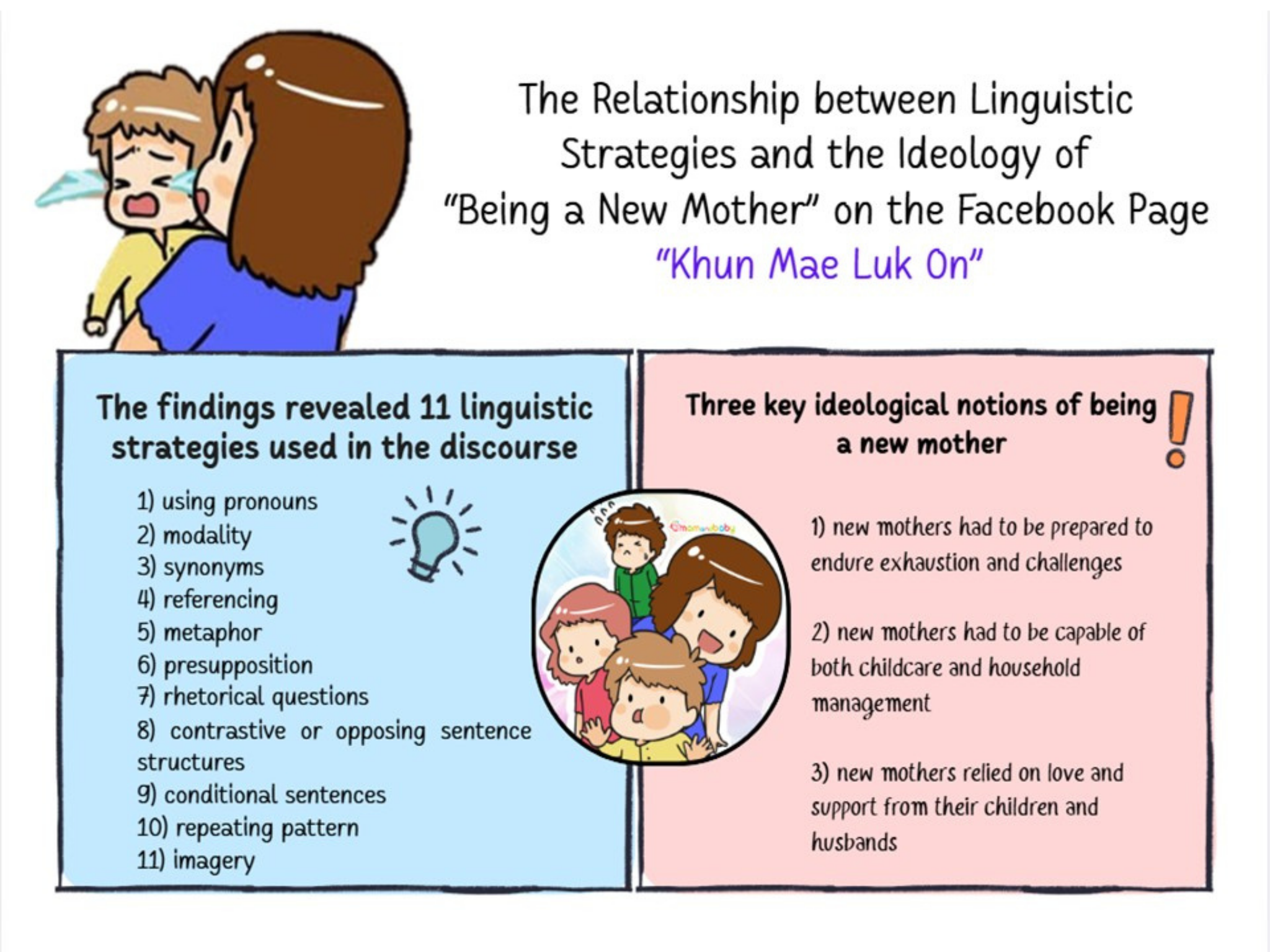
Results: The findings revealed 11 linguistic strategies used in the discourse: 1) using pronouns, 2) modality 3) synonyms, 4) referencing, 5) metaphor, 6) presupposition, 7) rhetorical questions, 8) contrastive or opposing sentence structures, 9) conditional sentences, 10) repeating pattern, and 11) imagery. These linguistic strategies conveyed three key ideological notions of being a new mother: 1) new mothers had to be prepared to endure exhaustion and challenges, 2) new mothers had to be capable of both childcare and household management, and 3) new mothers relied on love and support from their children and husbands. The processes and methods through which the text is produced and disseminated contribute to the transmission and reinforcement of ideas surrounding motherhood. These ideas become ingrained in societal beliefs and perceptions, forming an ideology that dictates, dominates, and perpetuates gender inequality. As a result, women are turned into social tools used to uphold and support the ideal of complete masculinity. Furthermore, the use of linguistic strategies on the Facebook page “Khun Mae Luk On” also reveals underlying business reasons.
Application of this study: Studying the relationship between linguistic strategies and ideology helped to understand the thought systems of people in the society. This, in turn, exposed how ideas, beliefs, and values were socially constructed and perpetuated, serving as a foundation for further critical discourse analysis.
Conclusions: These ideological notions were constructed, disseminated, and reinforced, shaping the societal expectation that women were responsible for childcare and household duties. These ideas have been reproduced within a patriarchal society, embedding a dominant ideology within the text, suggesting that, regardless of circumstances, women still require protection and care from men.
Downloads
Article Details

This work is licensed under a Creative Commons Attribution-NonCommercial-NoDerivatives 4.0 International License.
References
Alljitblog, (2022). Because the World Is Cruel, the New Generation Doesn’t Want to Have Children. Retrieved 18 April 2024, from https://url.in.th/rKtbA. (In Thai)
Bunwanno, C., & Prichakun, W. (2022). Ideology of “Housewives” in Maeban Magazine during 1977-2019. Rajabhat Rambhai Barni Research Journal, 16(2), 188-199. (In Thai)
Damnoensawat, S. (2012). Homographs. Retrieved 18 April 2024, from https://curadio.chula.ac.th/Images/Class-Onair/th/2011/th-2012-02-08.pdf. (In Thai)
Facebook Page “Khun Mae Luk On”. (2023). “Khun Mae Luk”. [Facebook Page “Khun Mae Luk On”]. Retrieved 15 August 2024, https://www.facebook. com/momand2baby. (In Thai)
Fairclough, N. (1995). Critical Discourse Analysis: The Critical Study of Language. London: Longman.
Fairclough, N. (1989). Language and Power. London: Longman.
Kaewjunkate, W. (2015). Linguistically Oriented CDA : An Approach for Studying Thai Advertisements. Journal of Humanities and Social Sciences Bansomdejchaopraya Rajabhat University, 9(1), 57-74. (In Thai)
Klaisingto, P. (2016). Language and Ideologies: Breastfeeding Discourse in Social Online. Journal of Language and Culture, 35 (special edition), 167-183. (In Thai)
Klinaon, A. (2020). Ideologies in Junior High Schools’ English Language Textbooks. Master Thesis. M.A. in Arts, Naresuan University, Thailand. (In Thai)
Kövecses, Z. (2002). Metaphor: A Practical Introduction. New York: Oxford.
Lakoff, G., & Johnson, M. (1989). Metaphors We Live By. Chicago: University of Chicago Press.
Longdo Dict. (2023). Mother With Her Infant. Retrieved 15 August 2024, from https://shorturl.asia/6eRhu. (In Thai)
Maneesai, C. (2010). The Use of Language for Effectivenes. Bangkok: Thammasat University Press. (In Thai)
Naksakun, K, (1997). Thai Pronouns Reflect Thai Culture. Retrieved 18 April 2024, from https://url.in.th/IeIww
Phakdeephasook, S. (2010). Discourse of Femininity un the Advertisements in Thai Health and Beauty Magazines. Bangkok: Thai Department Faculty of Arts, Chulalongkorn University. (In Thai)
Phanthumetha, N. (2006). Thai Grammar. Bangkok: Chulalongkorn University. (In Thai)
Phonpradapphet, P. (2018). “Motherhood” In the How-to Book. Journal of Humanities, Naresuan University, 15(2), 45-58. (In Thai)
Pollachom, T. (2017). “Women of Ayutthaya” Hidden Historical Things, Motherhood, Wifehood, and Humanity!. Asian Journal of Arts and Culture, 17(1), 157-164. (In Thai)
Pongudom, R. (2005). The Relationship Between Language and Values on Beauty : A Study of Advertising Discourse on Cosmetics in Thai. Master Thesis, M.A. in Linguistics, Chulalongkorn University, Thailand. (In Thai)
Punita. (2021). Emotions and Changes Prepare to Be a Mother of a Young Child. Retrieved 15 August 2024, from https://shorturl.asia/8hV6u. (In Thai)
Rocky journey. (2021). A Review of A Mother's Life. Retrieved 15 August 2024, from https://www.facebook.com/ photo/?fbid=1263960973983889&set=a.746067232439935. (In Thai)
theAsianparent. (2023). Family Life. Retrieved 15 August 2024, from https://th.theasianparent.com/treat-baby-is-hard.
(In Thai)
The Department of Health. (2018). Breast Milk, Real Benefits From Nature. Retrieved 15 August 2024, from https://multimedia.anamai.moph.go.th/help-knowledgs/benefits-of-breastfeeding/. (In Thai)
Tamdee, P. (2016). The Path of Breast Milk: Identity of Modern Working Mothers and Difficulties in Motherhood. Journal of Social Research and Review, 39(1), 1-38. (In Thai)
Thiensawangchaiand, S., & Noyjarean, N. (2023). Mother: A Refletion of Motherhood Portrays in the Language and Concept of Thai People. Nakhon Lampang Buddhist College’s Journal, 12(2), 17–30. (In Thai)
Thongphumprueaksa, K. (2018). Presentation of Motherhood in Children’s Books in Thailand. Journal of Journalism, 11(2), 113. (In Thai)
Supanchanaburee, W., Thammachoto, J., & Khumkhiam, A. (2022). Linguistic Strategies in Financial Discourse of Money Coach. In Hatyai University. (Eds.), The 13th Hatyai National and International Conference, Hatyai University, (pp. 304-318), May 12, 2022, Hatyai University. (In Thai)
Suvattanavanich, P. (2007). Woman and Motherhood In Thai Novels, 1967-2003. Retrieved 15 August 2024, from https://doi.nrct.go.th/ListDoi/listDetail?Resolve_DOI=10.14457/CU.the.2007.717. (In Thai)
Van Dijk, T. A. (1998). Ideology: A Multidisciplinary Approach. London: Thousand Oales.
Van Dijk, T. A. (2006). Discourse and Manipulation. Discourse and Society, 17(2), 357-383.
