
Challenges of Pronouncing and Applying Thai Tone Rules Faced by Vietnamese Learners
Article Sidebar
Main Article Content
Abstract
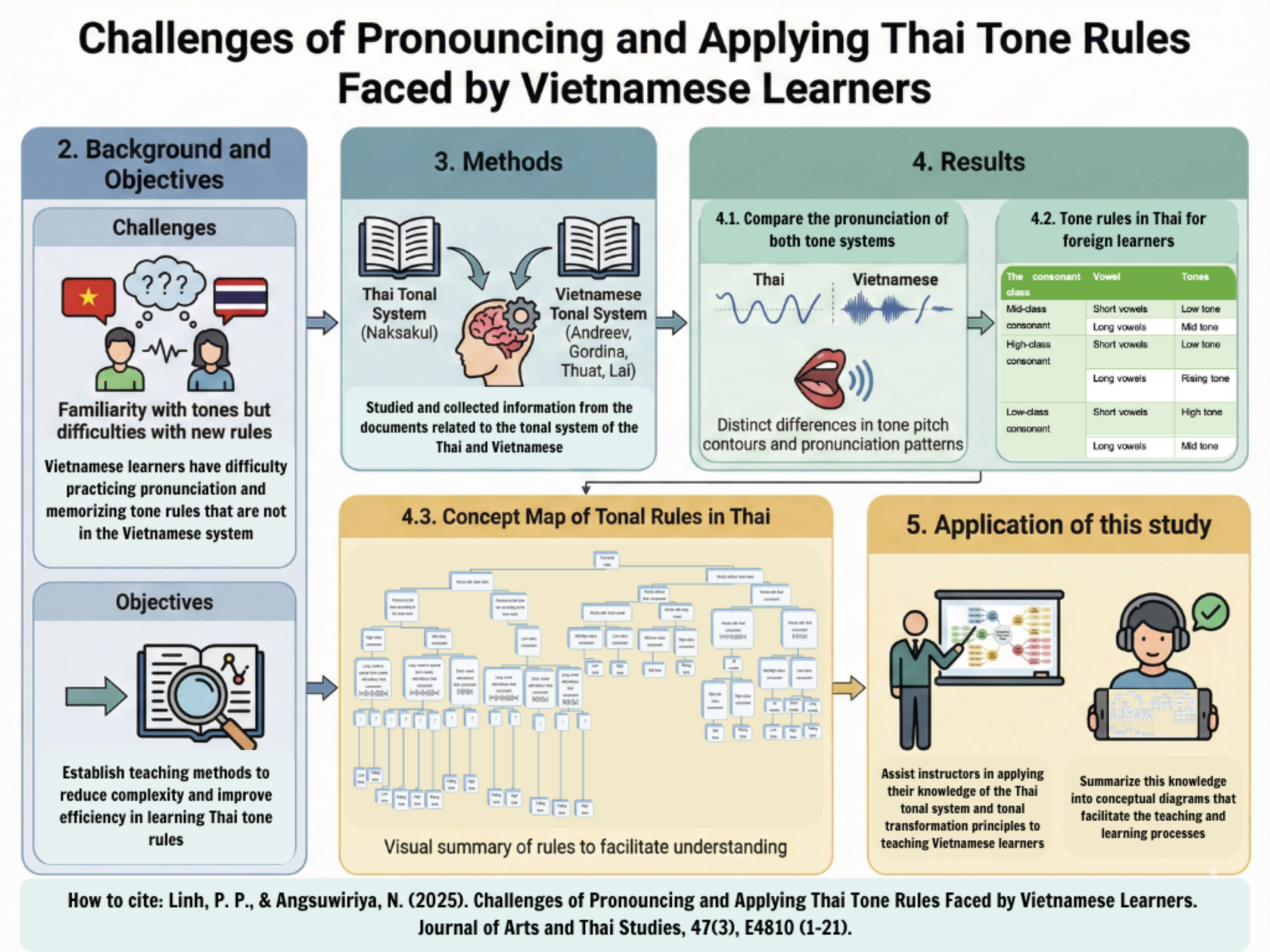
Background and Objectives: Thai is considered as a foreign language for Vietnamese learners. Developing the teaching of Thai as a foreign language plays an important role in economic, tourism, and educational contexts. However, foreign learners often encounter significant obstacles in learning Thai, particularly its tonal system, which is a crucial factor affecting word meaning. Generally, this obstacle poses a significant challenge for learners whose native language lacks a tonal system, often resulting in difficulties in pronunciation and in distinguishing tonal variations. In the case of Vietnamese learners, although they are familiar with tonal systems, they still encounter difficulties in practicing pronunciation and memorizing tonal rules that do not exist in the Vietnamese phonological system. Moreover, mastering tonal rules also requires an understanding of the structural components of the Thai language, such as the “triyang” (consonant classes), vowels, and final consonants, which presents a considerable challenge. For this reason, it is essential to establish teaching approaches that reduce the complexity of learning and enable learners, particularly Vietnamese students, to more easily understand and retain tonal rules, thereby improving their effectiveness in Thai pronunciation.
Methods: The researcher studied and collected information from the documents related to the tonal system of the Thai language, as presented by Kanchana Naksakul, and the tonal system of the Vietnamese language, as presented by Andreev and Gordina, Doan Thien Thuat, and Nguyen Tuong Lai. Based on the principles of Thai tonal rules according to standard Thai grammar, the researcher collected relevant knowledge, conducted comparative analyses, and employed a descriptive-analytical method to present the findings. Furthermore, a conceptual diagram illustrating the principles of Thai tone rules for Vietnamese learners was constructed to facilitate understanding.
Results: The tonal systems in Thai and Vietnamese share both similarities and differences. Thai has four tone markers and five tonal realizations, whereas Vietnamese has five tone markers and six tonal realizations. The similarities between the two languages can be observed in their tonal sounds. However, there are clear differences, such as the nga tone in Vietnamese and the falling tone (tho) in Thai, which are entirely dissimilar in both tonal contour and articulation. This indicates that Vietnamese learners may find it easier to learn the pronunciation of Thai tones compared with learners from countries without a tonal system. In order for learners to accurately distinguish and produce word tones, it is necessary to understand the fundamental knowledge of the triyang principle, vowels, and final consonants. The most important factors are the concepts of “live” and “dead” syllables, which are related to the pronunciation of tone-marked words in Thai. Vietnamese learners often have difficulty memorizing the tonal transformation rules or producing the falling tone in Thai, as Vietnamese does not have tone variations conditioned by initial consonant classes as found in Thai. In addition, the tonal transformation rules in Thai can be thoroughly explained according to the triyang principle, which classifies the number of tone markers and tonal realizations based on the consonant class. The use of conceptual diagrams to summarize knowledge about Thai tonal transformations helps learners understand the material more clearly and reduce confusion. Furthermore, it facilitates review and systematic organization of knowledge, which forms the foundation for studying more complex linguistic concepts. Such methods also enable teachers to explain and connect knowledge about tonal systems more effectively.
Application of this study: This article aims to assist instructors in applying their knowledge of the Thai tonal system and tonal transformation principles to teaching Vietnamese learners. It also seeks to summarize this knowledge into conceptual diagrams that facilitate the teaching and learning processes. These diagrams are intended to facilitate learning for both teachers and learners in the study of Thai and Vietnamese tonal rules.
Conclusions: Teaching the Thai tonal system to Vietnamese students poses significant challenges due to the differences in tonal structures between Thai and Vietnamese. Although both languages are tonal, they differ in tonal features and tonal transformation rules, especially in Thai where tonal changes depend on the initial consonants. This aspect is absent in Vietnamese. Various pedagogical approaches can be used to explain Thai tonal transformation rules. For instance, the use of minimal pairs can help learners distinguish subtle tonal contrasts at a phonemic level, while network diagrams or mapping techniques can assist in organizing and reinforcing tonal knowledge. Additionally, concept mapping supports learners in summarizing and systematically reviewing Thai tonal transformation rules. Choosing an appropriate instructional approach depends on the learner group and the specific content to be conveyed, with the goal of making tonal principles clearer, easier to retain, and more applicable in real-life communication.
Downloads
Article Details

This work is licensed under a Creative Commons Attribution-NonCommercial-NoDerivatives 4.0 International License.
References
Anansapsuk, O. (2021). Thai Language Is Not as Easy as People Think: Why Do Foreigners Find It Confusing?. Retrieved 25 February 2025, from https://www.sti.chula.ac.th/knowledge/2936/ (In Thai)
Andreev, N. D., & Gordina, M. V. (1957). Sisttema tonov vjetnamskogo jazyka. [The system of tones of the Vietnamese language]. Vetsnik Leningradskolo Gosudarstvennogo Universiteta: Serija Istorii, Jazyka i Literatury [Vestnik of Leningrad State University: History, Language, and Literature Series], 8, 132-148. (In Russia)
Chi, N. T. V. (2006). A Comparative Study of Acoustic Charateristics of Thai Tones Spoken by Vietnamese According to Language Experiences. Master Thesis, M.A. in Arts (Thai), Srinakharinwirot University, Thailand. (In Thai)
Hoa, N. D. (1966). Speak Vietnamese. Rutland, Vermont: Tuttle Co.
Juyaso, A. (2017). Read Thai in 10 Days. n.p.
Kowtrakun, S. (2016). Educational Psychology. 12nd ed. Bangkok: Chulalongkorn University Press. (In Thai)
Kusalasai, R. (1973). Thai Language, Part 2: Language Principles (A Subject in the Teacher Certification Curriculum for Secondary School Teachers Under the Teachers’ Council of Thailand). 3rd ed. Bangkok: Kurusapa Business Organization. (In Thai)
Lai, N. T. (2014). He thong thanh dieu tieng Thai Lan. [Thai Language’s Toning System]. Journal of Language and Life. 8(226), 66-71. (In Vietnamese)
Lai, N. T. (2018). Ngu am tieng Thai Lan trong su so sanh voi Tieng Viet. [Thai Phonetics in Comparison With Vietnamese]. Scientific Journal of Tan Trao University, 4(8), 15-20. (In Vietnamese)
Leelapornpinit, S. (2016). A Comparative Study of Thai and Chinese Phonology for the Use of Basic Thai Language as a Foreign Language. Sutthiparithat Journal, 30(93), 33-46. (In Thai)
Linh, P. P., & Angsuwiriya, N. (2025). Figure 4 Concept Map of the Tonal Rules in Thai.
Naksakul, K. (2016). Thai Phonological System. 8th ed. Bangkok: Academic Publishing Project, Faculty of Arts, Chulalongkorn University. (In Thai)
Phechtburi, N., & Punkhoom, W. (2017). Thai Language Teaching in Cambodia. RMUTT Suvarnabhumi Academic Journal (Humanities and Social Sciences), 2(1), 57–68. (In Thai)
Plaengsorn, R. (2017). The science of Teaching Thai as a Foreign Language. 4th ed. Bangkok: Chulalongkorn University Press. (In Thai)
Saksiriphol, D. (1998). Sounds in The Thai Language. 2nd ed. Bangkok: Srinakharinwirot University. (In Thai)
Srichampa, S. (1994). Vietnamese Pronunciation: Linguistic Approach. Nakhon Pathom: Institute of Language and Culture for Rural Development, Mahidol University. (In Thai)
Sudhinont, J. (2024). Teaching Tones to Foreigners Learning the Thai Language. Academic Journal of Humanities and Social Sciences, Sisaket Rajabhat University, 8(2), 21-45. (In Thai)
Thonglor, K. (1997). Thai Language Principles. 10th ed. Bangkok: Amarin Printing. (In Thai)
Thuat, D. T. (2007). Ngu am Tieng Viet. [Vietnamese Phonetics]. Hanoi: Vietnam National University Publishing House. (In Vietnamese)
Upakitsilpasarn, Phraya. (1990). Principles of The Thai Language. Bangkok: Thaiwattanapanich Printing House (In Thai)
Uttamang, S. (2009). Components of Language. Retrieved 25 February 2025, from https://curadio.chula.ac.th/Images/Class-Onair/th/2009/th-2009-08-13.pdf (In Thai)
Watanasawad, K. (1997). Coustic Characteristics of Tones in Vietnamese Stressed and Unstressed Syllables. Master Thesis, M.A. in Art in Linguistics, Chulalongkorn University, Thailand. (In Thai)
