
One Song, Seven Languages: An Analysis of the Process of Creating Singable Translations of “Dao Aksorn” (Star of Arts) Using Peter Low’s Pentathlon Approach
Article Sidebar
Main Article Content
Abstract
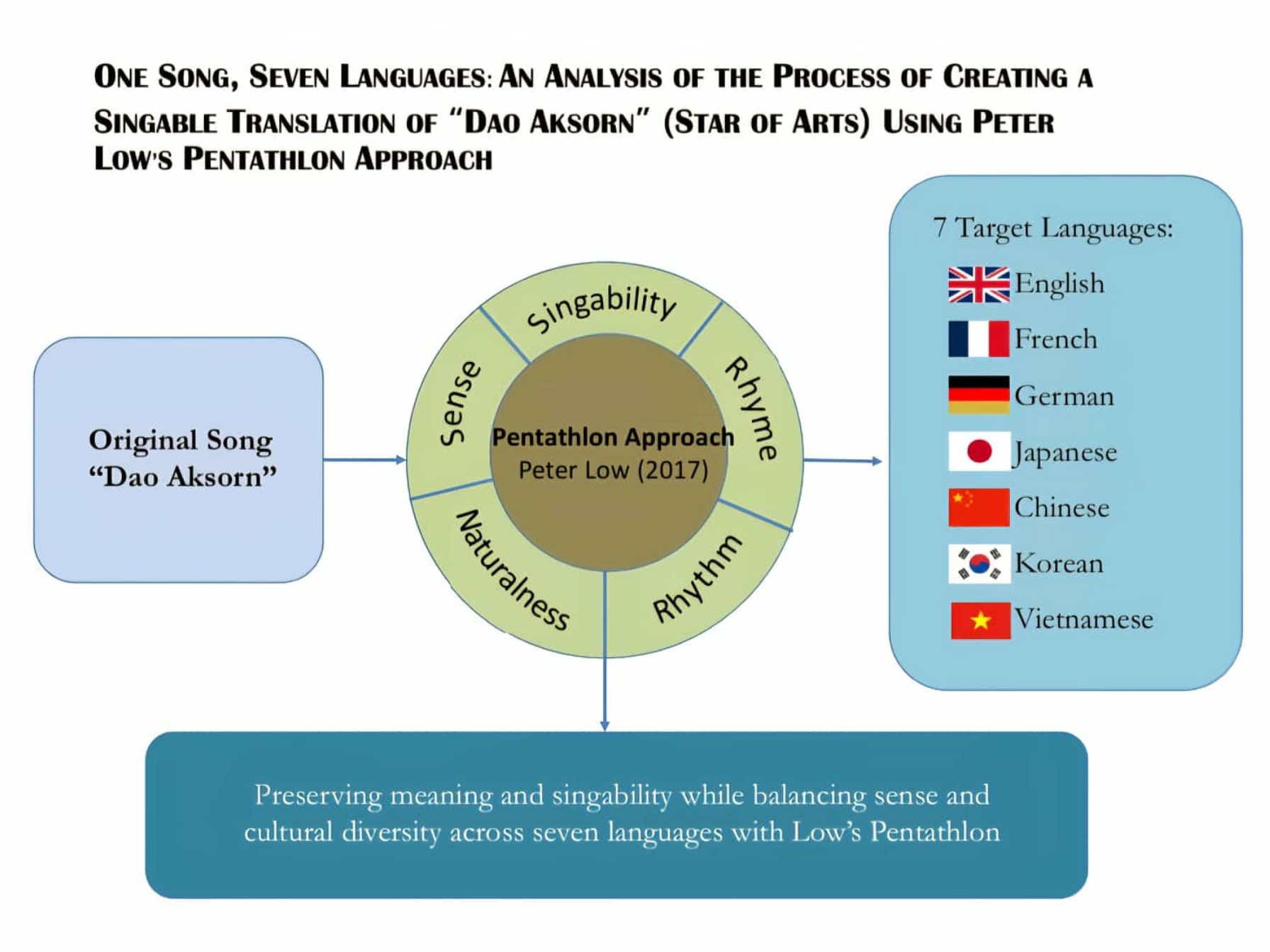
Background and Objectives: Peter Low’s Pentathlon has been widely used for singable song translation. However, no comparison among using this approach for more than one target language at the same time has been studied. The objectives of this research are twofold: 1) to describe and analyze the process of creating singable translations of the Thai song “Dao Aksorn” (Star of Arts) adhering to Peter Low’s Pentathlon Approach (singability, sense, naturalness, rhythm, rhyme) while also considering the unique features of each target language; and 2) to compare these seven translations examining similarities and differences within the framework of the aforementioned translation approach.
Methods: The data for this research consist of the Thai original lyrics and the song’s translations in seven languages: English, French, German, Japanese, Chinese, Korean, and Vietnamese. The research methodology involves an analysis of the translation process and the explanatory commentary for each target language, using word-for-word semantic transfer and back-translation as guidelines for comparison.
Results: The findings demonstrate the effectiveness of the Pentathlon Approach. Each translation addressed this principle to varying degrees. Notably, all translations maintained the song’s meaning and singability as the two most important aspects. During the translation process, synonyms were utilized along with the omission and addition of some words. This reflects an academic approach that prioritizes linguistic accuracy over considerations of rhythm, which may hold greater significance in a performance-oriented musical context.
Application of this study: The body of knowledge derived from this research has practical implications for teaching song translation in these target languages and can be further developed to promote Thai songs by translating them into foreign languages.
Conclusions: This study examines the application of Peter Low’s five principles of song translation—singability, sense, naturalness, rhythm, and rhyme—in translating the song “Dao Aksorn” into seven target languages: English, French, German, Japanese, Chinese, Korean, and Vietnamese. The research aimed to analyze the translation process and compare the translated versions within a shared theoretical framework. The findings demonstrate the effectiveness of the Pentathlon Approach in producing singable translations across typologically diverse target languages.
Downloads
Article Details

This work is licensed under a Creative Commons Attribution-NonCommercial-NoDerivatives 4.0 International License.
References
Apter, R., & Herman, M. (2016). Translating for Singing: The Theory, Art and Craft of Translating Lyrics. London: Bloomsbury Publishing.
Attaviriyanupap, K. (2015). Singable Song Lyrics Translation: Problems in Translating Thai Country Songs into German. Journal of Silpakorn University, 35(3), 115-147. (In Thai)
Attaviriyanupap, K., & Others. (2024). “Star of Arts” Across Languages: An Analysis of Singable Song Translation from a Typological Perspective. Journal of Arts and Thai Studies, 46(1), E2579 (1–24). (In Thai)
Bilge, S. (2024). Song Types and Song Translation in Musical Theater: The Case of Grease the Musical. Conservatorium, 11(2), 694-708. https://doi.org/10.26650/CONS2024-1577917
Buddawong, N., & Numtong, K. (2021). Strategies of Adapting Chinese Songs into Thai Songs: a case study of Suwanna Chanakan’s Bilingual Love Song Album of Chinese-Thai Volume 4. Lawarath Social E-Journal, 2(2), 95–116. (In Thai)
Do, T. U. (2019). A Study on Translating Lyrics of Some Common English Songs Into Vietnamese. Bachelor’s thesis, B.A. in English Language, Hai Phong Private University, Vietnam.
Franzon, J. (2008). Choices In Song Translation, The Translator, 14(2), 373–399.
Gritsenkoa, E., & Aleshinskaya, E. (2016). Translation of Song Lyrics as Structure-Related Expressive Device. Procdia–Social and Behavioral Sciences, 231, 165–172.
Handayani, S., & Rosliyah, Y. (2020). Internationalization of Character Values Through Project-Based Learning, Specifically Children’s Song Translation. In Drs. Gunahadi, M. Salimi, D.A. Nugraha, A. A. Colemeishi, M. H. M. Yasin & R.M. Roslan (Eds.), 3rd International Conference on Learning Innovation and Quality Education (ICLIQE 2019). (pp. 1278–1286). February 6, 2020, Surakarta, Indonesia.
Keeratiratwattana, T. (2018). Approaches to the Translation of Singable Songs in the Animation Tangled and Brave dubbed in Thai. Journal of Translation and Interpretation Thailand, 3(1), 156–189.
Kelly, A. B. (1992). Translating French Song as a Language Learning Activity. Equivalences, 22(1–2), 91–112.
Lauer, J. (2019). The Translation of Song Lyric in Popular Music: German Lyrics and Their Translation into English. Bachelor’s Thesis English Linguistics. Linnaeus University, Sweden.
Low, P. (2003). Singable translations of songs. Perspectives. Studies in Translatology, 11(2): 87-103.
Low, P. (2005). The Pentathlon Approach to Translating Songs. In D.L. Gorlée (Ed.), Song and Significance: Virtue and Vices of Vocal Translation. (pp. 185-212) Amsterdam & New York, Rodopi.
Low, P. (2008). Translating Songs That Rhyme. Perspective: Studies in Translatology, 16(1-2), 1-20.
Low, P. (2013). When Song Cross Language Borders. The Translator, 19(2), 229-244.
Low, P. (2017). Translating Song: Lyrics and Texts. London/New York: Routledge.
Quynh, D. T. (2019). Characteristics of Song Translation and English-Vietnamese Song Translations. VNU Journal of Foreign Studies, 35(2), 1610-1618. (In Thai)
Thumdee, N., Deepadung, S., & Akanisdha, K. (2015). Problems and Solutions in Translating Choi Songs: A Case Study of Choi Songs from the “Khun Phra Chuay” Variety Show. In Proceedings of 34th National Graduate Research Conference, (pp. 1610-1618), March 27, 2015. Khon Kaen, Thailand. (In Thai)
Trisnabudi, V. R., & Setiajid, H. H. (2022). The Translation Procedure to English Translated Song Versions: A Case Study on Japanese Song “Ano Yume Wo Nazotte” by Yoasobi. Retrieved 4 November 2022, from https://jurnal.unimus.ac.id/index.php/ELLIC/index12.
Zhang, L. (2015). Feasibility of Applying Functional Equivalence Theory to Chinese Translation of English Songs. Studies in Literature and Language, 10(1), 75-80.
