
A Study of Work Skills of Thai Students in the Digital Transformation Era
Article Sidebar
Main Article Content
Abstract
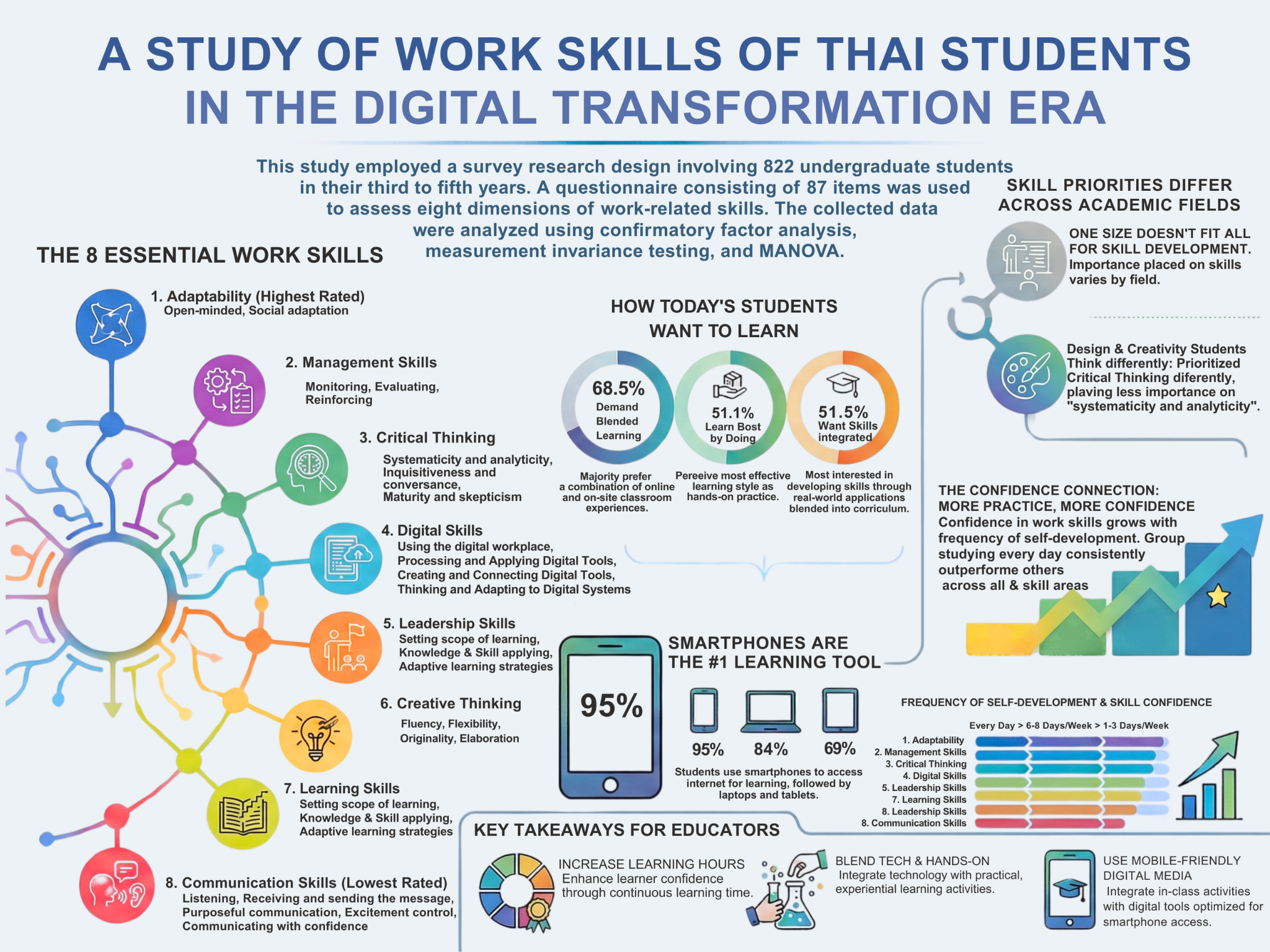
Background and Objectives: Technology has played an integral role in facilitating work processes to achieve higher efficiency, transforming people’s ways of life, as well as their learning and working patterns. Thai students must develop the necessary skills to compete in the labor market and adapt to new technology and digital advancements, which have become significant aspects of the modern workplace. The objectives of this research were to 1) study and compare the measurement model of work skills among Thai students in the digital transformation era, categorized by the fields of study, and 2) examine students’ learning behavior and their level of demand for work skill development.
Methods: The study population and sample consisted of undergraduate students at King Mongkut's University of Technology Thonburi in their 3rd, 4th, and 5th years. The multistage random sampling method was employed to collect data from 822 individuals. The instrument used in this study was a questionnaire, which was divided into two parts. The first part comprised general information questions. The second part consisted of an 87-item questionnaire using a 5-point Likert scale to measure work skills. Work skills consisted of eight components with 28 indicators. The measurement instrument was checked for validity by using Index of Item-Objective Congruence (IOC), and reliability by using Cronbach’s alpha coefficient for the quality of the appropriate tool. The statistical analysis included confirmatory factor analysis and the measurement invariance test, which were conducted to examine the structural measurement model using Mplus 8.0. Additionally, descriptive statistics and Multivariate Analysis of Variance (MANOVA) were performed using SPSS.
Results: Firstly, the results showed that the measurement model of employability skills for Thai students in the era of digital transformation consisted of communication skill, management skill, learning skill, leadership skill, digital skill, adaptability, critical thinking, and creative thinking. Regarding the results of the second order confirmatory factor analysis, it was found that the measurement model for fundamental work skills of students in the era of global digital was consistent with the empirical data, (Δχ²(252, N=822)=25.86, p=.00, RMSEA=0.04, SRMR=0.03, CFI=0.98) and the test of the invariance measurement model of work skills among Thai students in the digital transformation era across four disciplines—science and technology, engineering, education, and design and creativity—was conducted to examine the configural invariance of the indicators of work skills. Each field of study prioritized a different set of skills. It is obvious that the measurement model of work skills among Thai students in the Digital Transformation Era shows different constructs in different groups. The group that differed was the one focusing on design and creativity, which prioritized critical thinking differently from other groups, while those in systematicity and analyticity had factor loadings that were not statistically significant (Δχ²(2-1) = 39.99; df(2-1) = 23) . Secondly, the results regarding students’ learning behavior and their level of demand for work skill development in Thailand revealed that even though we are living in the digital transformation era, students 1) demand onsite and online learning together (68.51%), 2) prefer to learn independently and receive Learning by doing experience (51.14%), and 3) desire to develop practical skills blended into their courses (51.54%). In addition, the confidence level in having work skills increases with the frequency of self-development. In other words, the more regularly they develop themselves, the more confident they feel about their ability to improve. (F(24, 2347) = 1.73, p=0.02, Pillai's Trace = 0.50, partial η² = 0.02).
Application of this study: The research findings provide essential insights into the state of Thai work skills, enabling instructors to identify students’ strengths and weaknesses in various skill areas. Moreover, this study aims to examine these skills by categorizing students based on their backgrounds, thereby generating in-depth data on which student groups excel in particular skills, which areas they struggle with, and how they should be further developed. The aforementioned information contributes to curriculum enhancement and instructional improvements, ensuring that students receive targeted development opportunities that align more precisely with educational object.
Conclusions: The measurement model of Thai work skills in the digital transformation era consists of communication skills, management skills, leadership skills, learning skills, digital skills, adaptability, critical thinking, and creative thinking. Each field of study prioritizes a different set of skills. The perception of possessing work skills increases with the frequency of self-development. Namely, the more regularly students engage in self-improvement, the more confident they feel in their ability to enhance their skills. This research findings can assist teachers and educational institutions in designing the courses that foster work skills development, aligning with the demands of the future labor market.
Downloads
Article Details

This work is licensed under a Creative Commons Attribution-NonCommercial-NoDerivatives 4.0 International License.
References
Ahmed, N. (2019). Generation Z’s Smartphone and Social Media Usage: A Survey. Journalism and Mass Communication, 9(3), 101-122. https://doi.org/10.17265/2160-6579/2019.03.001
Ajzen, I. (2014). The Theory of Planned Behaviour Is Alive and Well, and Not Ready to Retire: A Commentary on Sniehotta, Presseau, and Araújo-Soares. Health Psychology Review, 9(2), 131-137.
Barman, A., & Das, K. (2020). Whether B-Schools Care Spencer & Spencer’s Workplace Competency Framework in the 21st Century? - Revalidating Through Reliability. International Journal of Advanced Science and Technology, 29(11), 2910-2920.
Billing, F., & Others. (2021). Building Workforce Skills at Scale to Thrive During-And After-The COVID-19 Crisis. Designed by McKinsey Global Publishing.
Byrne, B. M. (2012). Structural Equation Modeling With Mplus: Basic Concepts, Applications, and Programming. New York: Routledge.
Carracedo, F. S., & Others. (2018). Competency Maps: An Effective Model to Integrate Professional Competencies Across a Stem Curriculum. Journal of Science Education and Technology, 27, 448-468. https://doi.org/10.1007/s10956-018-9735-3
Chen, F. F. (2007). Sensitivity of Goodness of Fit Indexes to Lack of Measurement Invariance. Structural Equation Modeling: A Multidisciplinary Journal, 14(3), 464–504. https://doi.org/10.1080/10705510701301834
Clokie, T. L., & Fourie, E. (2016). Graduate Employability and Communication Competence: Are Undergraduates Taught Relevant Skills. Business and Professional Communication Quarterly, 79(4), 442-463. https://doi.org/10.1177/2329490616657635
Cohen, J. (1988). Statistical Power Analysis for the Behavioral Sciences. 2nd ed. New York: Lawrence Erlbaum Associates.
Dimock, M. (2019). Defining Generations: Where Millennials End and Generation Z Begins. Pew research center, 17(1), 1-7.
Flöthmann, C., Hoberg, K., & Wieland, A. (2018). Competency Requirements of Supply Chain Planners and Analysts and Personal Preferences of Hiring Managers. Supply Chain Management: An International Journal, 23(6), 480-499. https://10.1108/SCM-03-2018
Hengsadeekul, C. (2023). Creative Thinking: Nature or Nurture. Academic Journal of Phetchaburi Rajabhat University, 13(2), 122–130.
Hooper, D., Coughlan, J., & Mullen, M. R. (2008). Structural Equation Modelling: Guidelines for Determining Model Fit. Electronic Journal of Business Research Methods, 6(1), 53-60.
Kamket, W. (2012). Behavioral Research Methodology. Bangkok: Chulalongkorn University Press. (In Thai)
Kanjanawasee, S. (2015). Multivariate Statistical Analysis for Research. Bangkok: Chulalongkorn University Press. (In Thai)
Kautz, T., & Others. (2014). Fostering and Measuring Skills: Improving Cognitive and Non-Cognitive Skills to Promote Lifetime Success. Retrieved 25 September 2023, from https://www.nber.org/system/files/working_papers/w20749/w20749.pdf
Kenny, D. A. (2020). Measuring Model Fit. Retrieved 25 September 2023, from https://davidakenny.net/cm/fit.htm
Kolb, A. Y., & Kolb, D. A. (2005). Learning Styles and Learning Spaces: Enhancing Experiential Learning in Higher Education. Academy of Management Learning & Education, 4(2), 193-212.
Lazarova, M., & Others. (2023). Global Work In a Rapidly Changing World: Implications for MNEs and Individuals. Journal of World Business, 58(1), 1-13.
Lowden, K., & Others. (2011). Employers’ Perceptions of the Employability Skills of New Graduates. London: Edge Foundation.
Miani, P., & Others. (2021). The Impact of the COVID-19 Pandemic on Current Tertiary Aviation Education and Future Careers: Students’ Perspective. Journal of Air Transport Management, 94, 1-8.
Mitchell, R., Shen, Y., & Snell, L. (2022). The Future of Work: A Systematic Literature Review. Accounting & Finance, 62(2), 2667-2686.
Phetkliang, F. (2020). Blended Learning. Journal of Early Childhood Education Management, 2(2), 67-78.
Podmetina, D., & Others. (2017). Developing a Competency Model for Open Innovation From the Individual to the Organisational Level. Management Decision, 56(6), 1307-1335. https://10.1108/MD-04-2017-0445
Prifti, L., Knigge, M., Kienegger, H., & Krcmar, H. (2017). A Competency Model for “Industrie 4.0” Employees. In J. M. Leimeister & W. Brenner (Eds.), Proceedings of the 13th International Conference on Wirtschaftsinformatik (WI 2017), (pp. 46–60), February 12–15, 2017, St. Gallen, Switzerland.
Seemiller, C., & Grace, M. (2018). Generation Z: A Century in the Making. London: Routledge.
Soper, D. S. (2020). A-Priori Sample Size Calculator for Structural Equation Models [Computer Software]. Retrieved 25 September 2023, from https://www.danielsoper.com/statcalc/calculator.aspx?id=89
Suwannamek, N., Choochart, S., & Pitchayanan, M. (2018). Essential Skills of Learners in the Digital Era: A Case Study of Higher Education Students. Buriram Rajabhat University Academic Journal, 10(1), 45-58.
Twenge, J. M. (2017). Igen: Why Today’s Super-Connected Kids Are Growing up Less Rebellious, More Tolerant, Less Happy--and Completely Unprepared for Adulthood--and What That Means for the Rest of Us. New York: Simon and Schuster.
Waleeittipat, S. (2025a). Figure 1 Results of Measurement Invariance Analysis.
Waleeittipat, S. (2025b). Figure 2 The Average Levels of the Eight Work Skill Variables Varied Depending on How Frequently Students Engaged in Self-Development.
Wang, J., & Wang, X. (2020). Structural Equation Modeling: Applications Using Mplus. 2nd ed. United Kingdom: Wiley Press.
World Economic Forum. (2020). The Future of Jobs Report 2020. Retrieved 25 September 2023, from https://www.weforum.org/reports/the-future-of-jobs-report-2020
