
Lampang’s Cultural Identity: A Living Museum for Creative Tourism
Article Sidebar
Main Article Content
Abstract
Background and Objectives: Lampang province is renowned for its rich and distinctive cultural identity, as reflected in the local way of life, architecture in the community, traditional practices, and local community beliefs. This study examines and analyzes Lampang’s cultural identity across multiple dimensions, especially those aspects that reflect its historical identity, architecture, way of life, and beliefs of the local community to analyze the potential of transforming these cultural assets into a living museum model that supports creative tourism.
Methods: This study uses a quantitative research approach. The data collection tool used in this study was a questionnaire, which was administered to a sample of 400 tourists visiting Lampang province. A mixed method sampling technique was employed, and the data were analyzed using descriptive statistics, including mean and standard deviation.
Results: The cultural identity of Lampang province has been acknowledged at a high average level, supported by several significant components. These include temples and religious sites (mean = 4.33), nature (mean = 4.32), history (mean = 4.25), and local architecture (mean = 4.23). It received the highest level of recognition and a high overall potential to become a living museum (mean = 4.17), reflecting Lampang’s distinct cultural identity—especially in the dimensions of local identity (mean = 4.28), the identity of way of life, local wisdom, and knowledge; the continuous transmission of cultural traditions; and the historical dimension (mean = 4.22), especially documented historical, cultural, and traditional heritage. At the same time, the main approach or the most important factors in promoting creative tourism are tourism experience design (mean = 4.24), community participation (mean = 4.22), and cultural identity presentation (mean = 4.19).
Application of this study: The results of this study can be applied to formulate policies and developmental guidelines for Lampang province, establishing it as a model secondary city in the upper northern region that employs the concept of a living museum to promote creative tourism, which can enhance its economic strength and preservation of local culture. This requires integrated collaboration among the public sector, the private sector, and the local communities to ensure the cultural conservation process while generating sustainable economic value.
Conclusions: This study indicates that Lampang has a distinctive cultural identity, including temples and religious sites, nature, history, and local architecture, all of which demonstrate high potential for development as a living museum. The development of Lampang as a living museum to effectively promote creative tourism should focus on key strategic approaches: tourism experience design, cultural identity presentation, along with community participation. By adopting an integrated approach, these measures will enhance the diversity and sustainability of creative tourism in Lampang.
Downloads
Article Details

This work is licensed under a Creative Commons Attribution-NonCommercial-NoDerivatives 4.0 International License.
References
Black, G. (2012). The Engaging Museum: Developing Museums for Visitor Involvement. U.K.: Routledge.
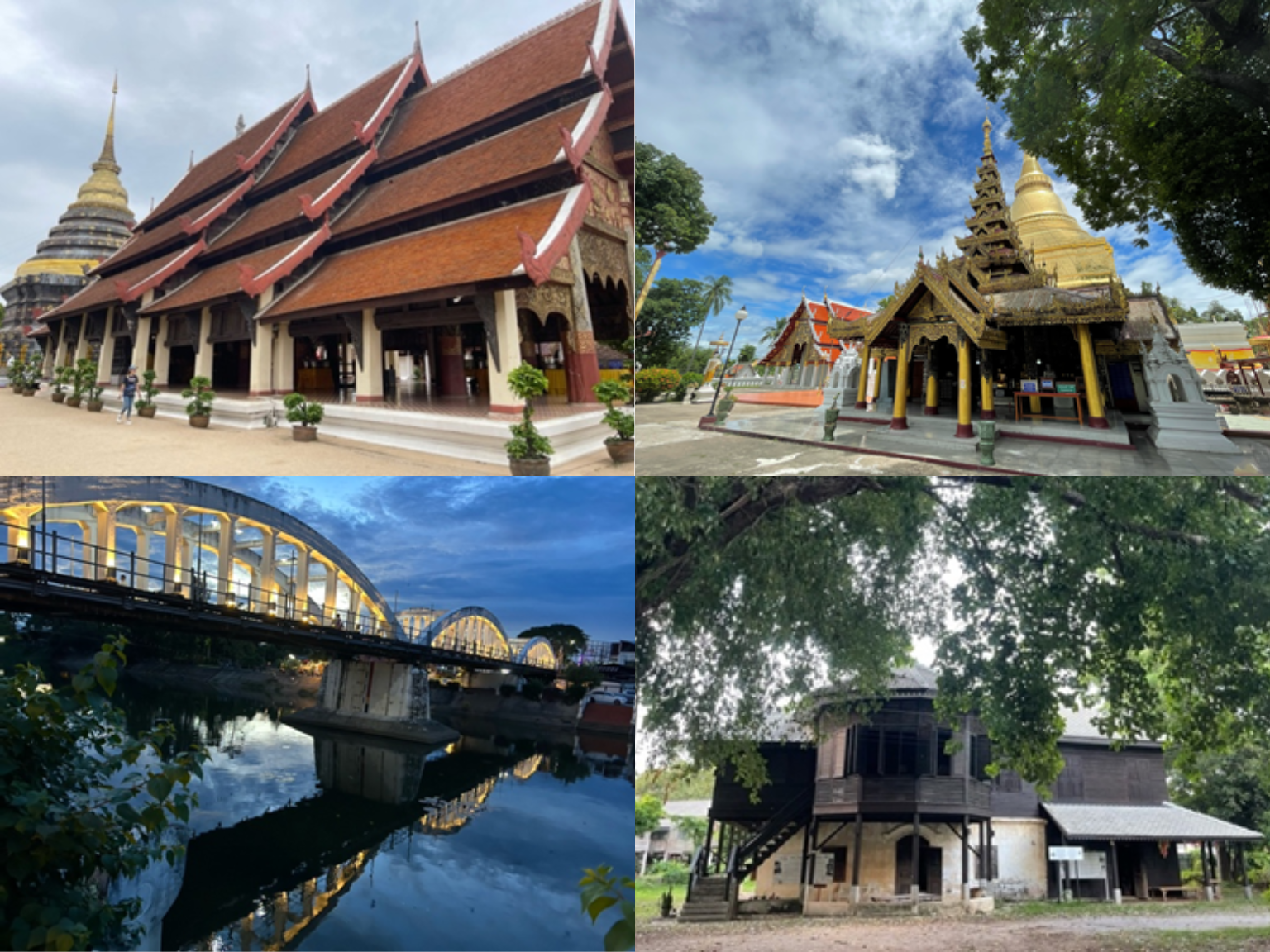
Chaijan, K. (2025). Figure 2 (a) Examples of Cultural attractions in Lampang Province e.g., Wat Phra That Lampang Luang. (b) Wat Phra Kaew Don Tao Suchadaram. (c) Chae Son National Park. (d) Ban Louis Cultural Learning Center. (e) Ratsada Phisek Bridge. (f) Kad Kong Ta Street Market.
Corsane, G., & Others. (2012). Ecomuseum Evaluation: Experiences in Piemonte and Liguria, Italy. International Journal of Heritage Studies, 18(1), 1-18.
Cronbach, L. J. (1951). Coefficient Alpha and the Internal Structure of Tests. Psychometrika, 16(3), 297-334.
Del Barrio-Tellado, M. J., & Herrero-Prieto, L. C. (2022). Museum Digitization and Visitor Engagement: A Technological Approach to Cultural Heritage. Journal of Cultural Heritage, 56, 102-115.
Department of Industrial Promotion. (2021). Lampang Ceramic Industry Report. Bangkok: Ministry of Industry, Thailand.
Duxbury, N., & Richards, G. (2019). Creative Tourism: Models and Practice. Journal of Tourism and Cultural Change, 17(3), 1-20.
Falk, J. H., & Dierking, L. D. (2013). The Museum Experience Revisited. Walnut Creek: Left Coast Press.
Harrison, R. (2015). Heritage and Globalization. U.K.: Routledge.
International Council of Museums (ICOM). (2011). Museum definition. Retrieved 15 January 2023, from https://icom.museum/en/resources/standards-guidelines/museum-definition/
Jongudomkarn, D., & Camfield, L. (2018). Cultural Resilience and Community-Based Tourism in Northern Thailand. Asian Journal of Social Science, 46(4-5), 516-538.
Krajangchom, S., & Srichai, P. (2023). Tourism Model of Lampang Cultural and Ceramic City. Journal of Thai Hospitality and Tourism, 18(1), 71-83. (In Thai)
Lampang Province. (2020). Lampang Cultural Heritage Report. Lampang: Provincial Administration Office. (In Thai)
Likert, R. (1932). A Technique for the Measurement of Attitudes. Archives of Psychology, 22(140), 1-55.
McKercher, B., & Du Cros, H. (2002). Cultural Tourism: The Partnership Between Tourism and Cultural Heritage Management. U.K.: Routledge.
Ministry of Tourism and Sports. (2020). Tourism Statistics Report 2019. Retrieved 5 November 2020, from https://www.mots.go.th/ (In Thai)
Na Chiangmai, S. (2019). Guidelines for the Collaboration to the Creation of New Media Artfrom the History of Mae MOH in the Community of Mae MOH District, Lampang Province. Veridian E-Journal, Silpakorn University: Humanities, Social Sciences, and Arts, 12(6), (2019),1762-1780. (In Thai)
Namwong, P., & Others. (2024). Cultural Capital and Community-Based Tourism Development: A Case Study of Lampang’s Old Town. Journal of Heritage Tourism, 19(3), 301-318.
National Statistical Office. (2022). Statistical Yearbook of Lampang Province. Bangkok: Ministry of Digital Economy and Society, Thailand. (In Thai)
National Statistical Office. (2025). Interactive GIS map of Lampang province [Web map]. Retrieved 10 January 2025, from https://statgis.nso.go.th/lampang/#/center/94.535,14.381/zoom/6.
Ntakhan, L., Wongkitrungrueng, N., & Assarut, N. (2023). Enhancing Cultural Tourism Through Horse-Carriage Experiences: A Case Study of Lampang’s Living Heritage. Journal of Sustainable Tourism, 31(4), 589-607.
Poria, Y., Butler, R., & Airey, D. (2003). The Core of Heritage Tourism: Distinguishing Heritage Tourists From Tourists in Heritage Places. Annals of Tourism Research, 30(1), 238-254.
Richards, G., & Raymond, C. (2000). Creative Tourism. ATLAS News, 23, 16-20.
Richards, G., & Wilson, J. (2006). Developing Creativity in Tourist Experiences: A Solution to the Serial Reproduction of Culture?. Tourism Management, 27(6), 1209-1223.
Sirindhorn Anthropology Centre. (2020). Lanna Cultural Heritage Documentation. Retrieved 20 January 2025, from https://www.sac.or.th/databases/ (In Thai)
Smith, M. K. (2012). Issues in cultural tourism studies. 2nd ed. U.K.: Routledge.
Sukhanthasingh, K. (2019). Conservation of Traditional Lanna Architecture in Lampang: Enhancing Urban Identity Through Heritage Preservation. Journal of Architectural Conservation, 25(3), 210-225.
Thamthong T., & Others. (2022). Cultural Heritage of the 8 Ways of Lampang Province. Lampang: Jaroenwat Printing.
UNESCO. (2019). Culture | 2030 indicators. Retrieved 20 December 2024, from https://unesdoc.unesco.org/ark:/48223/pf0000371562
Vallipodom, S. (2020). Lampang: Ancient City and Lanna Identity. Bangkok: Muang Boran. (In Thai)
Vanachayangkul, P., & Dankittikul, C. (2019). Cultural Landscape Management of Kadkongta, Lampang. Veridian E-Journal, Silpakorn University (Humanities, Social Sciences and Arts), 12(6), 1430-1447. (In Thai)
Vareiro, L., Ribeiro, J. C., & Remoaldo, P. C. (2021). Cultural Tourism and Sustainability: The Role of Local Communities. Sustainability, 13(8), 1-15.
Yamane, T. (1973). Statistics: An Introductory Analysis. 3rd ed. New York: Harper & Row.
