
Historical Background Context about the Worship of “Phra Kiu Ong Yah” in the Vegetarian Festival in Southern Thailand
Article Sidebar
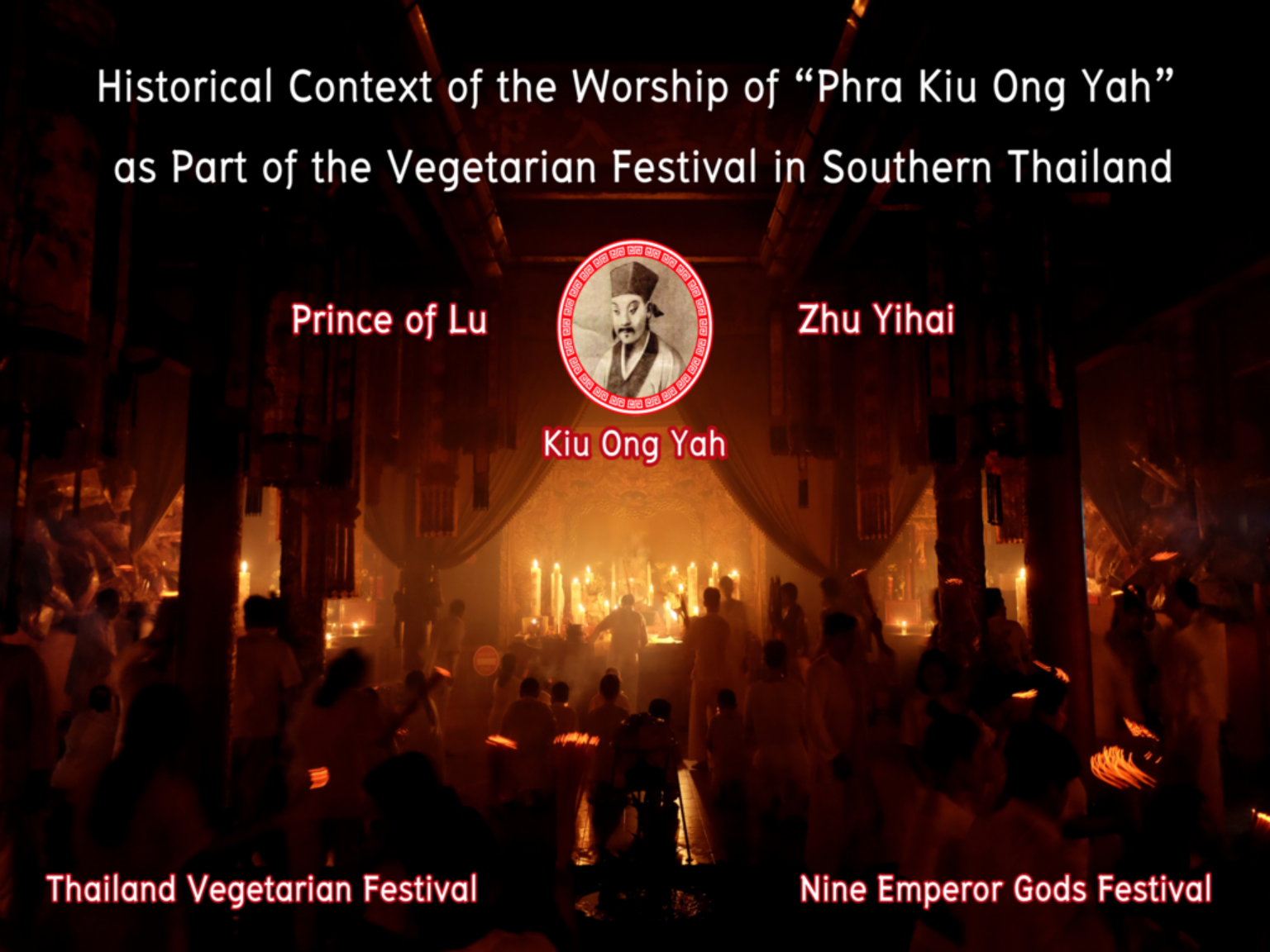
Main Article Content
Abstract
Background and Objectives: Phra Kiu Ong Yah serves as the principal deity in the Vegetarian Festival, playing a significant role in the ritual practices of Thai-Chinese communities, particularly in southern Thailand. Although prominently featured in folklore and ceremonial traditions, there remains a lack of systematic scholarly analysis linking the historical background of Phra Kiu Ong Yah to the origins and historical background context of the festival. This article aims to study the story of “Phra Kiu Ong Yah” based on the evidence from the stele inscription at the tomb of the Ming regent, Prince of Lu. Then, link the narrative to be communicated and the mission of resistance to the Qing dynasty and the restoration of the Ming dynasty carried out by secret societies. The analysis uses the couplets found in the Chinese shrine that has held the Vegetarian Festival tradition for nearly 200 years. In addition, the relationship between the worship of “Phra Kiu Ong Yah” and the Vegetarian Festival in southern Thailand is examined. Finally, insights are gained into who “Phra Kiu Ong Yah” is and how he is connected to this Vegetarian Festival in Southern Thailand.
Methods: The researcher uses historical research focusing on content analysis of the stele inscription from the tomb of the Ming regent, Prince of Lu, which refers to the Prince of Lu in the history of the Southern Ming dynasty. This includes analyzing the couplets found in the Chinese shrine that has held the Vegetarian Festival tradition for nearly 200 years, and examining the documents related to the worship of Phra Kiu Ong Yah at the Vegetarian Festival in southern Thailand. The findings are compiled and presented in the form of an analytical description.
Results: Phra Kiu Ong Yah, worshipped during the Vegetarian Festival in southern Thailand, can be traced back to Zhu Yihai, the prince of Lu, based on the analysis of the most evidence-based and credible legends. He was a descendant of the Southern Ming royal family and the 10th generation grandson of Zhu Yuanzhang, the founder of the Ming dynasty (Ming Taizu). This is the contextual background of the worship. However, most people understand Phra Kiu Ong Yah as a term for the Nine Emperor Gods, derived from the belief in the nine stars of the Big Dipper, which is at the forefront of the worship. In reality, the worship of Phra Kiu Ong Yah in its historical background context is a trace of secret societies in Southeast Asia whose mission was to overthrow the Qing dynasty and restore the rule of the Ming dynasty by the Han Chinese. By using the belief in the worship of the Big Dipper as a front, in order to escape the persecution by the Qing court.
Application of this study: This study result fills the gap in clarifying the question of who ‘Phra Kiu Ong Yah’ was by linking the historical background of the Southern Ming Dynasty with the worship of ‘Phra Kiu Ong Yah’ at the Vegetarian Festival in southern Thailand. The article provides valuable information for the study of the Vegetarian Festival in southern Thailand and can extend the analysis to the history of resistance to the Qing dynasty and the restoration of the Ming dynasty by Han Chinese groups who wanted to reclaim their independence.
Conclusions: The conclusion of this article shows that Phra Kiu Ong Yah has no connection with the meaning of the number 9. The association with the number 9 in communication was intended to evoke the homophonic meaning derived from the pronunciation of the number 9 in the Hokkien dialect, where the word for 9, ‘giu’ [giu3], sounds similar to ‘giu’ [giu5], meaning ‘help’. This was intended to convey the message of helping to restore the Ming dynasty from the Manchus. Furthermore, the content of the couplets found in the shrine confirms that the worship of Phra Kiu Ong Yah during the Vegetarian Festival does not derive its meaning from the foreground context of worshipping the nine stars of the Big Dipper or the nine ancient Chinese emperors. Rather, it is derived from the background context in which Phra Kiu Ong Yah is worshipped as the tutelary deity of the members of secret societies aiming to overthrow the Qing dynasty and restore the Ming dynasty. This deity is identified as Zhu Yihai, the prince of Lu, a descendant of the royal family of the Southern Ming.
Downloads
Article Details

This work is licensed under a Creative Commons Attribution-NonCommercial-NoDerivatives 4.0 International License.
References
Benjakul, S. (2021). Bramuan Kotmai Aya (Chabap Somboon). [Criminal Code (Complete Edition)]. Retrieved 25 October 2024, from https://library.coj.go.th/pdf-view.html?fid=14551&table=files_biblio (In Thai)
Chinese Text Project. (2006-2025). Huang qing shu shi·juan san shi er. [The Imperial Qing Bibliography: Volume 32]. Retrieved 25 October 2024, from https://ctext.org/wiki.pl?if=en&chapter=432399 (In Chinese)
Chen, Ch. (2013). Zai li fa zheng tong yu zheng zhi xian shi zhi jian-Lu wang zai jin men huo dong ji xiang guan li shi ji yi de yan jiu. [Between Ritual Law and Orthodox Political Reality - A Study of Lu Wang’s Activities in Jinmen and the Historical Memories Associated With Them]. Fujian-Taiwan Cultural Research, 33(1), 5-17. (In Chinese)
Guo, Y. (2023). Palace Beyond the City: Spatial Narratives and Symbolic Representations of Singapore's Hougang Tou Mu Temple. Retrieved 25 May 2024, from https://journal.ndhu.edu.tw/離城之宮:新加坡後港斗母宮的空間敘述與符號呈/
He, B., & Yue, Q. (1990). Zhong guo gong ting zhi shi ci dian. [Dictionary of Chinese Court Knowledge]. Beijing: China International Radio Press. (In Chinese)
Huang, J. H. (2006). Zhu Yihai, the 'Emperor of the Sea' in the Valley of Tigers and Wolves. Retrieved 20 May 2025, from http://paper.wenweipo.com/2006/07/25/OT0607250008.htm (In Chinese)
Jiang, B. (2024). Jin men xian shi ji “Ming qing jin men cheng yi ji” bao cun wei hu ji hua cheng guo bao gao shu. [Research Report on the Preservation and Maintenance Plan of Historical Sites in Jinmen district: Ming and Qing Kinmen City Relics]. Jincheng Town, Kinmen County: Kinmen County Bureau of Culture. (In Chinese)
Jincheng Township Municipality Office, Jinmen District. (2019). Jin cheng zhe zhi·di si pian kai tuo pian. [Jincheng Township Chronicles: Chapter 4–Pioneering Section]. Jin Men: Jincheng Township Municipality Office, Jinmen District. (In Chinese)
Li, F. M. (2020). Cong sheng jiao dao dao jiao-Ma hua she hui de jie su、xin yang yu wen hua. [From Sacred Teachings to Taoism: Festivals, Beliefs, and Culture in the Malaysian Chinese Community]. Tai pei: National Taiwan University Press Center. (In Chinese)
Li, F. M. (2009). Wang chuan、Chuan hua、Jiu huang chuan: Dai xun san xing de yi shi xing kua jing [King’s Ship, Ship Paintings and Nine Emperor’s Ships: Ritual Border Crossing in Three Types of Inspection by Decree]. Kong jian yu wen hua chang yu: Kong jian zhi yi xiang、Shi jian yu she hui de sheng chan. [Space and Cultural Fields: The Imagery, Practice, and Social Production of Space]. Taibei: Institute of Sinology. (In Chinese)
Lin, W. (1997). Tan tan shao lin wu zu quan. [A Discussion on Shaolin Five Ancestors Fist]. Bei jing: Forbidden City Publishing House. (In Chinese)
Minnan Cultural Association. (2020). The Minnan Cultural Association Is Planning a Search for the Real and Fake Historical Sites of Prince Lu of Southern Ming. Retrieved 25 October 2024, from https://www.kinmen.gov.tw/News_Content2.aspx?n=98E3CA7358C89100&s=EFCE66525B2D9851&Create=1 (In Chinese)
National Museum of History, Taiwan. (2011). Epitaph of Prince Lu, the Regent of the Ming Dynasty. Retrieved 17 February 2024, from https://www.nmh.gov.tw/News_Publish_Content.aspx?n=6998&s=174486
Ni, J. (2006). Huan jing yi shu·Di san dan yuan·Jing guan. [Environmental Art: Unit 3 – Landscape]. Tai pei: National Taiwan Arts Education Center. (In Chinese)
Ninsa-nguandecha, J. (2014). Tamnan Phra Kiu Hong Tai Te Kap Khwam Cheua Nai Sangkhom Thai. [The Legend of Kiu Hong Tai Te with the beliefs in Thai Society]. Silpakorn University Journal, 34(2), 63-80. (In Thai)
Ninsa-nguandecha, J. (2023). Jak Rong Phra Kin Phak Su San Chao Kiu Ong Yeah Changwat Trang. [From “Khin Phak Shrine” to “Kew Ong Yeah Shrine, Trang Province”]. Rusamilae Journal 44(2), 64-81. (In Thai)
“Prakat Krom Song Soem Watthanatham Reuang Kan Khuen Banchii Moradok Phum Panya Thang Watthanatham B.E. 2561”. [Announcement of the Department of Cultural Promotion on the Registration of Intangible Cultural Heritage, B.E. 2561 (2018)]. (2018). The Royal Thai Government Gazette, 135(27 June 2018). 3-4. (In Thai)
Taoist Monastery of the White Clouds. (2004). The Sutra of Life Extension of the Supreme Mysterious North Star. Retrieved 10 February 2024, from https://archive.org/details/beidoujing (In Chinese)
Wang, Ch. F., (2008). National Tragedy: The Hongmen Tiandihui Hidden Behind Malaysia's Jiuhuang Gods Belief, (n.p.), The 5th International Conference on Taiwanese and Southeast Asian Culture and Literature: Development and Approaches, June 1, 2008. Taiwan, Fo Guang University.
Wutthipanich, D. (2001). “Poetry and Couplets in Praise of the Ming Dynasty” in Chin Thaksin: Withee Lae Phalang. [Southern Chinese: Ways and Strengths]. Bangkok: The Thailand Research Fund (TRF) Office. (In Thai)
Yang, B. (2012). [Chronological Table of Chinese History (Volume II)], Beijing: People's Literature Publishing House. (In Chinese)
Zhao, Y., & Cui, D. (2022). Qing ming ding ge zhi ji Liu qiu dui wai bang jiao zai Nan mingy u Qing zhi jian de jian nan jue ze. [Ryukyu’s Diplomatic Dilemma Between the Southern Ming and Qing Dynasties During the Ming-Qing Transition Period]. Journal of Southwest University (Social Science Edition), 48(6), 253-261. (In Chinese)
Zhang, T., & Others. (1739). The “History of Ming”, The fourth volume of the “Biographies” section. Retrieved 25 July 2024, from https://www.shidianguji.com/ens/book/LS0024/chapter/LS0024_146?page_from=reading_midpage&version=15 (In Chinese)
Zhang, Y. J. (2014, June 25). “Jiu huang xin yang” qi yuan xin kao. [A Fresh Perspective on the Origins of the Jiu Huang Faith]. Zhong guo she hui ke xue bao. [Chinese Social Sciences Today], pp. A08. (In Chinese)
Zhi, L. (2020, May 26). Yuan de ci shen zhang bao guo. [May This Body Forever Serve the Nation]. Consumer Daily, pp. C2. (In Chinese)
Zhu, F. (1979, May 28). Jiu Wang Ye [Kiu Ong Yah]. Nan Yang Shang Bao [Nanyang Siang Pau], pp.19 (In Chinese)
