
A Comparative Study of Thai and Italian Historic Stone Statues: A Case Study of Khao Mo at Wat Prayurawongsawat and the Apennine Colossus
Article Sidebar
Main Article Content
Abstract
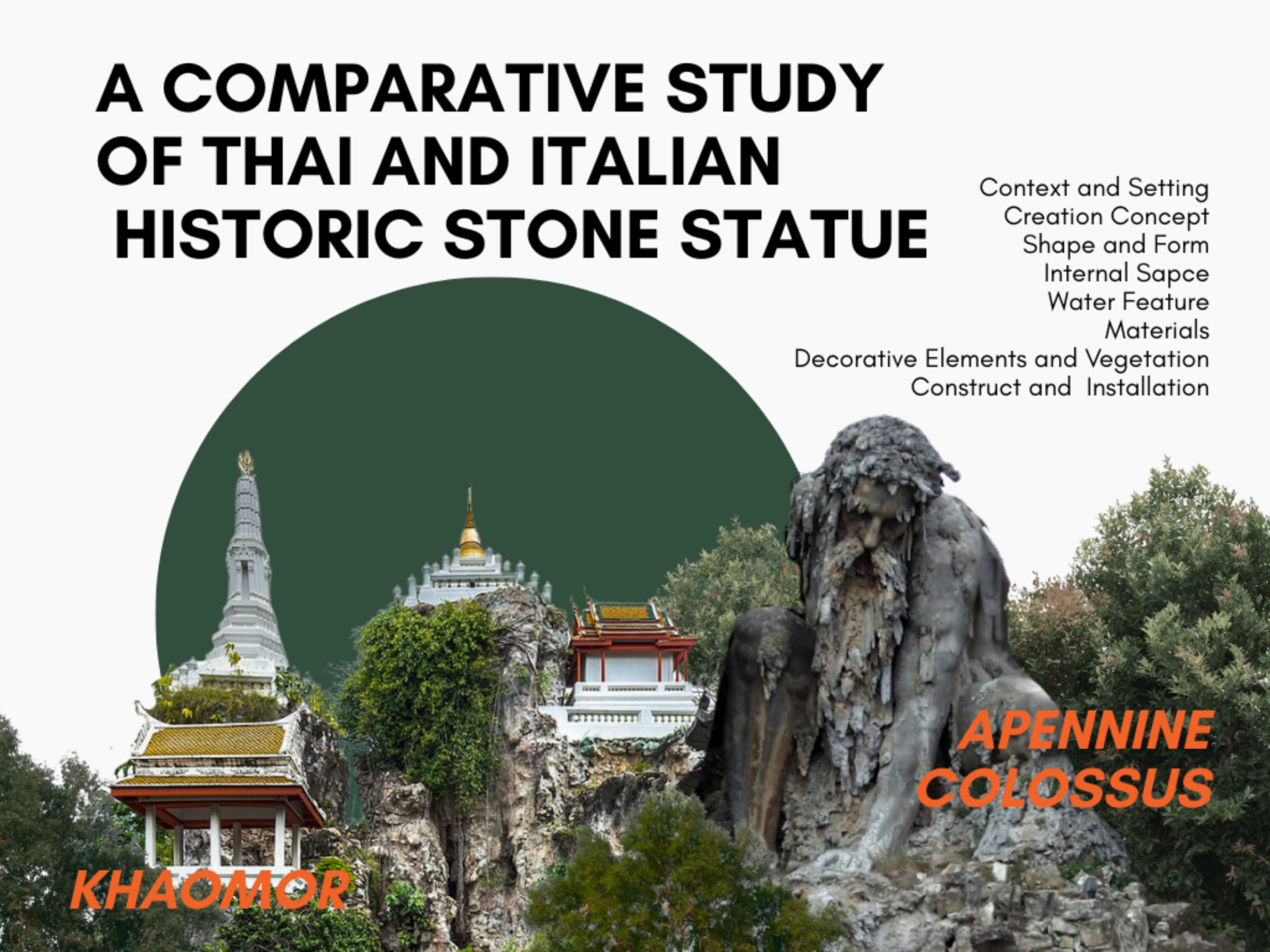
Background and Objectives: This study analyzes and compares the cultural significance of historic stone sculptures from Thailand and Italy: Khao Mo at Wat Prayurawongsawat in Bangkok and the Colossus of the Apennines in Italy. These monumental works are not merely landscape ornaments but serve as artistic, religious, and cultural symbols that embody profound narratives of cosmology, mythology, and power. The main objective is to understand how such sculptures reflect cultural values, beliefs, and the idea of integrating art with nature. The study also proposes approaches for conserving and presenting heritage that bridges local and global contexts. By comparing works with different origins but similar thematic intentions, this research highlights the role of heritage in transmitting identity, memory, and belief systems.
Methods: The research adopts a qualitative comparative analysis, examining the context, spatial setting, and forms of both monuments via the field surveys, photographic documentation, and analyses of construction techniques, materials, and symbolic elements. These data were synthesized to interpret the interrelations among sculptures, landscapes, and spiritual dimensions.
Results: Khao Mo at Wat Prayurawongsawat reflects Thai Buddhist cosmology, recreating a sacred landscape symbolizing Mount Meru. It integrates natural elements such as water, vegetation, and religious iconography to create an atmosphere conducive to meditation and spiritual reflection. In contrast, the Colossus of the Apennines embodies Renaissance and Mannerist ideals in Italy, employing mythological symbolism, artistic ambition, and architectural integration with nature. Beyond its artistic presence, the sculpture contains functional features, including interior chambers and a working water system, reflecting the era’s attempt to integrate art with functionality.
Application of this study: The findings indicate that heritage conservation must give priority to the context and the cultural values embedded within the structure to enhance restoration, interpretation, and communication of heritage significance. Comparative analysis further provides a foundation for cross-cultural knowledge exchange in art and architectural conservation, particularly within the framework of global heritage management, which requires interdisciplinary collaboration to preserve the profound meaning reflected in the works.
Conclusions: The comparison of Khao Mo and the Colossus of the Apennines demonstrates that historic monumental sculptures in public spaces can reflect cultural identity, religious worldviews, and artistic intent in profound ways. Despite differences in origin and style, both exemplify harmonious integration of art and nature, expressing shared human concerns with spirituality, myth, and memory. This study contributes to broader heritage discourse by emphasizing that conservation should extend beyond physical form to encompass intangible meanings. Cross-cultural perspectives on monumental stone sculptures enrich understanding of how societies interpret the relationship between humans, nature, and the sacred. They also highlight the necessity of contextual interpretation and interdisciplinary approaches that link art history, architecture, landscape architecture, and cultural studies. Ultimately, this research establishes a foundation for future comparative heritage conservation studies and promotes global awareness of the diverse ways in which meaning is conveyed through monumental art.
Downloads
Article Details

This work is licensed under a Creative Commons Attribution-NonCommercial-NoDerivatives 4.0 International License.
References
Anderson. (2024). Discovering the Colossus of the Apennines in Italy. Retrieved 17 February 2025. from https://traveldestinationsnow.com/discovering-the-colossus-of-the-apennines-in-italy/
Adminbenews. (2019). Samphat Khwam Sangop Romruen Thamklang Thammachat Thi Suan Somdet Phra Srinagarindra Changwat Nakhon Si Thammarat. [Experience Tranquility and Spiritual Serenity at the “Khao Mor” Garden, Wat Prayurawongsawas Woravihara] Retrieved 17 February 2025, from https://www.benewsonline.com/home/สัมผัสความสงบร่มรื่นทา/
Arunoprayote, S. (2024). Khao Mor and Thai garden at Wat Prayurawongsawat. Retrieved 17 February 2025. From https://en.wikipedia.org/wiki/Khao_mor#/media/File:Khao_Mo_at_Wat_Prayurawongsawat_20240922_(II).jpg
Avery, C. (1993). Giambologna: The Complete Sculpture. London: Phaidon Press.
Baker, C., & Phongpaichit, P. (2017). A history of Thailand. 3rd ed. Cambridge: Cambridge University Press.
Baldini, U. (2000). Giambologna: The Gods, the Heroes, Exhibition Catalogue. Florence: Giunti Publishers.
Boucher, B. (1991). Italian Baroque Sculpture. London: Thames & Hudson.
Byrne, D. (2014). Counterheritage: Critical Perspectives on Heritage Conservation in Asia. New York: Routledge.
Choay, F. (2001). The Invention of the Historic Monument. Cambridge: Cambridge University Press.
Clunas, C. (1996). Fruitful Sites: Garden Culture in Ming Dynasty China. London: Reaktion Books.
Cohen, E. (2001). The Chinese Vegetarian Festival in Phuket: Religion, Ethnicity and Tourism on a Southern Thai Island. Bangkok: White Lotus Press.
Cole, M. (2011). Ambitious Form: Giambologna, Ammanati, and Danti in Florence. Princeton: Princeton University Press.
Erbuer, M. (2013). Colossus of the Apennines. Retrieved 17 February 2025, from https://arthur.io/art/giambologna/colosso-dellappennino
Fine Arts Department. (2018). Conservation of Thai Buddhist Monuments: Policies and Practices. Bangkok: Fine Arts Department of Thailand.
Fisher, R. E. (2017). Buddhist Art and Architecture. London: Thames & Hudson.
Fletcher, B. (2001). A History of Architecture on the Comparative Method. 20th ed. Oxford: Architectural Press.
Friedman, D. (1988). Palaces and Gardens of the Renaissance. London: Thames & Hudson.
Giedion, S. (1941). Space, Time and Architecture: The Growth of a New Tradition. Cambridge: Harvard University Press.
Goldthwaite, R. A. (1993). Wealth and the Demand for Art in Italy, 1300–1600. Baltimore: Johns Hopkins University Press.
Gombrich, E. H. (1995). The Story of Art. 16th ed. London: Phaidon Press.
Hannerz, U. (1992). Cultural Complexity: Studies in the Social Organization of Meaning. New York: Columbia University Press.
Harrison, R. (2013). Heritage: Critical Approaches. London: Routledge.
Harvey, P. (2013). An Introduction to Buddhism: Teachings, History and Practices. 2nd ed. Cambridge: Cambridge University Press.
Honour, H., & Fleming, J. (2009). A World History of Art. 7th ed. London: Laurence King.
Janson, H. W. (2006). History of Art. 6th ed. A. F. Janson (revised). Upper Saddle River: Prentice Hall.
Jermsawatdi, P. (1979). Thai Art: With Indian Influences. New Delhi: Abhinav Publications.
Jiajanphong, P. (1988). Thai Heritage Conservation Policy. Bangkok: Fine Arts Department of Thailand.
Jullien, F. (2011). The Silent Transformations. Fijalkowski, K., & Richardson, M. (Trans.). Calcutta: Seagull Books.
Keswick, M. (2003). The Chinese Garden: History, Art and Architecture. Cambridge: Harvard University Press.
Kleiner, F. (2017). Gardner’s Art Through the Ages: A Global History. 15th ed. Boston: Cengage Learning.
Lertluksna, K., Pholpoke, P., & Vongvisitsin, T. (2013). Thai Buddhist Architecture and Symbolism. Nakhon Pathom: Silpakorn University Press.
Lertluksna, Y. & Others. (2013). Prayunwongsanusorn Krongkan Buranapatisangkhon Khaomor Wat Prayun Wongsa Wat.
[Prayurawongsanusorn, the Renovation Project of “Khao Mor”, Prayurawongsa Was Temple]. Bangkok: The Crown Property Bureau. (In Thai)
Lowenthal, D. (2015). The Past Is a Foreign Country – Revisited. Cambridge: Cambridge University Press.
Luchinat, C. (2004). Giambologna: Sculptor of the Renaissance. Florence: Museo Nazionale del Bargello.
Murck, A. F. (2000). Poetry and Painting in Song China: The Subtle Art of Dissent. Cambridge: Harvard University Asia Center.
Nokkaew, S. (2022). Wat Prayurawongsawat Wat Dang Ton Krung Rattanakosin Kap 6 Highlight Thi Tong Pak Mut Thiao. [Wat Prayurawongsawat: A Landmark Temple from Early Rattanakosin with 6 Must-See Highlights]. Retrieved 17 February 2025, from https://www.sarakadeelite.com/lite/history-of-watprayoon-bangkok/ (In Thai)
Norberg-Schulz, C. (1980). Genius Loci: Towards a Phenomenology of Architecture. New York: Rizzoli.
Office of the Royal Society. (2009). Khao Mor. Retrieved 14 November 2025, from http://legacy.orst.go.th/?knowledges=เขามอ-๑๕-พฤษภาคม-๒๕๕๒ (In Thai)
Pantip. (2021). Thiao Wat Prayurawongsawat Thanon Prachathipok Khet Thon Buri Krung Thep Maha Nakhon. [Visit Wat Prayurawongsawat on Prachatipok Road, Thonburi District, Bangkok]. Retrieved 17 February 2025, from https://pantip.com/topic/41135310 (In Thai)
Pallanti, G. (2006). The Medici Gardens: From Renaissance to Baroque. Florence: Giunti Editore.
Peleggi, M. (2002). Thailand’s Modern History: From the Ancient Kingdom to the Modern Nation. Chiang Mai: Silkworm Books.
Pinyonatthagarn, P. (2018). The Cultural Significance of Khao Mor Gardens in Thai Landscape Architecture. Bangkok: Chulalongkorn University Press.
Poshyananda, A. (1992). Modern Art in Thailand: Nineteenth and Twentieth Centuries. Singapore: Oxford University Press.
Ragin, C. C. (1987). The Comparative Method: Moving Beyond Qualitative and Quantitative Strategies. Berkeley: University of California Press.
Read, H. (1956). The Meaning of Art. 4th ed. Harmondsworth: Penguin Books.
Richter, G. M. A. (1970). The Sculpture and Sculptors of the Greeks. 4th ed. New Haven: Yale University Press.
Rihoux, B., & Ragin, C. C. (Eds.). (2009). Configurational Comparative Methods: Qualitative Comparative Analysis (Qca) and Related Techniques. Thousand Oaks: SAGE.
Ruskin, J. (1853). The Stones of Venice. London: Smith, Elder & Co.
Said, E. W. (1978). Orientalism. New York: Pantheon Books.
Sailko. (2014). Pratolino Park, Giambologna’s Apennine, Foggini’s Dragon. Retrieved 17 February 2025, from https://commons.wikimedia.org/w/index.php?curid=41582589
Selanon, P. (2025). Figure 1 Six Characteristics of Identity in Stone Statue.
Selanon, P. (2025a). Figure 3 Khao Mor Wat Prayurawongsawas With Its Context of Urban Surrounding and Apennine Colossus With Its Context of Urban Surrounding.
Smith, L. (2006). Uses of Heritage. London: Routledge.
Stierlin, H. (2009). Living Architecture: Western Traditions. Cologne: Taschen.
Strong, J. S. (2005). The Buddha: A Short Biography. Oxford: Oneworld Publications.
Strong, J. S. (2019). Buddhisms: An Introduction. Oxford: Oneworld Publications.
Talbot, T. (2017). Life Of The Site. Retrieved 16 March 2025, from https://www.chaslerie.fr/blog/vie-site?p=33)
Timian, A. (2011). The Colossus of Villa Demidoff: Renaissance Villa and Gardens Complete with a Tormented Colossus. Retrieved 8 May 2025, from https://www.atlasobscura.com/places/villa-demidoff
Thongchai, W. (2000). The Quest for “Siwilai”: A Geographical Discourse of Civilizational Thinking in the Late Nineteenth and Early Twentieth-Century Siam. The Journal of Asian Studies, 59(3), 528–549. https://doi.org/10.2307/2658944
UNESCO. (2021). World Heritage and Climate Change. Paris: United Nations Educational, Scientific and Cultural Organization.
van der Ree, P. (2012). Unusual Places. Retrieved 28 January 2025. From https://unusualplaces.org/the-appennine-colossus/
Wilailuk. (2024). The Khao Mor at Wat Prayurawongsawas, Thailand. Retrieved 17 February 2025. From https://www.thailibrary.in.th/2024/07/27/__trashed-8/
Winter, T. (2007). Post-Conflict Heritage, Postcolonial Tourism: Culture, Politics and Development at Angkor. London: Routledge.
Wong, W. C. (1991). The Paintings of the Song Dynasty. Taipei: National Palace Museum.

.jpg)