
Errors in Chinese Character Writing among Thai Learners: A Case Study of Students in an Intensive Chinese Language Course
Article Sidebar
Main Article Content
Abstract
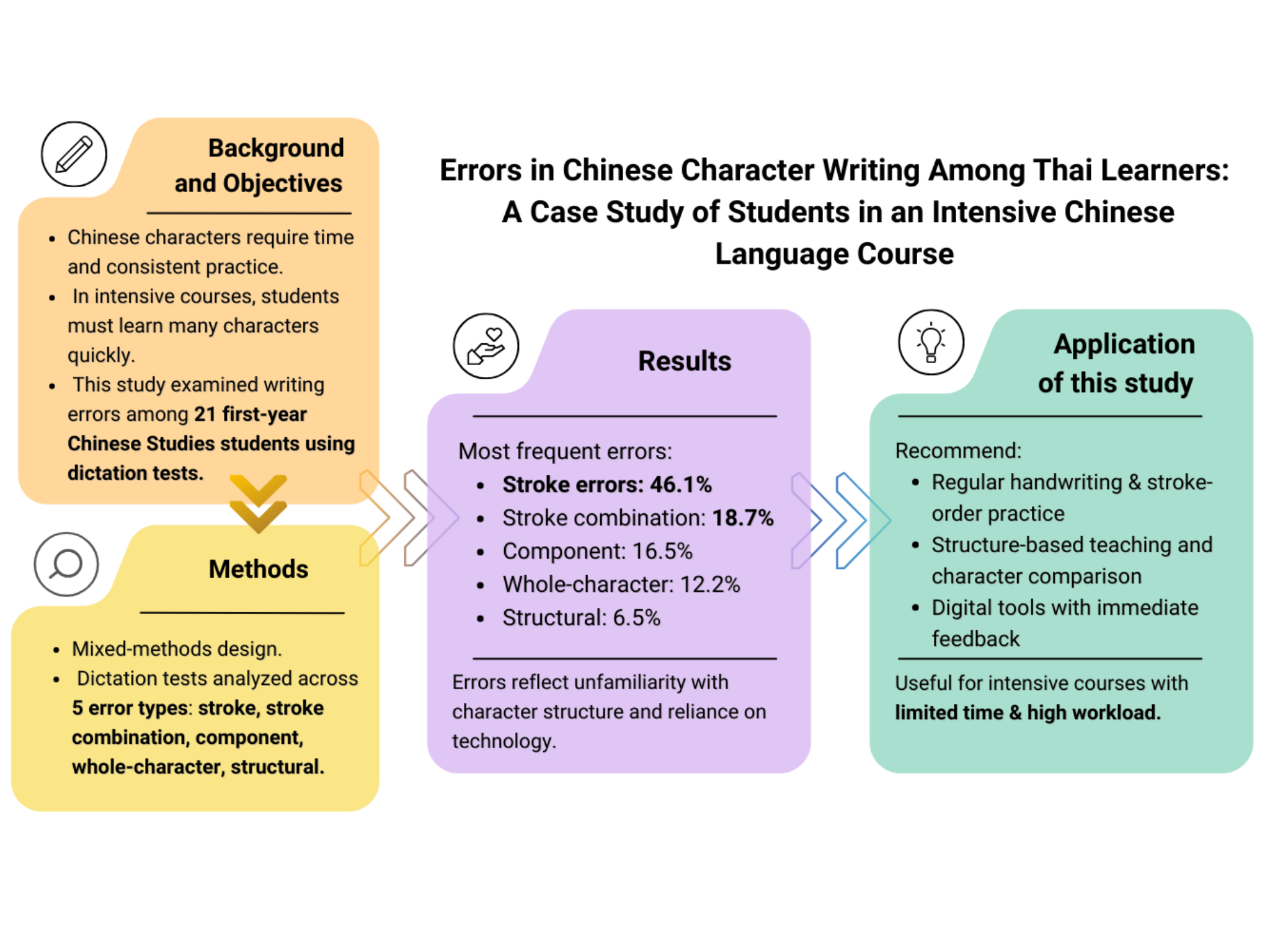
Background and Objectives: Learning to write Chinese characters requires time and continuous practice due to their complex structures and the importance of correct stroke order. However, in an intensive Chinese course where learning time is limited, students must memorize a large number of characters within a short period. This raises the research question, what types of writing errors do students in such intensive courses make, and what factors contribute to those errors? This study aims to investigate the writing errors of first-year students majoring in Chinese Studies at Mae Fah Luang University. The sample consisted of 21 students enrolled in an intensive Chinese course, which required them to learn a significant number of characters within a restricted timeframe. The study analyzed the errors from dictation tests covering 12 lessons with a total of 90 words.
Methods: A mixed-methods research design was employed, combining quantitative and qualitative approaches. Dictation tests served as the primary instrument for data collection. The writing errors were categorized into five types: stroke-related errors, stroke combination errors, component errors, structural errors, and whole-character errors. The frequency of each type was calculated.
Results: The results of the study showed that the most common type of error was stroke-related, accounting for 46.1% of all errors. Most of these involved distorted or malformed strokes rather than missing or incorrect strokes. Stroke combination errors constituted 18.7%, mostly caused by writing strokes too far apart instead of connected. Component errors accounted for 16.5%, while structural and whole-character errors were less frequent, at 6.5% and 12.2%, respectively. These findings reflect the complexity of Chinese characters, learners’ unfamiliarity with character structures, and the impact of reliance on technology in teaching and learning.
Application of this study: The findings can be applied to enhance instructional practices in intensive Chinese courses, particularly by designing the activities that emphasize regular handwriting practice. These activities aim to address the most common errors—stroke-related mistakes—most of which stem from malformed strokes. Incorporating stroke order exercises, character structure comparisons, and digital tools with immediate feedback can help students practice more effectively outside class hours and reduce errors accurately. Furthermore, the research results can be used in adapting teaching activities to suit the context of courses which have limited instructional time and emphasize intensive and efficient learning.
Conclusions: This study supports previous findings on the complexity of Chinese characters and the effects of technological reliance on writing errors. However, it differs in the prioritization of error types, likely due to the specific characteristics of the sample group under study. In other words, students enrolled in intensive Chinese courses are required to learn the language within a limited timeframe and under highly demanding conditions. As a result, the factors contributing to errors may differ from those of learners in regular programs. These factors include the considerably shorter duration of study, varying levels of language proficiency among students, and instructional approaches that prioritize the rapid intake of information. These findings reflect that the learning patterns of students in intensive Chinese courses may necessitate different teaching approaches from those used in conventional Chinese language instruction. Such insights may serve as a foundation for developing curricula and learning materials that are tailored to the needs of learners in the digital era effectively.
Downloads
Article Details

This work is licensed under a Creative Commons Attribution-NonCommercial-NoDerivatives 4.0 International License.
References
Doloh, N. (2016). Pavlov’s Learning Theory. Retrieved 14 February 2025, from http://netchanokdl.blogspot.com/p/blog-page_23.html (In Thai)
Du, Y. X. (2020). Effects of Lexical Variables and Individual Differences on Chinese Character Amnesia: A Writing-To-Dictation Study on High School and University Students. Master Thesis, M.A. in Linguistics, Shanghai University of Finance and Economics, China. (In Chinese)
Guo, Y. B. (2021). Analysis of the Errors in Writing Chinese Characters Among Thai Pupils and Teaching Strategies: Take Assumption College Thonburi as an Example. Master Thesis, M.A. in Teaching Chinese to Speakers of Other Languages, Henan Polytechnic University, China. (In Chinese)
Jan-yaem, S., & Promphichit, R. (2021). Chinese Character Writing Errors Among University Students. Journal of Humanities and Social Sciences, Suratthani Rajabhat University, 13(2), 62–72.
Jia, M. (2015). Contemporary College Students’ Chinese Character Writing Ability Research: Of Shanxi Normal University. Master Thesis, M.A. in Chinese Language and Literature, Shanxi Normal University, China. (In Chinese)
Kulphat, K. (2023). A Study of Chinese Character Writing Problems of Upper Secondary Students at Huachiew Chalermprakiet School. Journal of Humanities and Social Sciences, Suratthani Rajabhat University, 13(2), 40–52.
Promphichit, R., & Jan-yaem, S. (2021). A Study of Errors in Chinese Character Writing of First-Year Students at Princess of Naradhiwas University. Journal of Humanities and Social Sciences, Princess of Naradhiwas University, 8(2), 164–179.
Psychology Early Child. (2015). Bandura's Learning Theory. Retrieved 19 February 2025, from http://psycohlogyearlychild.blogspot.com/2015/12/bandura.html (in Thai)
Rakkuea, P., & Siriphan, R. (2021). The Study of Errors in Writing Chinese Alphabets of Chinese Minor Students in the Faculty of Liberal Arts, Princess of Naradhiwas University. Princess of Naradhiwas University Journal of Humanities and Social Sciences, 8(2), 164–179. (in Thai)
Shi, W. J. (2023). Study on the Errors of Chinese Character Writing and Its Teaching Suggestions for Thai Primary Students: Taking Pariyatrangsan School in Phetchaburi as an Example. Master Thesis, M.A. in Teaching Chinese to Speakers of Other Languages, Inner Mongolia Normal University, China. (In Chinese)
Tian, M. (2022). An Analysis of Chinese Character Writing Errors Among International Students at the Intermediate Level. Chinese Character Culture Journal, 13, 152–155. (In Chinese)
Wasinanon, N., & Wasinanon, S. (2023). Problems in Chinese Character Teaching and Learning in Thailand. Ramkhamhaeng University Journal of Humanities, 42(1), 1–17.
Watthanawelu, N. (2018). A Study of Common Errors in the Chinese Writing for Thai Learners: A Case Study of the First Year Students in Chinese Language Program, Faculty of Humanities and Social Sciences, Prince of Songkla University, Pattani Campus. Chinese Studies Journal of Kasetsart University, 11(1), 283–314. (In Thai)
