
The Romance of the Three Kingdoms on Panel Painting From the Old Sermon Hall at Wat Nak Prok
Article Sidebar
Main Article Content
Abstract
Background and Objectives: The Romance of the Three Kingdoms on the panel painting in the old sermon hall at Wat Nak Prok is a Chinese art in a Thai temple, in Bangkok, that has been forgotten by both the public and private sectors. This painting is known in small circles and lacks study and analysis in the context of form, meaning, and determining age. This research aimed to study and analyze the content found on the panel painting to determine the age of the panel painting in the old sermon hall at Wat Nak Prok.
Methods: This was qualitative research with an emphasis on analytical study and art historical research methodology. Data were collected from both primary and secondary sources. Primary evidence was gathered through field surveys, including photographing and examining the mural paintings and architectural features of the sermon hall. Secondary evidence included relevant documents. The collected data were analyzed by interpreting the paintings and comparing them with artworks in other temples according to the principles of iconography. Additionally, the murals were compared with The Romance of the Three Kingdoms to address the research objectives. The results were then summarized and presented.
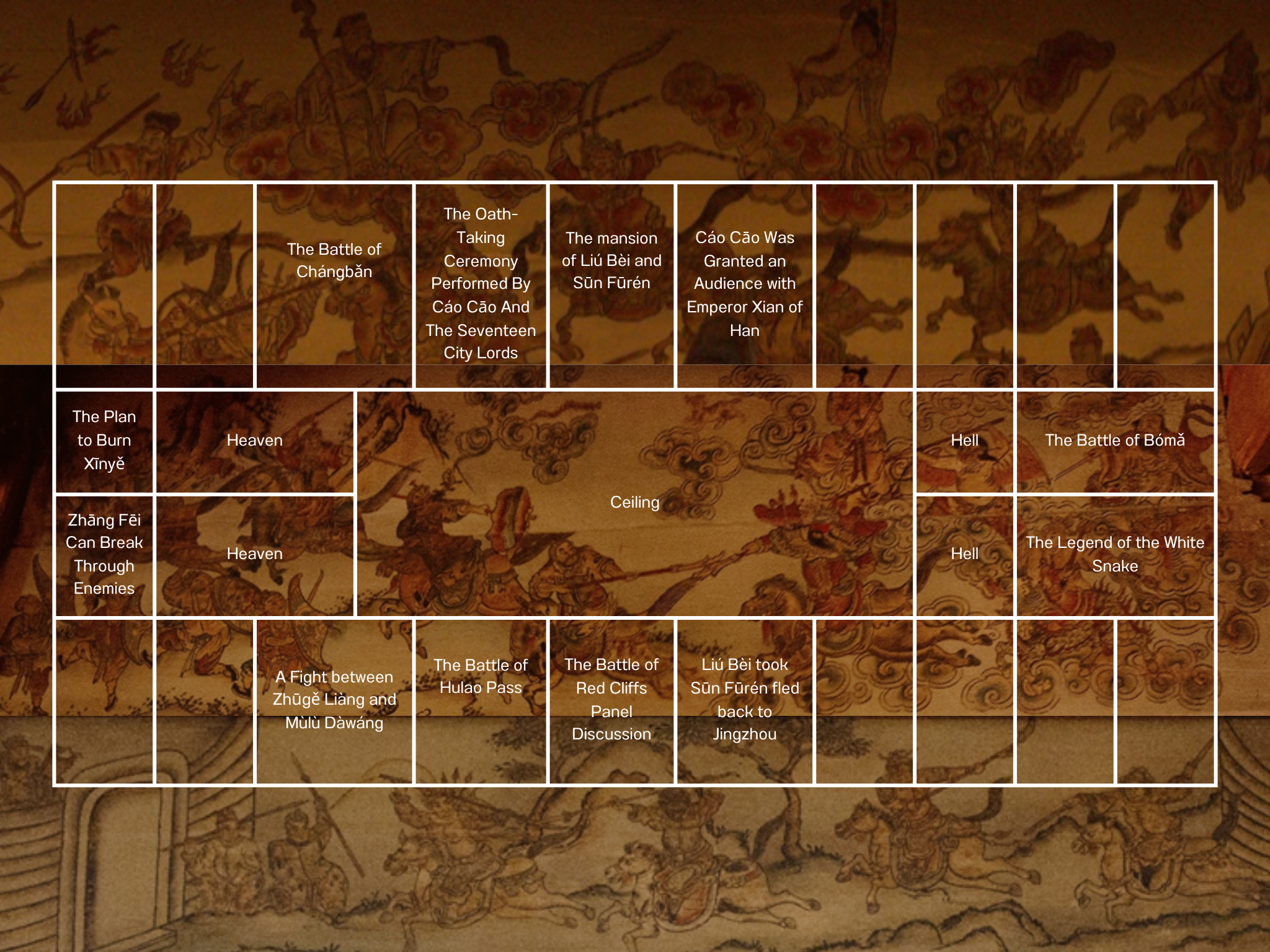
Results: The results revealed that The Romance of the Three Kingdoms were tempera paintings on wooden panels, created by Chinese artists during the reign of His Majesty King Nang Klao (King Rama III), dating no earlier than 1847. There are 11 episodes of the paintings of The Romance of the Three Kingdoms, namely: the plan to burn Xīnyě; Zhāng Fēi breaks through enemies; a fight between Zhūgě Liàng and Mùlù Dàwáng; the battle of Hulao Pass; the battle of Red Cliffs panel discussion; Liú Bèi took Sūn Fūrén and fled back to Jingzhou; The battle of Bómǎ; Cáo Cāo was granted an audience with Emperor Xian of Han; the mansion of Liú Bèi and Sūn Fūrén; The oath-taking ceremony performed by Cáo Cāo and the seventeen city lords; and the battle of Chángbǎn.
Application of this study: The results can help integrate the knowledge of Thai Buddhist decorations with Chinese art in the style of the royal style of His Majesty King Nang Klao (King Rama III). This also helps prevent the panel paintings on the sermon hall from disappearing and provides data for scholars and those interested in studying Chinese Studies in Thailand.
Conclusions: The Romance of the Three Kingdoms as decoration in Thai Buddhist sites in Bangkok was very popular during the reign of His Majesty King Nang Klao (King Rama III), found in six sites. The Romance of the Three Kingdoms as decoration in Thai Buddhist sites also reflects the understanding of the content of the literature of Thai people in the past, reflecting the popularity of The Romance of the Three Kingdoms through artworks in Thai society well.
Downloads
Article Details

This work is licensed under a Creative Commons Attribution-NonCommercial-NoDerivatives 4.0 International License.
References
Chumpol, P. (2002). Prachya lae naewkhid Wannakadee Thai Nai Jittrakam Fa Panung. [Philosophy and Literary Ideas in Thai Mural Painting]. Damrong Journal, 1(1), 263-293. (In Thai)
Committee for the Rattanakosin Bicentennial Celebrations. (1982). Jod Mai Hed Karn Anurak Krung Rattanakosin. [Rattanakosin Conservation Archives]. Bangkok: Department of Fine Arts. (In Thai)
DamrongRajanubhab. (1928). Tumnan Nangsoe Samkok. [History of the Romance of the Three Kingdoms]. Bangkok: Sophon Phiphat Thanakon Printing House. (In Thai)
Department of Religious Affairs. (1983). Prawat Wat Tua Raj Anajark lem Song. [History of Temples Throughout the Kingdom, Volume 2]. Bangkok: Religious Printing House. (In Thai)
Executive Committee. (2003). Silpakam Wat Bovoranives Vihara. [Buddhist Art of Wat Bovoranives Vihara]. Bangkok: Religious Printing House. (In Thai)
Klinhom, T. (Ed.). (2023). Phra Raj Vajira Dhamma Vides. [The Ceremony Book of Phra Raj Vajira Dhamma Vides]. Bangkok: Tonboonpimdee. (In Thai)
Klinhom, T. (2025a). Figure 2 The Old Sermon Hall at Wat Nak Prok in 2025.
Klinhom, T. (2025b). Figure 3 The Old Sermon Hall at Wat Absorn Sawan in 2025.
Klinhom, T. (2025c). Figure 4 The Panel Painting from the Old Sermon Hall at Wat Nak Prok.
Klinhom, T. (2025d). Figure 5 The Plan to Burn Xīnyě.
Klinhom, T. (2025e). Figure 6 Zhāng Fēi Can Break Through Enemies.
Klinhom, T. (2025f). Figure 7 A Fight between Zhūgě Liàng and Mùlù Dàwáng.
Klinhom, T. (2025g). Figure 8 The Battle of Hulao Pass.
Klinhom, T. (2025h). Figure 9 The Battle of Red Cliffs Panel Discussion.
Klinhom, T. (2025i). Figure 10 Liú Bèi Took Sūn Fūrén Fled Back to Jingzhou.
Klinhom, T. (2025j). Figure 11 The Battle of Bómǎ.
Klinhom, T. (2025k). Figure 12 Cáo Cāo Was Granted an Audience with Emperor Xian of Han.
Klinhom, T. (2025l). Figure 13 The Mansion of Liú Bèi and Sūn Fūrén.
Klinhom, T. (2025m). Figure 14 The Oath-Taking Ceremony Performed By Cáo Cāo And The Seventeen City Lords.
Klinhom, T. (2025n). Figure 15 The Battle of Chángbǎn.
Klinhom, T. (2025o). Figure 16 The Sequencing of Romance of the Three Kingdoms Narrative of on Panel Painting From the Old Sermon Hall at Wat Nak Prok.
Krittamethakul, S. (2012). Karn Suksa Jittrakam Fa Panung Nai Phra Ubosot Wat Nak Prok Khet Phasi Charoen Krung Thep Maha Nakhon. [The Study of Mural Painting in Wat Nakprok Khet Phasi Charoen Bangkok]. Master Thesis, M.A. in Fine Arts, Silpakorn University, Thailand. (In Thai)
MGR Online. (2016). Trakarn Ta Parb Pun Pan Wat Okas Nakorn Phanom Nueng Deaw Nai Muang Thai. [Spectacular! The Stucco Image of the Romance of the Three Kingdoms at Wat Okat Nakhon Phanom, the Only One in Thailand]. Retrieved 30 April 2025, from https://mgronline.com/local/detail/9590000036063. (In Thai)
Ninpat, K. (n.d.). Sala Kan Parian Wat Absorn Sawan. [old sermon hall Wat Absorn Sawan]. Retrieved 30 April 2025, from https://www.finearts.go.th/archae/view/36807-ศาลาการเปรียญวัดอัปสรสวรรค์. (In Thai)
Osatharom, W. (2012). Ngiw Nai Boribot Sangkom Silapa Watthanatham Thai. [Chinese Opera in The Context of Thai Society, Art and Culture]. In T.U. Thai Khadi Research Institute, (Ed.), Ngiw Nai Boribot Sangkom Silapa Watthanatham Thai. [Chinese opera in the context of Thai society, art and culture], (pp. 81-111). Bangkok: Thai Khadi Research Institute Thammasat university. (In Thai)
Phakdikham, N., & Phakdikham, S. (2006a). Samkok: Silapakam Jeen Wat Thai Nai Bangkok. [Sam Kok: The Classical Chinese Literature and Its Stories in Art Forms of Mural Painting and Bas-Relief in Bangkok Temples]. Bangkok: Matichon. (In Thai)
Phakdikham, N., & Phakdikham, S. (2006b). Parb Lai Kammalor Ruang Samkok Nai Phra Ubosot Wat Nang Nong Voravihara : Karn Tee Kwam Mai. [“Romance of the Three Kingdoms”, Lai Kammalor Painting (Lacquered Work) Inside the Ordination at Wat Nangnong Woravihara : A New Interpretation]. Silpawattanatham Magazine, 27(10), 128-142. (In Thai)
Reynolds, C. (2007). Chaosua, Khunsuk, Sakdina, Panyachon Lae Khonsaman. [Tycoons, Warlords, Feudal Lords, Scholars and Common Folk : A Collection of Historical Essays by Craig J. Reynolds]. Bangkok: The Foundation for the Promotion of Social Sciences and Humanities. (In Thai)
Tansakul, Y. (2015). Karn Palit Samkok Nai Boribot Sangkom Thai Po So 2480-2550. [The Production of “The Romance of Three Kingdoms” in Thai society, 1937-2007]. Master Thesis, M.A. in History, Thammasat University, Thailand. (In Thai)
SantadAksornSarn. (1924). Prawat Ngiw Nai Muang Thai. [The History of Chinese Opera in Thailand]. Sarp Thai, 3(9), 1591-1610. (In Thai)
Sartraprong, K. (1998). Rajadhiraja Samkok Lae Saihan : Lokkatad Chon Chan Num Thai. [Rajaghiraja Samkok and Saihan : World Views of the Thai Elites]. Bangkok: The Foundation for the Promotion of Social Sciences and Humanities. (In Thai)
Siritranon, D. (2019). Lao Can Pan Ngiw. [Telling Stories Through Chinese Opera]. Bangkok: So Asia Press (1989) Company. (In Thai)
The Fine Arts Department. (1990). Vivattanakarn Buddha Satarn Thai. [The Development of Thai Buddhist Temple Architecture]. Bangkok: The Fine Arts Department. (In Thai)
The Project to Survey and Register Ancient Sites and Archaeological Sites of the Nation. (1992). Tabian Boransatarn Nai Khet Krung Thep Maha Nakhon lae Parimonthon. [Registration of archaeological sites in Bangkok and its peripherals]. Bangkok: Fine Arts Department. (In Thai)
The Sangha of Wat Nakprok. (1999). Sri Pattana Khunanosorn. [The Commemorative Cremation Book of Phra kru Sri Pattana Khun]. Bangkok: Artornkarnpim. (In Thai)
Vajirayana Digital Library Project. (2025a). Phra Ratcha Phithi Sip Song Duean. [The Twelve Month Royal Ceremonies]. Retrieved 30 April 2025, from https://vajirayana.org/%E0%B8%9E%E0%B8%A3%E0%B8%B0%E0%B8%A3%E0%B8%B2%E0%B8%8A%E0%B8%9E%E0%B8%B4%E0%B8%98%E0%B8%B5%E0%B8%AA%E0%B8%B4%E0%B8%9A%E0%B8%AA%E0%B8%AD%E0%B8%87%E0%B9%80%E0%B8%94%E0%B8%B7%E0%B8%AD%E0%B8%99#google_vignette. (In Thai)
Vajirayana Digital Library Project. (2025b). Samkok. [Romance of the Three Kingdoms]. Retrieved 30 April 2025, from https://vajirayana.org/%E0%B8%AA%E0%B8%B2%E0%B8%A1%E0%B8%81%E0%B9%8A%E0% B8%81. (In Thai)
Wat Nak Prok Private Archives. (2022). Figure 1 The Old Sermon Hall at Wat Nak Prok in 1972.
Wongthes, S. (Ed.). (2015). Wat Nang Nong. [A History of Wat Nang Nong]. Bangkok: Matichon. (In Thai)
