
Protest and Ilmu Teluh: Superstitious Beliefs and Rituals in Thai Youth Political Movements
Article Sidebar
Main Article Content
Abstract
Background and Objectives: Between 2019 and 2023, Thailand witnessed waves of student- and youth-led protest movements. Although these young people are part of a new generation raised with scientific knowledge and technological advancements, many have chosen to incorporate supernatural beliefs and rituals—referred to as “ilmu teluh”—into their political activism, for example, the emergence of the “Ratsadon-muteluh”, a group which incorporates beliefs and rituals as a form of political expression.
Methods: This research studies the social phenomenon of superstitious belief and ritual practice among youth protesters using three methods: documentary analysis, non-participatory observation, and in-depth interviews (secondary data).
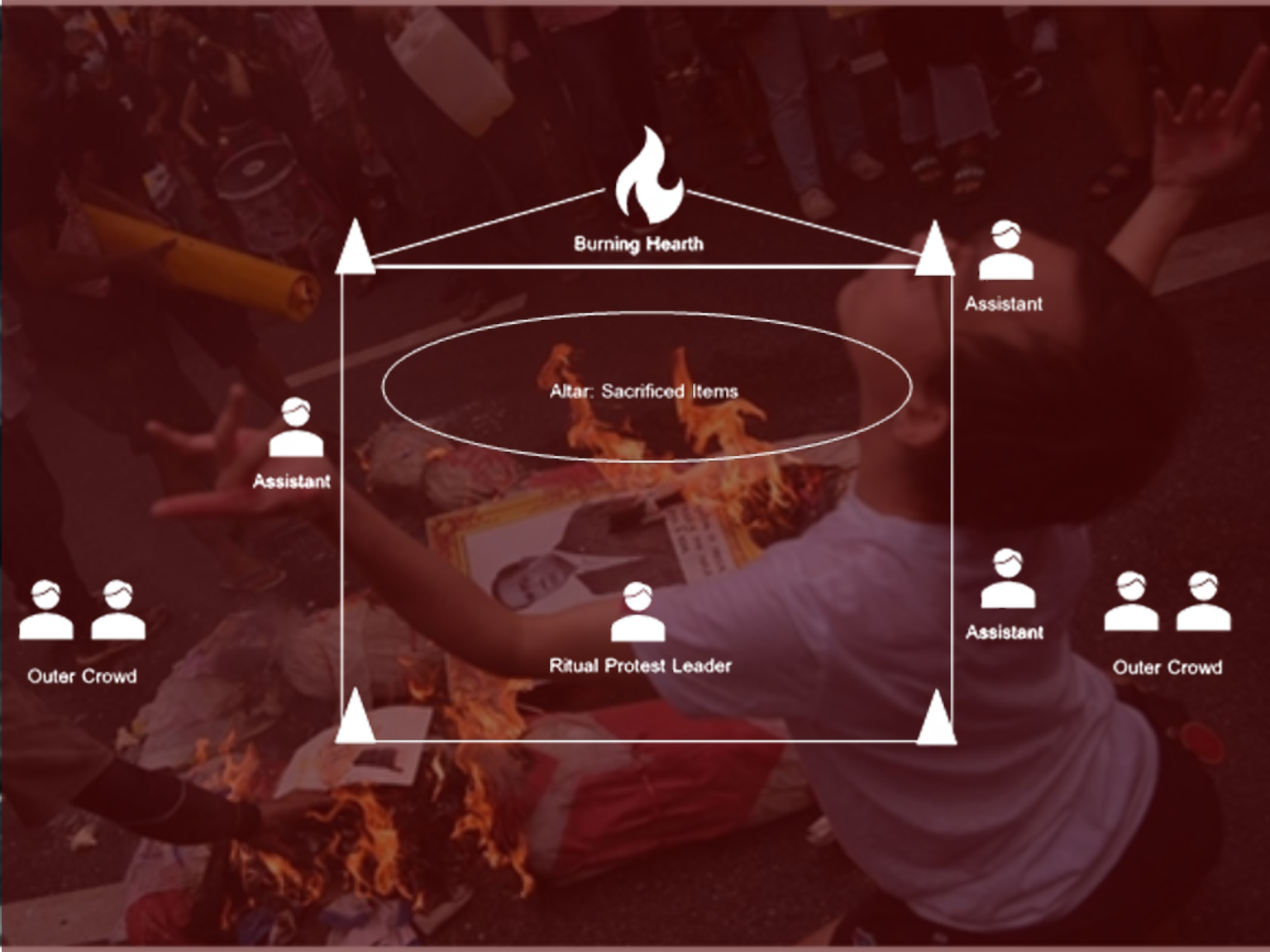
Results: Ilmu teluh rituals are practiced by numerous protest participants from various groups who believe that Thai society is dominated by a culture of privilege and oppression with a long-standing historical foundation, especially the Thai Royal Institution. These youth protesters perceive their political opponents, whom they label as the conservatives, to be highly credulous and devoted to superstition. As such, they therefore chose to use ilmu teluh as a symbolic tool to challenge their political opponents. Their protests targeted belief systems associated with prominent figures, while attempting to present an invented culture by reenacting rituals claimed to originate from the people instead. The protest rituals involving ilmu teluh were reenactments that did not follow the formal ritualistic principles of any particular belief system or religion, but were instead play-acting which comprises three acts: 1) the speech by protest leaders to clarify the objectives of the demonstration, 2) the role-playing as an artistic ritual to express emotions of resistance, and 3) the burning of effigies or objects as a form of symbolic communication through fire served as a climactic act in the performance. These rituals functioned both as a mechanism for moral healing and as a symbolic violence alternative to physical violence within the youth movements.
Application of this study: This research offers a framework for understanding the use of ilmu teluh rituals as a form of symbolic resistance. It serves as an analytical tool for examining youth-led cultural movements and political expressions within the context of an authoritarian society. The study is relevant to scholars, activists, and policymakers seeking to understand movements driven by beliefs.
Conclusions: Ilmu teluh rituals in Thai youth protests function as a symbolic expression that integrates political resistance with expressive culture. Through the reinterpretation and reconnection with traditional beliefs, youth protesters can use superstition as a tool for challenging authority, reclaiming public space, and expressing collective frustration. These rituals reflect a shift toward a movement rooted in the people rather than monopolized by the elites.
Downloads
Article Details

This work is licensed under a Creative Commons Attribution-NonCommercial-NoDerivatives 4.0 International License.
References
Dupuis-Déri, F. (2017). How Black Blocs Have Changed Protest Movements Around the World. The Conversation. Retrieved 18 April 2025, from https://theconversation.com/how-black-blocs-have-changed-protest-movements-around-the-world-80856 DOI: https://doi.org/10.64628/AAL.6ys3r3gsq
Friedman, T. (2014). The Square People, Part 1. Opinion, The New York Times. Retrieved 18 April 2025, from https://www.nytimes.com/2014/05/14/opinion/friedman-the-square-people-part-1.html
Hawae, P. (2021). Ratsadon Mu The Lu Chat Kitchakam Rarueka Khu Na Khondi Mi Khunkha Haeng Prachathipatai Tuathen Phei Rap Mai Dai Het Runraeng Nai #Op Sipsam Khumpha. [Mutelu Citizens Hold ‘Ruekrakun’ Event to Honor Democracy Advocates; Representatives Condemn Violence in #Mob13Feb Protest]. Retrieved 20 February 2025, from https://thestandard.co/mutelu-peoples-group-140264/ (In Thai)
Kerdphalanan, K. (2021). Poet Yutthasat Sa Yamu Tosu Duai Khwam Chuea. [The ‘Sai Mu’ Strategy: Battling with Belief]. Retrieved 27 February 2025, from https://www.bangkokbiznews.com/politics/924966 (In Thai)
Malinowski, B. (1971). Myth in Primitive Psychology. New York: Negro Universities Press.
Ongwanich, W. (2022). The Movements: Klum Mangkon Patiwat Kap Kan Khlueanwai Phuea Kanpatiru Sathaban. [The Movements: The Dragon Revolutionary Group and the Mobilization for Institutional Reform]. Retrieved 27 February 2025, from https://commonmuze.com/node/407 (In Thai)
Ortiz, I., & Others. (2022). World Protests: A Study of Key Protest Issues in the 21st Century [E-Book]. Switzerland: Springer. https://doi.org/10.1007/978-3-030-88513-7 DOI: https://doi.org/10.1007/978-3-030-88513-7
Panudomlak, N., & Suthichaya, Y. (2021). Ruchak Fa Ratsadon Mu The Lu Kap Pharakit Plot Aek Phadetkan Watthanatham Duai Khatha Akhom. [Meet ‘Fah, the Mutelu Citizen,’ and Her Mission to Dismantle Cultural Dictatorship through Incantations]. Retrieved 25 June 2025, from https://prachatai.com/journal/2021/05/92988 (In Thai)
Prachatai. (2021). Sattha Khwam Fan Lae Prawattisat Thi Thuk Phukkhat Fa Phrom Son Klum Ratsadon Mu The Lu. [Faith, Dreams, and Monopolized History: ‘Fah Phrommasorn’ of the Mutelu Citizens Group]. Retrieved 27 February 2025, from https://www.youtube.com/watch?v=kiCTdCrFxbY (In Thai)
Ratsadon News. (2022). Sot Chak Na Ruean Cham Mahakam "Mula Thoe" Doi Klum Mangkon Patiwat #Mu The Lu #Ploi Phuean Rao. [From the Prison Front: ‘Mula Ther’ Festival by the Revolutionary Dragons Group #Mutelu #FreeOurFriends]. Retrieved 30 June 2025, from https://www.youtube.com/watch?v=uNsTZiGva8g (In Thai)
Sandhinera, D. (2025a). Figure 3 Layout of Ritual Precinct in Thalufah Candle Festival.
Sandhinera, D. (2025b). Figure 4 Layout of Ritual Precinct in Hunting You by Muteluh.
Sandhinera, D., & Nakratok, S. (2023). Modern Protest in Thailand and Political Conflict Mapping. Bangkok: King Prajadhipok’s Institute. (In Thai)
Shek, D. T. L. (2020). Protest in Hong Kong (2019-2020): A Perspective Based on Quality of Life and Well-Being. Applied Research in Quality of Life, 2, 619-635. https://doi.org/10.1007/s11482-020-09825-2 DOI: https://doi.org/10.1007/s11482-020-09825-2
Shek, D. T. L., & Siu, A. M. H. (2019). “Unhappy” Environment for Adolescent Development in Hong Kong. Journal of Adolescent Health, 64(6), S1–S4. DOI: https://doi.org/10.1016/j.jadohealth.2019.01.007
Tapauhirun, S. (2023). A Study of Attitudes and Factors Affecting “Mutelu” Belief Behavior of Thai Consumers. Master Independent Study, M.A. in Communication Arts, Mahidol University, Thailand. (In Thai)
Turner, V. W. (1966). The Ritual Process: Structure and Anti-Structure. New York: Cornell University Press.
Udupa, S., & Pohjanen, M. (2019). Extreme Speech and Global Digital Cultures. International Journal of Communication, 13(2019), 3049-3067.
Voice TV. (2021). Wake Up Thailand - Phao 'Hun Prayut - 'Anuthin - Mo Yong' Chut Thian Hai Mong Hen Saengsawang #Hae Thian Khap Lai Saniat. [Wake Up Thailand: The Burning of Effigies of Prayut, Anutin, and Mor Yong, with Candle Lighting Symbolizing Enlightenment #CandleProcessionAgainstMalevolence]. Retrieved 25 June 2025, from https://www.youtube.com/watch?v=aKVYrEHj3VM (In Thai)
