
Sense of Place and Emotional Healing: Exploring Students’ Perceptions of Spaces for Emotional Recovery at Silpakorn University
Article Sidebar
Main Article Content
Abstract
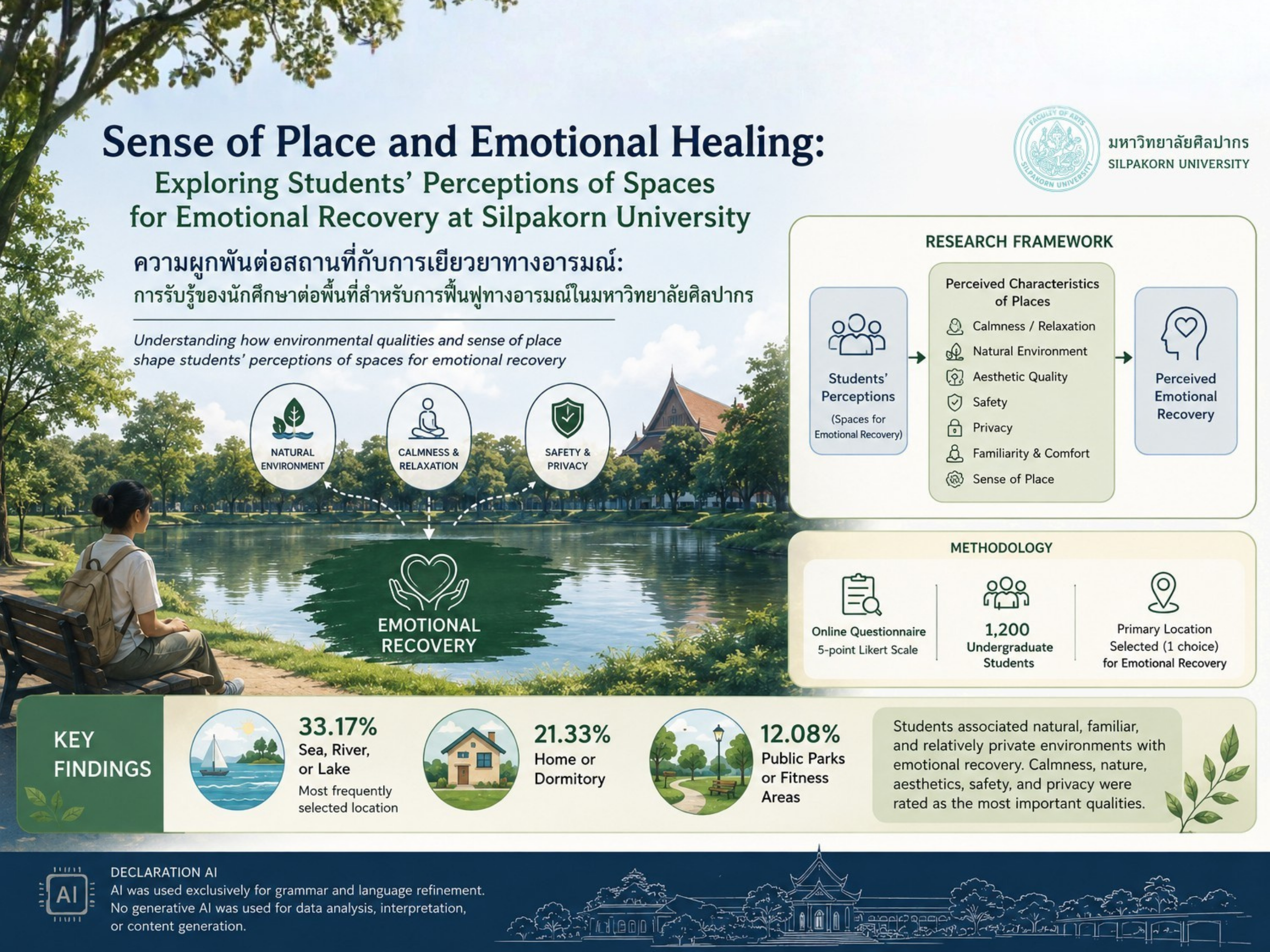
Background and Objectives: When individuals experience emotional distress arising from their daily lives or surrounding environment, they often seek places that provide comfort and emotional relief. Similarly, university students may encounter feelings of anxiety, stress, or distress, particularly those associated with adolescent romantic relationships. When these feelings occur, students need a place that helps them feel better and recover from such distress. This research aimed to study the characteristics of the places that university students use as places to manage heartbreak through the concept of Sense of Place and Environmental Psychology theory, and to analyze the factors that affect the formation of mental attachment and the meaning of those places related to memories and psychological healing processes.
Methods: The research used quantitative research methodology by collecting data from questionnaires with 1,200 students from Silpakorn University, Sanam Chandra Palace Campus. Stratified random sampling was used. The questionnaire was designed based on the concepts of Sense of Place and Environmental Psychology with an appropriate reliability value (Cronbach’s alpha = 0.80). The data were analyzed using descriptive statistics and interpretations based on the four conceptual frameworks of Sense of Place and Environmental Psychology.
Results: The results of the study found that the primary places that students selected for emotional recovery were the sea/river (33.17 percent), followed by their homes/dormitories (21.33 percent), and parks/fitness centers (12.08 percent), respectively. The main reasons students chose the places were the tranquility, relaxing atmosphere, and nature, which helped calm their minds. When considering the important factors of Sense of Place, which had the most impact on the choice of places, it was the environment, especially the atmosphere that helped them feel relaxed (𝑥̄ = 4.68). The least important factors were participation in activities in that place and historical or cultural values. The overall research results found that places can significantly promote the emotional recovery process, especially when the place creates a sense of peace and relaxation.
Application of this study: The results of this research can be used to design spaces within the university to respond to the emotional and mental health needs of students. It can be used as a guideline for developing public spaces or green spaces in the university to promote the mental health of youths and encourage university administrators or educational policy makers to be aware of the role of places in the process of mental healing and to integrate this knowledge into planning services or activities to sustainably develop the mental health of students.
Conclusions: This study reflects that a place plays an important role in the process of healing and restoring the emotional state of the students who experience romantic disappointment. The students tend to choose peaceful, relaxing, and nature-oriented spaces as places for emotional refuge, as these environments help reduce stress and promote psychological balance. The findings confirm that environmental elements, particularly an atmosphere that creates a sense of calm, are the most important factors in fostering place attachment and supporting emotional restoration. These findings indicate that physical spaces are not merely the backdrop of life experiences, but also important resources that influence psychological well-being. Therefore, the design and development of university spaces should take emotional dimensions and environmental psychology into consideration in order to create the environments that sustainably support students’ well-being and quality of life.
Downloads
Article Details

This work is licensed under a Creative Commons Attribution-NonCommercial-NoDerivatives 4.0 International License.
References
Appleton, J. (1975). Landscape Evaluation - Theoretical Vacuum. Transactions of the Institute of British Geographers, 66, 120-123.
Barajas, M., Castillo, C. C., & Balderrama, J. F. (2018). Characterization of a Breakup in Couples of University Students: Differences in Cognitive Assessment of the Event. Journal of Behavior Health & Social Issues, 9(2), 99-104.
Cao, Y., & Huang, L. (2023). Research on the Healing Effect Evaluation of Campus’ Small-Scale Courtyard Based on the Method of Semantic Differential and the Perceived Restorative Scale. Sustainability, 15(10), Article 8359.
Dosen, A. S., & Ostwald, M. J. (2013). Prospect and Refuge Theory: Constructing a Critical Definition for Architecture and Design. The International Journal of Design in Society, 6(1), 9-23.
Fang, W. T., Hassan, A., & Lepage, B. A. (2023). Environmental Psychology. In The Living Environment Education, (pp. 127–149). Singapore: Springer.
Fisher, H. (2016). Anatomy of Love: A Natural History of Mating, Marriage, and Why We Stray. New York, NY: W. W. Norton & Company.
Fisher, H. E., & Others. (2010). Reward, Addiction, and Emotion Regulation Systems Associated with Rejection in Love. Journal of Neurophysiology, 104(1), 51-60.
Foote, K. E., & Azaryahu, M. (2009). Sense of Place. In R. Kitchin, & N. Thrift (Eds.), International Encyclopedia of Human Geography, (Vol. 11, pp. 96–100). Oxford, UK: Elsevier.
Gifford, R. (2013). Environmental Psychology: Principles and Practice. 5th ed. Colville, WA: Optimal Books.
Hu, Q., & Others. (2025). Exploring the Effects of Colleges Green Spaces (CGSs) Exposure on Mental Health of Students From a Space–Time Path Perspective. Ecological Indicators, 175, Article 113538.
Humphrey, G. (1924). The Psychology of the Gestalt. Journal of Educational Psychology, 15(7), 401–412.
Kongprapun, N. (2020). Factors Influencing Adolescent Depression Case Study: Rajamangala University of Technology Suvarnabhumi. Journal of Social Science and Buddhistic Anthropology, 5(11), 302-315. (In Thai)
Krejcie, R., & Morgan, D. (1970). Determining Sample Sizes for Research Activities. Educational and Psychological Measurement, 30, 607-610.
Li, H., & Others. (2026). How Green Space Quantity and Quality Across Different Geographic Contexts Impact Mental Health. Cities, 168, Article 106439.
Khaidzir, M. F. S., & Kamal, M. A. A. (2023). Sense of Place: Place Identity, Place Attachment, and Place Dependence Among University Students. International Journal of Academic Research in Business & Social Sciences, 13(10), 1020-1033.
Kühn, T. & Bobeth, S. (2022). Linking Environmental Psychology and Critical Social Psychology: Theoretical Considerations Toward a Comprehensive Research Agenda. Frontiers in Psychology, 13, Article 947243.
Liu, Q., & Others. (2018). The Relationship Between Self-Rated Naturalness of University Green Space and Students’ Restoration and Health. Urban Forestry & Urban Greening, 34, 259-268.
Lynch, K. (1960). The Image of the City. Harvard-MIT Joint Center for Urban Studies Series. Cambridge, MA: MIT Press.
MacAllister, L., Bellanti, D., & Sakallasris, B. R. (2016). Exploring Inpatients' Experiences of Healing and Healing Spaces: A Mixed Methods Study. Journal of Patient Experience, 3(4), 119-130.
Nielsen, K. S., & Others. (2024). Realizing the Full Potential of Behavioural Science for Climate Change Mitigation. Nature Climate Change, 14(4), 322-330.
O-in, S. (2025). Figure 1 Conceptual Framework.
Piver, S. (2009). The Wisdom of a Broken Heart: An Uncommon Guide to Healing, Insight, and Love. New York, NY: Atria Books.
Rahmania, T. (2024). Exploring School Environmental Psychology in Children and Adolescents: The Influence of Environmental and Psychosocial Factors on Sustainable Behavior in Indonesia. Heliyon, 10, Article e37881.
Relph, E., (1976). Place and Placelessness. London, UK: Pion.
Sanguanwong, N., & Others. (2025). Adolescents Depression and Resilience. Journal of MCU NakhonDhat, 12(1), 236-245. (In Thai)
Seamon, D., & Sowers, J. (2008). Place and Placelessness: Edward Relph. In P. Hubbard, R. Kitchen, & G. Vallentine. (Eds.), Key Texts in Human Geography. (pp. 43-51). London, UK: Sage.
Shamai, S. (1991). Sense of Place: An Empirical Measurement. Geoforum, 22(3), 347-358. https://doi.org/10.1016/0016-7185(91)90017-K
Steele, F. (1981). The Sense of Place. Boston, MA: CBI Publishing.
Steiner, L. M., & Others. (2015). Effect of Infidelity, Initiator Status, and Spiritual Well-Being on Men’s Divorce Adjustment. Journal of Divorce & Remarriage, 56(2), 95-108.
Troughton, A., Chin, M., & Amankwaa, I. (2024). Nature as a Therapeutic Place and Tool for Enhancing Service Users’ Engagement in Mental Health Services: A Comprehensive Synthesis. Health and Place, 89, Article 103344.
Tuan, Y. F. (1974). Topophilia: A Study of Environmental Perception, Attitudes, and Values. Englewood Cliffs, NJ: Prentice-Hall.
Williams, D. R., & Stewart, S. I. (1998). Sense of Place: An Elusive Concept That is Finding a Home in Ecosystem Management. Journal of Forestry, 96(5), 18-23. https://doi.org/10.1093/jof/96.5.18
Yan, S., & Others. (2024). Healing Spaces as a Design Approach to Optimize Emotional Regulation for Patients with Mood Disorders. Buildings, 14(2), 472.
Yim, D., & Kwon, Y. (2025). How Residential Environments Affect Depressive Mood and Stress Among Young Adults in South Korea: The Role of Restorativeness. Cities, 166, Article 106165.
Zhang, R., Zhang, C., & Rhodes, R. E. (2021). The Pathways Linking Objectively-Measured Greenspace Exposure and Mental Health: A Systematic Review of Observational Studies. Environmental Research, 198, Article 111233.
