
The Impacts of Historic District Revitalization in the Transition Toward Creative Districts: A Case Study of Song Wat, Bangkok
Article Sidebar
Main Article Content
Abstract
Background and Objectives: Song Wat, located in Bangkok’s Samphanthawong district, has played a crucial role in Thailand’s commercial history since the reign of King Rama V. This has been reflected through mixed-use residential–commercial buildings and warehouses, benefiting from its riverside position on the Chao Phraya and nearby cargo piers, while linking to the wider region via Hua Lamphong Railway Station. Subsequently, with the increasing importance of land transportation, traffic congestion became a significant issue. In addition, the Bangkok Metropolitan Administration (BMA) introduced regulations limiting the use of heavy trucks in conservation areas to reduce pollution. This affected the local economy of Song Wat. Many long-standing businesses relocated, leaving behind vacant properties and an increasingly aging population. Despite this decline, wholesale activities, particularly those linked to Sampeng Market, continued to sustain the area’s commercial identity. To address these challenges, BMA adopted the Creative Economy policy, aimed at revitalizing historic districts, including Song Wat. This initiative focused on redeveloping deteriorated urban spaces and leveraging connectivity through rail networks. The policy has encouraged new generations of entrepreneurs, including the descendants of local families to re-engage with the area. Consequently, new businesses emerged, and the Song Wat district became well known, attracting tourists and benefiting the local economy. However, there were also negative impacts, including limited green space, along with those on traditional community ways of life and workers’ quality of life. This article aims to examine the impacts of creative economy–driven revitalization in Song Wat and to propose guidelines for the physical design and spatial management of the Song Wat district.
Methods: This study employed a qualitative research approach by collecting physical data of the area to understand the spatial issues that have emerged following its development into a creative district. The findings were then incorporated into participatory workshop activities, through which initial conceptual solutions were proposed for addressing these issues—both in terms of improving physical infrastructure and enhancing digital systems.
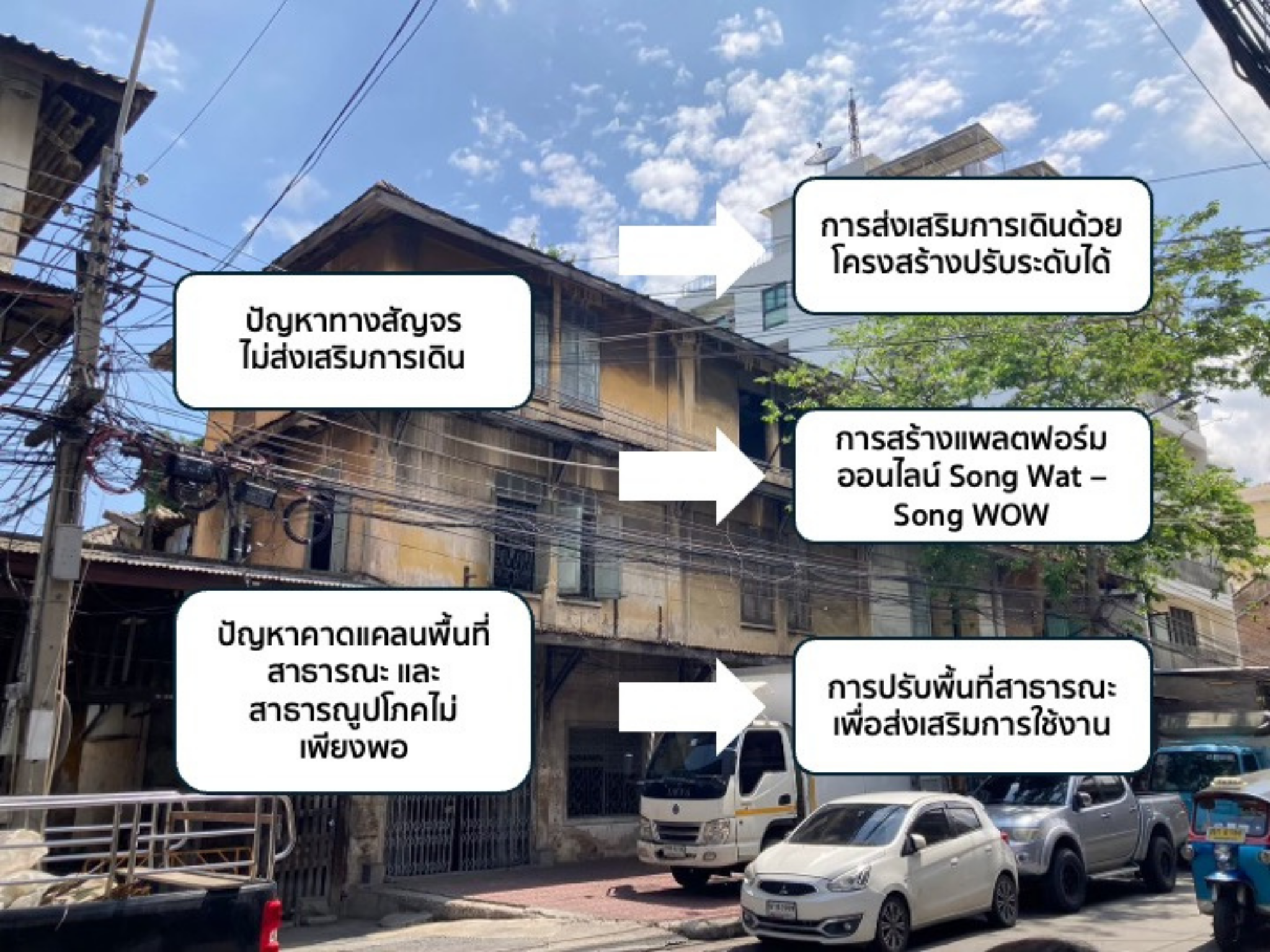
Results: The findings revealed that Song Wat has not yet achieved the conditions of a fully developed creative district. Key elements remain absent, such as permanent creative workspaces, a reliable internet network, financial incentive mechanisms between landlords and creative workers, and systems for knowledge transfer and data collection for further development. The continued growth of Song Wat as a creative district driven by tourism has generated positive economic impacts for the area. The increase in employment has led to higher population density in the area, which in turn affects the availability and capacity of public spaces that support residents’ quality of life. Therefore, this study proposes physical design strategies to enhance quality of life: 1) The adaptive street furniture attached to building facades or located in alleyways could create flexible shared spaces, enhancing walkability and accommodating overlapping user needs. 2) An online platform could facilitate data sharing among diverse users, linking onsite and digital activities to reduce pedestrian congestion. This could enhance commercial information for local businesses while also providing greater convenience for tourists. 3) The vacant or underutilized areas should be converted into usable public spaces for relaxation, providing benefits for both workers and tourists while improving the quality of life for both residents and tourists in the Song Wat area.
Application of this study: The results of this study can be applied as an initial conceptual framework for physical design and spatial management, serving as a foundation for proposing future district improvement projects. Stakeholders from both the public and private sectors may further discuss and build upon these recommendations for continued development.
Conclusions: The development of creative districts generates positive economic and social benefits for the area. However, it may also negatively affect residents’ quality of life and the ease of shared space usage between visitors and the local community. Therefore, creative district design should take into account the key components of district development and incorporate long-term spatial management planning. Stakeholders in the area should recognize these considerations in order to establish sustainable district management strategies moving forward.
Downloads
Article Details

This work is licensed under a Creative Commons Attribution-NonCommercial-NoDerivatives 4.0 International License.
References
British Council. (2020). Creative and Cultural Districts in Thailand. Retrieved 9 March 2025, from https://www.britishcouncil.org/sites/default/files/bc_creative_cultural_districts_in_thailand_online.pdf
Creative Economy Agency. (2025). Vision and Mission. Retrieved 9 March 2025, from https://www.cea.or.th/th/about
Klinmalai, S. (2025a). Figure 1 Location and Map of Song Wat Road in Samphanthawong District.
Klinmalai, S. (2025b). Figure 4 Promoting Activities of Song Wat Creative District Since 2021.
Klinmalai, S. (2025c). Figure 5 Scope of Study Area.
Klinmalai, S. (2025d). Figure 6 Workshops and Site Survey Photos.
Klinmalai, S. (2025e). Figure 8 Impact of Creative District Development in Song Wat.
Klinmalai, S. (2025f). Figure 9 From Area’s Issues to Design Solutions for Song Wat area.
Nureang, P. (2024). The Role and Change of Song Wat Neighborhood, Bangkok. Retrieved 9 March 2025, from https://digital.library.tu.ac.th/tu_dc/frontend/Info/item/dc:314988
Phonghanyudh, K., & Others. (2022). Social Impacts of Creative Hubs in Thailand. Retrieved 9 March 2025, from www.britishcouncil.or.th:https://www.britishcouncil.or.th/sites/default/files/social_impacts_of_creative_hubs_in_thailand_final_compressed_compressed.pdf
Pulles, K., & Others. (2023). Emerging Strategies for Regeneration of Historic Urban Sites: A Systematic Literature Review. City, Culture and Society, 35, 1-15.
Samphanthawong District Office. (2020). Regulations on Parking and Driving on the Pavement/Sidewalk. Retrieved 30 November 2025, from https://infocenter.oic.go.th/FILEWEB/CABINFOCENTER9/DRAWER068/GENERAL/DATA0003/00003200.PDF
Suvarnananda, C. (2024). The Regeneration of the Historic Area of Song Wat Through the Adaptive Reuse of Heritage Buildings and the Sense of Place. Bangkok: Faculty of Architecture, Silpakorn University.
TDSxKDS International Workshop. (2024a). Problems of Circulation in Song Wat. Bangkok: Faculty of Architecture and Planning, Thammasat University.
TDSxKDS International Workshop. (2024b). Example of Walking Promotion Design. Bangkok: Faculty of Architecture and Planning, Thammasat University.
TDSxKDS International Workshop. (2024c). Example of Application Design As Song Wat Song WOW! To Promote Convenience for Visitors And Locals In Area. Bangkok: Faculty of Architecture and Planning, Thammasat University.
TDSxKDS International Workshop. (2024d). Example of Rest Areas for Visitors and Community. Bangkok: Faculty of Architecture and Planning, Thammasat University.
Thailand Creative & Design Center (TCDC). (2017). TCDC Outlook Creative Prospects. Bangkok: Sunta Press.
The Bangkok Metropolitan Administration (BMA), Strategic Administration Division, Strategy and Evaluation Department. (2024, December 3). BMA Policy Tracking. Retrieved 9 March 2025, from https://policy.bangkok.go.th/tracking/frontend/web/index.php?r=site%2Fvwdkrs671&ID=1
