
Development of Natural-Dyed Fabric Products from Pink Trumpet Tree Flowers to Promote Creative Tourism Under the Green University Concept
Article Sidebar
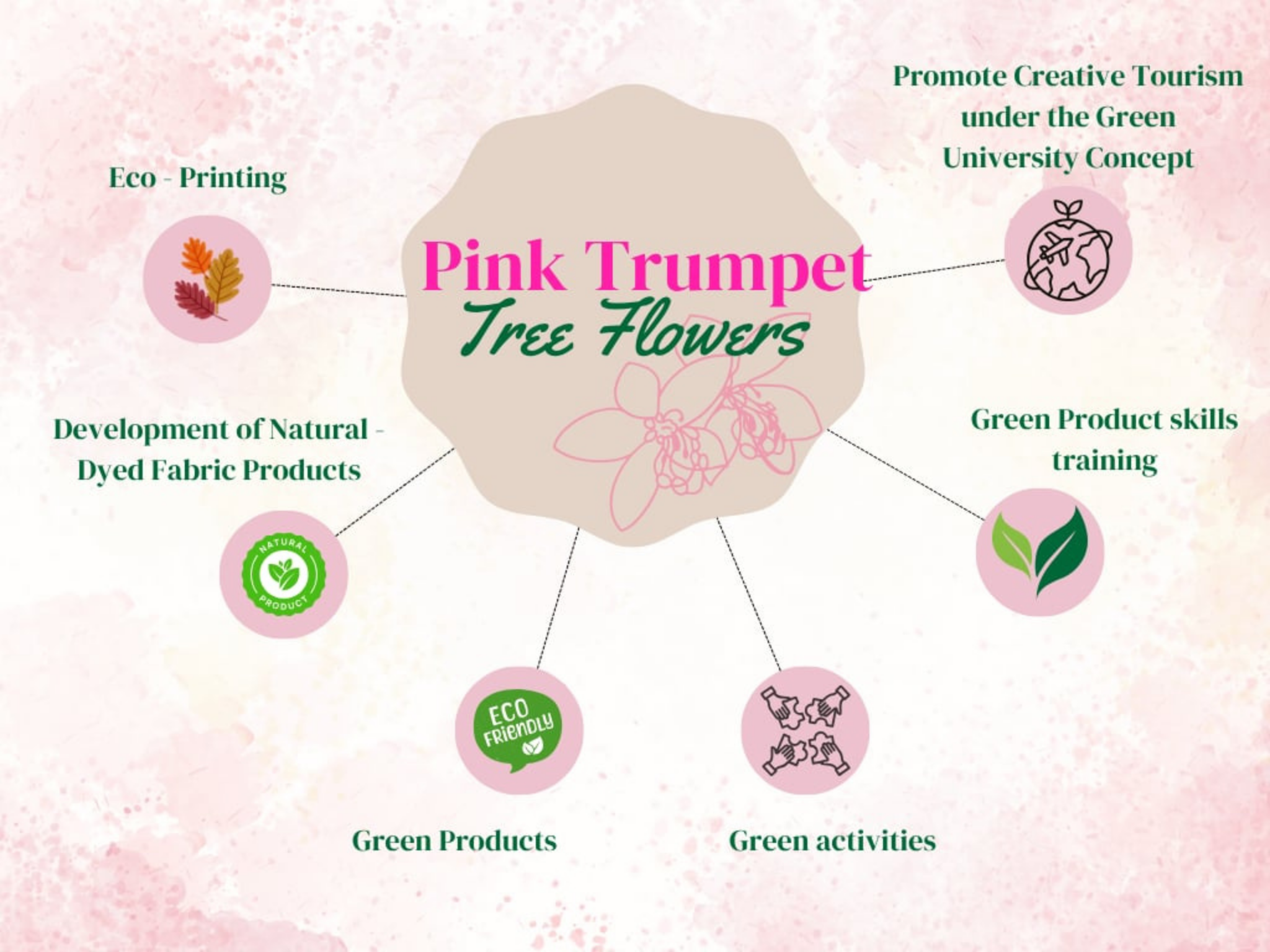
Main Article Content
Abstract
Background and Objectives: The pink trumpet tree (Tabebuia rosea) is a large tree known for its soft pink, bright pink, and white blossoms. This “Pink Trumpet Tree Road” has become a well-known attraction for both Thai and foreign tourists. To create the products that reflect the unique beauty of the pink trumpet tree, or to utilize this tree to generate income and develop new innovations, this research, highlights the importance of utilizing natural resources found within Kasetsart University, Kamphaeng Saen Campus—particularly the use of natural materials derived from the pink trumpet tree—and aligns with the university’s strategic goal of enhancing resource management capacity for sustainability under changing conditions.
Methods: The design of fabric products using natural materials from the pink trumpet tree was divided into three steps: 1) preparing the raw materials, which includes the process of collecting pink trumpet tree flowers and methods for preserving them in conditions suitable for use as printing materials, as well as the ingredients needed to ensure the fabric patterns are durable; 2) printing the fabric to create the finished fabric; 3) transforming the printed fabric into various products that use the pink trumpet tree patterned fabric as a main component.
Results: The study found that the pink trumpet tree can be a viable natural material for textile product development. Fallen blossoms and leaf stalks were used to enhance the beauty of the patterns. The fabrics printed with these natural components were then transformed into various eco-friendly or low-carbon products such as scarves, shirts, bags, tablecloths, and pillowcases. These items were marketed under the brand name “Watthana Setthasawat” to honor the university’s first vice president, who was instrumental in planting the pink trumpet trees, and to be in line with the name of the Pink Trumpet Tree Road.
At the same time, a creative tourism activity base was designed, allowing visitors to observe or participate in fabric-making using natural materials and the leaf-printing technique with consideration for maximizing the use of the university’s natural resources and adhering to the principle of causing no environmental impact.
Application of this study: The technique of transferring colors and patterns from nature (leaves) onto fabric and materials made from natural fibers (printing process) through a heat method known as eco printing is an innovation that meets all needs and requires low investment. Therefore, we collaborated to test printing leaves onto 100% cotton fabric using color-fixing agents, including fruit extracts and rust water. This was a trial-and-error printing process until a beautifully colored and patterned leaf-printed fabric was achieved that was durable, safe from chemical dyes, and one-of-a-kind. The printed fabric was then used to create a variety of products for sale, generating income under The Premium @KU within KUniverse, which integrates the academic excellence and research work of the faculty of Kasetsart University.
Conclusions: The pink trumpet tree can serve as a natural material that can be developed into textile products by using the fallen flowers from the tree, as well as the leaf stalks, to enhance the beauty of the fabric patterns. This allows for the creation of various eco-friendly or low-carbon products made from the fabric printed with the components of T. rosea, including scarves, shirts, bags, tablecloths, and pillowcases, under the brand “Watthana Setthasawat.” This brand pays tribute to the first vice president who initiated and developed the planting of the pink trumpet trees, in alignment with the name of Chompoo Pantip Road. However, it can also be expanded into designing creative tourism activities in line with the green university concept, which includes demonstrations of fabric-making using natural materials or allowing visitors to participate in activities such as printing leaf patterns on fabric. This initiative considers the optimal use of natural resources within the university while also adhering to principles that do not negatively impact the environment.
Downloads
Article Details

This work is licensed under a Creative Commons Attribution-NonCommercial-NoDerivatives 4.0 International License.
References
Binkhorst, E. (2006). The Co-Creation Tourism Experience. Retrieved 13 April 2025, from http://www.esade.edu/
Boonsom, K. (2022). The Womenswear Branding Innovation from Hemp for Environmental Creative Crafts Target Group by Using Japanordic Cultural Capital Concept to Sustainability. Master Thesis, M.A. in Creative Arts, Chulalongkorn University, Thailand. (In Thai)
Choawunklang, W., & Pasaja, P. (2013). The Studies Natural Extract in Dyeing Cotton. Master Thesis, M.A. in Physics Program, Rajabhat Maha Sarakham University, Thailand. (In Thai)
Chuanpit, S., & Others. (2009). Manual on the Knowledge of Silk Dyeing from Natural Materials in the Northeastern Region. Department of Sericulture, Ministry of Agriculture and Cooperatives: Bangkok. (In Thai)
Churat, K. (2021). Natural Dye Fabrics: Generating Income and Value from Nature, Science and Art. Retrieved 28 April 2023, from https://www.technologychaoban.com.
Designated Areas for Sustainable Tourism Administration Public Organization. (2018). Creating Creative Tourism Toolkit. Bangkok: Book Plus.
Limprakhon, K. (2022). Green Marketing Trend, A New Opportunity in an Era That Cares About Nature. Retrieved 13 April 2025, from https://contentshifu.com/blog/what-is-green-marketing/
Manori, T., & Others. (2021). Development and Design of Natural Tie Dye Bags. The Journal of Accounting Review Chiang Rai Rajabhat University, 6(1), 87-95. (In Thai)
Noipitak, C. (2018). The Design of Tie-Dye Patterns and Dyeing With Natural Colors: A Case Study of High School Students at Puranaawas School, Taling Chan District, Bangkok. Journal of Fine Arts, Research, and Creativity, 6(1), 246-265. (In Thai)
Pantung, P. (2019). Participatory Development of Textile Products of Ban Phu Thong Community, Sukhothai Province. Area Based Development Research Journal, 11(4), 331-345. (In Thai)
Piboon, T. (2014). Strategic Management. Bangkok: Amorn Printing. (In Thai)
Raymond, C. (2007). Creative Tourism New Zealand. In G. Richards, & J. Wilson, (Eds.), In Tourism, Creativity and Development, (pp.145-158). London: Routledge.
Richards, G., & Raymond, C. (2000). Creative Tourism. ATLAS News, 23, 16–20.
Saengsuwan, S. (2018). Clothing. Retrieved 28 April 2023, from https://readthecloud.co/entrepreneur-rissara/
Sarasuk, K. P., & Wongmuek, K. (2024). Pattern Design for Wood Block Printing on Mangrove Bark Dyed Fabric from The Identityof Khlong Pak Pid Community, Bang Saphan District, Prachuap Khiri Khan Province. Journal of Fine and Applied Arts, Khon Kaen University, 16(1), 135-153. (In Thai)
Siriwan, S. (2015). Impact of Foreign Worker Migration on Wage and Labor Market in Thailand. In A. P. Thanapat (Ed.), Global Migration: Issues, Challenges and Perspectives, (pp. 66–79). Hershey, PA: IGI Global.
Supattharayan, T. (2020). Report on the 2020 Performance of the Handwoven Village Project From the Firework Pattern Using Environmentally Conscious Design Technology. Retrieved 8 May 2024, from http://www.clinictech.ops.go.th/online/cmo/FinalReport/202010301056501.pdf
Tangtenglam, S. (2025a). Figure 1 The Printed Fabric Is Made from the Unblended Color of the Pink Trumpet.
Tangtenglam, S. (2025b). Figure 2 The Printed Fabric Mixed with Colors from The Pink Trumpet Tree.
Tangtenglam, S. (2025c). Figure 3 The Shirt Made from Non-Blended Fabric.
Tangtenglam, S. (2025d). Figure 4 The Shirt Made from Natural Blended Fabric.
Tangtenglam, S. (2025e). Figure 5.1 Hat.
Tangtenglam, S. (2025f). Figure 5.2 Hat.
Tangtenglam, S. (2025g). Figure 6 Coin Purse.
Tangtenglam, S. (2025h). Figure 7 Shawl and Scarf.
Thongprasert, N., & Others. (2020). Product Development to Premium Otop by Using Cultural Capital and Local Wisdom: A Case Study of Natural Dyne Silk of Hua Muang Weaving Women Group, Mahachanachai, Yasothon. Journal of Graduate School of Pitchayatat, 15(1), 95-108. (In Thai)
UNESCO. (2006). What is Open and Distance Learning (ODL)? Retrieved 13 April 2025, from http://portal.unesco.org/education/en/ev.phpURL_ID=22329&URL_DO=DO_TOPIC&URL_SECTION=201.html.
Wisudthiluck, S., & Others. (2011). Creative Tourism Thailand. Ancient City Journal, 37(1), 75-87. (In Thai)
Wongmuek, K. (2025). The Creation of Identity Color Palettes Using Natural Dyes for the Product Development of the Roi Rak Weaving Community, Pathum Rat District, Roi Et Province. Journal of Arts and Thai Studies, 47(1), E4027 (1-17).
Wurzburger, R. (2010). Introduction to the Santa Fe & Unesco International Conference a Global Conversation on Best Practices and New Opportunities. In R. Wurzburger, (Ed.), Creative Tourism: A Global Conversation How to Provide Unique Creative Experiences for Travelers Worldwide, (pp. 15–25), Santa Fe & Unesco International Conference on Creative Tourism, October 25-27, 2006. New Mexico, USA.
