
An Ethnosemantic Study of Village Place Names in the Songkhla Lake Basin
Article Sidebar
Main Article Content
Abstract
Background and Objectives: Place names might be considered as linguistic evidence that contains the area’s historical origin. An analysis of place names, hence, may result in further understanding local history. When combining such analysis with local interpretations of place names through their storytelling, this ethnosemantic study might reveal the historical depth and richness of the area that may be otherwise hidden in the explicit meaning of the place names.
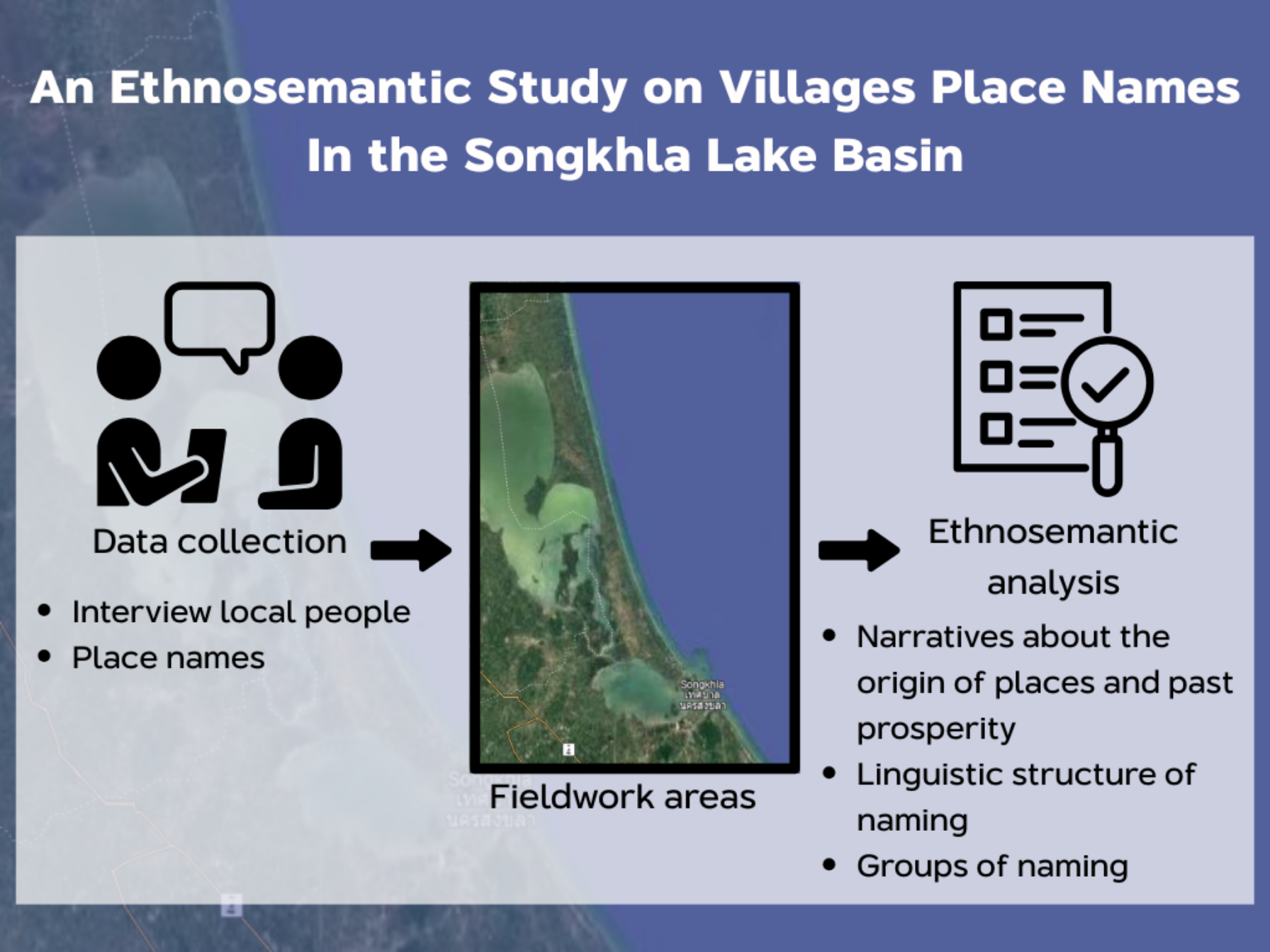
Methods: This study is qualitative research that aims to explore and study the place names of the villages along the Songkhla Lake Basin, Songkhla province, across 4 districts, 56 communities, and 150 villages with the linguistic concept of ethnosemantics. The study was carried out through interviews with local community leaders.
Results: The research findings revealed the structures of village names in both single and compound structures. The most prevalent was a two-semantic composition, which included both the head words and the modifiers, particularly the key word in words such as Bo, Phang, and Tha. The most prevalent way of naming was to refer to natural phenomena, places, or important people. Finally, the reflection obtained from the naming indicated that the majority of people practice Buddhism and other religions that coexisted in the area, specifically Islam. In addition, the Chinese population emerged as the most prominent in the area. Furthermore, ways of life and occupations can be discerned from naming, which illustrates the diversity of people’s lives, including rice farming, orchard keeping, fishing, and so forth. This reflects the demographical richness in the area and may be linked to the prosperity of the Suvarnabhumi region as inferred from an analysis of place names.
Applications of this Study: The research findings could be synthesized into knowledge for the local people, enabling them to appreciate the significance of their regional resources and to eventually foster the conservation of these resources in the future.
Conclusion: The research on village names in the coastal districts of Songkhla province (Mueang Songkhla, Ranot, Sathing Phra, and Singhanakorn) reveals that naming practices reflect the region’s geography, history, culture, and natural environment. Most villages are named after natural features, such as water-related terms like Bo, Phang, and Tha, indicating the area’s strong connection to water. Naming after natural phenomena is the most common strategy, followed by names rooted in historical events, important individuals, or nearby landmarks like temples. The influence of Buddhism is particularly notable as many village names reflect Buddhist stories and practices, even in religiously diverse areas. Ethnic diversity, especially the presence of Chinese communities, also plays a role in naming traditions, reflecting Songkhla’s historical origins. Additionally, village names often reflect the agricultural lifestyle of locals, referencing occupations like farming and fishing, as well as local flora. Thus, these naming patterns can indicate the cultural and environmental identity of the population in the Songkhla Lake Basin.
Downloads
Article Details

This work is licensed under a Creative Commons Attribution-NonCommercial-NoDerivatives 4.0 International License.
References
Angsuwiriya, N. (2024). Figure 1 Map of Fieldwork Area in Songkhla Province. (In Thai)
Buranaut, I., & Kirdsiri, K. (2014). Buddhism Vernacular Architecture in Songkhla Lake Basin. Journal of Architectural/Planning Research and Studies (JARS), 11(1), 1-20. https://doi.org/10.56261/jars.v11i1.24701. (In Thai)
Charunrochana, J. (2016). Language in Socio-Cultural Context. 2nd ed. Bangkok: Kasetsart University Press. (In Thai)
Conklin, H. (1964). Language in Culture and Society. New York: Harper & Row, Publisher.
Deelert, W., Wiyaporn, S., & Phaetprida, C. (2021). Toponyms of Temples in Nakhon Chai Si district, Nakorn Pathom province. Academic Journal Bangkokthonburi University, 10(1), 43-54. (In Thai)
Dinlansagoon, M. (2013). Place names: Life-stories of people and communities around Songkhla Lake. Journal of Education Thaksin University, 13(1), 154-173. (In Thai)
Frake, C. O. (1961). The Diagnosis of Disease Among the Subanun of Mindanao. American Anthropologist, 63, 113-132.
Frake, C. O. (1962). The Ethnographic Study of Cognitive Systems. In T. Gladwin, & W. C. Sturtevant. (Eds.), Anthropological and Human Behavior. (pp. 72-85). Washington, D.C.: Anthropological Society of Washington.
Gainey, J. W. (1984). Toponyms in Eastern and Southeastern Thailand: A Preliminary Study of Village Names in Chonburi, Rayong, Chanthaburi, and Trat. PASAA, 14(2), 36-57.
Hymes, D. H. (1964). Language in Culture and Society. New York: Harper & Row.
Jaiping, A., & Kemkan, W. (2022). Background and Change of Temple Names, Nai Wiang Sub-district, Mueang Nan District, Nan Province. Academic MCU Buriram Journal. 7(2) 207-220. (In Thai)
Prasithrathsint, A. (2006). The Making of a Linguist. Bangkok: Chulalongkorn University. (In Thai)
Prasithrathsint, A., & Others. (2012). Important People and Main Ideas in Ethnosemantics. Bangkok: ASP Publishing. (In Thai)
Prommas, C. (2022). Toponymy of Temples in the District of Mueng Nakhon Sawan, Kakhon Sawan Province: Characteristics of Language Used in the Origin of Naming. Inthaninthaksin Journal, 17(1), 63-90. (In Thai)
Radding, L., & Western, J. (2010). What’s in a Name? Linguistics, Geography, and Toponyms. Geographical Review, 100(3), 394-412. https://doi.org/10.1111/j.1931-0846.2010.00043.x.
Sharifian, F. (2014). Advances in Cultural Linguistics. In M. Yamaguchi, D. Tay, & B. Blount (Eds.), Approaches to Language, Culture, and Cognition (pp. 99-123). New York: Palgrave Macmillan.
Sturtevant, W. C. (1964). Studies in Ethnoscience. American Anthropologist, 66(3), 99-131. JSTOR. https://doi.org/10.2307/669326.
Supich, K., & Pewporchai, P. (2021). Village Names in Ubon Ratchathani Province. Journal of Humanities and Social Sciences Bansomdejchaopraya Rajabhat University, 15(1), 29-49. (In Thai)
The Institute for Southern Thai Studies. (1999). Thailand Cultural Encyclopedia, Southern Region (Vol. 16). Bangkok: Thailand Cultural Encyclopedia Foundation of Siam Commercial Bank. (In Thai)
VanPool, C. S., & VanPool, T. L. (2009). The Semantics of Local Knowledge: Using Ethnosemantics to Study Folk Taxonomies Represented in the Archaeological Record. Journal of Anthropological Research, 65(4), 529-554. https://doi.org/10.2307/25608261.
