
Influence of Ancient Indian Legislation on Traditional Law in Mainland Southeast Asia: The Study of the Concept of Women
Article Sidebar
Main Article Content
Abstract
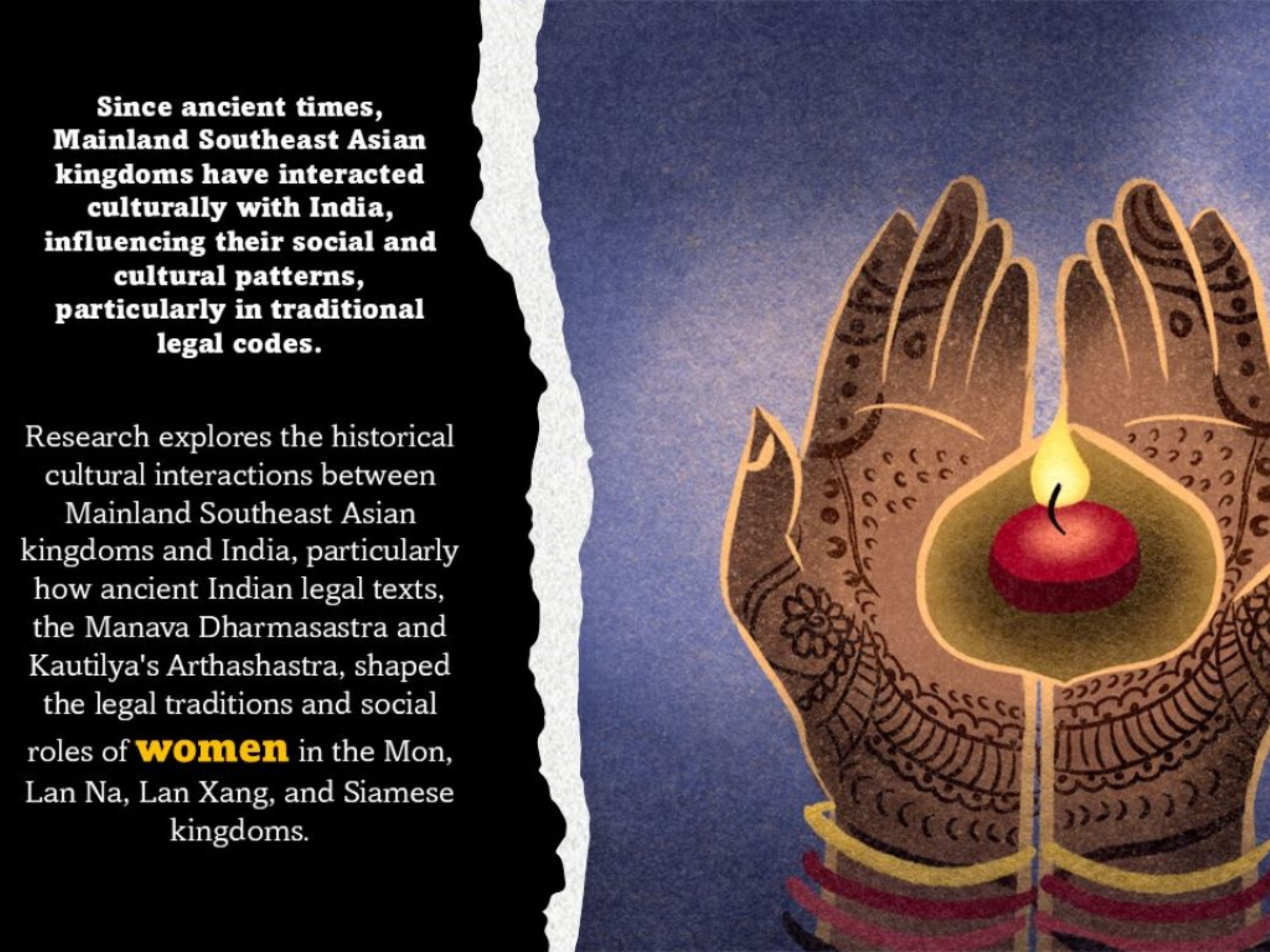
Background and Objectives: Since ancient times, the Mainland Southeast Asian kingdoms have engaged in cultural interactions with India, resulting in distinctive social and cultural patterns evident in the region's traditional legal codes. This research aims to examine the concept of women in ancient Indian laws, specifically the Manava Dharmasastra and Kautilya's Arthashastra, and to study the influences of these ancient Indian laws on the legal traditions of Mainland Southeast Asia, particularly with the adaptations of the laws of the Mon, Lan Na, Lan Xang, and Siamese kingdoms regarding their views on women.
Methods: This qualitative research employs historical and documentary research methods. Primary and secondary sources, including the documents from online databases, were analyzed alongside field data. The data were analyzed using content analysis and presented in a descriptive-analytical format.
Results: Ancient Indian laws, like the Manava Dharmasastra and Kautilya's Arthashastra, had a significant influence on the laws of the kingdoms of Mainland Southeast Asia. However, these kingdoms adopted and adapted these laws selectively, merging them with indigenous traditions rooted in Buddhist principles and local beliefs as part of their cultural assimilation. It led to a distinct concept of women's roles, as demonstrated in the Mon Dhammasat and the traditional laws of Lan Na, Lan Xang, and Siam (The Three Seals Law). The legal provisions that reflect the influence and adaptation of concepts concerning women and gender roles are found in the laws on family, disputes, property, and inheritance. These are 1) family law, which required women to have guardians; 2) adultery laws, which strictly governed male-female relations to maintain social order; 3) varying views on divorce; and 4) women’s rights and responsibilities regarding inheritance law. Understanding women's roles influenced by Indian civilization leads to a deeper comprehension of gender dynamics in history, as well as perspectives on the relationship of gender roles from the past to the present.
Application of this study: This study contributes new historical insights into women's roles by analyzing the important legal documents which are ancient Indian laws and the old laws in Mainland Southeast Asia. This constitutes an essential body of knowledge for the study of history and conceptualizations of women in Thailand and related regions, as certain ideas continue to persist through cultural transmission into the present. It also serves as a valuable foundation for further research in the fields of history, gender studies, law, and cultural studies.
Conclusions: Mainland Southeast Asian kingdoms were influenced by Indian culture such as the legal concepts from the Manava Dharmasastra and Kautilya’s Arthashastra, the religious and ideological influences of Brahman-Hinduism and Buddhism, including the concepts of womanhood. Nevertheless, these traditional states adapted and merged with local cultures, resulting in their own distinctive social and cultural characteristics. In particular, they shaped social attitudes toward the roles and duties of women, where women were found to possess relatively high status and gender roles, as reflected in the ancient legal codes of these states.
Downloads
Article Details

This work is licensed under a Creative Commons Attribution-NonCommercial-NoDerivatives 4.0 International License.
References
Altekar, A. S. (1949). State and Government in Ancient India. 5th ed. Delhi: Motilal Banaridass.
Aung, M. K. S. (2024, March 14). Interview. Dagon University.
Baosisavat, S. (transcribed). (1993). Khamphi Thammasat Lunag. [Thammasat Luang Law]. Vientiane: Vientiane Printing. (In Lao)
Baosisavat, S. (transcribed). (1996). Khamphi Phosarat lae Sangkhapakon. [Lao Customary Law]. Vientiane: Ministry of Education. (In Lao)
Basham, A. L. (1982). The Wonder That Was India. Calcutta: Fontana Books.
Beasley, C. (2005). Gender and Sexuality: Critical Theories, Critical Thinkers. London: SAGE Publications.
Bechert, H., & Braun, H. (1981). Pāli Nīti Texts of Burma: Dhammanīti, Likanīti, Mahārahanīti, Rājanīti; Critical Edition and Study. London: Pali Text Society.
Bronkhorst, J. (2011). The Spread of Sanskrit in Southeast Asia. In Pierre-Yves Manguin, A. Mani, and Geoff Wade. (Eds.), Early Interactions between South and Southeast Asia: Reflections on Cross-Cultural Exchange. (pp. 263–276). Chapter: The spread of Sanskrit in Southeast Asia. ISEAS–Yusof Ishak Institute.
Brown, R. L. (1994). The Dvaravati Wheels of the Law and the Indianization of Southeast Asia. E.J. Brill, Leiden, The Netherlands.
Bühler, G. (1886). The Laws of Manu. Oxford: Clarendon Press.
Chakravarti, U. (1993). Conceptualising Brahminical Patriarchy in Early India: Gender, Caste, Class and State. Economic and Political Weekly, 28(14), 579–585.
Cœdès, G. (1968). The Indianized States of Southeast Asia. In W. F. Vella (Ed.), S. B. Cowing (Trans.). Canberra: Australian National University Press.
Cooler, R. M. (2002). The Art and Culture of Burma. Retrieved 10 April 2025, from https://seasite.niu.edu/burmese/Cooler/BurmaArt_TOC.htm.
De Casparis, J. G., & Mabbett, I. W. (1992). Religion and Popular Beliefs of Southeast Asia before c. 1500. In N. Tarling (Ed.), The Cambridge History of Southeast Asia, Volume One: From Early Times to 1800 c. (pp. 276–339). Cambridge: Cambridge University Press.
De Campos, J. (1941). The Origin of the Tical. Journal of the Siam Society, 33 (2), 119–135.
Diskul, S. M. C. (2006). Prawatisat Asia Akhane thung Pho. So. 2000. [Southeast Asian History to 2000 B.E.]. Bangkok: Historical Society under the Royal Patronage of H.R.H. Princess Mahachakri Sirindhorn. (In Thai)
Doniger, W., & Smith, B. (1991). The Laws of Manu. London: Penguin Books.
Forchhammer, E. (translated). (1892). King Wakaru's Manu Dhammasattham: Text, Translation, and Notes. Rangoon: The Superintendent, Government Printing.
Ganjanapan, A. et al. (transcribed). (1985). Thammasat Racha Kuena. [Law of King Kue Na]. Chiang Mai: Chiang Mai University and Chiang Mai Teachers' College. (In Thai)
Gautam, P. K. (2013). Understanding Kautilya's Four Upayas. Retrieved 7 August 2025, from https://idsa.in/idsacomments/UnderstandingKautilyasFourUpayas_pkgautam_200613.
Geiger, W. (translated). (1912). Mahavamsa: The Great Chronicle of Ceylon. London: Oxford University Press.
Guillon, E. (1999). The Mons: A Civilization of Southeast Asia. Bangkok: Siam Society.
Haughton, G. C. (1982). Manava Dharma Sastra or The Institutes of Manu. In P. Percival (Ed.). New Delhi: Asian Educational Services.
Hooker, M. B. (1978). The Indian-Derived Law Texts of Southeast Asia. The Journal of Asian Studies, 37(2), 201–219.
Huxley, A. (1995). Buddhism And Law—The View from Mandalay. Journal of the International Association of Buddhist Studies, 18(1), 47–96.
Jain, N., & Mukherji, S. (2009). Communicating a Holistic Perspective to the World: Kautilya on Leadership. Leadership & Organization Development, 30(5), 435–454.
Kantekure, B. G. (2021). Various Aspects of Manusmriti-A Systematic Study. International Journal of Food and Nutritional Sciences, 10(11), 1057–1062.
Kounsamakom, D. (2015). Nitisart Thai: Bot Wichro Chak Rakthan nai Khamphi Manava Thammasart lae Khamphi Phra Thammasart. [Thai Jurisprudence: An Analysis Based on the Foundation of the Treatise of Manudharmasastra and the Treatise of Pradhmarmasastra]. Payap University Journal, 25(2), 12–16. (In Thai)
Krishna Rao, M. V. (1958). Studies in Kautilya. Delhi: Munshi Ram Manohar Lal.
Kumar, S. (2025). Numismatic Journey of Indian Currency System During Ancient India: An Overview. Integrated Journal for Research in Arts and Humanities, 5(2), 63–73.
Lammerts, D. C. (2010). Buddhism and Written Law: Dhammasattha Manuscripts and Texts in Premodern Burma. Doctoral Dissertation, Ph.D. in Asian Religions, Cornell University.
Lingat, R. (1949). The Buddhist Manu and the Propagation of Hindu Law in Hinayana Buddhist Indochina. Annals of the Bhandarkar Oriental Research Institute. 30(3/4), 284–297.
Lingat, R. (1950). Evolution of the Conception of Law in Burma and Siam, Journal of the Siam Society, 38(1), 9–31.
Lingat, R. (1963). Kotmai Tra Sam Duang Lem 2. [Three Seal Code, Book 2]. Bangkok: Suksapanpanit. (In Thai)
Lingat, R. (1973). The Classical Law of India. In J. D. M. Derrett (Trans.). Berkeley: University of California Press.
Mabbett, I. W. (1977). The "Indianization" of Southeast Asia: Reflections on the Prehistoric Sources. Journal of Southeast Asian Studies, 8(1), 1–14.
Majumdar, R. C. (1963). Hinducolory in the Far East. Calcutta: Firma K.L.M. Agents.
McGeachy, H. (2002). The Invention of Burmese Buddhist Law: A Case Study in Legal Orientalism. Australian Journal of Asian Law, 4(1), 30–52.
Mishra, P. P. (2021). India's Historical Impact on Southeast Asia. Education About Asia, 26(1), 1–7.
Mohapatra, H. (2015). Status of Women in Indian Society. Journal of Research in Humanities and Social Science, 3(6), 33–36.
Mougne, C. (1981). The Social and Economic Correlates of Demographic Change in a Northern Thai Community. Doctoral Dissertation, Ph.D. in The School of Oriental and African Studies, SOAS University of London.
Na Nagara, P. (transcribed). (1978). Mangraisat Chabap Wat Sao Hai. [Mangraisat, Wat Sao Hai Version]. Bangkok: Srinakharinwirot University. (In Thai)
Olivelle, P. (2005). Manu's Code of Law. New York: Oxford University Press.
Olivelle, P. (2004). The Asrama System. New Delhi: Munshiram Manoharlal Publishers Pvt. Ltd.
Pan Hla, N. (1992). Eleven Mon Dhammasat Texts. Tokyo: The Centre for East Asian Cultural Studies for UNESCO.
Patil, R. H. (2021). The Social Status of Indian Women of Different Periods in the Patriarchal Society. An International Multidisciplinary e-Journal, 5(4), 1–9.
Phayomyong, M. (1979). Khati Sorn Jai Lan Na Thai. [Lan Na Thai Moral Teachings]. Chiang Mai: Thara Thong Printing. (In Thai)
Pennington, B. K. (2005). Was Hinduism Invented? Britons, Indians, and Colonial Construction of Religion. New York: Oxford University Press.
Pollock, S. (1998). The Cosmopolitan Vernacular. Journal of Asian Studies, 57(1), 6–37.
Pongsripian, W. (2006). Khlong Tatkham Phra Phuttha Khosachan. [The Judgments of Phra Buddhaghosacarya: A Collection of Legal Decisions on Lawsuits in Traditional Lan Na]. Bangkok: The Research Project of "Kotmai Tra Sam Duang”: Thai Law as World Heritage, The Thailand Research Fund. (In Thai)
Pramuan Kotmai Ratchakan Thi 1 Chunlasakarat 1166 Phim Tam Chabap Luang Tra Sam Duang Lem 1. [The Laws of the King Rama I, 2347 BE According to the Royal Version of the Three Seals Code, Book 1]. (1986). Bangkok: Thammasat University. (In Thai)
Raksamanee, K. (1981). Chanakya kap Wannakhadi Nitisat Khong India. [Chanakya and Indian legal literature]. Journal of the Faculty of Arts, Silpakorn University, 4(2), 1–16. (In Thai)
Rangarajan, L. N. (1992). Kautilya: The Arthashastra. Haryana: Penguin Random House India.
Reid, A. (1988). Female Roles in Pre-colonial Southeast Asia. Modern Asian Studies, 22(3), 629–645.
Rocher, L. (2005). The Dharmasastras. In G. Flood. (Ed.), The Blackwell Companion to Hinduism. (pp. 102–115). Oxford: Blackwell Publishing.
Shamasastry, R. (1967). Kautilya's Arthasastra. 8th ed. India: Mysore Press.
Salangi, M. M. (2022). A Brief Study of Sati Custom in India. Bulletin of History, 104(1), 12–17.
Taw, S. K. (1892). The Kalyani Inscriptions Erected by King Dhammaceti at Pegu: Text and Translation. Rangoon: The Superintendent, Government Printing.
Tripathi, A. R. (2015). Manu Smriti: A Critical Study and Its Relevance in the Modern Times. Delhi: D.K. Print World.
Wanliphodom, S. (2020). Kan Khaoma Khong Phuttha Satsana lae Rabop Racha Mahakasat nai Dindaen Suwannaphum. [Emergence of Buddhism and the Monarchy to Suvarnabhumi]. Siamdesa. Retrieved 9 April 2025, from https://siamdesa.org/pagecontent.php?articles=1&type=2&page=1 (In Thai)
Weeraprajak, K. (1986). Mon nai Charuek Phasa Mon. [Mon Presence Reflected in Inscriptions]. The Silapakorn Journal, 33(1), 20–31 (In Thai)
Wichienkeeo, A., & Wijeyewardene, G. (1986). The Laws of King Mangrai (Mangrayathammasart). Canberra: The Richard Davids Fund.
Wicks, R. S. (1992). Money, Markets, and Trade in Early Southeast Asia: The Development of Indigenous Monetary Systems to AD 1400. New York: Southeast Asia Program, Cornell University.
Wolters, O. W. (1982). History, Culture, and Region in Southeast Asian Perspectives. Singapore: Institute of Southeast Asian Studies.
Wongthes, P. (2006). Phetsaphawa Nai Suwannaphum (Usakhane). [Gender in Southeast Asia]. Bangkok: Matichon.
(In Thai)
