
Thai-Khmer Textile: Wisdom Products to Create Cultural Values and Enhance Commercial Value
Article Sidebar
Main Article Content
Abstract
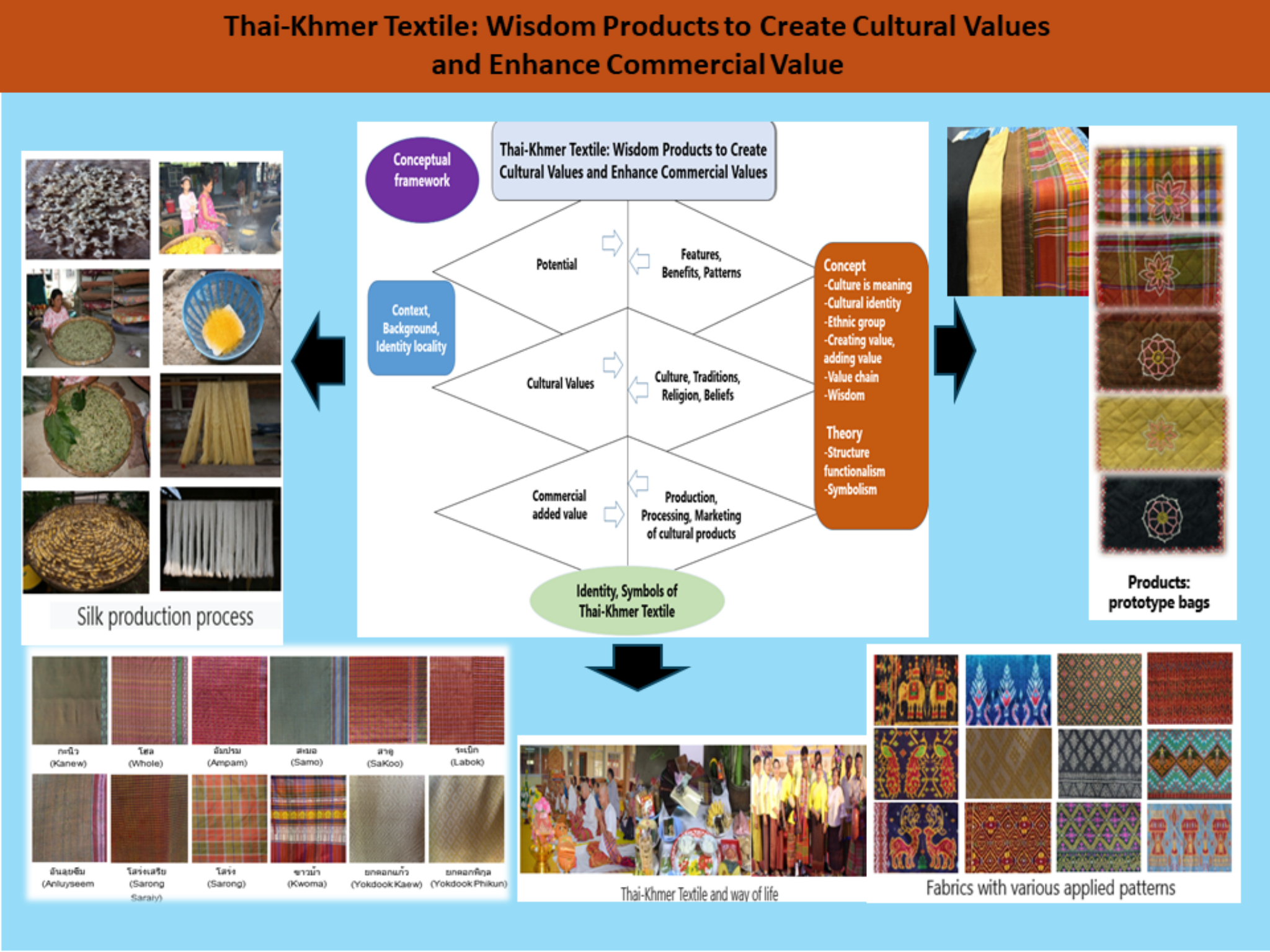
Background and Objectives: Thai–Khmer textiles are beautiful and distinctive products of local wisdom, reflecting a unique cultural identity through traditional weaving techniques and pattern creation. The wisdom has been passed down through generations for a long time. To preserve, promote, and generate awareness of these textiles, while enhancing their commercial potential, this research aimed to study their historical background and cultural significance, create cultural value, and explore ways to increase the commercial value of Thai–Khmer textiles.
Methods: This qualitative research collected data using purposive sampling. The participants included community and local wisdom leaders, as well as members of weaving groups, totaling 75 people. The data were gathered from the areas where the Thai-Khmer hand-woven cloth production has been passed down through generations, continuing for 50–80 years. Five areas were included: Ban Sanuan Nok, Huai Rat district, Buriram province; Ban Bu, Krasang district, Buriram province; Ban Ta Long, Satuek district, Buriram province; Ban Sawai, Mueang district, Surin province; and Ban Muang Luang, Huai Thap Than district, Sisaket province. The data were collected through in-depth interviews and focus group discussions. They were analyzed content-wise, categorized, compared, analyzed, and presented descriptively by using the concept of culture as meaning, structural functionalism, and semiotics theory to study the background, potential, cultural values, and the added value of Thai–Khmer textile.
Results: It was found that Thai–Khmer textiles are a beautiful, distinctive, and unique textiles that can identify the ethnic groups. They can be divided into many types, including traditional pattern textiles and contemporary pattern textiles, featuring animals, plants, tools and equipment, nature, and beliefs. In terms of cultural value, these textiles reflect both potential and identity, expressed through the meticulous production process of experienced weavers. Their knowledge and skills are passed down through generations, typically from mother to child within families and ethnic groups. Woven textiles are often used as symbolic expressions in each activity, and are sometimes framed to decorate spaces, becoming sources of cultural learning. The commercial value was increased by transforming the textile into a prototype bag, while adding more cultural value by using the wisdom of embroidering the ancient pattern and 8-petal lotus pattern. Integrating lifestyles, beliefs, and faith together creates a balance between intangible and tangible values of Thai–Khmer textile.
Application of this study: Weaving plays an integral role in the lives of Thai–Khmer communities, fostering the formation of weaving groups or other social groups. Furthermore, woven textiles serve as valuable cultural products. Studying the potential, cultural significance, and commercial enhancement of Thai–Khmer textiles—such as their transformation into prototype bags—can be beneficial to social and semiotic studies. This approach also supports the sustainable use of local wisdom products, providing opportunities for community income generation.
Conclusions: Thai–Khmer textiles are outstanding products of wisdom, crafted through a meticulous production process by skilled weavers proficient in creating textiles of various patterns. Each textile and its patterns can convey symbolic meanings, telling the story of the cloth and reflecting the pride and knowledge inherited across generations. Moreover, these textiles can be value-added to create income for the community.
Downloads
Article Details

This work is licensed under a Creative Commons Attribution-NonCommercial-NoDerivatives 4.0 International License.
References
Boonpok, D. (2019). Identity and Symbols of the Ethnic Khmer in Thailand’s Silk. Academic Journal, Faculty of Humanities and Social Sciences, Thepsatri Rajabhat University, 10(1), 91-102.
Charoensinolarn, C. (2012). Semiotics, Structuralism, Post-structuralism, and Political Science Studies. Wibhasa Publishing, Bangkok Thailand. (In Thai)
Khlangrit, S. (2019). Identity of Indigenous Wisdom in Local Silk Patterns of Khmer Ethnic Group in Surin City. Journal of Liberal Arts Maejo University, 7(1), 186-199
Leesuwann, W. (2016). Dictionary of Textiles and Weaving. Muang Boran, Bangkok Thailand. (In Thai)
Phanurat, A. (1993). Traditional Techniques and Development of Weaving and Use of Silk in the Lifestyle of Thai-Khmer Ethnic People. Office of the National Culture Commission, Ministry of Education, Bangkok Thailand. (In Thai)
Phayakprakhon, M. (2016). The Design and Development of Mudmee Patterns in Surin Province for Working Women. Rommayasan Journal, Burirum Rajabhat University, 14 (Special Issue), 155-163.
Peng, W., Puvasa, R., & Poradee, P. (2024). The Research on Protection and Inheritance Strategies of Intangible Cultural Heritage: A Case Study of Traditional Tujia Brocade Weaving Technique in China. Journal of Roi Kaensarn Academi, 9(4), 716-727.
Qiubo, H., & Mookam, T. (2024). Representation of Japanese Culture through Costumes in Konkimono Written by Pongsakorn. Ramkhamhaeng Journal Humanities Edition, 43(1), 67-88.
Rabibhadana, A. (2008). Culture Is Meaning: The Theory and Method of Clifford Geertz. Princess Sirindhorn Anthropology Centre (Public Organization), Bangkok Thailand. (In Thai)
Ruoyue, K., & Singyabuth, S. (2022). Bouyei Textile of Guizhuo, China: The Function and Meaning Change to Ethnic Socio-Culture in the Process of Commoditization. Academic-Journal of Mahamakut Buddhist University Roi Et Campus, 13(2), 245-257.
Sangvavann, K., Supannafai, A., & Sukantarat, S. (2023). Guideline of Value and Earning Potential on Cultural Hand-Woven Cloth at Paoy Char Village, Phnom Srok, Banteay Meanchey, Cambodia. Journal of Human and Society Sisaket Rajabhat University, 1(1), 18-39.
Sutthiyothin, N. (2020). Semiotics of communication. Political and Social Communication Research and Development Center, Sukhothai Thammathirat Open University. Pimsuay Company Limited, Bangkok Thailand. (In Thai)
Wongkum, K. (2025a). Figure 1 Conceptual Framework.
Wongkum, K. (2025b). Figure 2 Traditional Pattern of Thai-Khmer Textile.
Wongkum, K. (2025c). Figure 3 Cultural Product Design and Market Testing Process.
