
The State Behind the Dotted Line: Thai State Power and Graduated Sovereignty in the Mae Sot Border Area
Article Sidebar
Main Article Content
Abstract
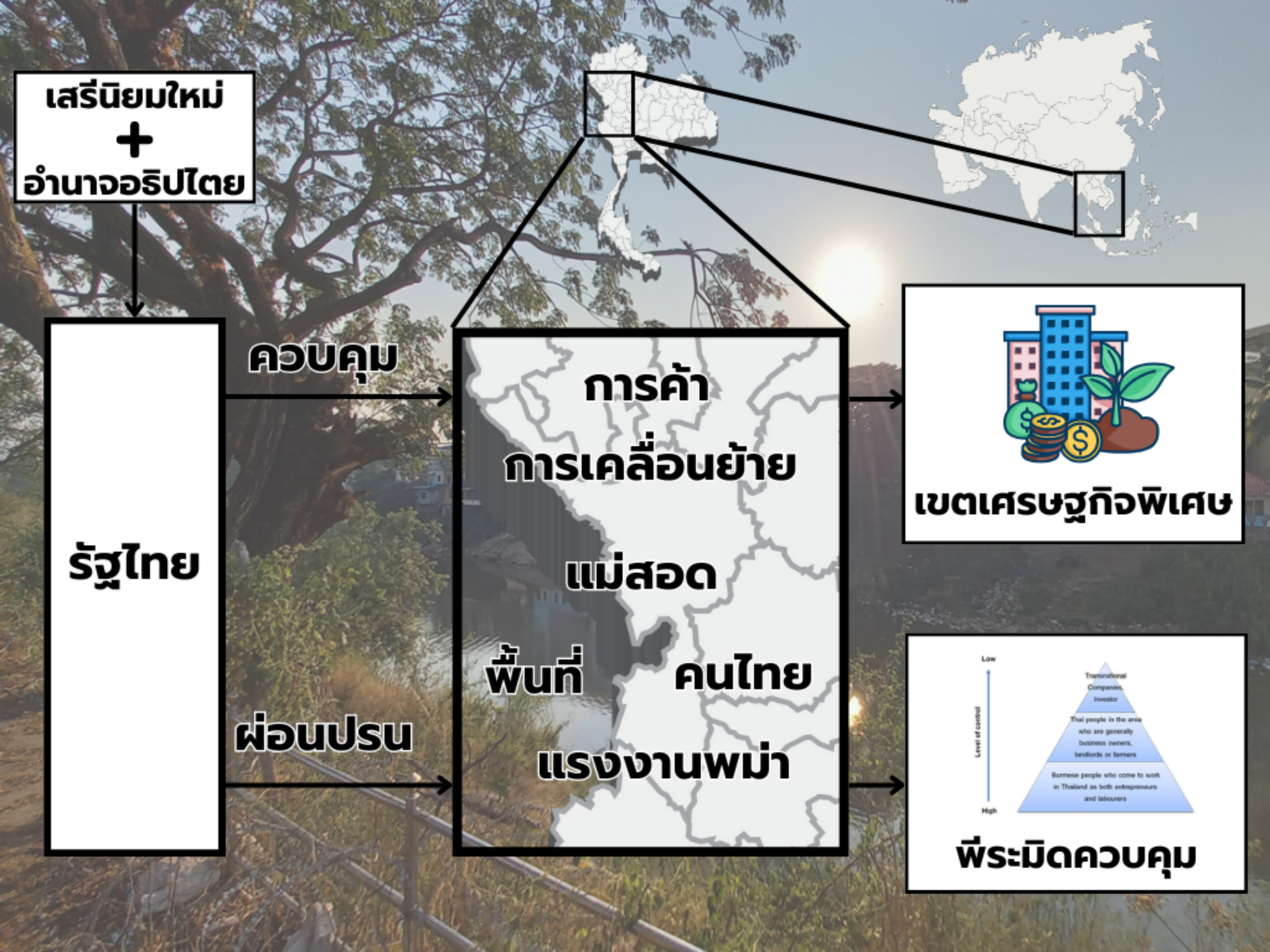
Background and Objectives: This academic article examines the shifting role of the Thai state in the Mae Sot border area amid the currents of neoliberal globalization. It challenges the assumption that the Thai state has truly diminished its role in border regions in accordance with neoliberal logic, by posing the central question: Does the Mae Sot border zone exist independently of state intervention, sovereign power, and legal regulation under the context of economic globalization? —and if so, in what ways? By exploring the state’s role in designing and managing the Mae Sot border area, this study seeks to reveal the strategic adjustments in sovereignty and governance undertaken by the Thai state.
Methods: This study draws on an analysis of primary documents such as state policies, laws, and official orders, supplemented by a field visit to Mae Sot district conducted during 5th–9th April 2023, in order to provide additional insights for the discussion. The analysis follows a qualitative descriptive approach.
Results: The study revealed that the Thai state has not retreated from the Mae Sot borderland but instead has adopted a strategy of differentiated governance. While certain legal and regulatory functions have been relaxed—such as the suspension of zoning laws and tax exemptions to attract foreign direct investment—state power remains assertively present in the surveillance of migrant labor, the regulation of daily life, and the orchestration of cultural legitimacy. Mae Sot should therefore be reinterpreted as a prototypical neoliberal enclave, which is flexible in legal and economic aspects, yet retains absolute control in certain dimensions. The region operates as a dual space: a zone of infrastructure and transnational capital on one hand, and a site of surveillance and precarious labor on the other. Rights and chances are stratified along the lines of economic class and ethnonational identity, with Burmese migrants facing systemic marginalization under a framework that prioritizes economic growth.
Application of this study: The findings provide an important lens for rethinking state power in border regions. Rather than viewing the border as a fading zone of sovereignty, the study proposes understanding it as a site of calculated state resurgence, wherein state actors reassert control to facilitate global market integration effectively. This insight has implications for policy design concerning special economic zones, labor rights, and migration governance. It also promotes transdisciplinary debates in development studies, border theory, and Southeast Asian political economy, offering the case study of Mae Sot as a model for analyzing similar zones across the Global South.
Conclusions: Mae Sot should not be conceived merely as a peripheral borderland or a stateless frontier. It exemplifies a dynamic interface where sovereignty is reassembled to accommodate and manage transnational flows of capital and labor. The Thai state reveals “behind the dotted line”—not absent but strategically repositioned, allowing neoliberal market mechanisms to flourish while maintaining tight control over mobility and legality. This underscores a broader pattern of state transformation under neoliberal globalization: a shift not towards state retreat but towards adaptive governance, where the state manages economic openness through selective sovereignty, legal flexibility, and infrastructural enclosure. In doing so, the Mae Sot case study challenges the binary notions of state presence/absence and presents a complex analysis of border governance as a multi-layered negotiation practice.
Downloads
Article Details

This work is licensed under a Creative Commons Attribution-NonCommercial-NoDerivatives 4.0 International License.
References
Arnold, D. (2004). The Situation of Burmese Migrant Workers in Mae Sot, Thailand (Searc Working Paper Series No. 71). Hong Kong: Southeast Asia Research Centre, City University of Hong Kong.
Arnold, D., & Hewison, K. (2005). Exploitation in Global Supply Chains: Burmese Workers in Mae Sot. Journal of Contemporary Asia, 35(3), 319-340. https://doi.org/10.1080/00472330580000191
Arnold, D., & Pickles, J. (2011). Global Work, Surplus Labor, and the Precarious Economies of the Border. Antipode, 43(2), 1598-1624. https://doi.org/10.1111/j.1467-8330.2011.00899.x
Arnold, D. (2012). Spatial Practices and Border SEZs in Mekong Southeast Asia. Geography Compass, 6, 740-751. https://doi.org/10.1111/gec3.12012
Board of Investment. (2022). Announcement of the Board of Investment No. 19/2565: Investment Promotion Measure in Special Border Economic Zones. Bangkok: Thailand: Board of Investment.
Dean, K., Sarma, J., & Rippa, A. (2022). Infrastructures and B/Ordering: How Chinese Projects Are Ordering China–Myanmar Border Spaces. Territory, Politics, Governance, 12(8), 1177–1198.
https://doi.org/10.1080/21622671.2022.2108892
Erol, M. E., & Şahin, Ç. E. (2022). Labour Unions Under Neoliberal Authoritarianism in The Global South: The Cases of Turkey And Egypt. Canadian Journal of Development Studies, 44(1), 131–150. https://doi.org/10.1080/02255189.2022.2119945
Fadahunsi, A., & Rosa, P. (2002). Entrepreneurship and Illegality: Insights from the Nigerian Cross-border Trade. Journal of Business Venturing, 17(5), 397-429. https://doi.org/10.1016/S0883-9026(01)00073-8
Foucault, M. (1976). The History of Sexuality, Volume 1: The Will to Knowledge. New York: Pantheon Books.
Kosem, S. (2010). Intersectionality of Ethnic and Nation-State Boundaries in Mae Sot Border Town Markets. Journal of Social Sciences, Chiang Mai University, 22(2), 11-51. (In Thai)
Kuaycharoen, P., & Others. (2020). Special Economic Zones and Land Dispossession in the Mekong Region. Bangkok: Land Watch Thai.
Laungaramsri, P. (2015). Commodifying Sovereignty: Special Economic Zones and the Neoliberalization of the Lao Frontier. In Y. Santasombat, (Ed.). Impact of China’s Rise on the Mekong Region, (pp. 117–146). New York: Palgrave Macmillan. https://doi.org/10.1057/9781137476227_5
Laungaramsri, P. (2019). China in Laos: Enclave Spaces and the Transformation of Borders in the Mekong Region. The Australian Journal of Anthropology, 30, 195-211. https://doi.org/10.1111/taja.12319
Loong, S. (2019). The Neoliberal Borderscape: Neoliberalism’s Effects on the Social Worlds of Migrants Along the Thai-Myanmar Border. Political Geography, 74, Article number 102035, https://doi.org/10.1016/j.polgeo.2019.102035.
Mae Sot Municipality. (2020). Sarup Praden Namsanoe Rueang Kan Chattang Thetsaban Nakhon Mae Sot Pen Ongkon Pokkhrong Thongthin Rupbaep Phiset, Khana Anukammathikan Kan Borihan Ratchakan Rupbaep Phiset Lae Krachai Amnat Nai Khana Kammathikan Krachai Amnat, Kan Pokkhrong Suan Thongthin Lae Kan Borihan Ratchakan Rupbaep Phiset, Sapha Phuthan Ratsadon. [Summary Presentation on the Establishment of Mae Sot Municipality as a Special Form of Local Government, Sub-Committee on Special Administration and Decentralization Under the House of Representatives Committee on Local Administration and Special Governance]. Retrieved 10 February 2025, from https://www.nakhonmaesotcity.go.th /webs/images/attachment_content/บรรยายสรุปท้องถิ่นรูปแบบพิเศษ%20นครแม่สอด.pdf. (In Thai)
Mae Sot Municipality Office. (n.d.). Khongmun Phuenthan Lae Sakyaphap Khong Thetsaban Nakhon Mae Sot. [Basic Information and Potential of Mae Sot Municipality]. Retrieved 8 May 2025, from https://www.nakhonmaesotcity.go.th/webs/images/attachment_content/สำนักงานเทศบาลนครแม่สอด.pdf. (In Thai)
Matthew, G. (2011). Ghetto at the Center of the World: Chungking Mansion, Hong Kong. Chicago: University of Chicago Press.
Office of the Council of State. (2016). Ncpo’s Order 3/2559 on the Legal Exemption of Urban Planning Law and Building Control Law in Special Economic Zones. Retrieved 19 February 2025 from https://data.thailand.opendevelopmentmekong.net/th/laws_record/3-2559. (In Thai)
Ong, A. (2000). Graduated Sovereignty in South-East Asia. Theory, Culture & Society, 17(4), 55–75. https://doi.org/10.1177/02632760022051310
Ong, A. (2001). Zone of New Sovereignty in Southeast Asia. In P. Richard, & M. Bill., (Eds.). Globalization Under Construction: Governmentality, Law, and Identity, (pp. 36-69), Minneapolis: University of Minnesota Press.
Paasi, A. (2011). A Border Theory: An Unattainable Dream or a Realistic Aim for Border Scholars?. In D. Wastl-Walter (Ed.), The Routledge Research Companion to Border Studies, (pp. 11–31). London: Routledge.
Palan, R. (2003). The Offshore World Sovereign Markets, Virtual Places, and Nomad Millionaires. Ithaca & London: Cornell University Press.
Realist Blog. (2015). Mae Sot Khet Setthakit Phiset Muen Lan. [Mae Sot: The Billion-Baht Special Economic Zone]. Retrieved 19 February 2025 from https://thelist.group/realist/blog/แม่สอด-เขตเศรษฐกิจพิเศษ/. (In Thai)
Rippa, A. (2019). Zomia 2.0: Branding Remoteness and Neoliberal Connectivity in the Golden Triangle Special Economic Zone, Laos. Social Anthropology, 27(2), 253-269. https://doi.org/10.1111/1469-8676.12649
Rippa, A. (2022), Imagined Borderlands: Terrain, Technology and Trade In the Making and Managing of the China-Myanmar Border. Singapore Journal of Tropical Geography, 43, 287-308. https://doi.org/10.1111/sjtg.12429
Rumford, C. (2012). Towards a Multiperspectival Study of Borders. Geopolitics, 17(4), 887–902.
Sangkhamanee, J. (2016). Limology: Khet-Khanda Epistemology of In-Between Spaces. Bangkok: Siam Publishing House. (In Thai)
Scott, J. (2009). The Art of Not Being Governed: An Anarchist History of Upland Southeast Asia. New Haven: Yale University Press.
Sittikan, P., & Others. (2023). Development of Border Special Economic Zones. Journal of Administrative and Social Sciences Review, 6(2), 229-236. (In Thai)
Sparke, M. (2013). Introducing Globalization: Ties Tension and Uneven Integration. United Kingdom: Wiley-Blackwell.
Sukplung, R. (2023). Strategic Business Development Plan of Special Economic Development Zone; Case Study: Tak Province. Master Thesis, M.M. in Management, Mahidol University, Thailand. (In Thai)
Sungsuwan, N., & Sonsuphap, R. (2023). The Special Economic Zone: A Regulation of Cross-Border Trading in a Developing Economy. Journal of Governance & Regulation, 12(4), 165–172.
https://doi.org/10.22495/jgrv12i4art16.
Tak Special Economic Zone. (2015). Samnakngan Khet Phatthana Setthakit Phiset Tak. [Tak Special Economic Zone Office]. Retrieved 8 February 2025, from https://www.taksez.com/th/page/taksezoffice.html. (In Thai)
Winichakul, T. (2004). Siam Mapped: A History of the Geo-Body of the Nation. Chiang Mai: Silkworm Book.
