
Concepts of Transition in Elephant Soothing Poems and the Royal Ceremony of Elephant Consecration
Article Sidebar
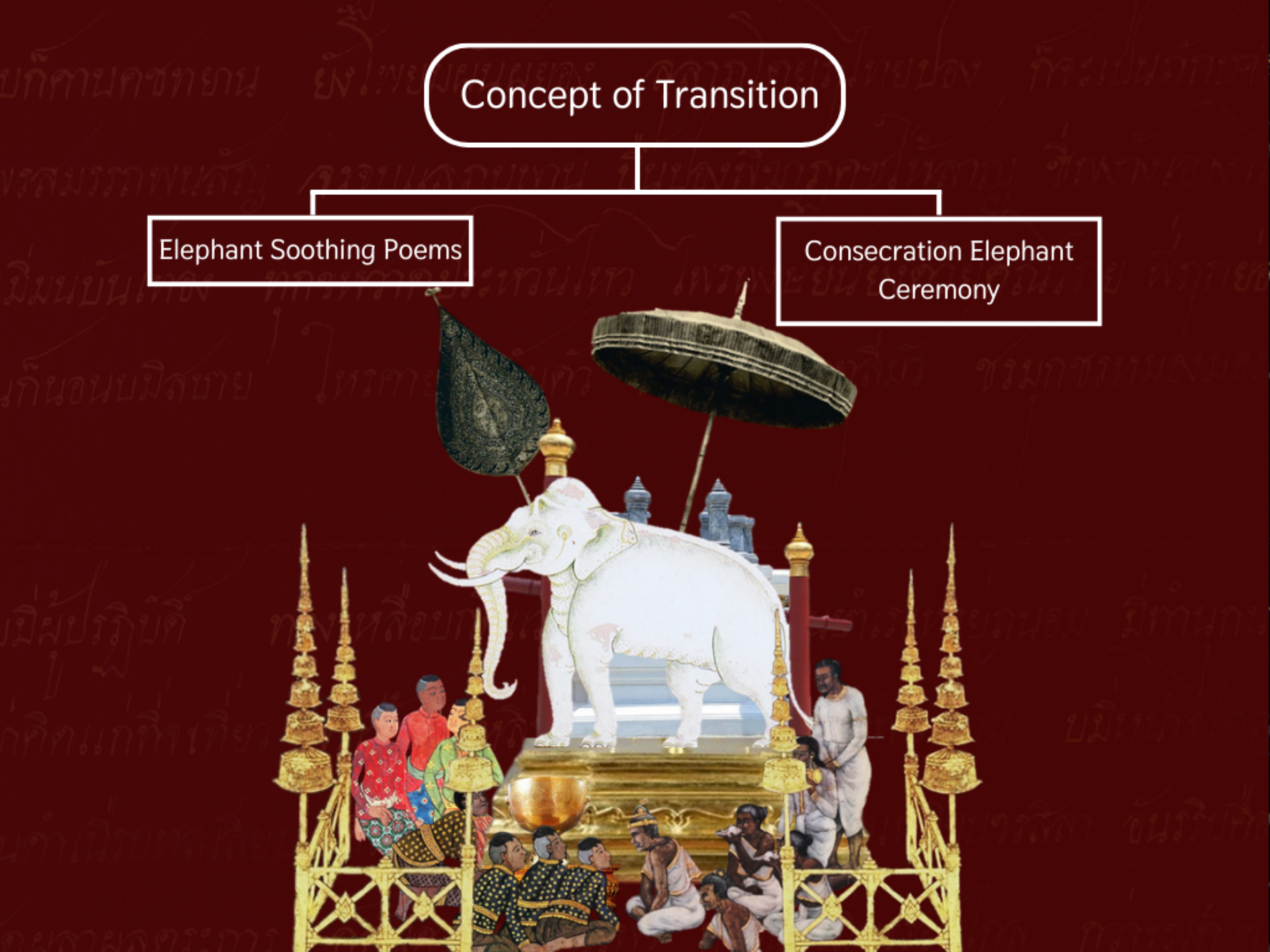
Main Article Content
Abstract
Background and Objectives: Elephant soothing poems are ritual literature recited during sacrificial rites in elephant ceremonies or royal rituals concerning elephants, dating back to the Ayutthaya period. In the Rattanakosin era, evidence shows that the elephant soothing poems were key texts used in the Royal Consecration Elephant Ceremony, which reflects the transition in status of a significant elephant from a wild elephant to a royal elephant through symbolic objects and symbolic behaviors. The content of the elephant soothing poems align with the procedures and details of the royal ceremony, yet there is still a lack of analysis connecting the literary text to the ritual. This research article, therefore, aims to study the concepts of transition in the content of the elephant soothing poems in order to identify key factors in the creation of literature that is related to the components and stages of the ritual.
Methods: This study is documentary research employing a descriptive analytical approach. The researcher examined a total of 36 poems, including both ‘Kham Chan Kloam Chang’ and ‘Karp Khap Mai Kloam Chang’, spanning from the Ayutthaya period to the reign of King Rama IX. The primary focus was to analyze the concepts of transition within these poems and explore their relationship with the concepts of transition found in the royal ritual known as the Royal Ceremony of Elephant Consecration.
Results: The elements of the elephant soothing poems demonstrate the concept of transition in two dimensions, both of which align with the concept of transition in the Royal Elephant Consecration Ceremony: spatial transition and social status transition. In the spatial dimension, the poems depict transition through contrasting descriptions of movement from old spaces to new ones, as well as through the narration of the route that leads the elephant to the site of the royal ceremony. This concept of spatial transition has undergone dynamic evolution in response to the shifting context of the modern nation-state, with its most notable transformation occurring during the reign of King Rama IX. In the social dimension, transition is expressed through content illustrating the elephant’s separation from its forest-dwelling family, descriptions of its ornaments and the Royal Elephant Stable, the process of teaching the elephant to abandon its untamed nature and adopt the customs of royal officials, and the royal name granted by the King. Moreover, the components of the elephant soothing poems are closely linked to ritual symbols and remain dynamic, reflecting changes in royal ceremonies, societal and cultural contexts, and the perspectives of the poets.
Application of this study: The results of this study are useful for understanding the relationship between the creation of literary texts and rituals. Furthermore, it provides a guideline for studying literature as the ritual texts for the transition rites in other ceremonies.
Conclusions: The elephant soothing poems reflect the concepts of transition involved in the transformation of a wild elephant into a royal elephant, encompassing both spatial and social status transitions. These two dimensions of transition are the significant factors that influenced the creation of the poems. Furthermore, studying these poems and examining the ritual data reveal the dynamic relationship between literature and ritual, a relationship that evolves in accordance with the social and cultural contexts of each era.
Downloads
Article Details

This work is licensed under a Creative Commons Attribution-NonCommercial-NoDerivatives 4.0 International License.
References
Ajchariyabodee, W. (2020a). The Representation of Forests and Cities in the Elephant Pacification Poems. Bangkok: Faculty of Liberal Arts. (In Thai)
Ajchariyabodee, W. (2020b). Role of Control: The Power Relationships in the Elephant Pacification Poems. VANNAVIDAS, 20(2), 29–62. (In Thai)
Chandavij, N. (2006). Chang Phueak Nai Ratchakan His Majesty King Bhumibol Adulyadej. [Royal White elephants during the reign of His Majesty King Bhumibol Adulyadej.]. Silpakorn Magazine, 49(3), 12–29. (In Thai)
Chitbundid, C. (2023). The Royally-Initiated Projects: The Making of King Bhumibol's Royal Hegemony. 3rd ed. Bangkok: Sommadhi. (In Thai)
Chumnum Chan Dusadee Sangwoei 1. [Elephant Soothing Poems Volume 1]. (1960). Bangkok: Suksapanpanit. (In Thai)
Chumnum Chan Dusadee Sangwoei 2. [Elephant Soothing Poems Volume 2]. (1960). Bangkok: Suksapanpanit. (In Thai)
Dhanachai, K. (2008). “Samo Amarit Sot Song”: Literary conventions and the aesthetics in Dusadee Sangwoei Kloam Chang. Journal of Thai Studies, 4(1), 91–141. (In Thai)
Eawsriwong, N. (2014). Phak Khawma, Phaksin, Kangkeng Nai, etc. [On tradition, change, and all sorts of matters.]. 2nd ed. Bangkok: Matichon. (In Thai)
Gennap, A. V. (1960). The Rites of passage. University of Chicaho Press.
Kasempholkoon, A. (2017). ‘Thai Traditional Knowledge of Animal’ From Central Thailand Manuscripts; The Animals Characteristics, Textsbooks of Premonition From Animals, The Lyrics Kwan Ceremony to Celebrate Animals and The Lyrics in Inviting The Animal Spirits: An Exploratory Study in The Relationship Between Man and Animal (Research report). Bangkok: Thailand Science Research and Innovation (TSRI). (In Thai)
Kloam Chang Phlai. [Elephant Soothing Poems]. (n.d.). National Library of Thailand. Thai book. Thai script. Thai language. White pencil lines, Arsenic trisulfide lines. No. 34. Literature category.
Kraipakorn, D. (2024). The Cultural Politics of the Royal Visit to the Monthon Phayap during the Reign of King Prajadhipok in 1926. SWU Journal of History, 49(1), 89 –128. (In Thai)
Pinyomark, K. (1999). Kan Sueksa Phatthanakan Khong Khamchan Dusadi Sangwoei Kloam Chang Samai Rattanakosin [A Study of the Development of the Dusadi Sangwoei Khamchan Kloam Chang in the Rattanakosin Period]. Master Thesis, M.A. in Department of thai. Silpakorn University, Thailand. (In Thai)
Phra Sawet Vajirabaha. [Royal White elephants during the reign of King Rama VI]. (1962). Bangkok: Phra Chan Printing. (In Thai)
Phimpha, S., & Sripum, T. (2025a). Figure 1 Diagram Showing the Sequence and Structure of Transition in the Consecration Elephant Ceremony.
Phimpha, S., & Sripum, T. (2025b). Figure 3 Concepts of Transition in the Elephant Soothing Poems and the Consecration Elephant Ceremony.
Polmuk, C. (2009). Royal Ceremony Literature in the Rattanakosin Period : Dharmaraja Concept and Literarytechniques. Master Thesis, M.A. in Department of thai. Chulalongkorn University, Thailand. (In Thai)
Sangkapantanon, T. (2013). Ecocriticism in Thai Literature. Bangkok: Nakorn. (In Thai)
Suputtamongkol, S., & Others. (1998). Exploring Theories of Bodies. In Koanantakool, P,C (Ed.), Body Hidden and Revealed: Bodies in Religion, Philosophy, Politics, History, Art, and Anthropology. (pp. 14–50). Bangkok: Kobfai Publishing. (In Thai)
The Fine Arts Department. (1975). Khruang Yot. [Rank insignia]. Bangkok: Prasert Kanphim. (In Thai)
The Fine Arts Department. (2008). Thananusak in Thai Architecture. Bangkok: Thaiphumi Publishing. (In Thai)
The Fine Arts Department. (2013). Phiphithaphan Rong Chang Ton Suan Chitralada. [The Royal Elephant Stable in Chitralada Royal Gardens]. Bangkok: The Fine Arts Department. (In Thai)
The Office of the Permanent Secretary. (1988). Chum Num Chan Dutsadi Sangwoei Klom Chang Samkhan Nai Ratchakan Patchuban. [Elephant Soothing Poems in Reign of King Rama IX]. Bangkok: Chuan Pim. (In Thai)
Turner, V. W. (1967). The Forest of Symbol: Aspects of Ndembu Ritual. New York: Cornell University Press.
Turner, V. W. (1969). The Ritual Process Structure and Anti-Structure. New York: Cornell University Press.
Warasitthichai, K. (2004). Khamchan Dusadi Sangwoei Kloam Chang Chak Phithikam Su Wannakam Kham Son. [The Dusadi Sangwoei Khamchan Kloam Chang: From Ritual to Didactic Literature]. Muang Boran Journal, 30(1), 105–113. (In Thai)
