
Understanding Female Ordination and the Status of Bhikkhunis in Thai Society Through a Sociological Perspective
Article Sidebar
Main Article Content
Abstract
Background and Objectives: Since the beginning of bhikkhuni (female Buddhist nun) tradition long ago, much difficulty surrounding their existence has been recorded. At present, a lot of controversy about the status of bhikkhunis occurs, including both opponents and supporters. However, discussions are often limited to issues of gender equality, religious precepts, or legal matters. This article seeks to move beyond the existing frameworks of debate by focusing on the ‘existence’ of bhikkhunis, their characteristics, and the various factors influencing their development and perception in Thai society. It also examines the religious practices that affect the status of bhikkhunis, as well as the significance of women’s roles and positions in Thai Buddhist society.
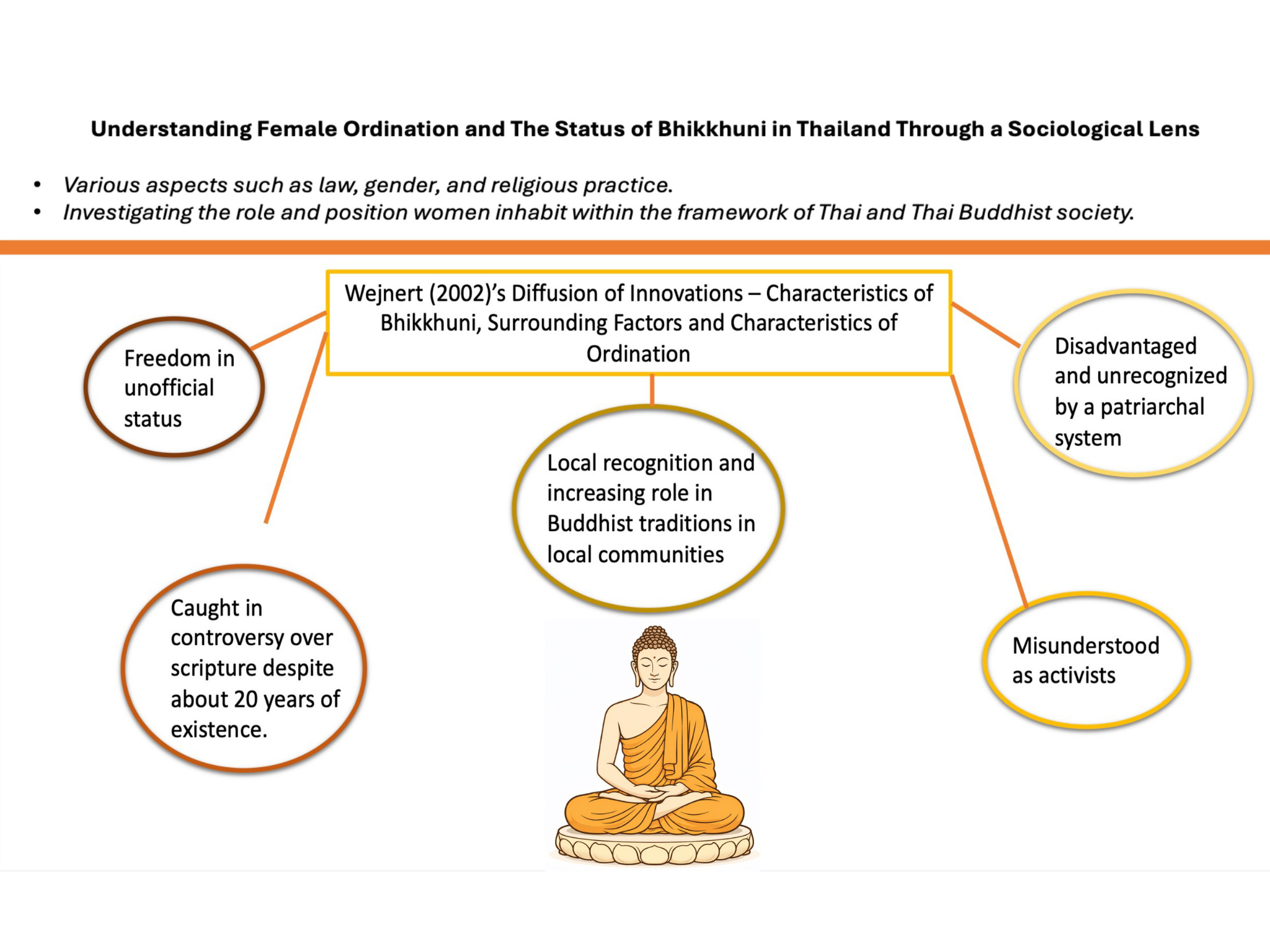
Methods: This article is qualitative research. It consists of a comprehensive literature review and an interview with the Venerable Dhammananda, de facto leader of the Thai bhikkhuni movement. It also points out that previous studies on bhikkhunis and Thai Buddhism have often overlooked the application of sociological frameworks in their analyses. This article therefore employs Wejnert’s (2002) ‘Diffusion of Innovations’ framework to analyze the status of bhikkhunis as a new innovation within Thai society. Although bhikkhunis once existed in the past, their reemergence in contemporary Thai society represents a new concept. The use of this framework provides a clearer understanding of how this innovation is accepted within its contextual environment, as well as the characteristics of the initiators (bhikkhunis) and the dynamics of the bhikkhuni movement. The data from the literature review and interviews were analyzed based on a conceptual framework concerning factors related to the bhikkhuni movement, including legal, gender, and social problems.
Results: It was found that the status of bhikkhunis in Thai Buddhism is uncertain, changing, and even misunderstood, but the bhikkhunis are persevering and involved in their ongoing activities. Past legal issues appear to have no significant impact in the present because the Constitution provides protection for the fundamental rights of bhikkhunis. Concerning gender, the bhikkhunis do exist outside the patriarchal framework of Thai society but but they still have the freedom to engage in social initiatives as they see appropriate and are also entitled to certain rights, such as the right to vote, which male monks sometimes do not possess. The bhikkhunis are sometimes misunderstood as feminist religious activists. In fact, bhikkhunis merely follow their own dispositions and the teachings of the Dhamma. Moreover, the debates concerning religious legitimacy have no significant effect on the current status of bhikkhunis, as they have already emerged and established their presence in society. Both the literature and interview data indicate that bhikkhunis have gained recognition at the local community level from laypeople and some monks, and that they play a significant role in Buddhist traditions, such as morning alms rounds.
Application of this study: This article has advanced beyond other papers which have only examined the validity of female ordination in Thailand. It has examined the status of the bhikkhuni as women in Thai Buddhism, and considered the conflict between the others’ opinions and the role of bhikkhunis by applying the sociological framework of ‘Diffusion of Innovations’ to analyze the bhikkhunis in Thailand for the first time. This approach allows for a deeper understanding of the various contexts that affect the status of bhikkhunis. Viewing bhikkhuni ordination as a social innovation within Thai society provides broader insights into its implications and meanings. Therefore, this research is suitable for those seeking a more profound understanding of the bhikkhuni movement—whether monks, religious organizations, or scholars. Future research should regard the bhikkhunis not merely as a site of social or religious conflict but as an existing social movement, whether it has supporters or not.
Conclusions: The framework revealed that surrounding factors, the characteristic of the bhikkhunis as an innovation, as well as personal characteristics all impact their status within Thai society, in both positive and negative ways. The conclusion drawn from this research is that despite controversy and debate, the bhikkhunis are not feminist religious activists, they are simply women who follow the Buddhist path and seek to claim their own space within the religion. Although these bhikkhunis may be at a disadvantage in a patriarchal social structure, they continue to play vital roles within their local communities. Instead of perceiving the bhikkhunis primarily through the lens of activism or conflict, attention should be given to their existence and the performance of their monastic duties. In spite of ongoing controversies and diverse interpretations, the bhikkhunis continue to exist and perform their duties as nuns with their own potential.
Downloads
Article Details

This work is licensed under a Creative Commons Attribution-NonCommercial-NoDerivatives 4.0 International License.
References
Avishai, O. A. (2015). A Gender Len's on Religion. Gender & Society, 29(1), 5-25. https://doi.org/10.1177/0891243214548920 DOI: https://doi.org/10.1177/0891243214548920
Battaglia, L. (2015). Becoming Bhikkhuni? Mae Chis and the Global Women’s Ordination Movement. Journal of Buddhist Ethics, 22(2015), 25-62.
Bhikkhuni Soma. (1997). Samyutta Nikaya (SN 5.2). Bhikkhu Bodhi (Trans.). Retrieved 4 April 2023, from https://www.accesstoinsight.org/tipitaka/sn/sn05/sn05.002.bodh.html
Bhikkhu Sujato (Translator). (2018). Sutta Central. Retrieved 6 April 2023, from https://suttacentral.net/an8.51/en/sujato?layout=plain&reference=none¬es=asterisk&highlight=false&script=latin
Bhikku Analyo. (2013). The Legality of Bhikkuni Ordination. Journal of Buddhist Ethics, 20(2013), 310-333.
Cho, E. (2009). Reinventing Female Identity: A Brief History of Korean Buddhist Nuns. Seoul Journal of Corean Studies, 22(1), 29-53. https://www.google.com/url?sa=t&source=web&rct=j&opi=89978449&url=https://sjks.snu.ac.kr/issue/download.jsp%3Fid%3D739%26aid%3D67%26ek%3Ddf263d996281d984952c07998dc54358&ved=2ahUKEwiKoPLFx8OQAxU-4zQHHYc5LGQQFnoECBgQAQ&usg=AOvVaw31Q_VI-mNgUgP_sLqJCi.
Crosby, K. (2014). Theravada Buddhism: Continuity, Diversity, and Identity. Chichester: John Wiley & Sons. https://doi.org/10.1002/9781394260942 DOI: https://doi.org/10.1002/9781394260942
Department of Religious Affairs, Thailand. (1928). Thalang Karn Khana Song. [Monastic Community Declaration] (Vol. 16). Bangkok: Department of Religious Affairs.
Falk, L. (2008). Gender and Religious Legitimacy in Thailand. In W. Lundström-Burghoorn (eds.), K. Iwanaga, C. Milwerts, & Q. Wang, Gender Politics in Asia: Women Manoeuvring Within Dominant Gender Orders. (pp. 95-120). Copenhagen: NIAS Press.
Ito, T. (2012). Questions of Ordination Legitimacy for Newly Ordained Theravada Bhikkhuni in Thailand. Journal of Southeast Asian Studies, 43(1), 55-76. https://doi.org/10.1017/S002246341100066X. DOI: https://doi.org/10.1017/S002246341100066X
Kabilsingh, C. (1991). Thai Women in Buddhism. Berkeley: Parallax Press.
Kabilsingh, C. (1998.). Women in Buddhism: Questions and Answers. Bangkok: Buddha Dharma Education Association Inc.
Kabilsingh, C. (2016). Phiksuni Kao Klai [Progress of Bhikkhuni]. Bangkok: Thai-Tibet Centre.
Klunklin, A., & Greenwood, J. (2005). Buddhism, the Status of Women and the Spread of HIV/AIDS in Thailand'. Health Care International for Women, 26(1), 46-62. https://doi.org/10.1080/07399330590885777. DOI: https://doi.org/10.1080/07399330590885777
Larsson, T. (2016). Keeping Monks in Their Place? Asian Journal of Law and Society, 3(1), 17-28. https://doi.org/10.1017/als.2015.22. DOI: https://doi.org/10.1017/als.2015.22
McCargo, D. (2012). The Changing Politics of Thailand's Buddhist Order. Critical Asian Studies, 44(4), 627-642. https://doi.org/10.1080/14672715.2012.738544. DOI: https://doi.org/10.1080/14672715.2012.738544
Owen, L. B. (1998). On Gendered Discourse and the Maintenance of Boundaries: A Feminist Analysis of the Bhikkhuni Order in Indian Buddhism. Asian Journal of Women's Studies, 43(1), 8-60. https://doi.org/10.1080/12259276.1998.11665825. DOI: https://doi.org/10.1080/12259276.1998.11665825
Phanthanaphruet, N. (2024). Bhikkhuni and Social Role in Sri Lanka. BUDDHO, 3(1), 40-51.
Prapapornpipat, K. (2005). Kan-Tor-Su Khorng Phiksuni Song Therawat: Jak Silanka Su Thai. [The fight of the Theravada Bhikkhuni Sangha: From Sri Lanka to Thailand]. Chulalongkorn University Journal of Buddhist Studies, 12(2), 28-41. (In Thai)
Seeger, M. (2008). The Bhikkhunī-ordination controversy in Thailand. Journal of the International Association of Buddhist Studies, 29(1), 155-182.
Seeger, M. (2009). The Changing Roles of Thai Buddhist Women: Obscuring Identities and Increasing Charisma. Religion Compass, 3(5), 806-822 https://doi.org/10.1111/j.1749-8171.2009.00165.x. DOI: https://doi.org/10.1111/j.1749-8171.2009.00165.x
Seeger, M. (2010a). ‘Against the Stream’: The Thai Female Buddhist Saint Mae Chi Kaew Sianglam (1901–1991)1. South East Asia Research, 18(3), 555-595. https://doi.org/10.5367/sear.2010.0006. DOI: https://doi.org/10.5367/sear.2010.0006
Seeger, M. (2010b). Theravada Buddhism and Human Rights. In C. Meinert, & H.-B. Zöllner, (Eds.), Buddhist Approaches to Human Rights. (pp. 63-92). Bielefield: Transcript, Verlag. DOI: https://doi.org/10.1515/9783839412633-004
Seeger, M. (2022). The Fragmentary History of Female Monasticism in Thailand: Community Formation and Development of Monastic Rules by Thai Mae Chis. Religions, 23(11), 1042. https://doi.org/10.3390/rel13111042. DOI: https://doi.org/10.3390/rel13111042
The Secretariat of the Senate. (2017). Rathathammanun Haeng Ratcha-anachak Thai Phutthasakkrat 2560. [The 2017 Constitution of the Kingdom of Thailand]. Retrieved 24 February 2025, from https://www.senate.go.th/assets/portals/13/files/รัฐธรรมนูญแห่งราชอาณาจักร%20พุทธศักราช%20๒๕๖๐.pdf
Tomalin, E. (2006). The Thai Bhikkhuni Movement and Women's Empowerment. Gender and Development, 14(3), 385-397. https://doi.org/10.1080/13552070600980492. DOI: https://doi.org/10.1080/13552070600980492
Van Esterik, P. (2000). Materlializing Thailand. Oxford: Berg.
Ven. Dhammananda. (2019). FAQ Dhammananda March 1, 2019. Retrieved 6 April 2023, from https://www.thaibhikkhunis.com/en/2019/12/02/faq-dhammananda-march-1-2019/
Wejnert, B. (2002). Integrating Models of Diffusion of Innovation: A Conceptual Framework. Annual Review Sociology, 28(2002), 297-326. https://doi.org/10.1146/annurev.soc.28.110601.141051. DOI: https://doi.org/10.1146/annurev.soc.28.110601.141051
Wongthet, P. (2015). Thana Botbat lae Sathanaphap khong Phuying nai Sangkhom Thai. [Roles and Status of Women in Thai Society]. In P. Wongthet, (Ed.), Phet lae Watthanatham. [Gender and culture]. (pp. 264-283). Bangkok: Natahak Publishing.
Yavaprabhas, K. (2018). The Values of Ordination: the Bhikkhuni, Gender, and Thai society. Doctoral Dissertation, Ph.D. in Philosophy, University College London, United Kingdom.
Yavaprabhas, K. (2022). Bhikkhunis in Thailand: Sangha, Society, and Situations. Journal of Hanmaum studies, 9(1), 127-199. https://doi.org/10.23217/jhms.9..202208.003
