
The Emergence of Male and Female Personal Pronouns in the Thai Language: A Historical Linguistics Study
Article Sidebar
Main Article Content
Abstract
Background and Objectives: A personal pronoun is a word that serves a grammatical function; when it stands alone, it conveys meaning or features related to person. Regarding gender, personal pronouns originally did not have grammatical gender distinctions. However, over time, they have developed differentiation between masculine and feminine forms. This research aims to study the forms of masculine and feminine personal pronouns in the Thai language from the Sukhothai period to the present, as well as to examine the processes involved in the formation of gender-specific personal pronouns in Thai.
Methods: This study adopts a historical linguistic approach. The data were collected from secondary sources, focusing on the personal pronouns found in the documents from five historical periods: 1) the Sukhothai period, 2) the Ayutthaya and Thonburi periods, 3) the early Rattanakosin period (from the reigns of King Rama I to King Rama III), 4) the mid Rattanakosin period (from the reigns of King Rama IV to King Rama VII), and 5) the late Rattanakosin period (from the reign of King Rama VIII to the present).
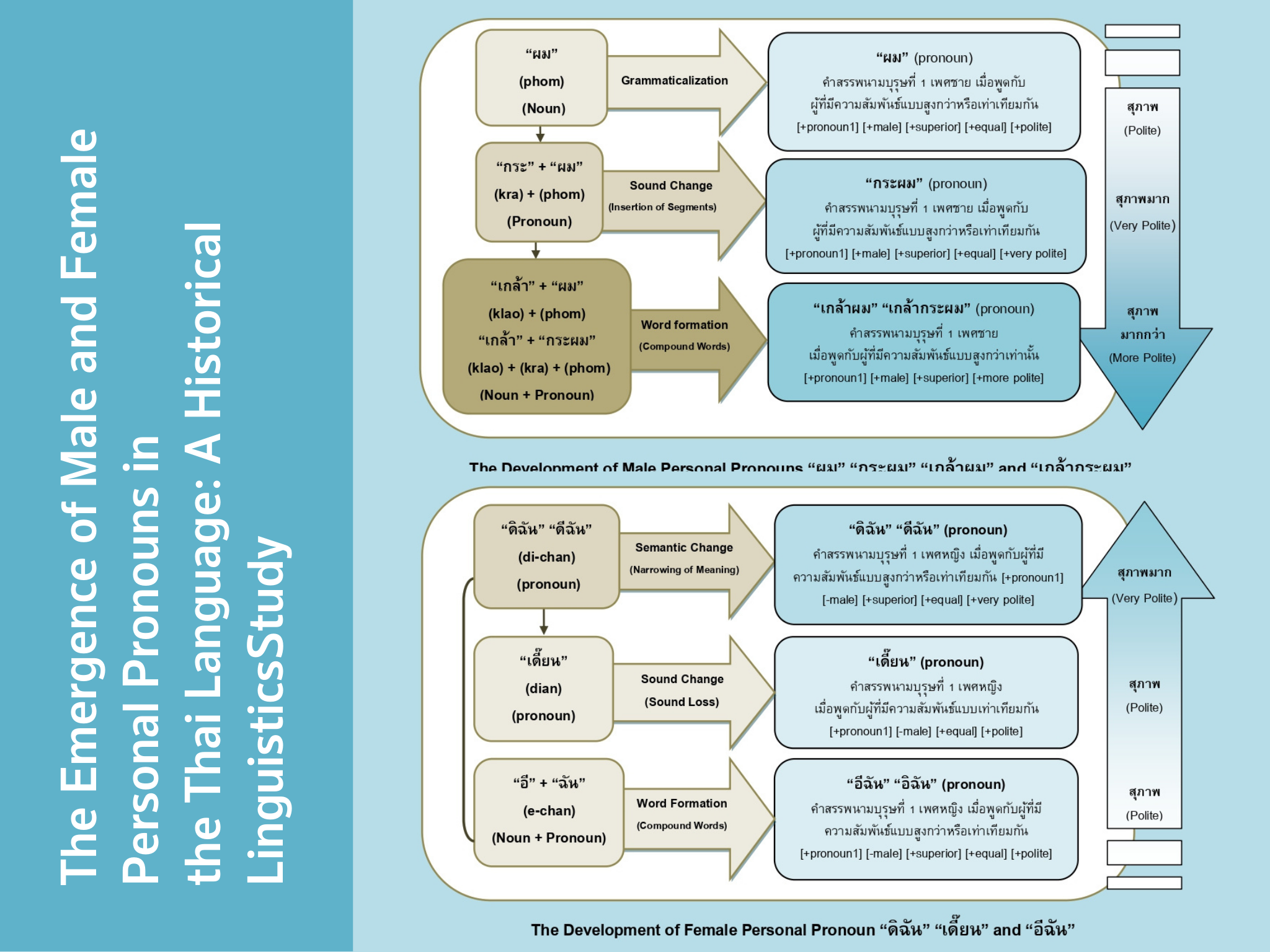
Results: The research found that the Thai language has both masculine and feminine forms of personal pronouns. These include the four male first-person pronouns “phom” “kra-phom” “klao-phom” and “klao-kra-phom”, and the three female first-person pronouns “di-chan”, “dian”, and “e-chan”. The male personal pronoun “phom” first appeared during the reign of King Rama IV, arising through grammaticalization—a transformation from the noun “phom”(meaning “hair”) into a first-person male pronoun. To increase politeness in addressing interlocutors of higher social status, the prefix “kra” was added, by insertion of segments yielding “kra-”. Similarly, the forms “klao-phom” and “klao-kra-phom” are compound words formed by combining “klao” (royal head) with “phom” and “kra-phom”, respectively. These highly respectful forms are exclusively used when speaking to individuals of significantly higher social rank. The female personal pronoun “di-chan”, appeared in use during the Rattanakosin period from the reign of King Rama I to King Rama VII, functioned as a gender-neutral first-person pronoun. However, through semantic change, it came to be used primarily as a female personal pronoun from the reign of King Rama VIII onwards. The word “dian”, which also appeared during the reign of King Rama IV, denotes a female first-person pronoun. It is a result of phonetic decay from “di-chan”, wherein vowel merging transformed “i” + “a” into the diphthong “ia”. The form “e-chan” was derived through compounding, by combining the feminine prefix “e” with “chan”, thus creating a female-specific first-person pronoun. Three primary linguistic processes underlying the emergence of gender-specific personal pronouns in Thai were identified: 1) semantic shift, as in the case of “di-chan”, which transitioned from a gender-neutral to a female-specific usage in the reign of King Rama IV; 2) grammaticalization, wherein the noun “phom” was reanalyzed as a male first-person pronoun and modified with the prefix “kra” for increased politeness, resulting in “kra-phom”; and 3) compounding, whereby the previously gender-neutral pronoun “chan” was combined with the feminine prefix “e” to form the female pronoun “e-chan” and the compounding of a noun “klao” with a grammaticalized element to form a pronoun “phom”, as in “klao” evolving into “klao-phom” and “klao-kra-phom” to be male pronouns.
Application of this study: The findings of this research can serve as guidelines for writing Thai grammar textbooks, particularly in the classification of word types in the Thai language. Furthermore, the results can be used to explore linguistic development and trends of language change within the context of Thai society.
Conclusions: This research adopts a historical linguistic approach, collecting the data from the documents across different historical periods. The findings reveal that Thai possesses four masculine and three feminine personal pronouns, which emerged through three primary linguistic processes: semantic change, grammaticalization, and compounding. The study identified two major factors contributing to the emergence of gender-differentiated personal pronouns in Thai: 1) grammatical influence from western languages, which exhibit grammatical gender, and 2) sociocultural concepts, emphasizing gender distinction between men and women. The results of this research can be applied to the development of Thai grammar textbooks and to further studies on the evolution and linguistic change of the Thai language.
Downloads
Article Details

This work is licensed under a Creative Commons Attribution-NonCommercial-NoDerivatives 4.0 International License.
References
Boonkhajorn, K. (2017). Novels and Thai Society 1932-1957. Bangkok: Academic Publication Project Faculty of Arts, Chulalongkorn University. (In Thai)
Burusphat, S. (2017). Historical Linguistics. Nakhon Pathom: Research Institute for Languages and Cultures of Asia Mahidol University. (In Thai)
Cooke, J. R. (1968). Pronominal Reference in Thai, Burmese, and Vietnames. Doctoral Dissertation, Ph.D. in Lingutics, University of California, United States of America.
Dailynews Online. (2023). Rieng Yue Khot. Retrived 9 July 2022, From, https://www.dailynews.co.th/articles/1230443/
(In Thai)
Dokmaisod, A. (1973). Novel Story Khamphit Khrangrek. Bangkok: Bunnakhan. (In Thai)
Haruethaivinyoo, S. (2002). A Historical Study of the Personal Pronoun System in the Rattankosin Period. Master Thesis, M.A. in Linguistics, Chulalongkorn University, Thailand. (In Thai)
Hopper, P. J., & Traugoot, E. (2003). Grammaticalization. Cambridge: Cambridge.
Intratat, C. (1996). Grammaticalization of Verbs into Preposition in Thai. Doctoral Dissertation, Ph.D. in Linguistics, Chulalongkorn University, Thailand. (In Thai)
Iamjinda, M. (1991). The Evolution of the Personal Pronoun System From the Sukhothai Period to the Present. Master Thesis, M.A. inLinguistics, Thammasart University, Thailand. (In Thai)
Imsamran, B. (2006). Observations on the Use of Masculine Pronouns by Female University Students. Warwaln Compiles Academic Articles on the Occasion of the Retirement of Asst. Prof. Dr. Walaya Changkhwanyuen. Nakhon Pathom: Department of Thai Language, Faculty of Arts, Silpakorn University. (In Thai)
Jiaphong, S. (2007). Personal Referents in LILIT PHRALAW : A Sociolinguistics Study. Journal of the Faculty of Arts, Silpakorn University, 29(Special edition), 73-89. (In Thai)
Jiaphong, S. (2010). A Comparative Study of Personal Pronouns in the Four Thai Dialects. Doctor Dissertation, Ph.D. in Thai Language, Silpakorn University, Thailand. (In Thai)
Jiaphong, S. (2011). Society and Culture Reflected in the Use of Personal Pronouns : A Comparative Study of Personal Pronouns in the Four Thai Dialects. Journal of Humanities Naresuan University, 9(2), 66-89. (In Thai)
Jiaphong, S. (2013). Thai Masculine and Feminine Personal Pronouns. Pasa Sangkhom Somchai: Academic and Research Articles in Thai Language and Linguistics in Honor of Assistant Professor Dr. Somchai Samniangngan’s Retirement. Bangkok: Thammasart University. (In Thai)
Jiaphong, S. (2017). Speakers’ Age and Choice of First and Second Person Pronouns: A Comparative Study of Word Forms and Usage. Wiwitwannasan Journal of Language and Culture, 1(3), 105-130. (In Thai)
Jiaphong, S. (2021). Foreign languages in Thai. Phitsanulok: Karnphim. (In Thai)
Jiaphong, S. (2025a). Figure 1 The Process of Semantic Change of “ดิฉัน”.
Jiaphong, S. (2025b). Figure 2 The Process of Grammaticalization of “ผม”.
Jiaphong, S. (2025c). Figure 3 The Compounding Process of “อีฉัน” and “เกล้ากระผม”.
Jiaphong, S. (2025d). Figure 4 The Process of Sound Change in “กระผม”.
Jiaphong, S. (2025e). Figure 5 The Process of Sound Loss in “เดี๊ยน”.
Jiaphong, S. (2025f). Figure 6 The Development of Male Personal Pronouns “ผม” “กระผม” “เกล้าผม” and “เกล้ากระผม”.
Jiaphong, S. (2025g). Figure 7 The Development of Female Personal Pronoun “ดิฉัน” “เดี๊ยน” and “อีฉัน”.
Keawthep, K. (1998). Women's Studies. Bangkok: ThammasatUniversity. (In Thai)
King Chulalongkorn, His Majesty King. (1963). The Royal Letter of His Majesty King Mongkut. Bangkok: Ongkarnkha Krusapa. (In Thai)
King Mongkut, His Majesty King. (1960). A Drama Script Talks About Hen Kae Luk. Bangkok: Ratchadaromp. (In Thai)
King Mongkut, His Majesty King. (1925). A Drama Script Talks About Khadee Samkhan. Bangkok: Ongkarnkha Krusapa. (In Thai)
Komonmisr, K. (1961). A Drama Script Talks About Thanaj Chawley. Bangkok: Khurusapa.
Li, F. K. (1977). A Hand Book of Comparative Tai. Honolulu: University of Hawaii.
Nation Library of Thailand. (1987). Note of King Rama III, Volumes1. Bangkok: Sahaprachapanit. (In Thai)
Netrangsri, P. (1992). Short Story Mae Sriruen. Bangkok: Dookya. (In Thai)
Prakhanphech. (1975). A Drama Script Talks About Noi in Thasen. Bangkok: Fine Arts Department.
Prasitratthasin, A. (2010). Types of Words in Thai: A Syntactic Analysis. Bangkok: Chulalongkorn University. (In Thai)
Palakornkul, A. (1972). A Socio-Linguistic Study of Pronominal Strategy in Spoken Doctoral Dissertation, Ph.D. Lingutics, University of Texas, United States of America.
Pallergoix, B. (2007). Grammatica Linguae Thai. Bangkok: Chulalongkorn University.
Panuphong, W. (1995). Thai Language Structure: Grammatical System. 13th ed. Bangkok: Ramkhamhaeng University. (In Thai)
Pewphorchai, P. (2003). Stylistic Varian of the Pronoun /di-chán/ and Thai’s Attitude. Journal of Ubon Ratchathani University, 5(2), 69-76. (In Thai)
Phitsanulokprachanart, P., & Khajronjarutrui, M. C. (1997). A Drama Script Talks About Nuja. Bangkok: Khurusapa. https://www.finearts.go.th/performing/view/28032-บทละครพูด-เรื่อง--หนูจ๋า (In Thai)
Royal Institute. (2013). Royal Institute Dictionary 2011. 2nd ed. Bangkok: Nanmeebooks. (In Thai)
Samniengngam, S. (2001). The Selection of Thai Pronouns and the Concept of Politeness by Brown and Levinson. Journal of the Faculty of Arts, Silpakorn University, 23(2), 220-242. (In Thai)
Samniengngam, S. (2009). Self-Adress Terms in Monologues of Speakers of Diverse Gender. Journal of the Faculty of Arts, Silpakorn University, 31(2), 7-25. (In Thai)
Sengsod, W. (1989). Personal Pronouns in Thai: A Historical Study. Master Thesis, M.A. in Art in Linguistics, Chulalongkorn University, Thailand. (In Thai)
Sillapasarn, U. (2003). Thai Language Principles. 13th ed. Bangkok: Thai Wattanapanich. (In Thai)
Singnoi Wongwattana, U. (2022). Thai Communicative Grammar: A Functional Linguistic Analysis from a Typological Perspective. Phitsanulok: Naresuan University Publishing House. (In Thai)
Siirid, P. (2019). The Royal Initiatives on Women's Rights of King Mongkut. Master Thesis, M.A. in Political Science, Sukhothai Thammathirat University, Bangkok, Thailand. (In Thai)
Strecker, D. (1984). Proto –Tai Personal Pronouns. Doctor Dissertation, Ph.D. University of Michigan, United States of America.
Wareeket, K., & Phothipath, V. (2013). Grammaticalization of the Noun /phom/. Vannavidas Journal, 13(2), 196-212. (In Thai)
