
Pragmatic Strategies in Travel and Hospitality Advertising Slogans
Article Sidebar
Main Article Content
Abstract
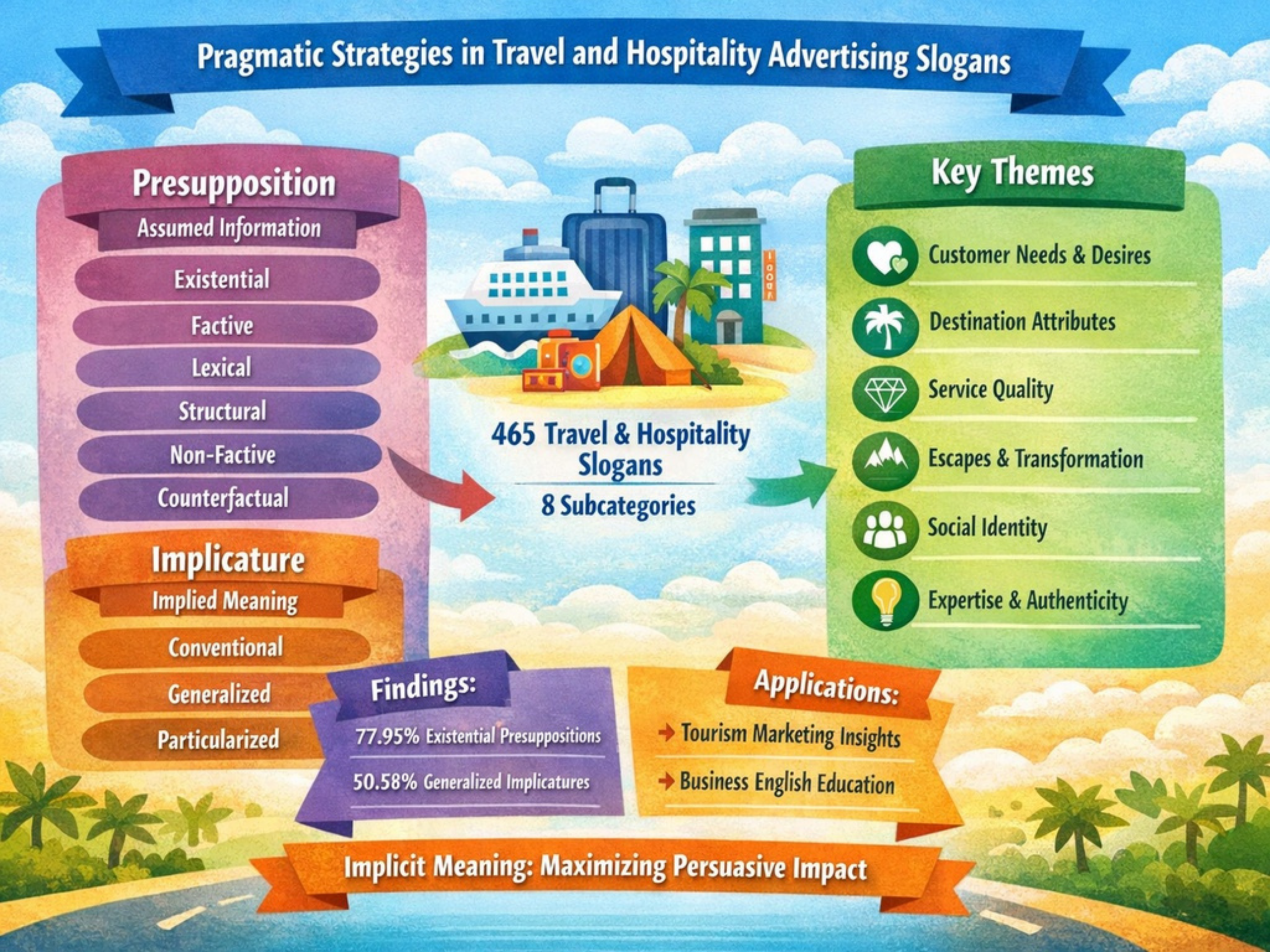
Background and Objectives: In advertising discourse, messages are often designed to use minimal words while having the maximum persuasive impact. One common way to accomplish this is through the strategic use of implicit meanings—the central focus of pragmatic theory. Among the key pragmatic concepts, presupposition (information assumed to be true based on what is explicitly stated) and implicature (additional meaning derived from the interaction between language and context) serve as powerful devices for attaining this effect. Despite the recognized importance of these pragmatic concepts in advertising, few studies have investigated their combined application in the tourism sector, specifically across its subcategories. To fill this gap, the main aim of this study is to examine how presupposition and implicature function as persuasive strategies in the different sectors of travel and hospitality advertising slogans by identifying the types of presupposition and implicature employed and analyzing the categories of the information they convey.
Methods: The study analyzed 465 travel and hospitality advertising slogans across eight industry subcategories (coach travel, train travel, camping, cruise, hostel, hotel, motel, and resort) drawn from the Database of Advertising Slogans using a mixed-methods approach involving both quantitative and qualitative analysis. Presuppositions were categorized into six types (existential, factive, lexical, structural, non-factive, and counterfactual) and implicatures were classified into three types (conventional, generalized conversational, and particularized conversational) using established pragmatic frameworks. They were then coded and tabulated for frequency analysis. Reliability was enhanced through independent coding by three researchers, followed by meetings to reach conclusions on disputed cases. A qualitative content analysis investigated the rhetorical and thematic functions of these pragmatic features. This integrated procedure allows for both quantitative precision and interpretive depth, providing insights into how implicit meaning boosts persuasion in advertising and it adapts well to the complexity of promotional discourse.
Results: The findings reveal a clear dominance of existential presuppositions (77.95%) and a strong overall preference for generalized conversational implicatures (50.58%), though distribution patterns vary by sector-specific marketing goals. Presuppositions primarily communicate five types of information: customer needs and desires, destination or experience attributes, value propositions, service quality, and brand authority. Implicatures convey six themes: sensory and emotional experience, superiority and competition, transformation and escape, service reliability and personalization, social identity and belonging, and expertise and authenticity. These categories align with the strategic focus of different travel sectors. Presupposition and implicature work cooperatively to deliver dense and compelling messages that prompt audience inference while maximizing brevity—ideal for advertising’s constrained format. This integrated analysis contributes to our understanding of how implicit meaning supports persuasive communication in tourism, especially in a service-oriented context where the product is an experience rather than a tangible object.
Application of this study: This study shows how presupposition and implicature contribute to creating concise and persuasive messages in travel advertising slogans. It offers practical insights for tailoring slogans to the unique value propositions of various travel sectors. In terms of pedagogical implications, it underscores the importance of teaching pragmatic mechanisms in business English curricula, particularly in tourism-focused contexts like Thailand. Theoretically, it highlights how these pragmatic tools function unitedly to convey layered meanings through minimal language, in line with relevance-based communication paradigms.
Conclusions: This study analyzed 465 travel and hospitality advertising slogans to explore how presupposition and implicature are utilized to convey persuasive and succinct messages in eight subcategories of the industry. Although researcher triangulation supported validity, limitations include interpretive subjectivity, the absence of multimodal context analysis, and assumptions regarding intentionality and audience effect. Future studies should therefore include visual analysis, audience reception studies, and cross-sector comparisons. Despite its limitations, the study offers practical guidance for branding in specific sectors, contributes to theoretical concepts through Relevance Theory, and supports business English education—particularly in a tourism-driven country like Thailand—by highlighting the effective incorporation of implicit strategies in professional communication.
Downloads
Article Details

This work is licensed under a Creative Commons Attribution-NonCommercial-NoDerivatives 4.0 International License.
References
Alter, A. L., & Oppenheimer, D. M. (2009). Uniting the Tribes of Fluency to Form a Metacognitive Nation. Personality and Social Psychology Review, 13(3), 219–235. https://doi.org/10.1177/1088868309341564
Chen, X. (1998). A Study on Pragmatic Presupposition in Advertising Texts. Foreign Languages, 5, 54–57.
Cook, G. (2001). The Discourse of Advertising. 2nd ed. London, UK: Routledge.
Dahlén, M., & Rosengren, S. (2005). Brands Affect Slogans Affect Brands? Competitive Interference, Brand Equity and the Brand-Slogan Link. Journal of Brand Management, 12(3), 151–164. https://doi.org/10.1057/palgrave.bm.2540212
Ge, L. (2011). Pragmatic Functions of Presupposition in Advertising English. Asian Culture and History, 3(1), 153–157. https://doi.org/10.5539/ach.v3n1p153
Geis, M. L. (1982). The Language of Television Advertising. New York, NY: Academic Press.
Goddard, A. (2002). The Language of Advertising: Written Texts. 2nd ed. London, UK: Routledge.
Grice, H. P. (1975). Logic and Conversation. In P. Cole & J. L. Morgan (Eds.), Syntax and Semantics (Vol. 3, Speech acts, pp. 41–58). New York, NY: Academic Press.
Horn, L. R. (1984). Toward a New Taxonomy for Pragmatic Inference: Q-Based and R-Based Implicature. In D. Schiffrin (Ed.), Meaning, Form, and Use in Context: Linguistic Applications (pp. 11–42). Washington, DC: Georgetown University Press.
Horn, L. R. (2004). Implicature. In L. R. Horn & G. Ward (Eds.), The Handbook of Pragmatics (pp. 3–28). Malden, MA: Blackwell.
Hu, N. (2023). A Study on Presuppositions in Chinese and English Advertising Slogans with Big Data Analysis. Academic Journal of Humanities & Social Sciences, 6(25), 82–90. https://doi.org/10.25236/AJHSS.2023.062514
Huang, L.-L., & Others. (2017). Impact of the Real Cost Campaign on Adolescents’ Recall, Attitudes, and Risk Perceptions About Tobacco Use: A National Study. International Journal of Environmental Research and Public Health, 14(1), Article 42. https://doi.org/10.3390/ijerph14010042
Huang, Y. (2014). Pragmatics. 2nd ed. Oxford, UK: Oxford University Press.
Ijabah, N., & Argina, A. (2022). Presupposition in Commercial Advertisements: A Pragmatic Analysis of Sk-II Advertisements. Journal of Pragmatics Research, 4(1), 13–30. https://doi.org/10.18326/jopr.v4i1.13-30
Kachin, T. (2022). Speech Acts and Value Expressions in Thai Tourism Slogans. LEARN Journal: Language Education and Acquisition Research Network, 15(1), 367–391.
Keller, K. L. (1998). Strategic Brand Management: Building, Measuring, and Managing Brand Equity. Upper Saddle River, NJ: Prentice Hall.
Lam, C. K. Y. (2009). What Is Useful About Presupposition in Advertisements and What Does It Reflect? A Sociolinguistic Study of Hong Kong Culture. Retrieved 5 January 2025, from https://www.scribd.com/document/252961942/4Carrie-Lam
Laosrirattanachai, P., & Panyametheekul, S. (2018). A Factor for Interpreting Tourism Slogan. Language and Linguistics, 36(2), 68–88.
Lavandeira Rojo, S. (2015). A Comparative Linguistic Analysis of English and Spanish Advertising Discourse. Doctoral Dissertation, Ph.D. in English Philology, Universidade da Coruña, Spain.
Leech, G. N. (1966). English in Advertising: A Linguistic Study of Advertising in Great Britain. London, UK: Longmans.
Levinson, S. C. (1983). Pragmatics. Cambridge, UK: Cambridge University Press.
Levinson, S. C. (2000). Presumptive Meanings: The Theory of Generalized Conversational Implicature. Cambridge, MA: MIT Press.
Liu, Y., & Tian, J. (2022). A Study of Pragmatic Presupposition on Airline Advertising Slogans. International Journal of Languages, Literature and Linguistics, 8(1), 31–35. https://doi.org/10.18178/ijlll.2022.8.1.318
Myers, G. (1994). Words in Ads. London, UK: Edward Arnold.
Potts, C. (2005). The Logic of Conventional Implicatures. Oxford, UK: Oxford University Press.
Sperber, D., & Wilson, D. (1986). Relevance: Communication and Cognition. Cambridge, MA: Harvard University Press.
Sperber, D., & Wilson, D. (1995). Relevance: Communication and Cognition. 2nd ed. Oxford, UK: Blackwell.
Strutton, D., & Roswinanto, W. (2014). Can Vague Brand Slogans Promote Desirable Consumer Responses?. Journal of Product & Brand Management, 23(4/5), 282–294. https://doi.org/10.1108/JPBM-02-2014-0507
Suvarnamani, S., Ratanakul, S., & Chiravate, B. (2024). A Morphological Analysis of Tourism Slogans. Journal of Arts and Thai Studies, 46(3), E3794(1–17). https://doi.org/10.69598/artssu.2024.3794.
Tanaka, K. (1994). Advertising Language: A Pragmatic Approach to Advertisements in Britain and Japan. London, UK: Routledge.
Tang, J. (2019). A Pragmatic Analysis of Presuppositions in Lancôme Advertisements. Theory and Practice in Language Studies, 9(8), 926–931. https://doi.org/10.17507/tpls.0908.03
Textart. (2024). Database of Advertising Slogans. Retrieved 30 January 2024, from http://www.textart.ru/advertising/slogans/tourism-travel/slogans.html
Yule, G. (1996). Pragmatics. Oxford, UK: Oxford University Press.
Yule, G. (2000). Pragmatics. 5th ed. Oxford, UK: Oxford University Press.
Zeng, B. (2012). Han Ying Guang Gao Zhong De Yu She Yan Jiu [Study of Presupposition in Chinese and English Advertising Texts]. Doctoral Dissertation, Ph.D. in English Language and Literature, Shanghai International Studies University, China. (In Chinese)
Zuhriani, N. (2022). Functions of Pragmatic Presuppositions in Advertisements: Promoting Cosmetics on Instagram. International Journal of Linguistics Studies, 2(1), 1–14. https://doi.org/10.32996/ijls.2022.2.1.1
