
Factors Associated with the Causes of Migration among Youth Migrants in Thailand
Article Sidebar
Main Article Content
Abstract
Background and Objectives: The transformation of economic and social structures, driven by capitalism, alongside advancements in technology and communication, and the development of infrastructure, have collectively facilitated migration across all age groups. This includes youth migrants, who are either currently enrolled in the formal education system or have recently graduated. Understanding the causes of the migration of the youth migrant group can reflect the opportunities afforded by societal shifts. Therefore, this research aims to investigate the causes of youth migration in Thailand and the factors associated with the causes of youth migration in Thailand. This study focuses on internal migration in Thailand.
Methods: Quantitative research with a cross-sectional design was utilized. The unit of analysis was the individual. The sample consisted of 1,917 youth migrants aged 15–24 years at the time of the 2023 survey. The data were derived from the microdata of the Population Migration Survey Project, collected by the National Statistical Office of Thailand between October and December 2023. Descriptive statistics and Chi-square tests were employed to analyze the factors associated with the causes of youth migration in Thailand. The research findings were presented with a narrative accompanied by tables.
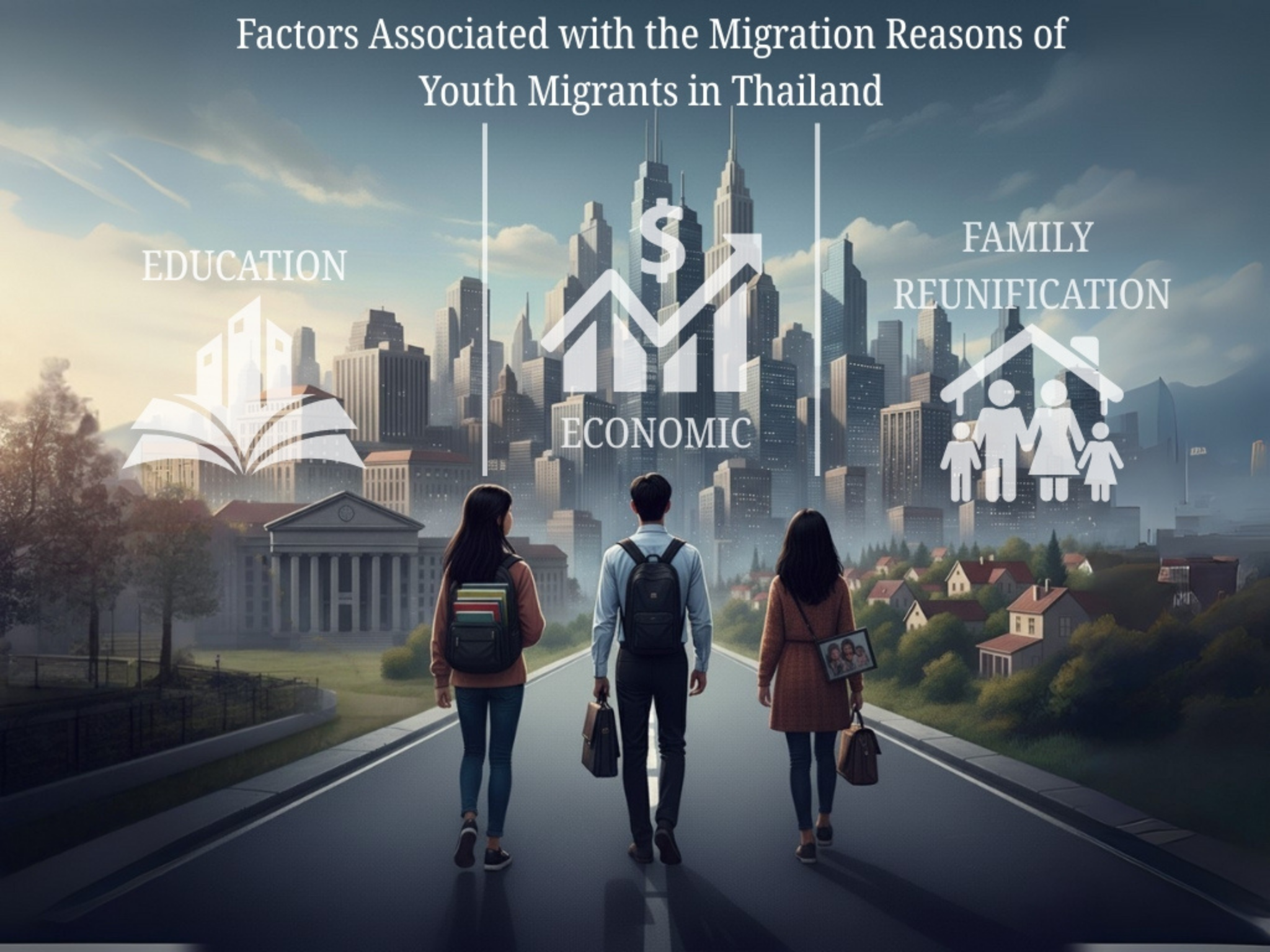
Results: The results found that the majority of youth migrants were female, single, aged 19–24 years, and had completed upper secondary education. Most originated from the Northeast and South regions, with primary destinations being urban areas in the Northeast, Central, and South regions. Nearly half of this group had resided in their destination areas for less than one year. Regarding the causes of youth migration in Thailand, education was the primary reason for migration, accounting for 54%, followed by family reunification. Specifically, older youth migrants (19–24 years), both male and female, who were single, originated from the Northeast and South, and lived in urban areas, primarily migrated for education. In contrast, younger youth migrants (15–18 years) predominantly migrated to follow their families. Additionally, married or previously married youth migrants with diplomas or higher education primarily migrated for economic reasons. A higher proportion of economic migration was observed among youth migrants who had resided in their destinations for less than one year compared to those who had stayed for more than one year.
Application of this study: This study contributes to the development of the body of knowledge on the causes of youth migration. The findings are valuable for policymakers in developing appropriate policies and measures to support youth migrants appropriately, for instance, developing the welfare systems for young migrants or adjusting the economic structure and development to align with the evolving trends of this age group, in order to enable their full potential.
Conclusions: This study employed a quantitative research approach using a cross-sectional design, drawing upon the data from the 2023 Migration Survey conducted by the National Statistical Office of Thailand. The sample consisted of 1,917 adolescent migrants aged 15–24 years. The findings revealed that the majority of adolescent migrants were female, single, aged between 19 and 24, and migrated primarily for educational purposes, followed by family-related reasons. The younger adolescents tended to migrate to follow their families, while older and more highly educated individuals migrated mainly for economic reasons. The study indicated that adolescent migration is associated with age group, marital status, educational level, and duration of residence at the destination. These findings can serve as a foundation for formulating policies and measures to better support adolescent migrants in alignment with the current economic and social contexts.
Downloads
Article Details

This work is licensed under a Creative Commons Attribution-NonCommercial-NoDerivatives 4.0 International License.
References
Antosik, L. V., & Ivashina, N. V. (2021). Factors and Routes of Interregional Migration of University Graduates in Russia. Voprosy Obrazovaniya. Educational Studies Moscow, 2021(2), 107–125.
Assaf, L. (2020). ‘Abu Dhabi Is My Sweet Home’: Arab Youth, Interstitial Spaces, and the Building of a Cosmopolitan Locality. City, 24(5–6), 830–841.
Ayuwat, D. (2019). “The Isan Migrants on the Move” Situations and Impacts. Khon Kaen: Klang Nana Vithaya. (In Thai)
Ayuwat, D. (2024). How to analysis Quantitative data in Social Sciences Research. Khon Kaen: Lecture Handout, Faculty of Humanities and Social Sciences, Khon Kaen University. (In Thai)
Basnet, N., Timmerman, M. C., & van der Linden, J. (2020). The Education-To-Work Transition of Young Rural–Urban Migrants in Kathmandu, Nepal. Journal of Applied Youth Studies, 3(4–5), 331–344.
Basnet, N., Timmerman, M. C., & van der Linden, J. (2021). Opportunities and Barriers for Young Rural–Urban Migrants Transitioning From Education to Work in Kathmandu, Nepal. International Journal of Adolescence and Youth, 26(1), 27–40.
Basnet, N., Timmerman, M. C., & van der Linden, J. (2023). ‘I Need to Switch the Job’. Young Rural-Urban Migrants’ Perceptions About Their Job During Their Education to Work Transition. Journal of Education and Work, 36(4), 299–309.
Byishimo, P., & Others. (2022). The Effect of Land Inheritance on Youth Migration and Employment Decisions in Rwanda. Sustainability, 14(9), 14(9), 5404.
Casey, B. J., Jones, R. M., & Hare, T. A. (2008). The Adolescent Brain. Annals of the New York Academy of Sciences, 1124, 111-126.
Clendenning, J. (2022). Between the Village and the City: The In-Betweenness of Rural Young People in East Indonesia. International Development Planning Review, 45(1), 19–40.
Corona Maioli, S., & Others. (2024). Growing up in Transit. Personal Development and Resistance of Migrant Adolescents Travelling Through Mexico Unaccompanied. Journal of Migration and Health, 10, 2024, 100245.
Díaz Baca, M. F., & Others. (2024). Why Do Rural Youth Migrate? Evidence From Colombia and Guatemala. Frontiers in Sociology, 9, 2024, 1439256.
Harkins, B. (2019). Thailand Migration Report 2019. Bangkok: United Nations Thematic Working Group on Migration in Thailand.
Hof, H. (2023). Worklife Pathways to Singapore and Japan: Gender and Racial Dynamics in Europeans’ Mobility to Asia. Social Science Japan Journal, 21(1), 45–65.
International Labour Organization. (2024). Work Wise Youth: A Guide to Youth Rights at Work. Switzerland: International Labour Organization.
Kummitha, H. R., & Others. (2020). Rural-To-Urban Migration of Young People and Its Effect on Small Cities in Hungary. DETUROPE, 12(2), 71-83.
Lee, E. S. (1966). A Theory of Migration. Demography, 3(1), 47-57.
Malamassam, M. A. (2016). Youth Migration in Indonesia: Decision to Move and to Choose Destination Areas. Indonesian Journal of Geography, 48(1), 62–71.
Martins, M. I. F. P., & Others. (2022). Comings and Goings: The Mobility of Rural Populations in Protected Areas in the Brazilian Amazon. RA’EGA, 55, 39–57.
Naik, M. (2024). Smaller Cities as Sites of Youth Migrant Incorporation. Urban Studies, 61(12), 2399–2415.
National Statistical Office. (2023). The 2023 Migration Survey. Bangkok: Ministry of Digital Economy and Society. (In Thai)
National Statistical Office. (2024). The 2024 Survey of The Older Persons In Thailand. Bangkok: Ministry of Digital Economy and Society. (In Thai)
Phanthalee, P. N., & Others. (2022). Social Inequality in Thailand in the New Normal. Journal of Social Sciences, Mahamakut Buddhist University, 5(2), 137-148. (In Thai)
Richter, K., & Others. (1997). Report of the Northeastern Follow-up to the National Migration Survey: Migration and the Rural Family: Sources of Support and Strain in a Mobile Society. Nakhon Pathom: Institute for Population and Social Research, Mahidol University. (In Thai)
Saraswati, Y., & Others. (2025). Push-Pull Theory of Migration Impact on Students Decisions at East Java Province. SHS Web of Conferences, 212, 04025.
Samuel Hall. (2023). Youth, Migration and Development: A New Lens for Critical Times - Case Studies from Colombia, Jordan, Kenya, Mexico, Pakistan, Senegal, Thailand, and Tunisia (KNOMAD Paper 53). Washington, DC: World Bank.
Sergienko, A. M., & Snegireva, O. A. (2019). Migration of Rural Youth in Altai Krai as an Agrarian Region. Regional Research of Russia, 9(1), 78–88.
Skeldon, R. (2018). International Migration, Internal Migration, Mobility and Urbanization: Towards More Integrated Approaches. Geneva: International Organization for Migration.
United Nations. (2012). Young People, Participation, and Sustainable Development in an Urbanizing World. Norway: United Nations.
United Nations. (2020). World Youth Report. New York: United Nations.
Yeboah, T. (2020). Future Aspirations of Rural-Urban Young Migrants in Accra, Ghana. Children’s Geographies, 19(1), 45–58.
