
Revitalizing Local Food and Wisdom: A Case Study of Ban Muang Klang, Ban Luang Subdistrict, Chom Thong District, Chiang Mai Province
Article Sidebar
Main Article Content
Abstract
Background and Objectives: Traditional local food represents a form of cultural heritage that reflects the identity, way of life, beliefs, and wisdom of local communities. However, contemporary economic, social, and cultural changes have increasingly affected the transmission of knowledge related to traditional food, particularly the intergenerational transfer of culinary practices and local wisdom. Consequently, the preservation and revitalization of traditional food knowledge have become important issues that warrant further study and promotion in order to safeguard cultural identity and strengthen communities in a sustainable manner. The objective of this study is to examine local wisdom related to traditional local food, with the intention of contributing to the support of community learning, transmission, and revitalization of traditional local food wisdom. This is because food represents local identity, reflecting the way of life, beliefs, and relationships among people in the community. The development of this body of wisdom will help promote and revitalize traditional local food so that it continues to exist.
Methods: This study employed a qualitative research approach. The data were collected from academic documents, research reports, scholarly articles, and related studies, together with fieldwork. The field data were gathered through interviews with 10 key informants, including monks, teachers, local wisdom holders, members of women’s groups, and both formal and informal local leaders. The research was divided into two main phases: Phase 1 involved qualitative ethnographic inquiry, and Phase 2 employed participatory action research (PAR).
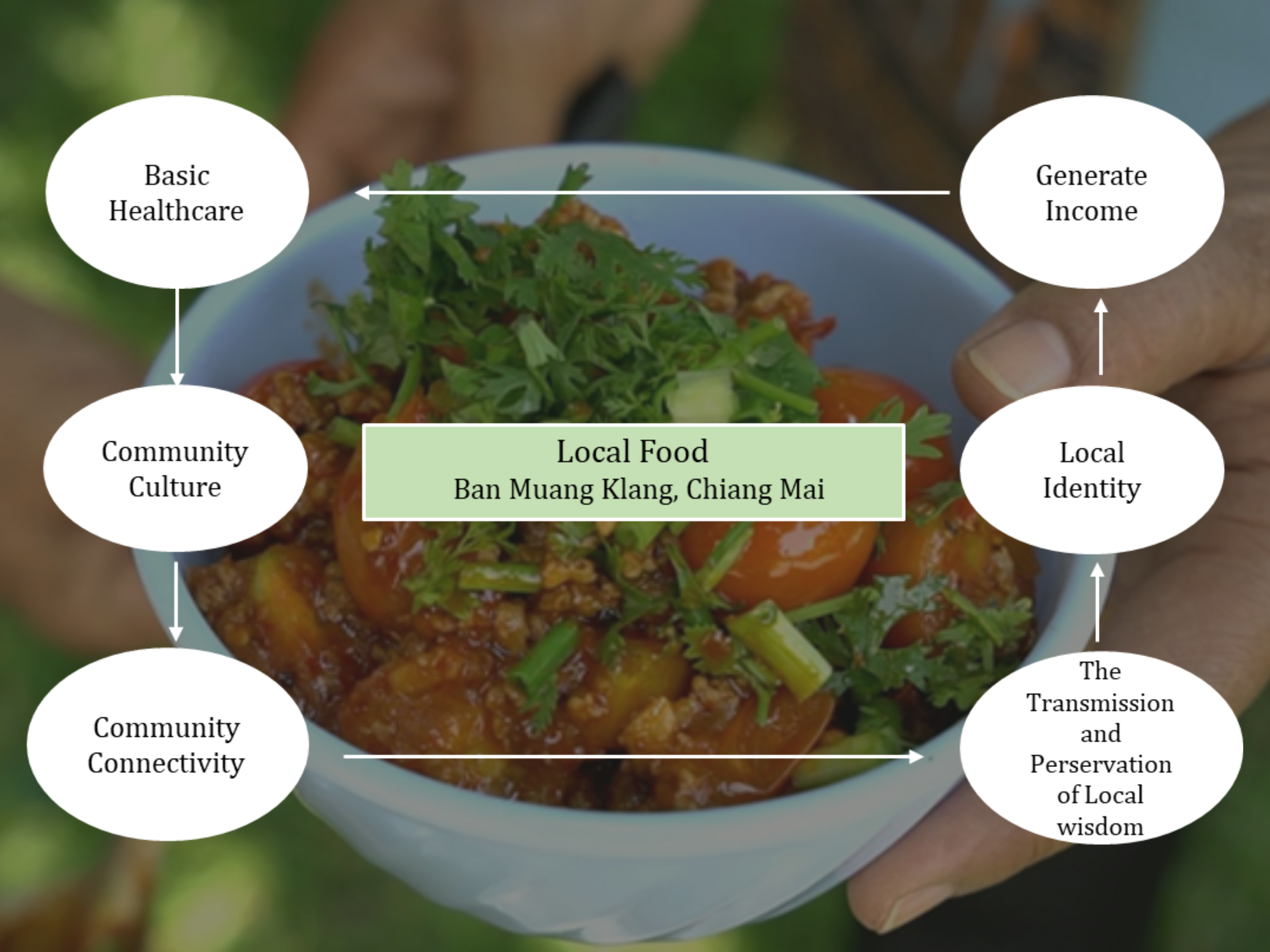
Results: The findings reveal that local food is integral to fostering community learning, transmitting knowledge, restoring cultural practices, and ensuring practical application in daily life. As a marker of local identity, it embodies the community’s lifestyle, belief systems, and social relationships. The cultivation and preservation of culinary wisdom not only strengthen self-reliance but also enhance learning capacities and further develop the community’s body of knowledge derived from its food-related wisdom.
Application of this study: This research resulted in the development of a comprehensive learning tool on local food, available in both video and manual formats. The tool is intended for dissemination and integration into the school curriculum within the Ban Luang Subdistrict Municipality, Chom Thong District, Chiang Mai Province.
Conclusions: This research aimed to study, document, and revitalize local wisdom related to traditional food, which reflects the identity, way of life, beliefs, and social relationships of the community amid ongoing social and cultural changes that have affected the transmission of such knowledge. The study employed a qualitative research approach combined with participatory action research, drawing upon documentary sources and fieldwork involving key community informants. The findings indicate that traditional local food constitutes a significant foundation for the learning, transmission, and application of local wisdom. It contributes to the promotion of self-reliance, the development of learning skills, and the extension of the community’s body of knowledge. Furthermore, the study resulted in the development of learning resources in the form of videos and a traditional local food manual for dissemination and for supporting teaching and learning within the local curriculum. These resources serve as an important means of preserving and sustaining the community’s cultural heritage.
Downloads
Article Details

This work is licensed under a Creative Commons Attribution-NonCommercial-NoDerivatives 4.0 International License.
References
Anderson, E. N. (2014). Everyone Eats: Understanding Food and Culture. 2nd ed. New York: University Press.
Aromkliang, T., & Chatraphorn, S. (2014). Sustainabilityof Local Wisdom Transferringon Lanna Food. Kasetsart Journal: Social Sciences, 35(2), 189–205.
Boonchaisri, S., & Pongpattanasiri, S. (2011). Diversity and Utilization of Local Vegetables in Communities Around Kwan Phayao. In Proceedings of the 1st Phayao Research Conference: Knowledge for Community Strength, (pp. 24–28). Phayao: University of Phayao.
Bourdieu, P., & Wacquant, L. J. D. (1992). An Invitation to Reflexive Sociology. Cambridge: Polity Press.
Charoenmuang, T., & Apavatjrut, D. (1986). 700 Years of Chiang Mai. Bangkok, Thailand: Akson Siam Printing.
Chuengsatiansup, K. (2007). Health Dimensions: A New Paradigm for Building a Healthy Society. Nonthaburi, Thailand: Society and Health Institute.
Department of Thai Traditional and Alternative Medicine. (2023). Pho Chon Sat Nai Phumpanya Thai [Nutrition in Thai Wisdom]. Retrieved 25 May 2025, from https://dmsic.moph.go.th/index/detail/9369 (In Thai)
Duennapa. (2007). Ahan Phuea Sukkhaphap Si Phak [Healthy food of Northern Thailand]. Retrieved 24 November 2023, from https://duennapa.wordpress.com (In Thai)
Krittiya. (2015). Prapeni Fon Phi. [Spirit dance tradition]. Retrieved 7 June 2023, from https://fonpejow.blogspot.com/ (In Thai)
Meechubot, W. (2014). Khon Mueang. Sinlapawatthanatham Magazine. [Townsfolk]. Retrieved 9 March 2026, from https://silpa-mag.com/history/article_99058 (In Thai)
Prasopsombat, L. (2023a). Figure 1 Green Jackfruit Curry.
Prasopsombat, L. (2023b). Figure 2 Young Jackfruit Salad.
Prasopsombat, L. (2023c). Figure 3 Nam Phrik Noom.
Prasopsombat, L. (2023d). Figure 4 Nam Phrik Ta Daeng.
Prasopsombat, L. (2023e). Figure 5 Nam Phrik Pla.
Prasopsombat, L. (2023f). Figure 6 Nam Phrik Ong.
Prasopsombat, L. (2023g). Figure 7 In-Depth Interview With a Key Community Stakeholder Regarding Local Food Culture.
Sage, C. (2012). Environment and Food. New York: Routledge.
Sangwasi, S. (2006). Ahan Thai Si Phak [Thai Food From the Four Regions]. Bangkok: Amarin Printing and Publishing. (In Thai)
Secretariat of the National Strategy Committee. (2018). Yutthasat Chat B.E. 2561-2580 [National Strategy 2018–2037]. Bangkok: Office of the National Economic and Social Development Council. (In Thai)
Tangtrakul, P., & Others. (2014). Value Creation of Local Thai Food for Northern Thailand Tourism (Research Report). Bangkok: Institute of Food Research and Product Development, Kasetsart University. (In Thai)
Thai National Food Committee. (2011). Krop Yutthasat Kan Chatkan Dan Ahan Khong Prathet Thai [Strategic Framework for Food Management in Thailand]. Nonthaburi: Food and Drug Administration. (In Thai)
Trakulwaranon, P. (2009). Thun Thang Sangkhom Lae Pracha Sangkhom: Chak Thruesadi Su Withi Witthaya [Social Capital and Civil Society: From Theory to Methodology]. Bangkok: Sanya Dharmasakti Institute for Democracy. (In Thai)
Trubek, A. B. (2008). The Taste of Place: A Cultural Journey Into Terroir. California: University of California Press.
Wilk, R. (2008). Home Cooking in the Global Village: Caribbean Food From Buccaneers to Ecotourists. New York: Berg.
