
Developing a Community-Based Participatory Model for Managing Tai Yai Cultural Capital to Reviving Traditions in Mueang Mae Hong Son
Article Sidebar
Main Article Content
Abstract
Background and Objectives: The decline and the gradual disappearance of Tai Yai traditions, including the Poi Loen Sip Song festival, the Tang Som Tor Luang ritual, and the pilgrimage to Phra That Doi Kong Mu, reflect the significant vulnerability of the processes through which local cultural heritage is transmitted. This situation highlights the urgent need for systematic study and revitalization in order to preserve and sustain these important traditions for the future. This research aimed to study the history of Mueang Mae Hong Son and Phra That Doi Kong Mu, develop a community participation model for managing Tai Yai cultural capital, revitalize local traditions, and assess socio-economic impacts.
Methods: This study employed a mixed-methods research design. The qualitative component involved data collection through documentary research and field research conducted in Chong Kham Subdistrict and at Wat Phra That Doi Kong Mu in Mae Hong Son province. In addition, the research design integrated a research and development (R&D) process to develop prototypes and related activities. The data were collected from 20 selected Tai Yai villagers through in-depth interviews, observations, and focus group discussions. The data were analyzed using descriptive analysis. To ensure the credibility and validity of the data, data triangulation was employed. Subsequently, the research findings were utilized to develop local knowledge, learning media, exhibitions, cultural databases, and festival revitalization initiatives in order to promote the sustainable and participatory management of Tai Yai cultural heritage. The stakeholders were interviewed to assess the economic impact on the academic service project. In addition, for the quantitative component, two questionnaires were used to evaluate the satisfaction of local people who participated in the revival of the “Tang Som Tor Luang” (rice cooking and stirring ceremony) in 2023 (n=300) and 2024 (n=250), as well as their opinions on the “Poi Loen Sib Song: Walking Up Phra That Doi Kong Mu” event (n=250). The quantitative data were analyzed using mean, percentage, and standard deviation.
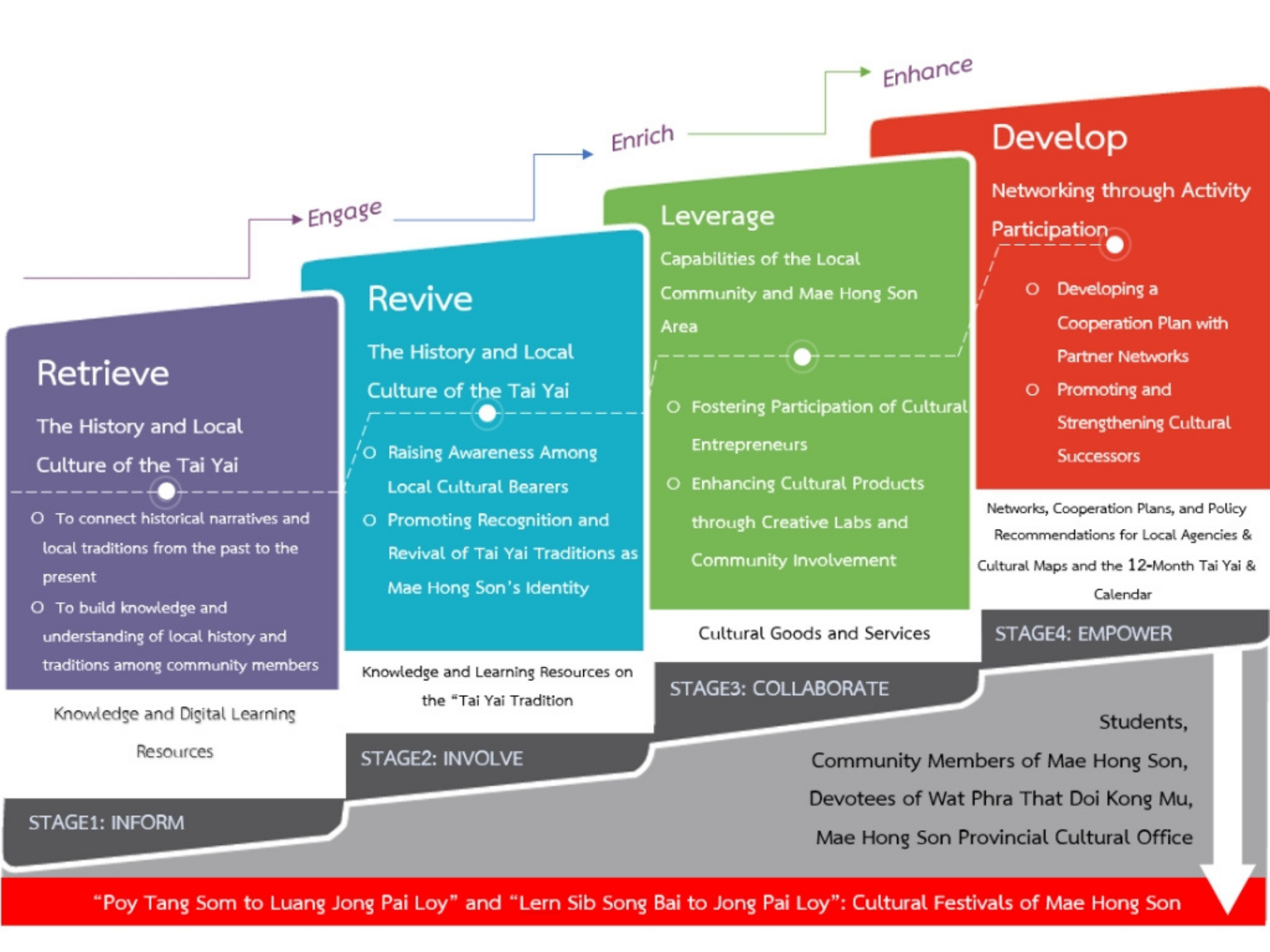
Results: The study found that the historical development can be categorized into four distinct periods: pre-1874, 1874–1910, 1910–1957, and post-1957. Moreover, local people lacked knowledge and understanding of their local history and traditional rituals, such as the nearly forgotten “Tang Som Tor Luang” ceremony. The annual festival at Phra That Doi Kong Mu, once spiritually meaningful, had gradually become just an annual event. From that situation, the research team developed a participatory cultural revitalization model comprising three phases (Pre-festival, Festival, and Post-festival activities). Phra That Doi Kong Mu Temple served as the central site for learning and practice. The revival of Tai Yai traditions, including the Poi Loen Sip Song festival, the Tang Som Tor Luang ritual, and the pilgrimage to the temple, helped developed an awareness of the value of cultural capital, a sense of ownership, and a readiness to transmit it to younger generations, which contributed to fostering pride in Tai Yai identity. These activities also generated economic and social returns at a rate of 3.76 times, and the outcomes were extended to eight communities.
Applications of this Study: Mae Hong Son Municipality has adopted the research outcomes to further develop and plan city-level activities for the fiscal year 2025. Meanwhile, the Tourism Authority of Thailand (TAT), Mae Hong Son Office, has promoted and publicized these activities at both local and national levels. This reflects the strength of community and network collaboration in driving sustainable cultural development.
Conclusion: This study developed a community participation model for managing Tai Yai cultural capital to revitalizing the traditions in Mae Hong Son. It successfully revived key traditions, fostered cultural pride, and generated economic benefits at the local level. At present, the Mae Hong Son Municipality has adopted this model and expanded it to the city level in order to promote the sustainable management of cultural heritage.
Downloads
Article Details

This work is licensed under a Creative Commons Attribution-NonCommercial-NoDerivatives 4.0 International License.
References
Chiang Mai Rajabhat University. (2013). Tai Yai–Thai Dictionary. Chiang Mai: Chiang Mai Rajabhat University. (In Thai)
Janklap, E. (2020). Cultural capital management guidelines for promoting creative economic development: A case study of Nakhon Si Thammarat Provincial Cultural Office. Master’s thesis, M.A. in Public Administration, Chulalongkorn University, Thailand. (In Thai)
Jeenakham, M. (2023, September 5). Interview. Mayor of Mae Hong Son Municipality. Mae Hong Son, Thailand. (In Thai)
Kosol, C. (2018). Cultural Capital Management of Ethnic Groups in Northern Thailand. Journal of Innovation in Management and Administration, 6(2), 64–73. (In Thai)
Lingane, A., & Olsen, S. (2004). Guidelines for Social Return on Investment. California Management Review, 46(3), 116-135. https://doi.org/10.2307/41166224
Mae Hong Son Province. (2022). Annual Report Summary of Mae Hong Son Province. Mae Hong Son: Mae Hong Son Province. (In Thai)
Mae Hong Son Municipality Registry Office. (2024). Population Data Report. Mae Hong Son: Mae Hong Son Municipality Registration Office. (In Thai)
Mankong, A. (2017). The Role of Cultural Capital and the Community’s Economic Development: Case Study of Community in Ban Toon Sub-District, Mueang District, Phayao Province. Research and Development Journal Loei Rajabhat University, 12(39), 90–100. (In Thai)
Maung Tin Aung. (2005). History of Burma. Sumit, P. (Trans.). Bangkok: Social Science and Humanities Textbook Project, Social Science Association of Thailand.
Ministry of Education, Department of Religious Affairs. (1990). History of Temples Throughout the Kingdom, Volume 8. Bangkok: Department of Religious Affairs. (In Thai)
Nimsakul, S. (2023, August 25). Interview. Local expert. Mae Hong Son, Thailand. (In Thai)
Office of the Permanent Secretary for Culture, Ministry of Culture. (2019). Creative Culture, Creative Economy. Bangkok: Rungsin Printing. (In Thai)
Ongsakul, S. (2023). Lanna History. 13th ed. Chiang Mai: Chiang Mai University. (In Thai)
Panyamulwongsa, S. (2023, September 15). Interview. Local expert. Mae Hong Son, Thailand. (In Thai)
Phra Khru Anusasanasakorn. (1987). Wat Phra That Doi Kong Mu Nai Changwat Mae Hong Son. [Mae Hong Son and The Phra That Doi Kong Mu Temple]. Bangkok: Charoenphon. (In Thai)
Pholphirul, P. (2013). Creative Economy and the Development Issues in Thailand. NIDA Economics Review, 7(1), 1–68. (In Thai)
Phra Sumon Sasanakit. (2023, May 6). Interview. Abbot of Wat Phra That Doi Kong Mu, Mae Hong Son, Thailand.
Phra Sumon Sasanakit. (2023, September 5). Interview. Abbot of Wat Phra That Doi Kong Mu, Mae Hong Son, Thailand. (In Thai)
Pitchdamrong, N. (2010). Cultural Capital: The Treasure of the Creative Economy. Journal of Economics and Society, 47(4), 9–13. (In Thai)
Pradit, P. (2023, July 20). Interview. Local expert. Mae Hong Son, Thailand.
Sitthiwet, P. (1939a). Sithtiwet Phap. [Picture book]. N.P.
Sitthiwet, P. (1939b). Figure 3 (a) The Eastern Vihara of the Main Stupa, Photographed in 1939; (b) The Pond on the Western Side of Phra That Doi Kong Mu, With a View of the Main Stupa in the Background.
Sriratanaban, M. (1939). Figure 2 Doi Kong Mu.
Sriratanaban, T., & Others. (2023a). Figure 4 (a) Garuda, Singha, and Naga: Traditional Clay Sculptural Models in Ancient Style, and (b) Garuda, Singha, and Naga: Sculptural Models Cast in Cement.
Sriratanaban, T., & Others. (2023b). Figure 5 (a), (b), (c), and (d) Revival of the “Som To” Rice-Cooking and Stirring Ritual in 2023.
Sriratanaban, T., & Others. (2023c). Figure 6 (a), (b), (c), (d), and (e) Products Inspired by Symbolic Forms Reintroduced During the Revival.
Sriratanaban, T., & Others. (2024a). Figure 1 Research Framework Diagram Illustrating the Objectives, Outputs, and Indicators of the Research.
Sriratanaban, T., & Others. (2024b). Figure 7 Phra That Doi Kong Mu Exhibition and Stamping Postcards Activity.
Sriratanaban, T., & Others. (2024c). Figure 8 Two Sets of Phra That Offering Prototypes.
Sriratanaban, T., & Others. (2024d). Figure 9 Revitalization of the Tradition “Poi Loen Sib Song: Walking Up Phra That Doi Kong Mu”.
Surinta, A. (2024, January 5). Interview. Local expert. Mae Hong Son, Thailand.
Voget, F. W. (1956). The American Indian in Transition: Reformation and Accommodation. American Anthropologist, 58(2), 249-263.
Waidee, A. (2023, May 5). Interview. Local expert. Mae Hong Son, Thailand. (In Thai)
Wallace, A. F. C. (1956). Revitalization Movements. American Anthropologist, 264-281.
Wannasiri, S. (2023, September 5). Interview. Local expert. Mae Hong Son, Thailand. (In Thai)
Winichakul, T. (2013). The Birth of Siam From the Map: A Bodily History of the Nation. Bangkok: Kobfai. (In Thai)
