
Avidya under Visibility: Winston Smith’s Buddhist Ignorance through Sexual Misconduct in Orwell’s 1984
Article Sidebar
Main Article Content
Abstract
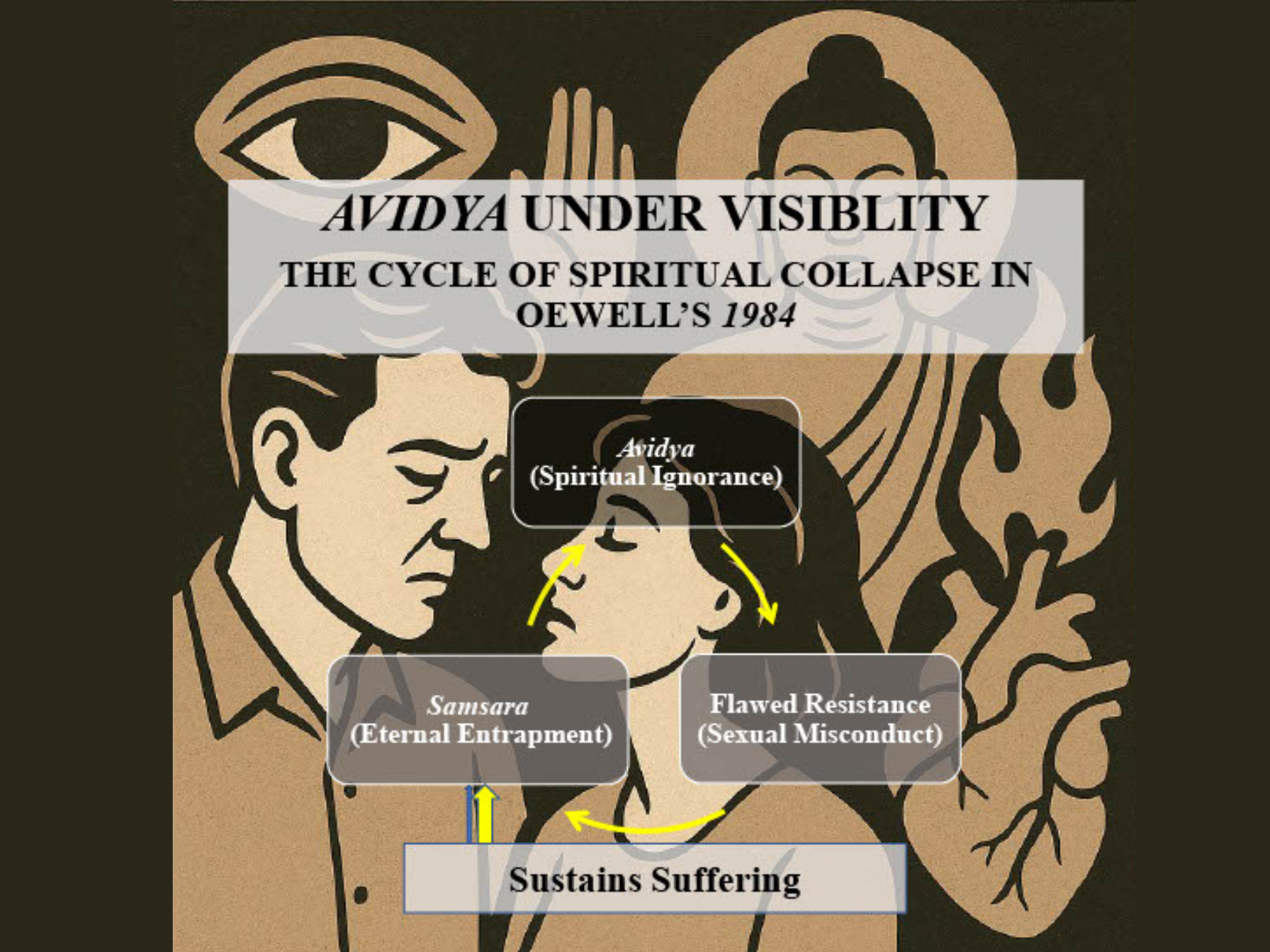
Background and Objectives: This study examines the spiritual ignorance of Winston Smith in George Orwell’s 1984 through his sexual relationship or sexual assault against Julia, an Outer Party member whose surname is never revealed. The research has two objectives: 1) to analyze how Winston’s sexual relationship reflects spiritual ignorance, and 2) to identify the consequences of that ignorance. While Orwell was not influenced by Buddhist philosophy, the concept of Avidya, a Buddhist term for spiritual ignorance, is applied as a complementary interpretive framework. In terms of philosophical analysis, Avidya adds an ethical dimension that supplements the widely discussed political analyses of the novel and enriches its moral implications.
Methods: The study draws on nineteen excerpts from the primary text, Orwell’s 1984, chosen for their relevance to Winston’s sexual misconduct (actions related to illicit desire), moral reasoning (judgments on right or wrong that deviate from the Party’s mandates), and psychological conflict (internal struggle between self-assertion and fear), along with secondary philosophical sources that frame the analysis. These excerpts are examined through descriptive qualitative analysis using the framework of Avidya (spiritual ignorance of self and reality causes suffering) to explore how misunderstanding and unawareness lead to Winston’s actions and decisions, affecting both his private desires and broader sense of right and wrong.
Results: The findings show that Winston initially perceives the affair as a private act of rebellion, secure from Party surveillance. His spiritual ignorance deepens as Julia becomes a necessity and right; their rented room, imagined as a “paradise,” is marked by decay and covert monitoring, eventually becoming a crime scene upon discovery. This process reveals how unexamined desire overrides discernment, fostering craving, attachment, and self-deception. Winston’s sexual misconduct functions as both personal defiance and self-sabotage, shaped by the Party’s manipulation of desire, morality, and secrecy.
His unhesitating acceptance of Julia’s secret message develops into obsession and ultimately culminates in betrayal under torture and spiritual submission to Big Brother. Interpreted through Avidya, this downfall is not only political but spiritual, as he fails to recognize the impermanence of pleasure, the illusion of control, and the deceptive nature of self in attachment.
Application of this study: Integrating Avidya into the analysis, this research expands critical perspectives on 1984, showing how totalitarian regimes invade and control intimate human bonds to enforce submission. This study reflects the value of cross-cultural interpretation in literary analysis and provides a framework that addresses both public mechanisms of control and private areas of ethicality, intimacy, vulnerability, and attachment.
Conclusions: Winston’s spiritual ignorance—manifested through sexual misconduct, possessive entitlement, and moral confusion—illustrates how a totalitarian regime exerts domination by intruding into the most personal aspects of human life. Situating Orwell’s narrative within political and ethical-philosophical contexts, the research concludes that Winston’s Avidya ultimately leads to the total disintegration of his autonomous self and moral agency, emphasizing that true resistance requires spiritual detachment—an insight the Party is powerless to destroy.
Downloads
Article Details

This work is licensed under a Creative Commons Attribution-NonCommercial-NoDerivatives 4.0 International License.
References
Al-Subaihi, M. N., & Ismail, H. H. (2020). Orwell’s 1984 and the Concept of Powerlessness. International Journal of English, Literature and Social Sciences, 5(1), 291–294. https://doi.org/10.22161/ijels.51.48
Blakemore, S. (1984). Language and Ideology in Orwell’s 1984. Social Theory and Practice, 10(3), 349–356.
Campbell, J. W. (2001). The Book of Great Books: A Guide to 100 World Classics. New York: Barnes & Noble.
Foucault, M. (2012). The History of Sexuality: An Introduction [Kindle Version]. Hurley, R. (Trans.). New York: Vintage.
Hanh, T. N. (2009). Beyond the self: Teachings on the middle way [Kindle Version]. Berkeley: Parallax Press.
Hassan, A. M., & Elaref, A. I. A. (2022). Predictions of George in His Political Novel 1984. Open Journal of Social Sciences, 10(3), 273-278. https://doi.org/10.4236/jss.2022.103020
Hitchens, C. (2008). Why Orwell Matters [Kindle Version]. New York: Basic Books.
Johnson, P. (2011). Socrates: A Man for Our Times [Kindle Version]. New York: Viking Penguin.
Keown, D. (2004). A Dictionary of Buddhism [Kindle Version]. Oxford: Oxford University Press.
Khmiri, D. M. (2021). James M. Decker’s Forced Thought of an End to Ideology in George Orwell’s 1984. International Journal of Humanities and Education Development (IJHED), 3(3), 102-110. https://doi.org/10.22161/jhed.3.3.11
Ma, S. (2025). The Alienated World: A Critical Analysis of George Orwell’s 1984. Journal of International Social Science, 2(2), 59–65. https://doi.org/10.62639/sspjiss08.20250202
Orwell, G. (2021). Why I Write (Orwell’s Essays Book 1) [Kindle Version]. London: Renard Press.
Orwell, G. (2024). 1984 [Kindle Version]. London: Biblios.
Paudel, P. (2021). Role Relations in George Orwell’s 1984: Agency-Goal Analysis. The Batuk, 7(2), 88–101. https://doi.org/10.3126/batuk.v7i2.39507
Petrovic, A. (2022). Preserving One’s Humanity in Challenging Times: The Various Forms of Resistance in George Orwell’s 1984. Philologia Mediana, 14(14), 141-151. https://doi.org/10.46630/phm.14.2022.10
Phothisuwan, K. (2017). Ignorance of Moses in John Cheever’s The Wapshot Chronicle. MANUTSAT PARITAT: Journal of Humanities, 39(1), 7–21.
Rahman, M. M., & Zaman, S. (2019). 1984: A Study on Repressed Sexuality and Individual Rebellion. International Journal of Multidisciplinary Research and Development, 6(8), 189–192.
Tyner, J. A. (2007). Self and Space, Resistance and Discipline: A Foucauldian Reading of George Orwell’s 1984. Social & Cultural Geography, 4(2), 295–302. https://doi.org/10.1080/1464936032000137966
Wayman, A. (1957). The Meaning of Unwisdom (Avidya). Philosophy East and West, 7(1/2), 21–25. https://doi.org/10.2307/1396830
Yun-fei, D. (2016). The Tragedy of Winston Smith: A Naturalistic Perspective of Nineteen Eighty-Four. International Journal of Business and Social Science, 7(4), 176–180.
