
A Cross-Industry Mixed-Methods Study of High-Stakes Email Genres in Thai Workplaces: Needs, Moves, and Lexical Bundles
Article Sidebar
Main Article Content
Abstract
Background and Objectives: Email writing competence is a critical 21st-century skill in today’s interconnected business environment. In the context of Thailand, professionals frequently use English emails for routine workplace communication, yet many employees continue to struggle to compose effective messages. Drawing on an English for Specific Purposes (ESP) orientation, this study aimed to identify cross-industry workplace email needs and to analyse the genre features of high-priority business emails, which are treated here as high-stakes workplace email genres in the Thai context. The primary objectives were to determine which types of business emails are most critical for job performance and to analyse their rhetorical move sequences and frequently occurring lexical bundles found in such email genres.
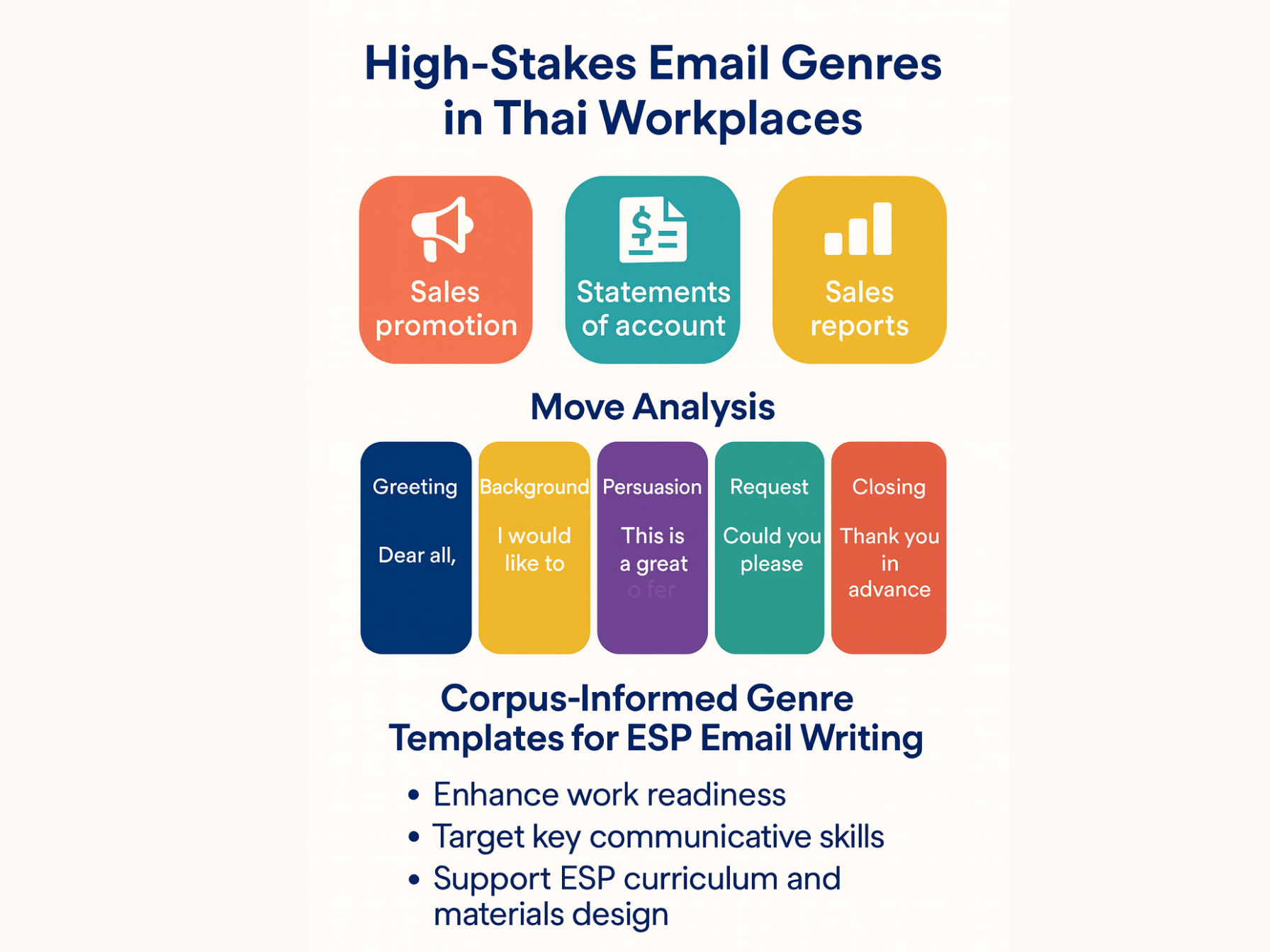
Methods: An exploratory sequential mixed-methods design was employed. First, a survey of Thai employees (N = 400) across eight industries was conducted using proportional stratified sampling to rank the importance of 17 common workplace email genres. On the basis of these rankings, three high-stakes genres—sales promotion emails, statement of account emails, and sales report emails—were selected for detailed corpus-based genre analysis. Next, a corpus of authentic emails was compiled, drawn primarily from the Enron dataset and supplemented with a small baseline set of anonymised Thai workplace emails. These emails were then analysed using genre analysis techniques to identify their move structures, and a corpus-based lexical bundle analysis was conducted for each move.
Results: The needs analysis showed that sales promotion emails and statement of account emails emerged as the top-ranked genres across sectors, followed by sales report emails and internal office announcements. Accordingly, these three genres were conceptualised as high-stakes workplace email genres, representing the email types most critical for job performance and directly associated with revenue generation, cash flow, and managerial oversight. Genre analysis of the three focal genres indicated relatively stable but distinct move structures: sales promotion emails were organised around persuasive attention–interest–action sequences, statements of account emails combined information-giving with payment-related moves, and sales report emails foregrounded concise reporting with further interpretation in some cases. Lexical bundle analysis further demonstrated that each move was realised through high-frequency functional bundles, reflecting a reliance on formulaic language in professional email writing.
Application of this study: The findings underscore the pedagogical value of combining needs analysis with genre-based corpus analysis. ESP instructors and corporate trainers can tailor business writing curricula to focus on the email genres that are most salient in the workplace, using the identified move structures and lexical bundles as teaching templates. In particular, integrating practice with high-stakes email genres and their characteristic functional bundles into course materials and training workshops can enhance learners’ email writing proficiency, work readiness, and awareness of the polite, clear, and professional email style.
Conclusions: This research demonstrated an approach to designing an ESP curriculum that integrates needs analysis with genre-based analysis. By first pinpointing critical email genres through a large-scale survey and then analysing those genres’ discourse patterns, a multi-dimensional understanding of Thai workplace email communication was obtained. The results can directly be used in curriculum and materials development by highlighting the importance of training learners to write the kinds of emails that employers value most, using authentic organisational patterns and phraseology. This genre-focused approach offers a model for designing ESP courses aligned with real-world professional needs. It is recommended that future research extend this approach to other communication channels and assess the effectiveness of genre-focused instruction on learners’ performance in those contexts.
Downloads
Article Details

This work is licensed under a Creative Commons Attribution-NonCommercial-NoDerivatives 4.0 International License.
References
Alaiyed, M. (2024). Politeness Strategies in Email Opening and Closing Moves by Saudi Female EFL Students. Theory and Practice in Language Studies, 14(9), 2834–2842. https://doi.org/10.17507/tpls.1409.19
Bhatia, V. K. (1993). Analyzing Genre: Language Use in Professional Settings. London: Longman.
Cowling, J. D. (2007). Needs Analysis: Planning a Syllabus for a Series of Intensive Workplace Courses at a Leading Japanese Company. English for Specific Purposes, 26(4), 426–442. https://doi.org/10.1016/j.esp.2006.10.003
Creswell, J. W., & Plano Clark, V. L. (2018). Designing and Conducting Mixed Methods Research. 3rd ed. Thousand Oaks, CA: SAGE.
Department of Labour Protection and Welfare. (2025). Labour Statistics by Industry Sector. Retrieved 25 January 2025, from https://eform.labour.go.th/dlpwMapWeb/map/
Dineshika, H. K. P., & Jayasinghe, R. R. (2025). An Investigation Into the Errors in Email Writing of First-Year Undergraduates. Journal of Multidisciplinary & Translational Research, 9(2), 39–56. https://doi.org/10.4038/jmtr.v9i2.28
Dudley-Evans, T., & St John, M. J. (1998). Developments in English for Specific Purposes: A Multi-Disciplinary Approach. Cambridge, England: Cambridge University Press.
Evans, S. (2010). Business as usual: The use of English in the professional world in Hong Kong. English for Specific Purposes, 29(3), 153–167. https://doi.org/10.1016/j.esp.2009.11.005
Flowerdew, J. (2002). Genre in the Classroom: A Linguistic Approach. In A. M. Johns (Ed.), Genre in the Classroom: Multiple Perspectives, (pp. 91–102). Mahwah, NJ: Lawrence Erlbaum.
Gains, J. (1999). Electronic Mail—A New Style of Communication or Just a New Medium? An Investigation Into the Text Features of Email. English for Specific Purposes, 18(1), 81–101. https://doi.org/10.1016/S0889-4906(97)00051-3
Hiranburana, K. (2017). Use of English in the Thai Workplace. Kasetsart Journal of Social Sciences, 38(1), 31–38. https://doi.org/10.1016/j.kjss.2015.10.002
Hutchinson, T., & Waters, A. (1987). English for Specific Purposes: A Learning-Centered Approach. Cambridge, England: Cambridge University Press.
Hyland, K. (2008). As Can Be Seen: Lexical Bundles and Disciplinary Variation. English for Specific Purposes, 27(1), 4–21. https://doi.org/10.1016/j.esp.2007.06.001
Jitpanich, T., Leong, L. M., & Ismail, S. A. M. M. (2022). Assessing the English Writing Needs of Undergraduate Business Administration Students for ESP Writing Course Development. LEARN Journal: Language Education and Acquisition Research Network, 15(2), 104–128.
Kepnil, W. (2020). The Problems of English E-mail Writing among Thai Workers in a Logistics Company. Master’s independent study, M.A. in Career English for International Communication, Thammasat University, Thailand.
Locher, M. A., & Watts, R. J. (2005). Politeness Theory and Relational Work. Journal of Politeness Research, 1(1), 9–33. https://doi.org/10.1515/jplr.2005.1.1.9
Long, M. H. (2005). Second Language Needs Analysis. Cambridge, England: Cambridge University Press.
Nateghian, N. (2024). English Language Needs of Iranian Students of Civil Engineering: Are the Courses Aligned With Workplace Needs?. English for Specific Purposes, 76, 122–135. https://doi.org/10.1016/j.esp.2024.08.002
Pang, B., Abd Majid, F. B., & Narayanan, G. A. (2025). Needs Analysis of English-Language Use of Tourism Personnel in XI’an, China. Arab World English Journal, 16(3), 315–328. https://doi.org/10.24093/awej/vol16no3.19
Park, S., Jeon, J., & Shim, E. (2021). Exploring Request Emails in English for Business Purposes: A Move Analysis. English for Specific Purposes, 63, 137–150. https://doi.org/10.1016/j.esp.2021.03.006
Siricharoen, A., & Wijitsopon, R. (2020). A Corpus-Based Comparative Study of Lexical Bundles in Authentic and Textbook English Business Emails. LEARN Journal: Language Education and Acquisition Research Network, 13(2), 41–63.
Spencer-Oatey, H. (2008). Culturally Speaking: Culture, Communication and Politeness Theory. 2nd ed. London: Continuum.
Swales, J. M. (1990). Genre Analysis: English in Academic and Research Settings. Cambridge: Cambridge University Press.
Vongvirulh, S. (2021). The Development of Instructional Model for Business English Writing Based on Genre-Based Approach and Lexical Bundles for Undergraduate Students. Doctoral dissertation, Ph.D. in Curriculum and Instruction, Silpakorn University, Thailand. (In Thai)
Waldvogel, J. (2007). Greetings and Closings in Workplace Email. Journal of Computer-Mediated Communication, 12(2), 456–477. https://doi.org/10.1111/j.1083-6101.2007.00333.x
Woodrow, L. (2018). Introducing Course Design in English for Specific Purposes. London: Routledge.
Xia, D., & Others. (2024). Making Requests at Work: An Examination of Phrase Frames in Workplace Email Communication. Ibérica, 47, 67–92. https://doi.org/10.17398/2340-2784.47.67
