
Translation Strategies in Thai Language Versions of Japanese Travel Guidebooks
Article Sidebar
Main Article Content
Abstract
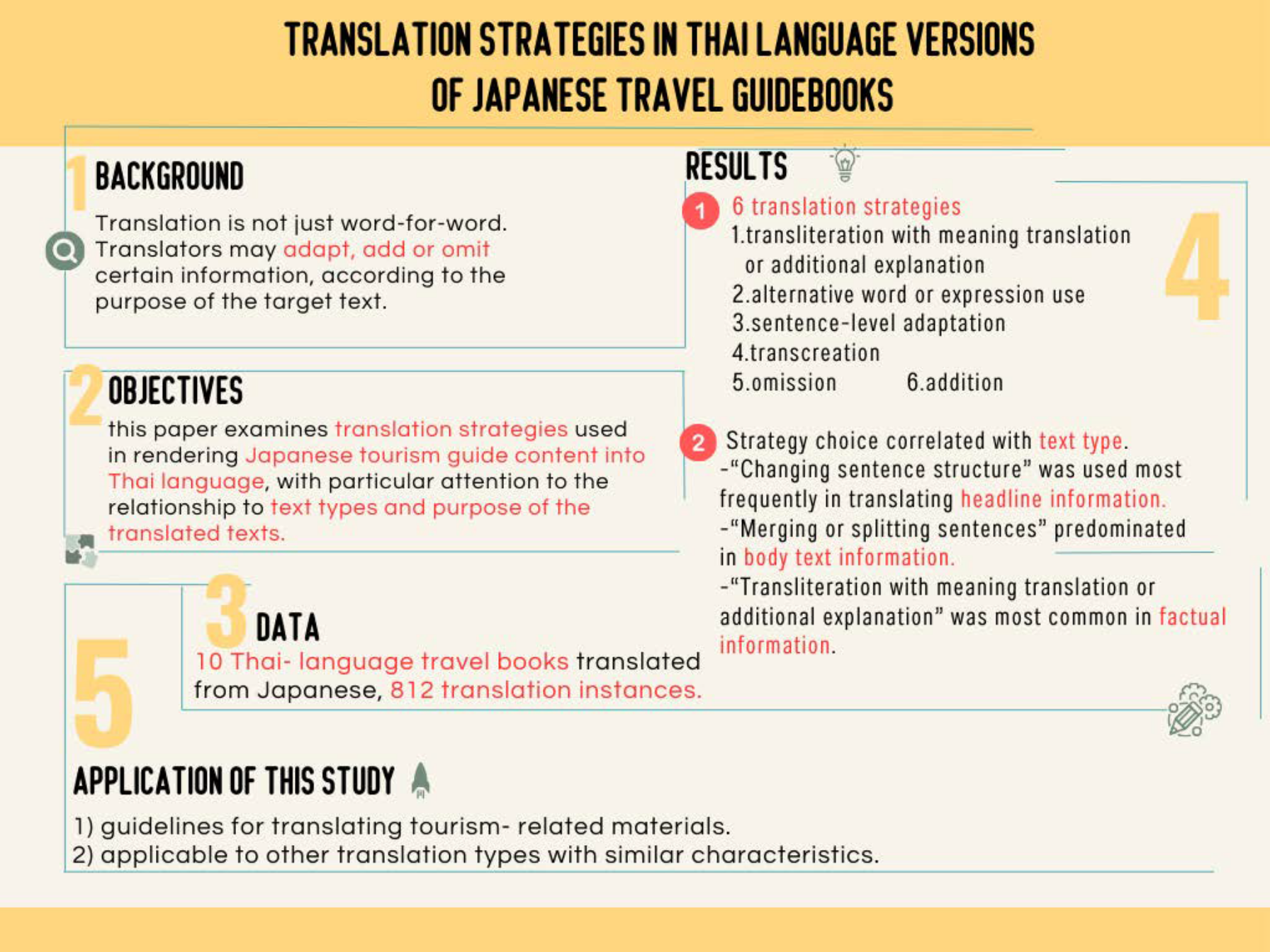
Background and Objectives: According to the purpose of the target text, translators may adapt, add or omit certain information when translating Japanese tourism guide content into Thai language. However, relatively few studies have examined this issue. Therefore, this article aims to examine translation strategies used in translating Japanese tourism guide content into Thai language, with particular attention to the purpose of the translated texts and relationship to text types.
Methods: Data were collected from ten Thai-language travel books translated from Japanese, comprising 812 translation instances. They were analyzed for translation strategies by adapting, adding or omitting information, following Andrew Chesterman’s information change concept. Additionally, translation strategies and their correlation with text types were examined.
Results: Six primary translation strategies were identified: 1) transliteration with meaning translation or additional explanation; 2) alternative word or expression use; 3) sentence-level adaptation; 4) transcreation; 5) omission; and 6) addition. The most common observed strategies were 1) sentence-level adaptation and 2) alternative word or expression use. In addition, strategy choice correlated with text type involved. Changing sentence structure was used most frequently in translating headline information, merging or splitting sentences predominated in body text information, and transliteration with meaning translation or additional explanation was most common in specific information.
Application of this study: These findings may serve as guidelines for translating tourism-related materials and could also be applied to other types of translation with similar characteristics.
Conclusions: Most Japanese–Thai translation studies focus on equivalence between source and target texts. However, in certain fields, translators must select strategies by considering the target text’s purpose. This study analyzed translation of tourism guide content and revealed distinctive characteristics of translation strategies differing from those commonly observed in other types of written translation. The results highlight alternative word or expression use, sentence-level adaptation, transcreation, omission, addition, as well as strategy selection tendencies across different text types. These findings offer practical applications for translators working in related fields and contribute to research on purpose-oriented translation practices.
Downloads
Article Details

This work is licensed under a Creative Commons Attribution-NonCommercial-NoDerivatives 4.0 International License.
References
Bilteh, P., Suktarachan, M., & Timyam, N. (2021). Translation Strategies Used to Translate Cultural Terms in Cultural Tourism Handbooks. Vacana Journal, 9(2), 44-65. (In Thai)
Chawengkijwanich, S. (2015). Translation Strategies of Cultural Expressions from Japanese into Thai. Japanese Studies Journal, 32(2), 103-117. (In Thai)
Chawengkijwanich, S. (2017). Naturalization in Japanese-Thai Translation: An Analysis of Business Documents Translation. Journal of Letters, 46(1), 209-246. (In Thai)
Chawengkijwanich, S. (2018). Naewkit Lae Theknik Kanplae Phasa Yipun-Thai. [Concepts and Techniques of Japanese-Thai Translation]. Bangkok: Thammasat University Press. (In Thai)
Chesterman, A. (2016). Memes of Translation: The Spread of Ideas in Translation Theory. Amsterdam: John Benjamins Publishing.
Dittabanjong, R. (2021). An Analysis of Language Strategies Using in the Public Relations of Cultural Tourism Collected from Timeline Messages of Amazing Thailand Line Account. Journal of Humanities and Social Sciences Nakorn Phanom University, 11(2), 287 – 303. (In Thai)
Gong, W. (2021). Adaptation in Japanese-Chinese Tourism Translation: on the “Faithfulness” of Translation. Josai International University Bulletin, 29(2), 101-115. (In Japanese)
Jatupornpimol, K. (2014). A Translation of Thai Tourist Attraction Names into Chinese. Journal of the Faculty of Arts, Silpakorn University, 36(1), 226-244. (In Thai)
Luangthongkum, N. (2021). A Study of Strategies for Translating Culture-specific Items in the Thai Subtitles of the Japanese Film. Japanese studies Journal, 38(2), 37-48. (In Thai)
Methasate, N., & Chawengkijwanich, S. (2003). Kan Thaythot Watthanatham Nai Ngan Plae Wannakam Yipun Pen Phasa Thai. [Cultural Transmission in the Translation of Japanese Literature into Thai]. Bangkok: Thammasat University. (In Thai)
Mihara, K. (2022). Teiji Kinou kara Miru Bunpou. [Grammar Viewed from the Perspective of Presentative Function]. Tokyo: Kurosio Publishers. (In Japanese)
Nakamura, Y. (2007). An Analysis of English-Japanese Translation of Natural Discourse in Tourism Advertisements: A Case Study of Tourism Websites. Invitation to Interpreting & Translation Studies, 1(1), 109-123. (In Japanese)
Newmark, P. (1988). A Textbook of Translation. New York: Prentice Hall.
Pedersen, J. (2005). How is Culture Rendered in Subtitles? In S. Nauert. (Ed.) Challenges of Multidimensional Translation. Mutra Conference Proceedings (pp.1-18). Saarbrücken.
Pinmanee, S. (2019). Plae Phit Plae Thuk. [Translation: from Wrong to Right]. Bangkok: Chulalongkorn University Press. (In Thai)
Reiss, K. (2000). Translation Criticism: Potential and Limitations. Rhodes, E. F. (Trans.). Manchester: St Jerome Press. (Original work published 1971).
Robrue, M. (2016). When Translation is not the Final Answer to Convey the Meaning of a Message. Panyapiwat Journal, 8(2), 249-260.
