
Integrating Art and Local Cultural Heritage into Art Toy Design: A Case Study of the Thamamasasinghathen Busabok, Ubon Ratchathani, Thailand
Article Sidebar
Main Article Content
Abstract
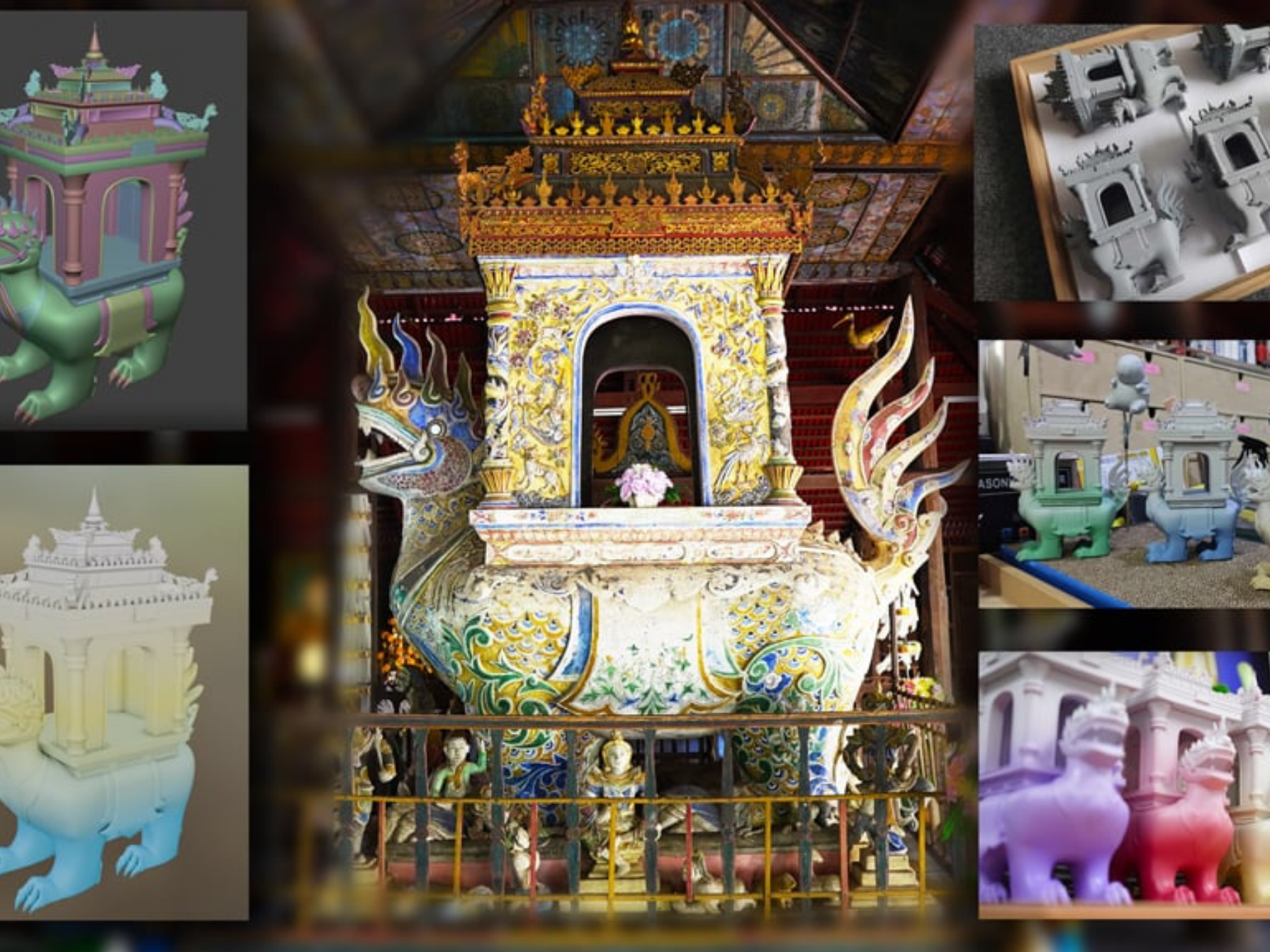
Background and Objectives: Thailand is a centre of culture and civilization that supports local wisdom and cultural heritage in its various forms of art, as well as Buddhist art and indigenous art. Ubon Ratchathani province is renowned for its outstanding works of Buddhist craftsmanship, including the Thamamasasinghathen Busabok (Lion Supported Tiered Pulpit) located in the village of Ban Cheethuan, in Khueang Nai district, and it was built during the period from 1925–1927. It blends local artistic traditions with Vietnamese craftsmanship, ultimately becoming an important cultural heritage. With the application of the concept of art toys to the Buddhist artisanal works of the Thamamasasinghathen Busabok, a creative approach can be applied to bridge the gap between the traditional art and cultural symbols of today’s society, to enable the transmission of history, culture and community identity to future generations. The purposes of this research are as follows: 1) to study methods of integrating the artistic, cultural, and symbolic elements of the Thamamasasinghathen Busabok into art toy development through systematic analysis of form, meaning, and contemporary design requirements; 2) to develop the prototype of art toys based on the Thamamasasinghathen Busabok; and 3) to assess the level of satisfaction of users with the Thamamasasinghathen Busabok art toys.
Methods: This study employed a research and development approach to create art toys by integrating local art and cultural heritage derived from the Sing Thern Busabok Dhammasana in Khueang Nai district, Ubon Ratchathani province. The study applied the SASMES model within a systems theory framework. The design and development process consisted of data synthesis, selection of key artistic elements, creation of three-dimensional digital prototypes, and refinement based on expert feedback. Research instruments included document and photographic analysis forms, quality evaluation forms completed by 8 experts, and user satisfaction questionnaires administered to 20 participants during a simulated context of the Candle Festival in 2024. Quantitative data were analyzed using mean and standard deviation.
Results: This study found 4 fundamental principles for incorporating cultural heritage into a work of art; selecting key artistic elements, simplifying the design, relating to the current time period, and communicating the cultural relevance of the work of art. Mean ratings from expert evaluations (n = 8) of design quality averaged 4.34, and average ratings from user evaluations (n = 20) of satisfaction with the product averaged 4.28.
Application of this study: Cultural capital serves as a source of inspiration for the design and development of valuable art toys that are capable of conveying the history and culture of the community in a profound manner. These art toys also possess the potential to function as creative media that promote community identity and local wisdom, while offering an effective approach to preserving and disseminating cultural heritage to younger generations. Furthermore, they can be further developed into creative products for commercial distribution or utilized in cultural activities and creative tourism initiatives.
Conclusions: This study developed art toys to reflect contemporary artistic and cultural symbolism by examining the artistic characteristics, historical background, and symbolic meanings of the Thamamasasinghathen Busabok. These elements were then synthesized into a contemporary design. The findings indicate that the developed art toys are capable of profoundly expressing the cultural and artistic values and identity of the community. Moreover, they demonstrate strong potential as creative media that bridge traditional art with younger generations and can be further developed into community-based products that generate both economic benefits and intangible cultural value.
Downloads
Article Details

This work is licensed under a Creative Commons Attribution-NonCommercial-NoDerivatives 4.0 International License.
References
Boone, H. N., & Boone, D. A. (2012). Analyzing Likert Data. The Journal of Extension, 50(2), Article Number 48. https://doi.org/10.34068/joe.50.02.48
Bou, L. (2014). We Are Indie Toys: Make Your Own Resin Characters. New York: Harper Collins.
Chantarasakha, K., & Panthupkorn, P. (2019). Inspiration from Northeastern arts and cultures for toy designing for 6-12-year-old children. Mangrai Saan Journal of Humanities and Social Sciences, 7(2), 89-102. (In Thai)
Cultural Information Centre. (2020). Thamamasasinghathen Busabok. Retrieved 9 September 2025, from http://www.m-culture.in.th/album/view/192911 (In Thai)
Fan, J. X., & Vanitwatthananuwat, C. (2020). The Design of Art Toy That Combines the Emotion and Feeling of Childhood With Interaction. Journal of Humanities and Social Sciences Review, 22(2), 121-133. (In Thai)
Harney, B. (2024). Systems theory. In A Guide to Key Theories for Human Resource Management Research, (pp. 312-318). Cheltenham, UK: Edward Elgar Publishing.
Kantipat, P., Pengchai, T., & Khongyuen, C. (2024). The Art Toy Design Inspired by Phra Buddhabat Bua Bok Temple Arch Patterns in Udon Thani Province. Journal of Asia Arts and Design, 4(2). 93-112. (In Thai)
Lanwong, A., Juntapoon, P., & Punnawa, P. P. (2022). Buddhist Arts: Historical Development and Influences on People’s Living in the North–Eastern Region. Arts of Management Journal, 6(2), 728–746. (In Thai)
Local Information and Ubon Ratchathani University Archives Section, Ubon Ratchathani University. (2017). Wat Si Nuan Saeng Sawang Arom: Thammas Singh Thern Busabok, National Heritage. Retrieved 9 September 2025, from https://www.esanpedia.oar.ubu.ac.th/esaninfo/?p=1792 (In Thai)
Saggiomo, V. (2022). A 3D Printer in the Lab: Not Only a Toy. Advanced Science, 9, 2202610. https://doi.org/10.1002/advs.202202610
Samniang, P. & Others. (2017). The Promote Cultural Resource Management of Buddhist in Conservation of World Heritage Sites: Sub-Research Report 2. Retrieved 9 September 2025, from http://mcuir.mcu.ac.th:8080/jspui/handle/123456789/543 (In Thai)
Sanboon, T., & Buranakhet, P. (2009). Isan Pulpits. Art and Culture Magazine, 30(9), 72–74.
Siregar, T. (2025). Research and Development (R&D) Methods: Concepts, Categories, Procedures, and Excellence. Retrieved 9 September 2025, from https://www.researchgate.net/publication/388427315_RESEARCH_AND_DEVELOPMENT_RD_METHODS_CONCEPTS_CATEGORIES_PROCEDURES_AND_EXCELLENCE
Thongsan, Y., & Others. (2024a). Figure 1 The Thamamasasinghathen Busabok, Ban Chi Thuan, Chi Thuan Subdistrict, Khueang Nai District, Ubon Ratchathani Province, Thailand.
Thongsan, Y., & Others. (2024b). Figure 2 Thamamasasinghathen Busabok in Digital 3D Sculpture Technique.
Thongsan, Y., & Others. (2024c). Figure 3 3D Printing of Thamamasasinghathen Busabok.
Thongsan, Y., & Others. (2024d). Figure 4 Four Key Principles for Integrating Local Art and Cultural Heritage into Art Toy Design.
Thongsan, Y., & Others. (2024e). Figure 5 (A) Thamamas in Busabok Form (B) Singha Head (C) Singha Tail.
Thongsan, Y., & Others. (2024f). Figure 6 Thamamasasinghathen Busabok Design for Art Toy Production.
Thongsan, Y., & Others. (2024g). Figure 7 Thamamasasinghathen Busabok with Different Color Variations.
Thongsan, Y., & Others. (2024h). Figure 8 Thamamasasinghathen Busabok was Exhibited and Sold During the Candle Festival Tradition in Ubon Ratchathani Province, Thailand, in 2024.
