
The Worship of Jia Pung Tao Gong Among the Chinese Community in Suphan Buri
Article Sidebar
Main Article Content
Abstract
Background and Objectives: “Jia Pung Tao Gong” (石本頭公), revered as the guardian deity of the city by the Chinese community in Suphan Buri Province, represents a belief tradition that originated from the migration of Chinese settlers to the central region of Thailand, bringing with them their ancestral rituals and religious practices. The establishment of the City Pillar Shrine reflects the efforts of the Chinese community to preserve their cultural identity while seeking security, stability, and prosperity in their new homeland. This article aims to examine the worship of Jia Pung Tao Gong (石本頭公) among the Chinese community in Suphan Buri by analyzing its historical background, symbolic meanings, and social functions. It seeks to provide a comprehensive understanding of the beliefs and cultural practices of the Chinese community in Suphan Buri. The findings may be applied to the development of educational resources, the preservation of Sino–Thai cultural heritage, the design of cultural tourism, and the enrichment of academic knowledge concerning the social and cultural landscape of Suphan Buri.
Methods: This research is grounded in a methodological framework that emphasizes the analysis of beliefs in relation to local historical contexts. It focuses on analyzing data collected through fieldwork at shrines dedicated to “Jia Pung Tao Gong” in Suphan Buri and nearby provinces, together with documentary sources related to the beliefs and worship of “Jia Pung Tao Gong” among Chinese communities in Thailand. The findings are compiled and presented in the form of analytical description in order to clearly illustrate the historical and cultural meanings associated with the worship of this deity.
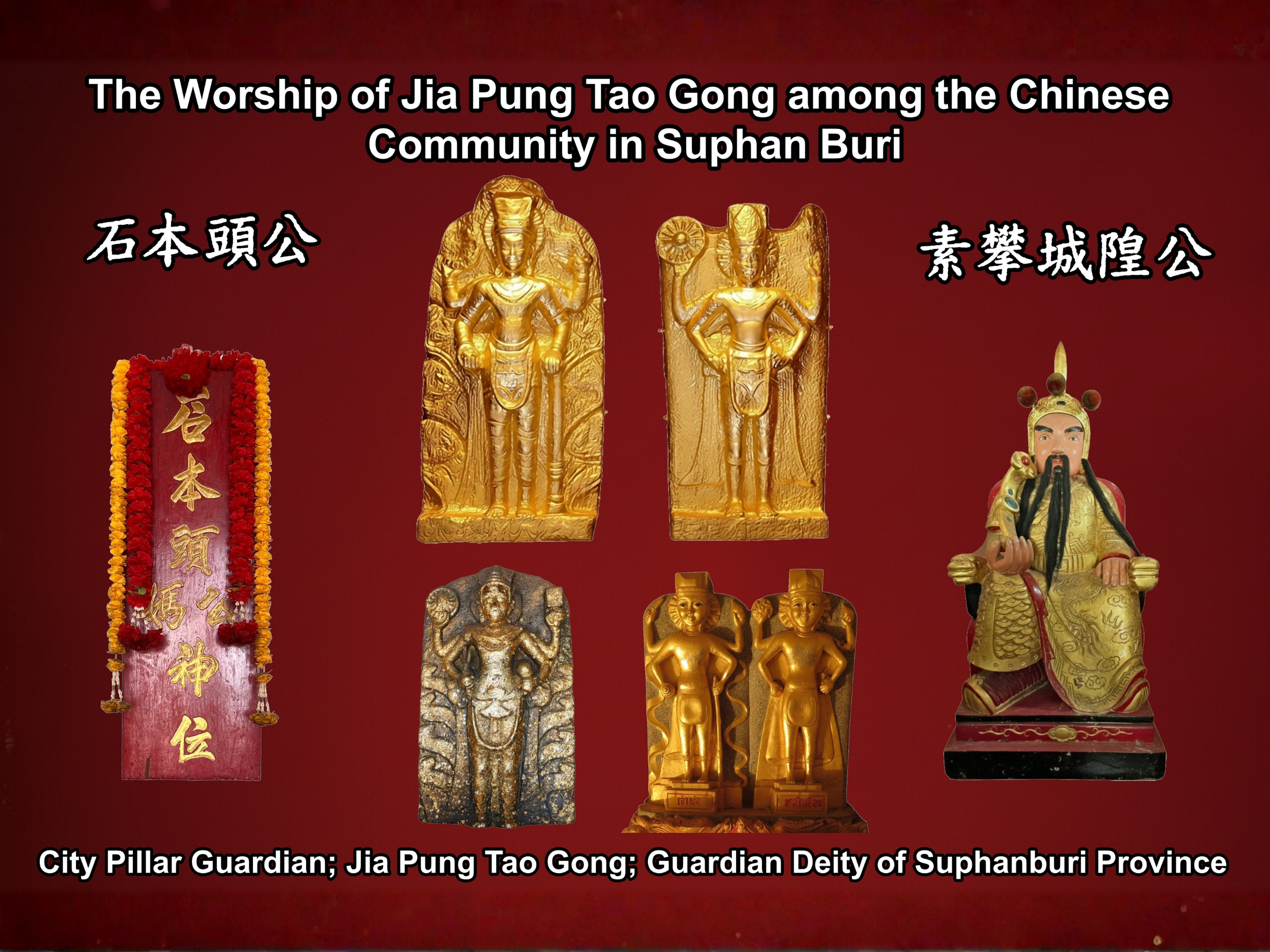
Results: “Jia Pung Tao Gong” is the name of a deity associated with the Chinese tradition of venerating local guardian deities, or “Chinese tutelary gods,” worshipped by the Chinese community in Suphan Buri. This belief has spread throughout all districts of Suphan Buri and has also exerted religious and cultural influence on neighboring provinces. The belief originates from the Chinese veneration of local guardian deities known as “Tudigong” (土地公), who are believed to be sacred beings responsible for protecting a particular area and are regarded as the spiritual owners of that place. Over time, the scope of this protective role expanded from a specific locality to the wider community level, where the deity came to be known as “Bentougong” or “Pung Tao Gong” (本頭公). Eventually, the deity’s protective authority developed further to encompass the city level, becoming known as “Chenghuanggong” or “Sia Ung Gong” (城隍公), meaning “City God” or “Guardian Deity of the City Pillar.” In the case of Suphan Buri, the iconographic form of Pung Tao Gong is represented by a four-armed image of Lord Vishnu carved from stone. For this reason, the Chinese community in the area came to call the deity “Jia Pung Tao Gong,” meaning a city guardian deity embodied in a stone image, as the word “jia” means “stone.” Thus, “Jia Pung Tao Gong” has continued to be venerated through a syncretic form of worship that combines Thai Brahmanical traditions with Chinese religious practices among Chinese devotees in the border area of three provinces up to the present day: Phra Nakhon Si Ayutthaya, Suphan Buri, and Nakhon Pathom.
Application of this study: In the dimensions of promoting education and preserving local culture, the findings of this study can be applied to the development of educational materials on the history and Chinese–Thai culture of Suphan Buri Province. Regarding the development of cultural tourism, the insights into beliefs and rituals can inform the design of cultural tourism routes centered on the Jia Pung Tao Gong Shrine. Moreover, from a socio-cultural perspective, this research provides a valuable database for scholars in anthropology, local history, and beliefs studies.
Conclusions: The belief in “Jia Pung Tao Gong” within the Chinese community of Suphan Buri is manifested through three principal city guardian deities, narrated as three siblings. The eldest is the city guardian deity of Mueang Suphan Buri District, the middle sibling is Chao Pho Phra Ya Chak at Tha Phra Market, U Thong District, and the youngest is Chao Pho Chak Narai at Wat Khao Phra, also in U Thong District. Consequently, the city guardian temples have become sites for the veneration of deities who protect the city and its people. This belief has become an integral part of local culture, exemplified through the annual city pillar worship ritual, known as the “Thing Kra Jad Festival,” held on the 18th day of the 7th month according to the Chinese lunar calendar. Moreover, the belief of Jia Pung Tao Gong extends its influence to the border areas of three provinces—Phra Nakhon Si Ayutthaya, Suphan Buri, and Nakhon Pathom—as well as Bangkok. The worship reflects a harmonious integration of Chinese, Hindu, and Thai religious and spiritual beliefs, encompassing aspects of religion, culture, and animistic traditions.
Downloads
Article Details

This work is licensed under a Creative Commons Attribution-NonCommercial-NoDerivatives 4.0 International License.
References
An official historical compilation of the Ming dynasty. (1962). Ming Tai Zu Shi Lu Juan San Ba Hong Wu Er Nian Chun Zheng Yue Bing Shen Shuo [The Veritable Records of Ming Taizu, Vol. 38, 2nd year of Hongwu, 1st month, day Bingshen]. Taipei: Academia Sinica, Institute of History and Philology, edited and published edition. (In Chinese)
Amornwanitsak, S. (2012). Bentougong: The Chinese Land God in Thai Society, Proceedings of the 1st International Conference on Chinese Studies: “Sinic Evolution in Language, Literature, Teaching, and Cultural Studies”, (pp. 34-57), The International Academic Conference on Chinese Studies, May 3-4, 2012. University of the Thai Chamber of Commerce, Bangkok, Thailand. (In Thai)
Amornwanitsak, S. (2014). Thep Pha Chao Pun Tao Gong Lampang kap Tamnaeng Hu Guo Hou Wang [Pun Tao Gong, the Deity of Lampang, and His Investiture as ‘Hu Guo Hou Wang’]. Silapawattanatham Journal, 35(3), 60-66. (In Thai)
Amornwanitsak, S. (2016). Chaopho Khaotok: Thepa Rak Thai Thi Klai Pen Thep Pha Chao Chin. [Chaopho Khaotok: the Thai guardian Angel that Became a Chinese God]. Thai Journal of East Asian Studies, Institute of East Asian Studies, Thammasat University, 20(2), 1-21. (In Thai)
Amulets of U Thong. (2021a). Figure 5 A Replica of the Deity Statue of Chao Pho Phaya Chak. Retrieved 12 September 2025, from https://www.facebook.com/photo?fbid=4239404696146936&set=pcb.3753823611387437
Amulets of U Thong. (2021b). Figure 5 A Replica of the Deity Statue of Chao Pho Phaya Chak. Retrieved 12 September 2025, from https://www.facebook.com/photo?fbid=4239404716146934&set=pcb.3753823611387437
Arunsak, K. (2021). The Vishnu Sculpture at the Suphanburi City Pillar Shrine. 65 Years of Archaeology: A Collection of Academic Articles on the Occasion of the 65th Anniversary of the Faculty of Archaeology, Silpakorn University, (pp. 185-202), Bangkok: Faculty of Archaeology, Silpakorn University. (In Thai)
Buddhist Association of Suphan Buri Province. (1963). The City Pillar Guardian Shrine and Boundary Marker of Suphan Buri–Nakhon Pathom. In The 11th Conference of the Buddhist Association of Thailand, held in Suphan Buri Province, (p.317). November 14–17, 1963. Suphan Buri, Thailand.
Committee for Document Compilation and Archives, Executive Committee for the Royal Celebration of His Majesty the King. (2001). Watthanatham Phatthana Kan Thang Prawattisat Ekkalak Lae Phum Panya Changwat Suphanburi [Culture, Historical Development, Identity, and Wisdom of Suphanburi Province]. Bangkok: Kurusapa Printing, Ladprao. (In Thai)
Committee of Suphanburi City Pillar Shrine. (n.d.). 49 Pi Haeng Khwam Mungmun Charuek Wai… Nai Phaendin [49 Years of Dedication Inscribed… in the Land]. Phetchaburi: Phetchaphum Printing. (In Thai)
Damrong Rajanubhab, Prince. (1960). Nithan Borankhadi [Tales of Archaeology]. Phra Nakhon: Kasem Bannakit. (In Thai)
Department of Academic Affairs, Ministry of Education. (1983). Ni-thaan Yaan Suphan [Folktales of Suphan Buri]. Bangkok: Kurusapa Printing, Ladprao. (In Thai)
Faculty of Archaeology, Silpakorn University. (2021). 65 Pi Boran Khadi: Ruam Botkhwam Wichakan Nueang Nai O kat Khrop 65 Pi Khana Boran Khadi Mahawitthayalai Silpakorn [65 Years of Archaeology: A Collection of Academic Articles on the Occasion of the 65th Anniversary of the Faculty of Archaeology, Silpakorn University]. Bangkok: Faculty of Archaeology, Silpakorn University. (In Thai)
Fine Arts Department. (1948). Rueang Ham Mai Hai Chao Pai Mueang Suphan Kap Akkharanukrom Phu Mi-sat Changwat Suphanburi [Prohibition for Officials to Go to Suphanburi and the Geographical Encyclopedia of Suphanburi Province]. Phra Nakhon: Udom Printing. (In Thai)
Fine Arts Department. (1963). Nirat Suphan [Journey to Suphan]. 5th ed. Phra Nakhon: Rung Rueang Tham Printing. (In Thai)
Lai, L. J. (2006). Wu Tang Dai De Cheng Huang Xin Yang [The Cheng Huang Cult in Tang and Five Dynasties]. Journal of History, National Chung Hsing University, 17(1), 293-348. (In Chinese)
Matichon Academy. (2020). U Thong–Suphan Buri: Mueang 2,000 Pi Ton Thang Prawattisat Thai [U Thong–Suphanburi: A 2,000-Year-Old City at the Origins of Thai History]. Retrieved 28 July 2024, from https://www.matichonacademy.com/content/article_51705 (In Thai)
Narisara Nuwattiwong, Prince, & Damrong Rajanubhab, Prince. (1956). San Somdet (Phak Thi 19) [Letters of the Princes (Part 19)]. Phra Nakhon: Fine Arts Department. (In Thai)
Ninsa-nguandecha, J. (2023a). Figure 1 The Deity Statue of ‘Jia Peng Te Gong’, Carved From Wood Rather Than Stone, At the City Pillar Shrine, Lat Bua Luang District, Phra Nakhon Si Ayutthaya Province.
Ninsa-nguandecha, J. (2023b). Figure 4 The Deity Statue of Chao Pho Phaya Chak in U Thong, Venerated as ‘Wu Thong Jia Peng Te Gong’ (有通石本頭公) , Serving as the City Guardian Deity.
Ninsa-nguandecha, J. (2023c). Figure 6 The Deity Statue of Chao Pho Chaknarai, Revered as ‘Jia Peng Te Gong’ (石本頭公), Serving as the City Guardian Deity.
Ninsa-nguandecha, J. (2023d). Figure 7 City Pillar Deity in the Form of a Carved Wooden Plaque, Housing the Spirit of the Deity Pung Tao Gong Shrine of Chao Pho Thung Khae, Kao Hong Market, Suphan Buri Province.
Office of Archaeology Region 2, Suphanburi. (2014). Boran Khadi Lae Prawattisat Mueang Suphanburi [Archaeology and History of Suphanburi City]. Nonthaburi: Cyber Rock Agency Group Co., Ltd. (In Thai)
Opakul, M. (1996). Yi-Pae Chin Tai Phuen Din Mueang Suphan [Chinese Yi Pe Coins Unearthed in Suphan Buri]. Silpa Wattanatham Journal, 17(4), 188. (In Thai)
Opakul, M. (1999). Prawatisat Mueang Suphan [History of Suphanburi City]. Bangkok: Matichon Publishing House. (In Thai)
Osatharom, W. (2014). Mueang Suphan Bon Sen Thang Kan Plian Plaeng Thang Prawattisat, Phutthasatsapha Thi 8–Ton Phutthasatsapha Thi 25 [Suphanburi on the Historical Path of Change: 8th to Early 25th Buddhist Century]. Bangkok: Thammasat University Press. (In Thai)
Phumisak, J. (2018). Sangkhom Thai Lum Maenam Chao Phraya Kon Samai Si Ayutthaya [Thai Society Along the Chao Phraya River Before the Ayutthaya Period]. Bangkok: Charoenwit Printing. (In Thai)
Phientham, Ch. (2018). The Preparation of a Master Plan for the Historical City of Suphannaphum Using a Participatory Process, Mueang Suphanburi District, Suphanburi Province. Journal of Graduate Studies, Mahamakut Buddhist University, 16(1), 14–30. (In Thai)
Qiu, Zh. R., & Qiu, A. L. (2024). Ke Jia Liu Dui Di Qu Shi Tou Chong Bai Zhi Yan Jiu-Jie He Di Li Ding Wei Yu Zhi Xing Fen Xi [A Study of Stone Worship in the Hakka Six Pile: Combining Geographic Location and Qualitative Analysis]. Cultural and Creative Industry Management Review, 1(1), 33-66. (In Chinese)
Royal Institute. (2014, October 22). Wa Duay Lak Mueang [On the City Pillar]. Retrieved 20 July 2024, from http://legacy.orst.go.th/?knowledges=ว่าด้วยหลักเมือง-๒๒-ตุล (In Thai)
Sangpetch, J. (2017). Vishnu Statues in Thailand: Evidence from Archaeology and the History of Thai Art. Supported by the Thailand Research Fund (TRF), Thailand. (In Thai)
Suphan Buri Provincial History and Archaeology Club. (2023a). Figure 3 The City Pillar Deity Statue of Suphanburi, Regilded in 2012. Retrieved 10 September 2025, from https://www.facebook.com/photo?fbid=10226476312727344&set=oa.574494144014612&locale=th_TH
Suphan Buri Provincial History and Archaeology Club. (2023b). Figure 3 The City Pillar Deity Statue of Suphanburi, Regilded in 2012. Retrieved 10 September 2025, from https://www.facebook.com/photo?fbid=10226476313567365&set=oa.574494144014612&locale=th_TH
Suphanburi Provincial Buddhist Association. (1963). “The City Pillar Shrine, Boundary Marker, Suphanburi–Nakhon Pathom.” In Proceedings of the 11th Meeting of the Buddhist Associations of Thailand, Suphanburi Province, November 14–17, 1963. (p. 317). (In Thai)
The Encyclopedia of Thai Culture Foundation, Siam Commercial Bank. (1999). Saranukhrom Watthanatham Thai Phak Klang Lem 15 [Encyclopedia of Thai Culture: Central Region, Volume 15]. Bangkok: Siam Press Management Co., Ltd. (In Thai)
Wang, C. F. (2014). Da Bo Gong、Li Shi Xu Shu Yu Zheng Zhi Qing Xiang [Da Bo Gong, Historical Narratives, and Political Tendencies]. In Wu, Sh. X. (ed.), Fu De Zheng Shen De Chuan Shuo Yu Xin Yang Yan Jiu-Yi Ma Lai Xi Ya Hua Ren She Hui Wei Li [Inheritance and Continuity: Studies on the Legends and Beliefs of Fude Zhengshen—A Case Study of the Chinese Community in Malaysia], Malaysia: Sibu Sarawak Yong An Ting Da Bo Gong Temple. (In Chinese)
Zhang, F. Y. (2020). Ming Qing Cheng Huang Shen De Deng Ji Xing Ji Qi Biao Da [The Hierarchy of “the City Gods” in the Ming and Qing Dynasties and Their Expressions]. Nankai Journal (Philosophy, Literature and Social Science Edition), 275(3), 157-172. (In Chinese)
