
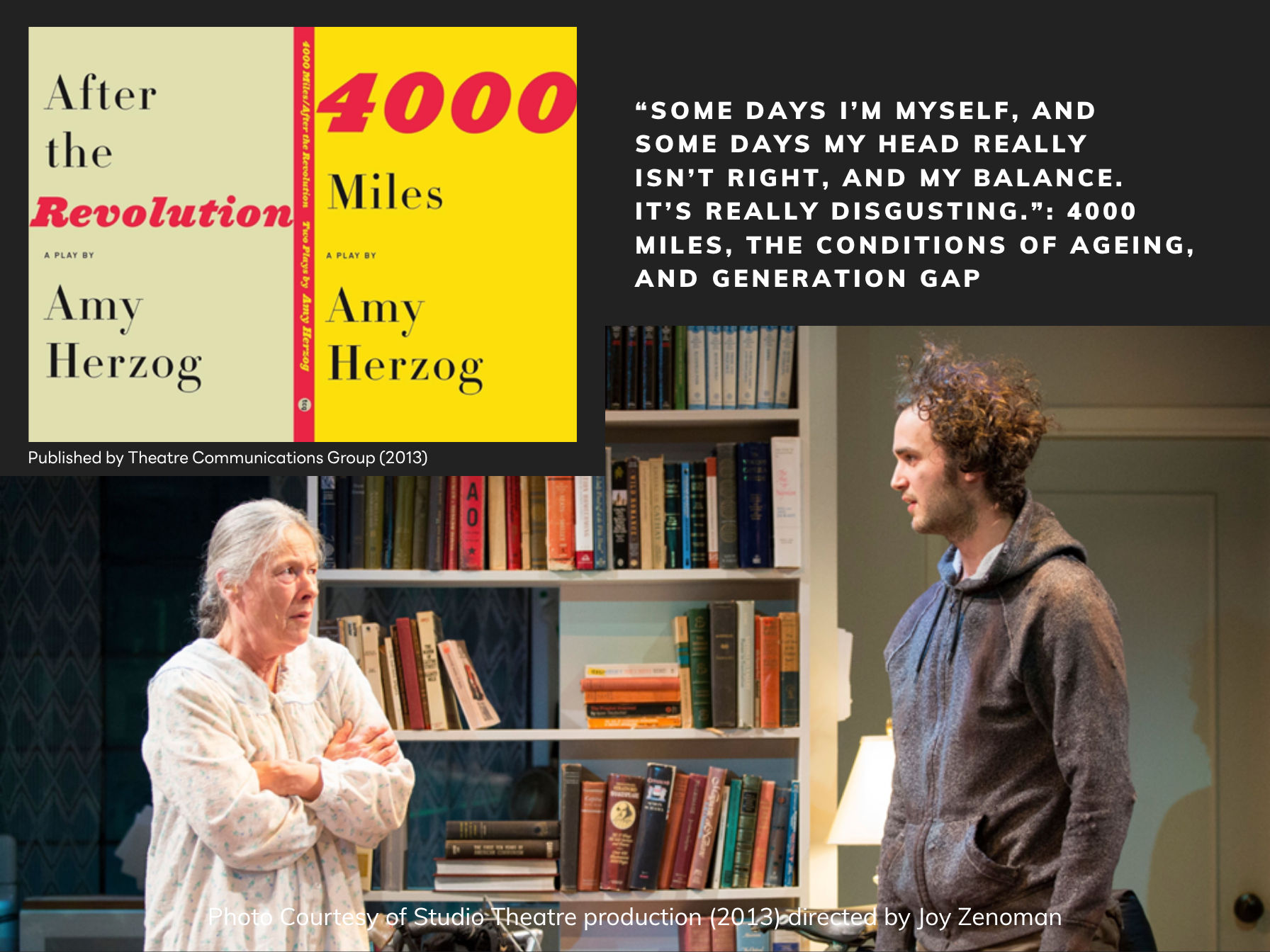
“Some Days I’m Myself, and Some Days My Head Really Isn’t Right, and My Balance Is Really Disgusting.”: 4000 Miles, the Conditions of Ageing and Generation Gap
Article Sidebar
Main Article Content
Abstract
Background and Objectives: As ageing becomes an urgent issue in contemporary society, authors and playwrights explore its complexities through literary representations, which reflect social transformations and cultural values. This article aims to explore Amy Herzog’s play 4000 Miles (2011) which engages with the concept of growing old by questioning stereotypes and biases through the portrayal of an old, frail, yet defiant female protagonist, with a binary opposition of the depiction of the young grandson, who cycles from Seattle across the US to visit his grandmother in New York. In this regard, the author examines the redefinition of cultural constructions while also revealing the complexity of old age, elderly care within society, and the nuanced differences of ageing, particularly as expressed through language and performance.
Methods: As qualitative research, this paper, with literary gerontology—the study of literature and ageing—analyses how 4,000 Miles represents ageing in, as Gullette (2004) noted, a “decline narrative,” including dementia, hearing impairment, and other signs of physical decay, which constitutes generation divides, communication problems, differences in political beliefs and social values.
Results: The dramatization of old age can critically draw on its cultural meanings related to gender, politics, personal and social memory, death, and attitudes toward the technologically oriented world. First, the play reveals the stereotype of ageing by highlighting the physical declines and vividly represents old age and its troubling conditions via the character ‘Vera’. Moreover, with the focus on the old character’s past, the playwright draws on the power of personal and social memory in the recount of her active political activities for socialism. By depicting an elderly female character living alone in an urban context, 4,000 Miles significantly comments on the ethics of care for the elderly and the significant role of society or the community in supporting the welfare of this group. Ultimately, the generational gap has become a key issue in family relationships, offering insights into ageing as a condition that poses challenges in many societies, in which older adults must confront, overcome, or negotiate such circumstances.
Application of this study: This critical discussion may shed light on how age studies and literature can deepen our understanding of old age, foster empathy, and promote an ethic of care for older adults across society as a whole.
Conclusions: The study of 4,000 Miles has provided a critical discussion of ageing conditions which unravels the meanings of old age and how our culture has reshaped and questioned its complexity. By combining age studies and literary studies, this article highlights how dramatization of old age can unsettle our stereotypes and the playwright’s imagination of the old woman adjusting herself to the changing contexts culminates in reconciliation between different generations. This play also emphasizes an ethic of care, through which the author invites the audience to reflect on social and cultural values that require deeper understanding and further studies.
Downloads
Article Details

This work is licensed under a Creative Commons Attribution-NonCommercial-NoDerivatives 4.0 International License.
References
Ayalon, L, & Tesch-Römer, C. (Eds.). (2018). Contemporary Perspectives on Ageism. Retrieved 10 April 2025, from https://link.springer.com/book/10.1007/978-3-319-73820-8#toc
Bitence, R. (2020). Reconsidering Dementia Narratives: Empathy, Identity, and Care. London: Routledge.
Beauvoir, S. (1972). Old Age. O'Brien, P. (Trans). London: Andre Deutsch and Weidenfeld and Nicolson.
Chiver, S. (2003). From Old Woman to Older Women: Contemporary Culture and Women’s Narratives. Columbus: Ohio State University Press.
Cole, T. R. (1992). The Humanities and Aging: An Overview. In T. R. Cole, D. R. Van Tassel, & R. Kastenbaum (Eds.), Handbook of the Humanities and Aging. (pp. xi-xxiv). New York: Springer.
Cruikshank, M. (2017). Fierce with Reality: Literature on Aging. Maryland: Hamilton Books.
Edelstein, P. R. (2014). Matriarchal Might: 4000 Miles of Feminine Perseverance, Wisdom, and Strength. Praxis: The Journal of Theatre, Performance Studies and Criticism, 15, 1-10.
Falcus, S., & Sako, K. (2019). Contemporary Narratives of Dementia: Ethics, Ageing, Politics. New York: Routledge.
Falcus, S. (2012). Unsettling Ageing in Three Novels By Pat Barker. Ageing and Society, 32, 1382-1398.
Gilleard, C., Barry, E., & Skagen, M. V. (2021). Literature and Ageing. Age, Culture, Humanities: An Interdisciplinary Journal, 5, 1–15. https://doi.org/10.7146/ageculturehumanities.v5i.130548
Gullette, M. M. (2015). Aged by Culture. In J. Twigg & W. Martin (Eds.), Routledge Handbook of Cultural Gerontology. (pp. 21-28). Oxon: Routledge.
Gullette, M. M. (2004). Aged by Culture. Chicago: University of Chicago Press.
Henneberg, S. B. (2006). Of Creative Crones and Poetry: Developing Age Studies through Literature. The National Women's Studies Association Journal, 18 (1), 106–125. http://www.jstor.org/stable/4317188
Herzog, A. (2010). 4,000 Miles. Retrieved 10 April 2025, from https://static1.squarespace.com/static/540b22a1e4b0d0f549866135/t/5f6de7a89afc6255
f5aafc/1601038249851/4000+Miles+by+Amy+Herzog+-+FULL+PLAY.pdf
Howes, A. (2014). 4,000 Miles: Study Guide. Retrieved 10 April 2025, from https://parksquaretheatre.org/wp-content/uploads/4000Miles2014.pdf
Kohn, M., Donley, C., & Wear, D. (1992). Editors’ Statements. In M. Kohn, C. Donley, & D. Wear (Eds.) Literature and Aging: An Anthology, (pp. xv-xviii). Kent, Ohio: The Kent State University Press.
Maginess, T. (2023). Ageing in Poetry: A Windfall. In S. Falcus, H. Hartung, & R. Medina (Eds.), The Bloomsbury Handbook to Ageing in Contemporary Literature and Film. (pp. 39-50). London: Bloomsbury Academic.
Rooke, C. (1992). Old Age in Contemporary Fiction: A New Paradigm of Hope. In T. R. Cole, D. R. Van Tassel, & R. Kastenbaum (Eds.), Handbook of the Humanities and Aging. (pp. 241-257). New York: Springer.
Sako, K., & Falcus, F. (Eds). (2022). Contemporary Narratives of Ageing, Illness, Care. New York: Routledge.
Schrage-Früh, M., & O’Neill, M. (2023). Novels of Ripening: The Maturation of The Bildungsroman. In S. Falcus, H. Hartung, & R. Medina (Eds.), The Bloomsbury Handbook to Ageing in Contemporary Literature and Film, (pp. 11-24). London: Bloomsbury Academic.
Soloski, A. (2012, March 22). The Playwright and the Radical. The New York Times. Retrieved 10 April 2025, from https://www.nytimes.com/2012/03/25/theater/amy-herzogs-4000-miles-at-mitzi-e-newhouse-theater.html
Twigg, J., & Martin, W. (2015). The Challenge of Cultural Gerontology. The Gerontologist 55 (3), 353–359. https://doi.org/10.1093/geront/gnu061
Vassilas, C. A. (2003). Dementia and Literature. Advances in Psychiatric Treatment, 9, 439-445.
Volk, M. (2017). Driving, not Losing, the Plot: Narrative Patterns in Implicit and Explicit Fictional Representations of Dementia. Open Cultural Studies, 1, 55-65. https://doi.org/10.1515/culture-2017-0006
Wallace, D. (2011). Literary Portrayals of Ageing. In I. Stuart-Hamilton (Ed.), An Introduction to Gerontology, (pp. 389-415). Cambridge: Cambridge University Press.
Woodward, K. (1991). Aging and its Discontents: Freud and other Fictions. Bloomington and Indianapolis: Indiana University Press.
Woodward, K. (2006). Performing Age, Performing Gender. The National Women's Studies Association Journal, 18(1), 162-189.
World Health Organization, (2025). Dementia. Retrieved 31 March 2025, from https://www.who.int/news-room/fact-sheets/detail/dementia.
Wyatt-Brown, A. M. (1992). Literary Gerontology Comes of Age. In T. R. Cold, D. V. Tassel, & R. Kastenbaum (Eds.), Handbook of the Humanities and Aging. (pp. 331-335). New York: Springer.
