
Confusing Words: Contextual Usage of Chinese Verbs Through Cognitive Linguistics
Article Sidebar
Main Article Content
Abstract
Background and Objectives: In the process of second language (L2) acquisition, word pairs that L2 learners often feel confused about are called “confusing words (A word easily confused with another because of similar meaning, alphabet, pronunciation, or translation)”. Among Thais studying Chinese as a foreign language (CFL), confusion usually emerges in the use of the five Chinese verbs: ‘Gei (给)’, ‘Jiao (叫)’, ‘Qing(请)’, ‘Rang (让)’, and ‘Shi (使)’. This research aims to examine the contextual usage of these five verbs, especially in cases of semantic overlap, with the research question, “How do Chinese verbs with shared meanings differ in their contextual usage?”
Methods: This research article employed a qualitative research approach. Data were collected from books, dictionaries, and Chinese proficiency test (HSK) materials. The analysis was grounded in cognitive linguistics framework, including image schema theory and idealized cognitive models (ICMs).
Results: The findings reveal that from the five semantically related verbs, verbs expressing “causing someone do something” commonly occur in general and service-related contexts, while those denoting “permission” are primarily found in workplace and medical settings. The meanings of “causation” and “invitation” are more broadly applicable in general contexts. Moreover, the ICMs-based analysis identified four schematic sentence structures that reflect underlying conceptual representations.
Application of this study: This research contributes to a better understanding and accurate use of easily confusable Chinese vocabulary among learners and teachers of Chinese as a foreign language. Teachers can apply the findings as instructional strategies, while learners can use them to further develop their communicative competence. Emphasizing appropriate contextual usage, the application of image-schema–based concepts helps learners better comprehend and acquire the contextual meanings and uses of vocabulary.
Conclusions: The result indicate that the Chinese verbs have a shared meaning and are grouped under the same semantic category, but some of those words have different schematic usage structures. This study found that some words can be used in the same contexts and situations, but they might emphasize different orientations. The theoretical significance of this research article is that using schema theory and ICMs to analyze contextual usage of words, can be helpful to clearly visualize sentence structures by highlighting the prominence and focal points.
Downloads
Article Details

This work is licensed under a Creative Commons Attribution-NonCommercial-NoDerivatives 4.0 International License.
References
Ampala, P. (2016). ‘Time’ conceptual systems of Northern Thailand dialect speakers. Doctoral Dissertation, Ph.D. in Linguistics, Thammasat University, Thailand. (In Thai)
Arunmanakul, W. (2020). Science of Language: History and Development [Unpublished manuscript]. Bangkok: Faculty of Arts, Chulalongkorn University. (In Thai)
Confucius Institute Headquarters (Hanban). (2018a). Official Examination Paper of HSK (Level 1). Beijing: People’s Education Press. (In Chinese)
Confucius Institute Headquarters (Hanban). (2018b). Official Examination Paper of HSK (Level 2). Beijing: People’s Education Press. (In Chinese)
Confucius Institute Headquarters (Hanban). (2018c). Official Examination Paper of HSK (Level 4). Beijing: People’s Education Press. (In Chinese)
Confucius Institute Headquarters (Hanban). (2018d). Official Examination Paper of HSK (Level 5). Beijing: People’s Education Press. (In Chinese)
Confucius Institute Headquarters (Hanban). (2019a). Official Examination Paper of HSK (Level 3). 3rd ed. Beijing: People’s Education Press. (In Chinese)
Confucius Institute Headquarters (Hanban). (2019b). Official Examination Paper of HSK (Level 6). 3rd ed. Beijing: People’s Education Press. (In Chinese)
Institute of Linguistics. (2021). Contemporary Chinese Dictionary (Xiandai Hanyu Cidian) (7th Edition). 735th ed. Beijing: The Commercial Press. (In Chinese)
Johnwick. (2024). Contextual Dynamics: A Linguistic Analysis of Word usage in Sentences. Retrieved 18 May 2025, from https://medium.com/@biowick/contextual-dynamics-a-linguistic-analysis-of-word-usage-in-sentences-33def9912093
Lai, L. (2018). The Study on Chinese Confusable Words in Thai Students. Doctoral Dissertation, Ph.D. in International Chinese Language Education, Minzu University of China, China. (In Chinese)
Lakoff, G. (1987). Woman, Fire, and Dangerous Things: What Categories Reveal About the Mind. Chicago: University of Chicago Press.
Lakoff, G. (1988). Cognitive Semantics. In Eco, U., Santambrogio, M., & Violi, P. (Eds.) Meaning and Mental Representations (pp. 119-154). Bloomington: Indiana University Press.
Oakley, T. (2012). Image Schemas. In Geeraerts, D. & Cuyckens, H. (Eds.), The Oxford Handbook of Cognitive Linguistics (pp. 214-235). Oxford: Oxford University Press.
Samita, F., Supardi, I., & Husin, S. (2015). The Use of Contextual Analysis in Teaching Vocabulary. Jurnal Untan, 4(2), 1-11. https://doi.org/10.26418/jppk.v4i2.9120
Sirisumpan, S., & Saralamba, C. (2021). The Meanings of Qi in Mandarin Chinese in Factive Motion Events. Journal of Language and Linguistics, 39(2),1-30. (In Thai)
Soontornthamniti, N. (2024). Meanings and Categories of Confusing Chinese Verbs “gei (给)” “jiao (叫)” “qing (请)” “rang (让)” “shi (使)”: A Semantic Analysis. Journal of Arts and Thai Studies, 46(1), 1-14. (In Thai)
Soontornthamniti, N. (2025a). Figure 1 Research Framework.
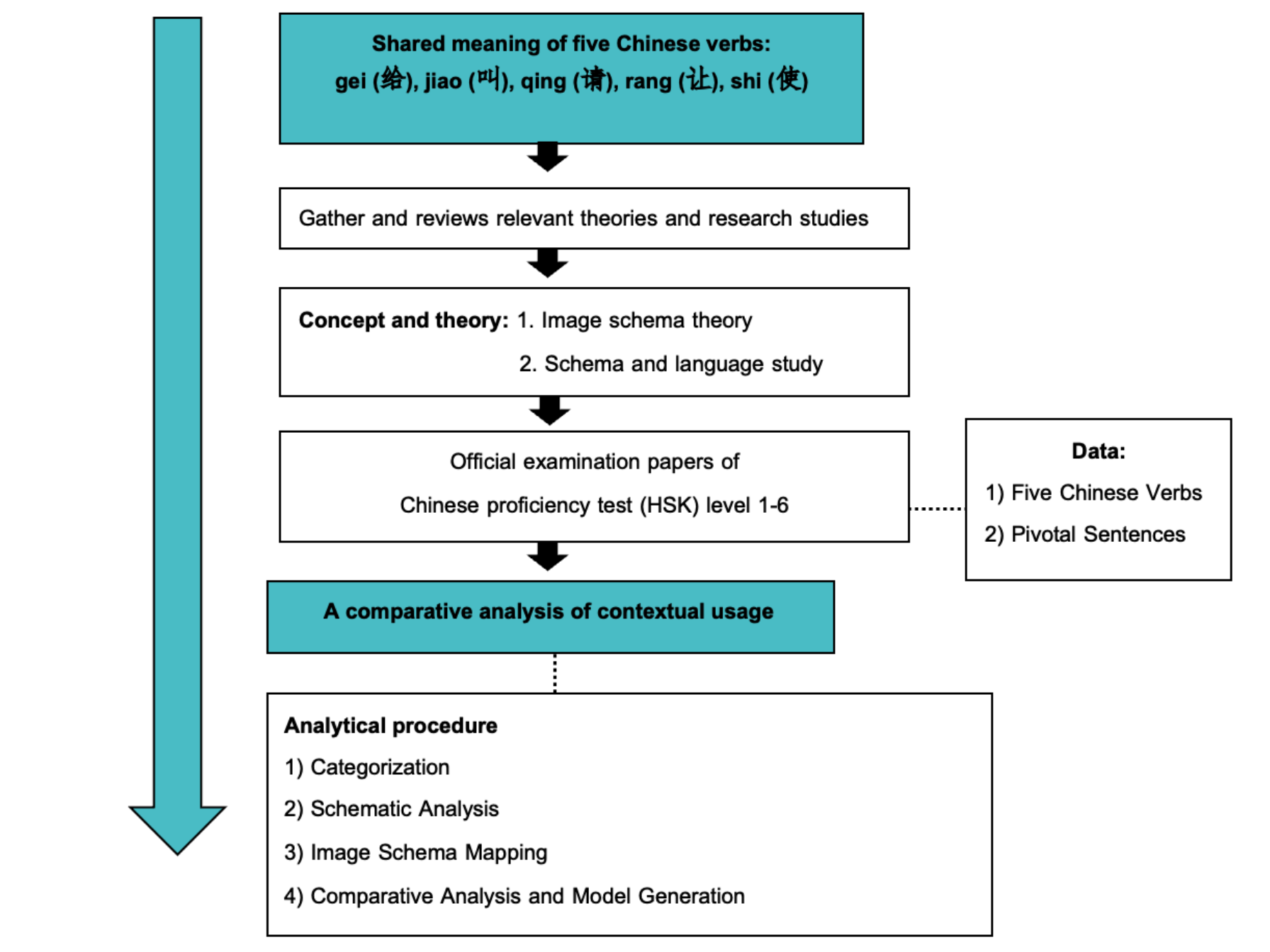
Soontornthamniti, N. (2025b). Figure 2 Research Flow.
Soontornthamniti, N. (2025c). Figure 3 Image Schema of Verbs With “Causing Someone to Do Something” Meaning.
Soontornthamniti, N. (2025d). Figure 4 Image Schema of Verbs With “Granting Permission” Meaning.
Soontornthamniti, N. (2025e). Figure 5 Image Schema of Verbs With “Causation” Meaning.
Soontornthamniti, N. (2025f). Figure 6 Image Schema of Verbs With “Invitation” Meaning.
Soontornthamniti, N. (2025g). Figure 7 Image Schema of Five Chinese Verbs.
Tangpakorn, B. (2018). An Application of Cognitive Semantics of Chinese Polysemy Teaching for Thai Learners. Journal of Humanities and Social Sciences Mahasarakham University, 37(1), 75-87. (In Thai)
Urapeepatanapong, O. (2024). Time Metaphors of Local Words Qian and Hou in Mandarin Chinese and Thai. Journal of Sinology, 18(1), 182-197. (In Chinese)
Xiao, P. (2008). The Research on Confusable Words of Indonesian Students in Chinese Interlanguage. Doctoral Dissertation, Ph.D. in Linguistics and Applied Linguistics, Beijing Language and Culture University, China. (In Chinese)
Zhang, B. (2008). Compiling Principles and Style Designing of Export-Oriented Dictionaries of Confusable Words. Chinese Language Learning, 2(1), 85. (In Chinese)
Zhang, B. (2016). Butong Muyu Beijing de Hanyu Xuexizhe Ciyu Hunxiao Fenbu Tezheng Jiqi Chengyin Yanjiu. [A Study on the Distribution Patterns and Causes of Lexical Confusion among Chinese Language Learners with Different Native Language Backgrounds]. Beijing: Peking University Press. (In Chinese)
Zhang, D. (2024). A Corpus-Based Study on Confusable Words in the Visiting and Calling Word Category. Communications in Humanities Research, 27(1), 209-220.
