
Tai Dam Cultural Capital: Souvenirs, Creative Tourism, and Long-Term Tourist Loyalty
Article Sidebar
Main Article Content
Abstract
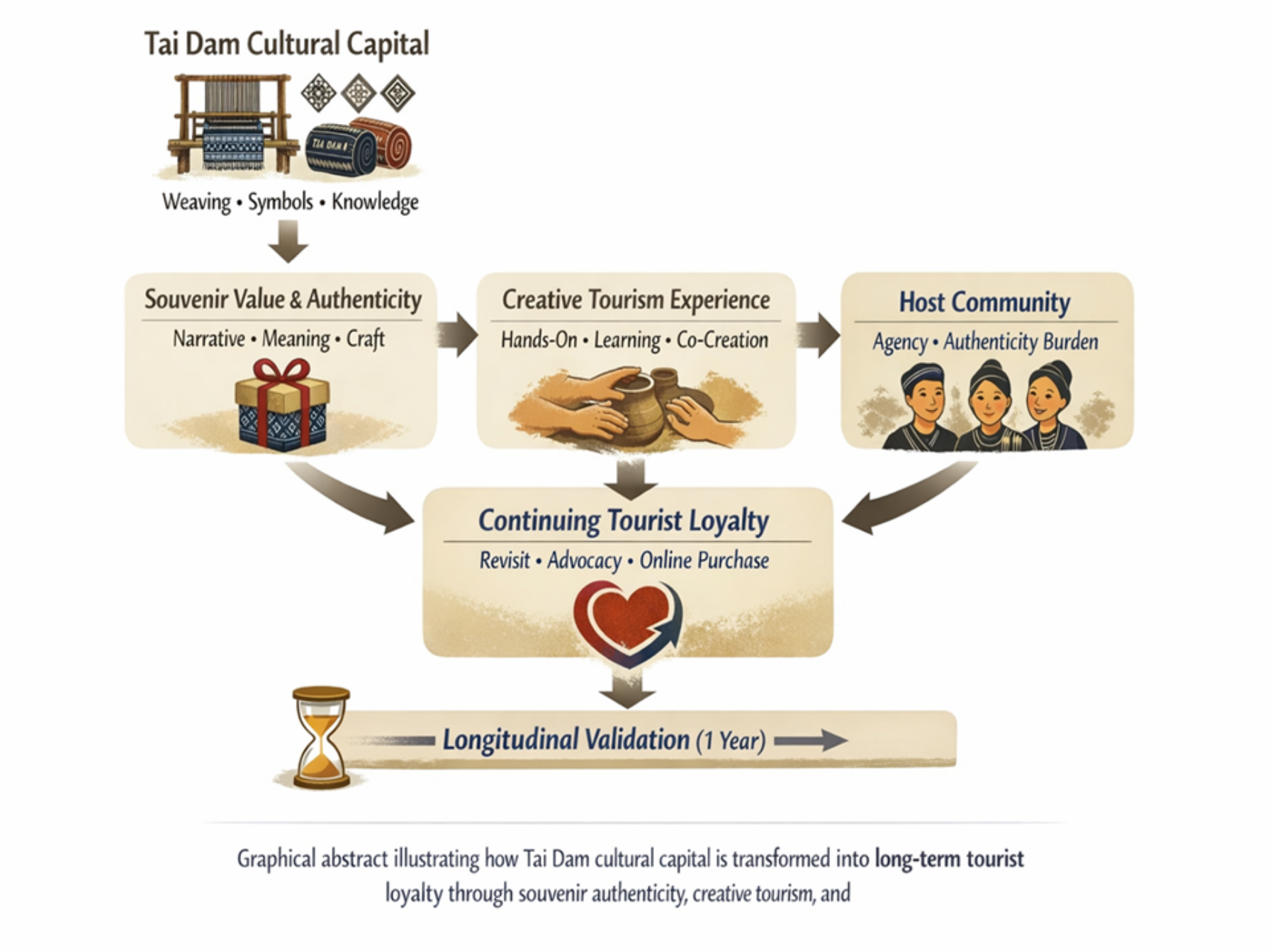
Background and Objectives: In an increasingly competitive tourism landscape, cultivating sustainable tourist loyalty is a critical asset for the long-term sustainability of destinations. Modern travelers, driven by the “experience economy,” are shifting from passive sightseeing towards seeking authentic, immersive encounters that foster deep emotional connections. Creative tourism, which emphasizes hands-on participation, has emerged as a key framework for this, elevating cultural souvenirs from mere keepsakes to catalysts for deeper engagement. However, a comprehensive understanding of the structural relationships between cultural capital, souvenir value, creative tourism, and long-term loyalty remains limited, with research often neglecting the host community’s voice and the longitudinal evolution of loyalty. This research addresses this gap by developing and testing a holistic model of the loyalty value chain. There are four objectives: 1) to quantitatively establish the causal links between souvenir value, creative tourism, and loyalty; 2) to qualitatively explore the tourist experiences behind these links; 3) to integrate the host community’s perspective for a balanced understanding; and 4) to assess the durability of loyalty in the long term. The research is situated within the Tai Dam ethnic community in Thailand, renowned for its textile weaving heritage.
Methods: This study employed a multi-phase, longitudinal mixed-methods design to build a comprehensive understanding. Phase 1 employed a quantitative survey of 400 tourists using partial least squares structural equation modeling (PLS-SEM) to test the hypothesized structural model. Phase 2 qualitatively explored these findings through in-depth interviews with 18 tourists, focusing on the narratives connecting souvenir value to creative engagement. Phase 3 incorporated the host perspective via semi-structured interviews and focus groups with 20 Tai Dam artisans, leaders, and elders. Phase 4, the final phase, introduced a temporal dimension by re-surveying 185 tourists from the original cohort one year later to assess the evolution and durability of their loyalty, comparing creative tourism participants with non-participants.
Results: The multi-phase research validated the proposed theoretical framework. Quantitative analysis confirmed that the perceived value and authenticity of souvenirs (PVAS) was a significant predictor of engagement in creative tourism (CRT) (β = 0.58), which in turn was a primary driver of continuing tourist loyalty (CTTL) (β = 0.65). Qualitative findings explained this link through three themes from the tourist perspective: “the narrative imperative,” the pursuit of authentic connection,” and the high value placed on “the embodied souvenir.” At the same time, a critical counter-narrative emerged from the host community, reflecting “the burden of authenticity” and a strong preference for “students” over “customers.” The long-term findings also indicate that loyalty generated through creative participation is significantly more enduring. The CRT group demonstrated a markedly higher repeat visitation rate (28% compared with 6%) and word-of-mouth recommendations about the destination (82% compared with 45%) after one year.
Applications of this Study: The findings provide an evidence-based blueprint for stakeholders. Destination managers should shift from promoting sites to curating holistic experiences that support artisans as cultural facilitators. Cultural entrepreneurs can enhance value by reframing their offerings from products to experiences, such as workshops, to attract a more engaged tourist segment. Policymakers should invest in “soft infrastructure,” such as community capacity-building and legal support for intellectual property, while implementing policies to mitigate the “burden of authenticity,” for instance, by supporting community-defined “backstage” cultural spaces.
Conclusion: This research confirms that sustainable tourist loyalty is co-created through the fusion of meaningful cultural products and participatory experiences. This process is grounded in mutual respect, community empowerment, and fair economic exchange. Sustainable loyalty is not a commodity sold to tourists but a relationship built through a dynamic dialogue between a guest and a host. To achieve both economic prosperity and cultural preservation, tourism development must prioritize authentic engagement, community well-being, and fostering long-term, mutually beneficial relationships.
Downloads
Article Details

This work is licensed under a Creative Commons Attribution-NonCommercial-NoDerivatives 4.0 International License.
References
Akhoondnejad, A. (2016). Tourist Loyalty to a Local Cultural Event: The Case of the Turkmen Handicrafts Festival. Tourism Management, 52, 468–477. https://doi.org/10.1016/j.tourman.2015.06.027
Altamirano, M. E. (2022). Legitimizing Discourses Within Favela Tourism. Tourism Geographies, 25, 1712–1729. https://doi.org/10.1080/14616688.2022.2154380
Bohne, H. (2021). Uniqueness of Tea Traditions and Impacts on Tourism: The East Frisian Tea Culture. International Journal of Culture, Tourism and Hospitality Research, 15(3), 390–403. https://doi.org/10.1108/ijcthr-08-2020-0189
Braun, V., & Clarke, V. (2006). Using thematic analysis in psychology. Qualitative Research in Psychology, 3(2), 77–101. https://doi.org/10.1191/1478088706qp063oa
Candra, Y., Yasri, Y., & Abror, A. (2025). Destination Authenticity: Investigating the Mediating Role of Tourist Satisfaction and Loyalty. International Journal of Innovative Research and Scientific Studies. 8(1), 2447-2455. https://doi.org/10.53894/ijirss.v8i1.5002
Chaidirek, P. (2025). Human-Home-Canal: The Guideline for the Souvenir Product Design to Reflect the Cultural Way and Community Life of Chumchon Ban Khrua. Edelweiss Applied Science and Technology. 9(2), 4946. https://doi.org/10.55214/25768484.v9i2.4946
Chang, A. Y., & Hung, K. (2021). Development and Validation of a Tourist Experience Scale for Cultural and Creative Industries Parks. Journal of Destination Marketing & Management, 19, 100560. https://doi.org/10.1016/J.JDMM.2021.100560
Chang, J., Wall, G., & Hung, J.-C. (2012). Tourists’ Perceptions of Aboriginal Heritage Souvenirs. Asia Pacific Journal of Tourism Research, 17(6), 684–700. https://doi.org/10.1080/10941665.2011.640700
Creswell, J. W. (2024). My 35 Years in Mixed Methods Research. Journal of Mixed Methods Research, 18(3), 259–265. https://doi.org/10.1177/15586898241253892
Ezra, P., & Duffy, L. (2022). Promoting the Tourist Experience Economy in Ledcs Through Authentic Fair-Trade Handicrafts. In R. Augusto Costa, et al., (Eds.), Planning and Managing the Experience Economy in Tourism (pp. 318-336). New York: IGI Global. https://doi.org/10.4018/978-1-7998-8775-1.ch017
Fafouti, A. E., & Others. (2023). Designing Cultural Routes as a Tool of Responsible Tourism and Sustainable Local Development in Isolated and Less Developed Islands: The Case of Symi Island in Greece. Land, 12(8), 1590. https://doi.org/10.3390/land12081590
Hair, J. F., & Others. (2022). A Primer on Partial Least Squares Structural Equation Modeling (PLS SEM). 3rd ed. Thousand Oaks: SAGE. https://doi.org/10.1007/978-3-030-80519-7
He, L., & Timothy, D. (2023). Ourists’ Perceptions of ‘Cultural and Creative Souvenir’ Products and Their Relationship With Place. Journal of Tourism and Cultural Change, 22(2), 143–163. https://doi.org/10.1080/14766825.2023.2293287
Huang, X., & Chelliah, S. (2025). Exploring the Impact of User-Generated Content and Tourist Satisfaction on Destination Loyalty in China’s Ethnic Tourism: The Moderating Role of Cultural Intelligence. International Journal of Management and Sustainability, 14(1), 177-193. https://doi.org/10.18488/11.v14i1.4042
Jebbouri, A., & Others. (2021). Exploring the Relationship of Image Formation on Tourist Satisfaction and Loyalty: Evidence From China. Frontiers in Psychology, 12, 748534. https://doi.org/10.3389/fpsyg.2021.748534
Jiang, L., Eck, T., & An, S. (2022). A Study on the Effect of Emotional Solidarity on Memorable Tourism Experience and Destination Loyalty in Volunteer Tourism. SAGE Open, 12. https://doi.org/10.1177/21582440221087263
Kattiyapornpong, U., & Rattanaphinanchai, S. (2020). C Ommunity Participation and Perceived Authenticity in Creative Tourism: A Thai Case Study. Tourism Culture & Communication, 20(2), 87–103. https://doi.org/10.3727/109830420X15894679115171
Leong, A. M. W., & Others. (2024). Exploring the Influence of Historical Storytelling on Cultural Heritage Tourists’ Value Co-Creation Using Tour Guide Interaction and Authentic Place as Mediators. Tourism Management Perspectives. 50, 101198. https://doi.org/10.1016/j.tmp.2023.101198
Li, J., Chung, Y. K., & Kim, W. (2018). Freedom of Choice as a Critical Success Factor in Destination Marketing: Empirical Evidence From a Far-East Gambling City. Tourism and Hospitality Research, 18(3), 321–332. https://doi.org/10.1177/1467358416663819
Li, X., Yang, F. X., & Lau, V. M.-C. (2021). Antecedents and Consequences of Souvenir Authenticity. Tourism Analysis. 26(4), 363-376. https://doi.org/10.3727/108354220x15960579691584
Liu, Y., Chen, M.-W., & Wang, Q. (2022). The Impact of Symmetry Design of Intangible Cultural Heritage Souvenir on Tourists’ Aesthetic Pleasure. Frontiers in Psychology, 13. 987716. https://doi.org/10.3389/fpsyg.2022.987716
Moscardo, G., & Others. (2017). Linking Tourism to Social Capital in Destination Communities. Journal of Destination Marketing and Management, 6(3), 286–295. https://doi.org/10.1016/j.jdmm.2017.10.001
Pappalepore, I., Maitland, R., & Smith, A. (2014). Prosuming creative urban areas: Evidence from East London. Annals of Tourism Research, 44, 227–240. https://doi.org/10.1016/j.annals.2013.11.001
Park, E., Choi, B., & Lee, T. J. (2019). The Role and Dimensions of Authenticity in Heritage Tourism. Tourism Management, 74, 99-109. https://doi.org/10.1016/j.tourman.2019.03.001
Ponglawhapun, A. (2024). Cultural Capital Development: A Case Study of Local Entrepreneurs on Textile Design and Production in Nan Province, Northern Thailand. In IAFOR (Eds.), The Kyoto Conference on Arts, Media & Culture (KAMC2024) Official Conference Proceedings, (pp. 177–188), October 17–20, 2024, Kyoto, Japan. https://doi.org/10.22492/issn.2436-0503.2024.14
Prabuddha, C., & Others. (2024). The Augmented Reality Effect on Destination Satisfaction Towards Revolutionizing Heritage Tourism in Sri Lanka. Sri Lanka Journal of Marketing. 9(3), 58–81. https://doi.org/10.4038/sljmuok.v9i3.153
Prasetyo, H., & Others. (2021). The Revival of the Past: Privatizing Cultural Practices in the Festival Era. Open Cultural Studies, 5, 194–207. https://doi.org/10.1515/culture-2020-0125
Qi-Jie, Z., & Others. (2012). An Analysis on the Demand for Cultural Creative Tourism and Its Differences. Tourism Tribune/Lvyou Xuekan, 27(5). 103-108.
Rocha, F. (2022). Tourist Souvenirs: Learning Cultural Identity Representation Through Design. KnE Social Sciences, 7(13), 421–435. https://doi.org/10.18502/kss.v7i13.11642
Šebová, M., & Others. (2014). Promoting and Financing Cultural Tourism in Europe Through European Capitals of Culture. Amfiteatru Economic, 16(36), 655-671. https://hdl.handle.net/10419/168849
Shen, D., & Yaacob, H. B. (2024). From Authenticity to Perceived Value: Role of Souvenir Image and Place Identity on Ceramic Souvenir-Repurchasing Intention. South Asian Journal of Social Sciences and Humanities, 5(1), 289–312. https://doi.org/10.48165/sajssh.2024.5116
Shen, H., & Lai, I. K. W. (2023). The Value of Craft Souvenirs Induces Travel Intention by Shaping Destination Image: From the Perspective of Souvenir Gift Recipients. Asia Pacific Journal of Tourism Research, 28(13), 1311–1326. https://doi.org/10.1080/10941665.2023.2293787
Shen, S., Guo, J., & Wu, Y. (2014). Investigating the Structural Relationships Among Authenticity, Loyalty, Involvement, and Attitude Toward World Cultural Heritage Sites: An Empirical Study of Nanjing Xiaoling Tomb, China. Asia Pacific Journal of Tourism Research, 19(1), 103–121. https://doi.org/10.1080/10941665.2012.734522
Snyman, S., & Bricker, K. (2019). Living on the Edge: Benefit-Sharing From Protected Area Tourism. Journal of Sustainable Tourism, 27(5), 705–719. https://doi.org/10.1080/09669582.2019.1615496
Srichai, P., Thapatiwong, A., & Tistueng, K. (2024). Defining and Cultivating Creative Citizenship in Northern Thailand: Enhancing Urban Livability Through Sustainable Tourism. International Journal of Tourism Cities, 10(4), 1341–1357. https://doi.org/10.1108/ijtc-01-2024-0034
Suttikun, C., & Meeprom, S. (2021). Examining the Effect of Perceived Quality of Authentic Souvenir Product, Perceived Value, and Satisfaction on Customer Loyalty. Cogent Business & Management, 8. https://doi.org/10.1080/23311975.2021.1976468
Taecharungroj, V., & Tansitpong, P. (2017). Attractions, Attitude, and Activities: Tourism Attributes That Drive Destination Loyalty for International Tourists Visiting Thailand. International Journal of Tourism Policy, 7, 129. https://doi.org/10.1504/IJTP.2017.10006040
Tamnanwan, P., & Sangnak, D. (2025a). Figure 1 Practical Implementation of Creative Tourism at Kasetsart Kamphaeng Saen Agriculture Fair.
Tamnanwan, P., & Sangnak, D. (2025b). Figure 2 Multi-Phase, Longitudinal Mixed-Methods Research Design Flowchart.
Tamnanwan, P., & Sangnak, D. (2025c). Figure 3 Structural Model.
Tian, D., & Others. (2020). Influence of Cultural Identity on Tourists’ Authenticity Perception, Tourist Satisfaction, and Traveler Loyalty. Sustainability, 12(16), 6344. https://doi.org/10.3390/su12166344
Torabian, P., & Arai, S. (2016). Tourist Perceptions of Souvenir Authenticity: An Exploration of Selective Tourist Blogs. Current Issues in Tourism, 19(7), 697–712. https://doi.org/10.1080/13683500.2013.820259
Tosun, C., & Others. (2007). Tourist Shopping Experiences and Satisfaction. International Journal of Tourism Research, 9(2), 87–102. https://doi.org/10.1002/jtr.595
UN Tourism. (2024). World Tourism Barometer and Statistical Annex, January 2024. Madrid: World Tourism Organization. https://doi.org/10.18111/wtobarometeren
Uslu, F., & Others. (2023). The Perception of Cultural Authenticity, Destination Attachment, and Support for Cultural Heritage Tourism Development by Local People: The Moderator Role of Cultural Sustainability. Sustainability, 15(22), 15794. https://doi.org/10.3390/su152215794
Wu, Y., & Others. (2021). Difference in Authenticity Perception of Old Towns Among China’s Various Cultural Regions. International Journal of Tourism Cities, 10(4), 1341–1357. https://doi.org/10.1108/ijtc-05-2019-0061
Yan, H., & Others. (2024). Uncovering the Critical Drivers of Tourists’ Willingness to Pay a Premium for Souvenirs: A Mixed-Method Approach. Current Issues in Tourism, 27(10), 1459–1476. https://doi.org/10.1080/13683500.2023.2213878
Yuliana, Y., & Others. (2023). Mediating Role of Authenticity in the Relationship Between Destination Image and Destination Loyalty. Innovative Marketing, 19(4), 14. https://doi.org/10.21511/im.19(4).2023.02
Zhang, T., Chen, J., & Hu, B. (2019). Authenticity, Quality, and Loyalty: Local Food and Sustainable Tourism Experience. Sustainability, 11(12), 3437. https://doi.org/10.3390/SU11123437
Zhang, T., Yin, P., & Peng, Y. (2021). Effect of Commercialization on Tourists’ Perceived Authenticity and Satisfaction in the Cultural Heritage Tourism Context: Case Study of Langzhong Ancient City. Sustainability, 13(12), 6847. https://doi.org/10.3390/SU13126847
Zhao, L., & Others. (2022). Development Mode of Recreation Belt Around the City: Ecological Authenticity or Fashion Creativity? Bioinorganic Chemistry and Applications, 2022. https://doi.org/10.1155/2022/9292668
