
Cultural Heritage Innovation Through Performing Arts: The Creation of Pa Sin Tin Chok Isan Dance Performance to Promote Traditional Silk Weaving
Article Sidebar
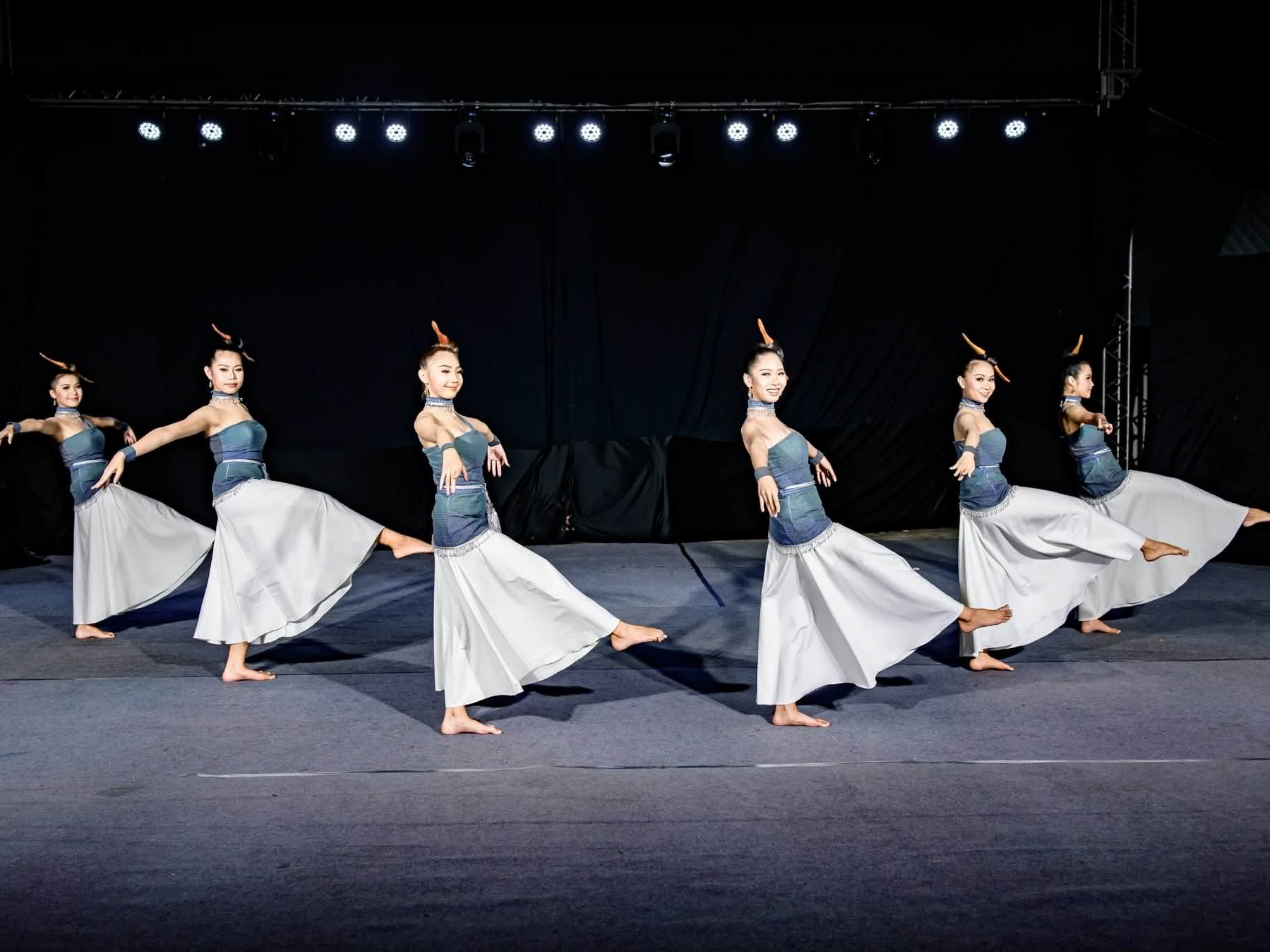
Main Article Content
Abstract
Background and Objectives: There has been a decline in the interest of traditional Thai weaving practices that necessitates the implementation of promotion mechanisms to encourage the preservation of these traditions. This study examines the integration of traditional silk weaving techniques into Northeastern Thai (Isan) folk culture through the creation of Pa Sin Tin Chok of Isan, a choreographed performance inspired by weaving practices in Nong Bua, Mahasarakham Province. The objective of this research is to revive and preserve the cultural wisdom heritage of silk weaving by providing opportunities for younger generations to participate through performing arts, while respecting the interpretive authority, meanings, and aesthetic values of the local community. The interpretation and creative development of this work are grounded in several theoretical frameworks, including body movement theory, aesthetic theory, performance success theory, and cultural diffusion theory.
Methods: Using a creative practice–based methodology, the research combined documentary analysis, field observations participant and non-participant, and expert/performance interviews. Co-creation workshops with master weavers in Ban Nong Bua mapped weaving gestures and narratives, which were translated into movement phrases, music, costume motifs, and stagecraft. The resulting work integrates traditional Isan dance vocabularies with weaving actions, and employs both traditional and modern musical instruments. All activities conducted in this study received ethical approval, and voluntary informed consent was obtained from all participants.
Results: The performance successfully translated weaving gestures into dance, generating a narrative that highlights the cultural significance of Isan silk traditions and demonstrating that performance can function as both a medium of knowledge transmission and a mechanism for cultural innovation. Co-creative processes foregrounded local interpretive authority and produced movement idioms legible to community audiences. The project also reflected the structural challenges—labor intensity, market pressures, and environmental problems—relevant to long-term sustainability of the craft.
Application of this study: The model offers a replicable approach for performance-based heritage work:
1) embed co-creation with artisans, 2) convert craft processes into movement pedagogy, 3) integrate workshops (basic loom setup, thread/dye practice) into rehearsal, and 4) disseminate via festivals, curricula, and digital media to reach youth and broader publics. It is adaptable to other crafts and cultural contexts.
Conclusions: This study demonstrates that performing arts can serve as an innovative means of preserving and transmitting cultural heritage. Its key contribution lies in transforming the traditional silk-weaving process of B
an Nong Bua community into a language of dance through the creative integration of choreography, music, costumes, and performance structure that reflect the stages and cultural meanings of silk weaving in the Isan context. Unlike conventional forms of knowledge transmission that occur within families or among artisans, this approach converts traditional craft knowledge into a performance-based learning medium accessible to a wider audience. The creative performance Pa Sin Tin Chok Isan functions as both a platform for cultural communication and a means of engaging younger generations, while enhancing the cultural visibility and value of the community. Strategically, this approach can be applied in conjunction with cultural activities, creative tourism, and learning activities in educational institutions to support the sustainable preservation and development of local wisdom heritage in the future.
Downloads
Article Details

This work is licensed under a Creative Commons Attribution-NonCommercial-NoDerivatives 4.0 International License.
References
Appadurai, A. (1996). Modernity at Large: Cultural Dimensions of Globalization, Vol. 1. Minneapolis, MN: University of Minnesota Press.
Assmann, J. (2011). Communicative and Cultural Memory. In E. Wunder (Ed.), Cultural Memories: The Geographical Point of View (15-27). Dordrecht: Springer Netherlands.
Beardsley, M. C. (1981). Aesthetics, Problems in the Philosophy of Criticism. Indianapolis, IN: Hackett Publishing.
Bleeker, M. (2016). Transmission in Motion. New York, NY: Taylor & Francis.
Chai-Arayalert, S., Suttapong, K., & Kong-Rithi, W. (2021). Systematic Approach to Preservation of Cultural Handicrafts: Case Study on Fabrics Hand-Woven in Thailand. Cogent Business & Management, 8(1), Article 1872889.
Chantamool, A., & Others. (2023). Promoting Traditional Ikat Textiles: Ethnographic Perspectives on Indigenous Knowledge, Cultural Heritage Preservation and Ethnic Identity. Global Knowledge, Memory and Communication, ahead-of-print. https://doi.org/10.1108/GKMC-08-2022-0198.
Charungkiattikul, S., & Joneurairatana, E. (2021). A Revival for Thailand’s Textile Traditions: New Value for Local Materials (Eri Silk) through Art Practice. Textile, 19(3), 340-353.
Dalferro, A. G. (2021). Shimmering Surfaces: An Ethnography of Silk Production in Surin, Thailand. Doctoral Dissertation, Ph.D. in Anthropology, Cornell University, USA.
Dameri, R .P., & Demartini, P. (2020). Knowledge Transfer and Translation in Cultural Ecosystems. Management Decision, 58(9), 1885-1907.
Delahunta, S. (2013). Publishing Choreographic Ideas: Discourses from Practice. In M. Wilson, & S. van Ruiten, (Eds.). Share: Handbook for Artistic Research Education, (pp. 170-177). Amsterdam: European League of Institutes of the Arts (ELIA).
Dewey, J. (2008). Art as Experience. In H. Cannatella (Ed.), The Richness of Art Education (33-48). Leiden: Brill.
Eco, U. (1976). A Theory of Semiotics. Bloomington, IN: Indiana University Press.
Fink, B., & Others. (2021). Evolution and Functions of Human Dance. Evolution and Human Behavior, 42(4), 351-360.
Graham, M. (2011). Perish or Globalize: Network Integration and the Reproduction and Replacement of Weaving Traditions in the Thai Silk Industry. ACME: An International Journal for Critical Geographies, 10(3), 458-482.
Hayami, Y. (2019). Community Discourse as Governance: Moralizing Rural Life in Thailand. Southeast Asian Studies, 8(3), 387-412. https://doi.org/10.20495/seas.8.3_387
Hodgson, J. (2016). Mastering Movement: The Life and Work of Rudolf Laban. London, UK: Routledge.
Imus, S. D., & Others. (2022). More than One Story, More than One Man: Laban Movement Analysis Re-Examined. American Journal of Dance Therapy, 44(2), 168-185.
Katz, E., Lazarsfeld, P. F. & Roper, E. (2017). Personal Influence: The Part Played by People in the Flow of Mass Communications. London, UK: Routledge.
Keyes, C. F. (2004). Cultural Diversity and National Identity in Thailand. Cambridge, MA: MIT Press.
Leach, J. (2016). Making Knowledge from Movement: Some Notes on the Contextual Impetus to Transmit Knowledge from Dance. In M. Bleeker (Ed.), Transmission in Motion (165-178). London, UK: Routledge.
Marchand, T. H. J. (Ed.). (2010). Making Knowledge: Explorations of the Indissoluble Relation Between Mind, Body and Environment [Special Issue]. Journal of the Royal Anthropological Institute, 16(Suppl. 1).
McCargo, D., & Hongladarom, K. (2004). Contesting Isan-ness: Discourses of Politics and Identity in Northeast Thailand. Asian Ethnicity, 5(2), 219–34.
McCarthy, K. F., & Others. (2001). Gifts of the Muse: Reframing the Debate about the Benefits of the Arts. Santa Monica, CA: Rand Corporation.
Myrvold, T. E. (2022). Can You Relate to a Dance from the Past? Why Teenagers Love to Dance in Museums. Nordisk Museologi, 33(1), 59-74.
Namjaidee, S. (2017). Role of Community Leaders on Sharing Local Knowledge of Silk Making in Thai Communities. Review of Integrative Business and Economics Research, 6(NRRU special issue), 297-305.
Phochanthilath, C. (2015). Women’s Rights in Intellectual Property and Traditional Knowledge Protection in Lao PDR. Asia-Pacific Journal on Human Rights and the Law, 16(1-2), 9-25.
Photisan, A. (2013). Fabricating Tradition: The Evolution of Silk-Cloth Weaving Among the Mon-Khmer Ethnic Group in Lower Isan. Indian Social Science Journal, 2(1), 1-5.
Potisansuk, S., & Others. (2026a). Figure 1 Dance Posture Still From Pa Sin Tin Chok of Isan Symbolizing the Gathering of Silk Threads Before Weaving.
Potisansuk, S., & Others. (2026b). Figure 2 Dance Posture Still From Pa Sin Tin Chok of Isan Symbolizing Placement of the Silk Threads.
Potisansuk, S., & Others. (2026c). Figure 3 Dance Posture Still From Pa Sin Tin Chok of Isan Symbolizing Preparation of the Threads for Weaving.
Potisansuk, S., & Others. (2026d). Figure 4 Dance Posture Still From Pa Sin Tin Chok of Isan Symbolizing Creation of Lai Soi Dok Mai Patterns.
Potisansuk, S., & Others. (2026e). Figure 5 Dance Posture Still From Pa Sin Tin Chok of Isan Symbolizing Integration of Modern Design Elements into Traditional Weaving.
Potisansuk, S., & Others. (2026f). Figure 6 Dance Posture Still From Pa Sin Tin Chok of Isan Symbolizing the Rhythm of the Weaving Process.
Potisansuk, S., & Others. (2026g). Figure 7 Costumes Worn by Performers in the Pa Sin Tin Chok of Isan Dance.
Reason, M. (2006). Young Audiences and Live Theatre, Part 2: Perceptions of Liveness in Performance. Studies in Theatre and Performance, 26(3), 221-241.
Rogers, E. M. (2003). Diffusion of Innovations. 5th ed. Tampa, FL: Free Press.
Roos, H. (2016). Culture in Motion: Dance as an Embodied Practice of Cultural Transmission. In S. Mawani & A.A. Mukadam (Eds.), Perspectives of Female Researchers: Interdisciplinary Approaches to the Study of Gujarati Identities (121). Berlin, Germany: Logos.
Sae-Wang, R. (2015). Spirit of the Loom: The Conservation and Commodification of Surin’s Textile Cultural Heritage. International Journal of Intangible Heritage, 10(1), 85-100.
Sangkhachantharanan, N., & Singyabuth, S. (2022). Praewa, the Queen of Silk: Phu Tai Ethnic Identity and Invented Tradition in Kalasin Province, Thailand. The International Journal of Interdisciplinary Cultural Studies, 17(2), 37.
Shils, E. (1981). Tradition. Chicago: IL: University of Chicago Press.
Strathern, M. (2006). A Community of Critics? Thoughts on New Knowledge. Journal of the Royal Anthropological Institute, 12(1), 191-209.
Thepboriruk, K. H. (2020). Dressing Thai: Fashion, Nation, and the Construction of Thainess, 19th Century–Present. Journal of Applied History, 2(1-2), 112-128.
Ungsitipoonporn, S. (2020). Transmission of Hakka Traditional Knowledge from Two Revitalization Projects in Thailand: What Did they Achieve? Dialectologia: Revista Electrònica, 24, 253-272.
Wakpa, T. B. (2016). Culture Creators and Interconnected Individualism: Rulan Tangen and Anne Pesata's Basket Weaving Dance. Dance Research Journal, 48(1), 107-125.
Watthanachanobon, W., & Chantaranamchoo, N. (2020). A Local Wisdom Knowledge Management Model to Enhance Economic Value Added for Textile Products of Thai-Yuan Ethnic Groups in Mid-Central Provincial Cluster. Journal of Community Development Research (Humanities and Social Sciences), 13(4), 9-24.
Wongsawangsiri, D., & Wechk, T. (2024). Integration of Concepts for the Learning Process of Textile Weaving at Lan Khoi Village, Phatthalung Province, Thailand. International Journal of Education and Literacy Studies, 12(1), 140-147.
