
Listening to Folk Music from Ta Pho Sub-District: Conservation, Silenced Voices, and Negotiating Thai Identity in Secondary Urban Contexts
Article Sidebar
Main Article Content
Abstract
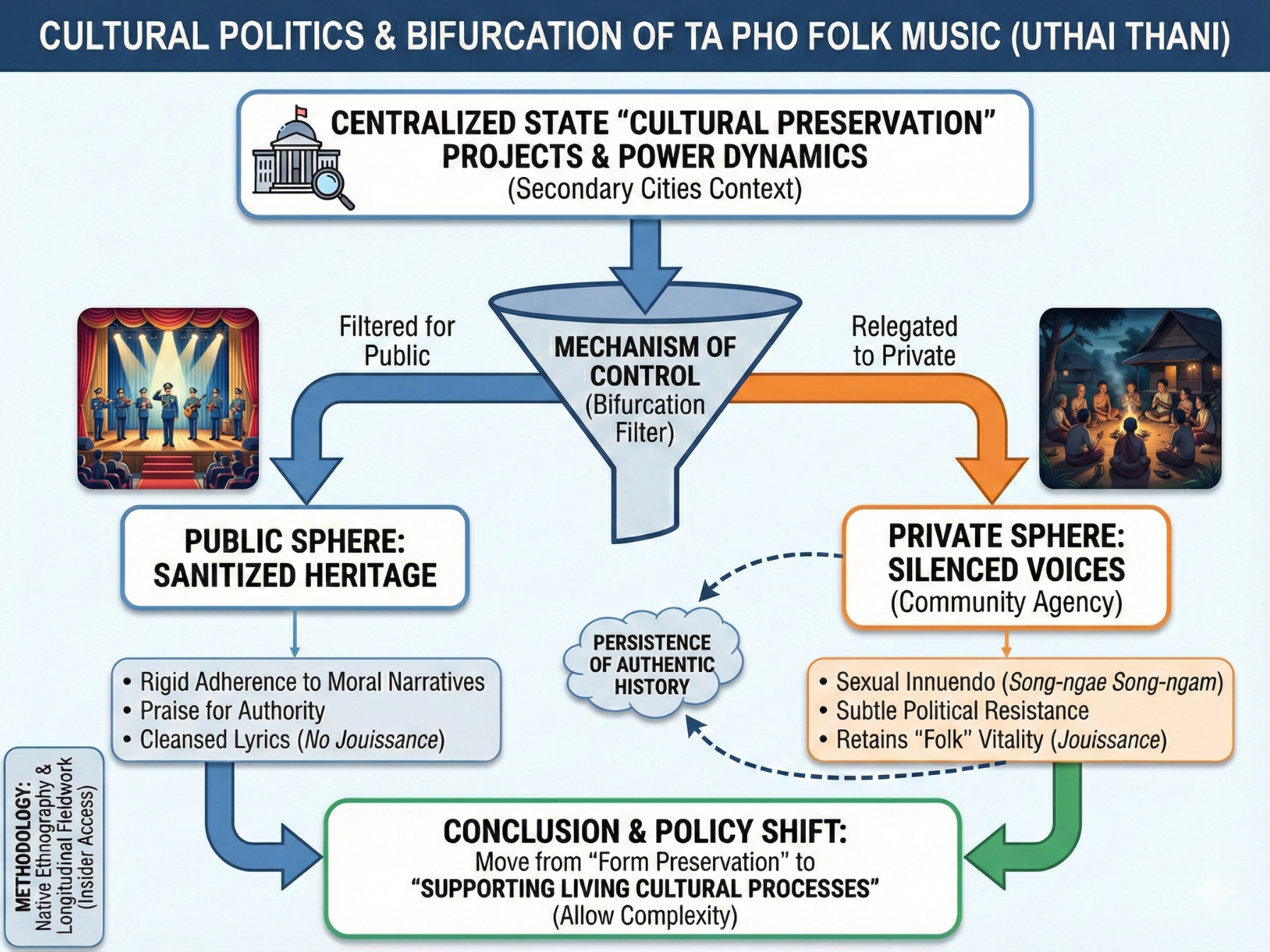
Background and Objectives: Secondary cities in Thailand occupy a liminal space—peripheral to national cultural hierarchies yet subject to centralized state control. This study examines Ta Pho folk music in Uthai Thani province, investigating how local communities negotiate their identity amidst state-sponsored “cultural preservation” projects. The objective was to analyze the power dynamics that determine which songs are amplified and which are silenced in the public sphere.
Methods: Employing a longitudinal ethnographic approach, fieldwork was conducted from January 2024 to September 2025. Data collection involved 6 site visits (comprising both overnight stays and short visits), utilizing high-fidelity soundscape recording and in-depth interviews. Uniquely, this research adopts a “native ethnographer” perspective, leveraging the researcher’s insider status to access private musical practices often withheld from outsiders.
Results: The study reveals a bifurcation of Ta Pho folk music into two distinct categories: 1) sanitized heritage, performed at state festivals, characterized by rigid adherence to moral narratives and praise for authority; and 2) silenced voices, preserved only in private circles, containing sexual innuendo (song-ngae song-ngam) and subtle political resistance. Musical analysis indicates that while the traditional strophic form and heterophonic texture remain resilient, the lyrical content in public spaces has been systematically cleansed of its original “folk” vitality (jouissance) to align with bureaucratic definitions of Thainess. However, musicians employ these structures for strategic adaptation, satisfying state mandates while preserving authentic repertoires in private.
Application of this study: The findings are relevant to both students and scholars of music, highlighting that music is not merely an art form but also a site of power involving selection, audibility, and preservation. The study also offers policy implications, suggesting that musical preservation should shift from maintaining fixed forms toward supporting creative freedom for communities and artists, thereby critically reflecting the role of the state in cultural governance.
Conclusions: Cultural preservation in secondary cities functions not merely as protection but as a mechanism of control. However, the persistence of “silenced songs” in private spheres demonstrates the community’s agency in maintaining their authentic history. This supports the policy shift from “form preservation” to “supporting living cultural processes,” allowing the complexity of local voices to exist without being domesticated.
Downloads
Article Details

This work is licensed under a Creative Commons Attribution-NonCommercial-NoDerivatives 4.0 International License.
References
Attali, J. (1985). Noise: The Political Economy of Music. Massumi, B. (Trans.). Minneapolis: University of Minnesota Press.
Bakhtin, M. M. (1984). Rabelais and His World. Iswolsky, H. (Trans.). Bloomington: Indiana University Press.
Baudrillard, J. (1981). Simulacra and Simulation. Glaser, S. F. (Trans.). Ann Arbor: University of Michigan Press.
Boonrod, V., Intarakaew, C., & Samnieng, C. (2025a). Figure 1 Map Showing the Location of Uthai Thani Province in Relation to Bangkok and Major Urban Centers in Thailand (Adapted from Google Maps).
Boonrod, V., Intarakaew, C., & Samnieng, C. (2025b). Figure 2 Ms. Somjit Tipsiri (Kru Lin Chee) Demonstrates Ta Pho Folk Music Performance in Nong Kha Yang Sub-District, Uthai Thani.
Boonrod, V., Intarakaew, C., & Samnieng, C. (2025c). Figure 3 Providing Rhythmic Support With the Rammana Drum and Interjecting Improvised Verses.
Boonrod, V., Intarakaew, C., & Samnieng, C. (2025d). Figure 4 A Yellow-Painted Buffalo Skull Inscribed With “Ta Pho Folk Music,” Symbolizing the Negotiation Between Local Agrarian Roots and the Official Aesthetic of “Thai Cultural Heritage.”.
Butler, J. (1990). Gender Trouble: Feminism and the Subversion of Identity. New York: Routledge.
Carillo, J. (2014). The New Urban: Towards Progressive Secondary Cities. Singapore: Asia Development Dialogue.
Derrida, J. (1994). Specters of Marx: The State of the Debt, the Work of Mourning and the New International. Kamuf, P. (Trans.). New York: Routledge.
Feld, S. (1984). Sound Structure as Social Structure. Ethnomusicology, 28(3), 383–409.
Fisher, M. (2014). Ghosts of My Life: Writings on Depression, Hauntology and Lost Futures. Winchester: Zero Books.
Foucault, M. (1978). The History of Sexuality: Vol. 1: An Introduction. New York: Pantheon.
Harrison, K. (2012). Epistemologies of Applied Ethnomusicology. Ethnomusicology, 56(3), 505–529.
McDonald, D. A. (2013). My Voice Is My Weapon: Music, Nationalism and the Poetics of Palestinian Resistance. Durham: Duke University Press.
Miller, T. E., & Shahriari, A. (Eds.). (2021). World Music: A Global Journey. 5th ed. New York: Routledge.
Narayan, K. (1993). How Native Is a “Native” Anthropologist?. American Anthropologist, 95(3), 671–686.
Schafer, R. M. (1977). The Tuning of the World. New York: Knopf.
Schofield, K. B. (2024). Music and Empire: South and Southeast Asia, c. 1750–1950. Journal of Music History Pedagogy, 14(1), 119-161.
Scott, J. C. (1990). Domination and the Arts of Resistance: Hidden Transcripts. New Haven: Yale University Press.
Smith, L. (2006). Uses of Heritage. London: Routledge.
Spivak, G. C. (1988). Can the Subaltern Speak?. In C. Nelson & L. Grossberg (Eds.), Marxism and the Interpretation of Culture. (pp. 271–313). Urbana: University of Illinois Press.
Sudhipongpracha, T., & Dahiya, B. (2019). City profile: Khon Kaen, Thailand. Environment and Urbanization ASIA, 10(2), 271–289.
Teanthaworn, Y., Chapman, W., & Tangpoonsupsiri, T. (2023). Creative Tourism Development Guidelines of Uthai Thani Province. Arts of Management Journal, 7(3), 1024–1052. (In Thai)
Titon, J. T. (2015). Sustainability, Resilience, and Adaptive Management for Applied Ethnomusicology. In S. Pettan & J. T. Titon (Eds.), The Oxford Handbook of Applied Ethnomusicology, (pp. 157–195). Oxford: Oxford University Press.
Žižek, S. (1989). The Sublime Object of Ideology. London: Verso.
